

创作上传
VIP
收藏下载
登录 | 注册有礼
查看完整案例

收藏

下载

分享
《礼记》云:“焚香以养德”,从上古的原始祭祀、庙堂的宗教礼制、王室的香事盛行到民间香道兴起,香在中国曾经源远流长并被广泛使用,具有药用性、宗教性、美学性和文化性。西方的香文化与中国香文化侧重点不同,它与化学、商业、宫廷、工业化更密切相关。19世纪,随着化学工艺的发展、合成香料的问世和香水分子结构理论的提出,西方的现代香文化开始普及大众。如今,香文化已经成为全球生活美学的一环。
The Book of Rites states: “Burning incense nourishes virtue.” From the primitive rituals of ancient times, to temple ceremonies, to the flourishing fragrance traditions of royal courts, and finally to the rise of incense culture among the people, fragrance in China has a long and profound history. It has been widely used and carries medicinal, religious, aesthetic, and cultural significance. Western fragrance culture differs from its Chinese counterpart in focus; it is more closely tied to chemistry, commerce, courtly traditions, and industrialization. In the 19th century, with the advancement of chemical technology, the invention of synthetic aroma compounds, and the introduction of molecular theories of perfumery, modern Western fragrance culture began to take hold among the general public. Today, fragrance culture has become an integral part of global lifestyle aesthetics.
▼东南人视角度,Southeastern Perspective ©直角建筑摄影

当代香氛文化主要源于西方,伴随着工业革命和消费主义进入中国。广州雪蕾秉持东方香氛文化传承初心,致力建造中国首个香氛博物馆。我们希望这里的香气,去掉商业的标签,展现出其历史底蕴和匠心本质,通过建筑本身的形式语言和沉浸式的空间体验,唤起人与自然的深层联系。因此我们从自然山体汲取灵感,将雄浑土地转译为轻盈的基座,如香气从大地中升腾,然后慢慢向上,进入象征着香氛工艺的罐装柱体,凝固为香水文化历史和工业文明的一部分。
Contemporary fragrance culture is largely rooted in the West and entered China alongside industrialization and consumerism. Staying true to the essence of Oriental fragrance heritage, Guangzhou Xuelei aspires to build China’s first Fragrance Museum. Here, we hope to strip fragrance of its commercial labels and reveal its historical depth and artisanal spirit. Through architectural form and immersive spatial experience, we aim to evoke a deeper connection between people and nature. Drawing inspiration from natural landscapes, we translated the power of the earth into a light, floating base—like scent rising from the ground. From there, it ascends into towering capsule-like structures symbolizing the craft of perfumery, solidifying into part of the history of fragrance culture and the evolution of industrial civilization.
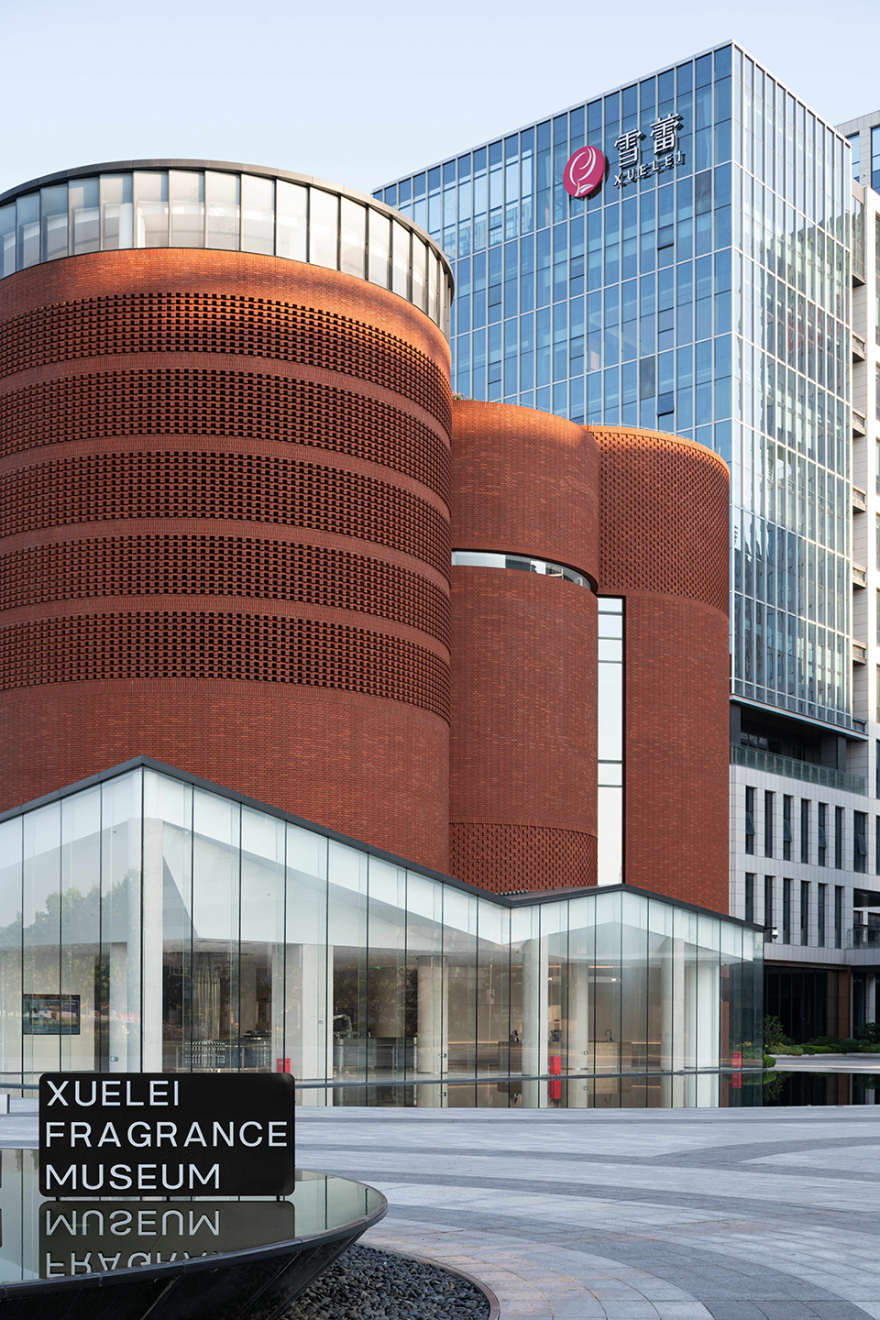
▼广州雪蕾香氛博物馆立面,Facade of Guangzhou Xuelei Fragrance Museum ©直角建筑摄影

▼博物馆入口,Entrance to Museum ©直角建筑摄影
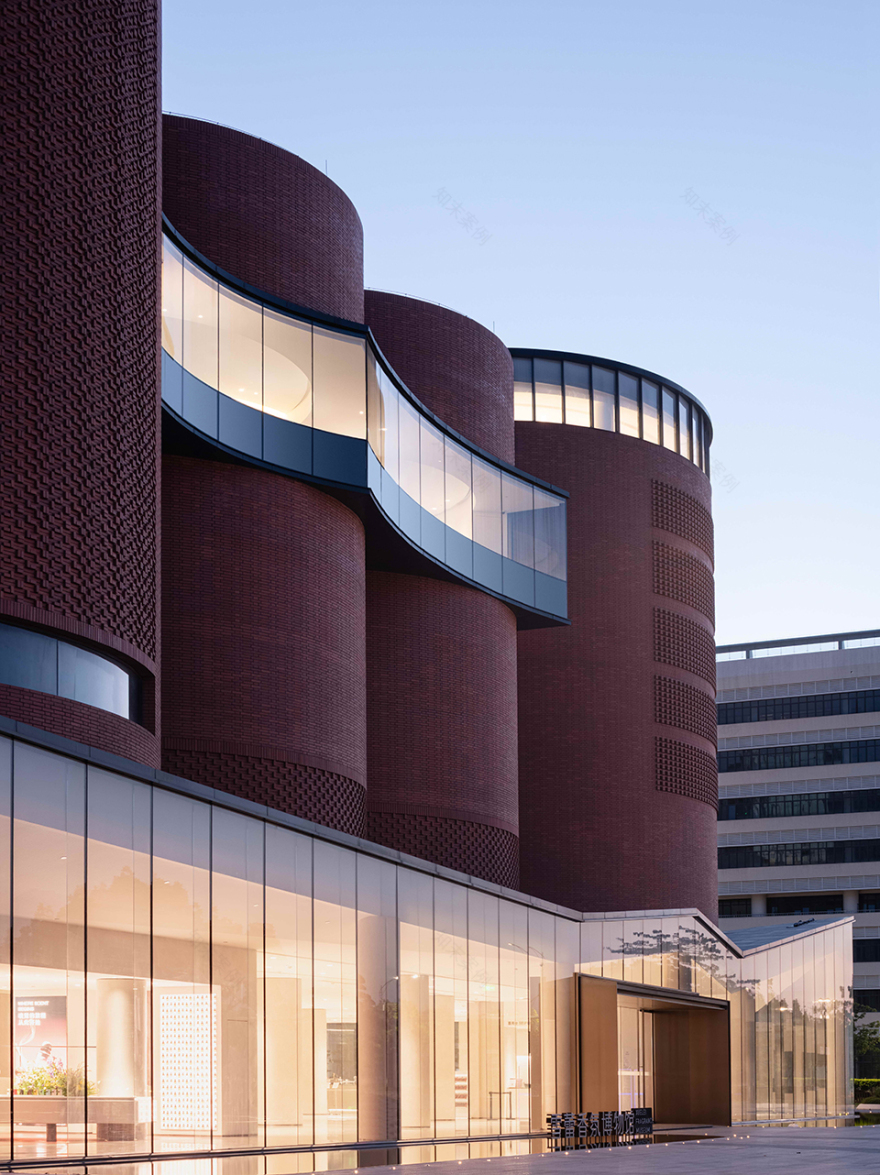
香氛作为一种无形的感官体验,它以气味与情感在空气中交织,却往往被建筑空间的视觉语言所忽略。在广州雪蕾香氛博物馆项目里,建筑在香氛的无形性中得以拓展其感官的边界,承载气味的容器,最终成为记忆与感官的交汇点。秉承开放、协作与可持续发展的理念,广州雪蕾香氛博物馆不仅是一个极具吸引力的博物馆,也将成为公众了解香氛历史沿革、传统工艺与现代科技,体验前沿香氛创作发展的理想目的地,通过建筑语汇将气味的无形转化为有形的体验,营造中外香氛文化交流沟通的重要场所。
Fragrance is an intangible sensory experience—an interplay of scent and emotion that drifts through the air, yet is often overlooked within the visual language of architecture. In the Guangzhou Xuelei Fragrance Museum, architecture embraces the immateriality of scent, expanding its sensory boundaries: the space becomes a container for aroma, and ultimately a point where memory and perception converge. Guided by principles of openness, collaboration, and sustainability, the museum is conceived not merely as an attractive cultural destination, but as a platform for public engagement with the history of perfumery, traditional craftsmanship, and contemporary technologies. It offers an ideal environment to experience the evolution of fragrance creation. Through architectural expression, the intangible nature of scent is transformed into a tangible, spatial encounter—establishing the museum as a vital venue for dialogue and exchange within global fragrance culture.
▼博物馆东北侧视角,Northeast perspective of Museum ©直角建筑摄影

▼博物馆西南视角,Southwest perspective of Museum ©直角建筑摄影

项目区位及背景
Site Context and Background
广州雪蕾新总部园区项目位于广州民科园核心地带,坐拥产业高地的城市界面。设计以“产业+文化”的双重视角出发,将企业总部与香氛博物馆并置规划,在紧凑的办公区与开阔的文化广场之间,塑造出开放、共享的城市文化界面。
The Guangzhou Xuelei Headquarters Campus is located at the heart of the Guangzhou Science and Technology Innovation Park, positioned along a strategic urban interface at the crest of a key industrial zone. The design adopts a dual lens of “industry + culture,” placing the corporate headquarters alongside the Fragrance Museum. Between the compact office precinct and the expansive cultural plaza, the project creates an open and shared civic frontage—an urban cultural interface that invites interaction, exchange, and public engagement.
▼博物馆与城市,The Museum and the City ©直角建筑摄影
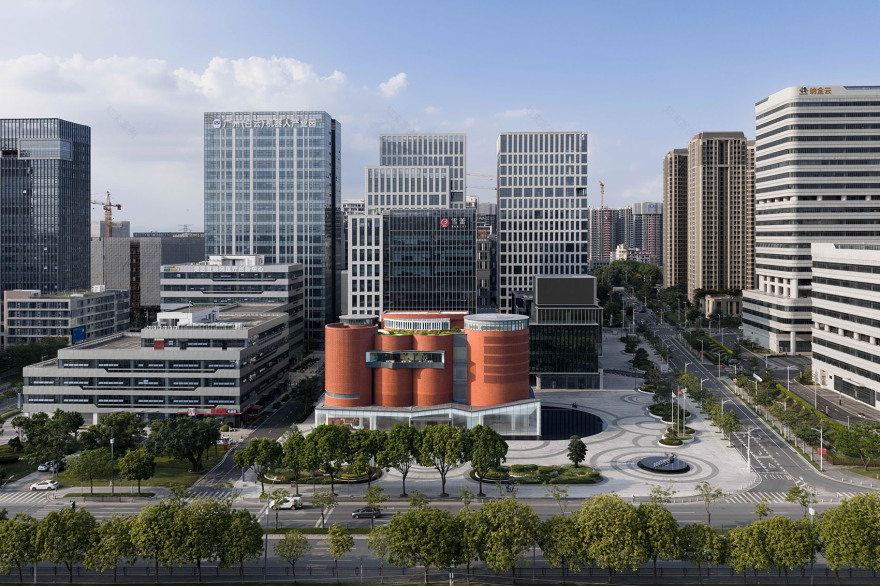
▼广州雪蕾新总部园区鸟瞰,Aerial View of Guangzhou Xuelei New Headquarters Campus ©直角建筑摄影

场地由北太路与其余两条城市支路三面围合,基于对场地特质的研判,设计将场地划分为南北两个功能场域,北侧的产业园以紧凑的“回” 字型布局承载日常办公功能,其东侧刻意设计的低矮建筑体量,形成了尺度宜人的连续城市界面。而南侧的博物馆区则被释放出大量开敞空间,在与北太路相接的界面及街角区域,营造出开阔的博物馆前广场,足以容纳各类文化活动与露天展览,为城市预留出一片充满活力的文化聚集地。
▼设计生成,Design Generation ©深圳华汇设计

The site is enclosed on three sides by Beita Road and two other urban collector roads. Based on an analysis of the site’s characteristics, the design divides the site into two complementary domains: a northern industrial campus and a southern cultural precinct. The industrial zone adopts a compact, courtyard-like configuration that supports daily office operations. Along its eastern edge, intentionally lowered building volumes establish a human-scaled, continuous urban frontage. In contrast, the museum zone to the south opens up generous public space. At the interface with Beitai Road and the corner of the site, a wide museum forecourt unfolds, capable of hosting cultural events and open-air exhibitions. This spatial release reserves a vibrant cultural ground for the city—an urban gathering field where art, community, and public life converge.
▼专属于香氛的城堡,A Castle Exclusively for Fragrances ©直角建筑摄影

空间的诗意构建:香气的流动
Poetics of Space: The Flow of Fragrance
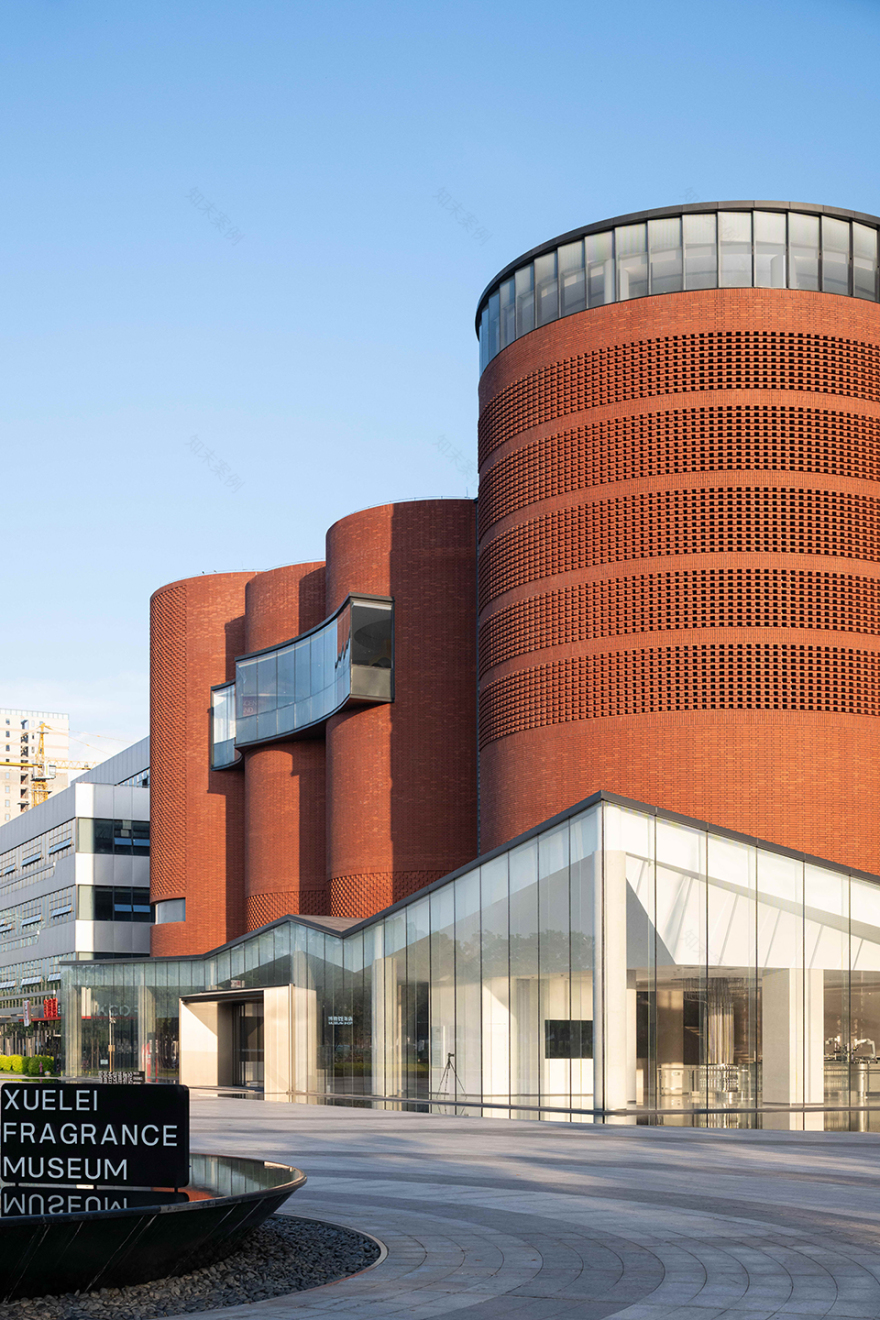
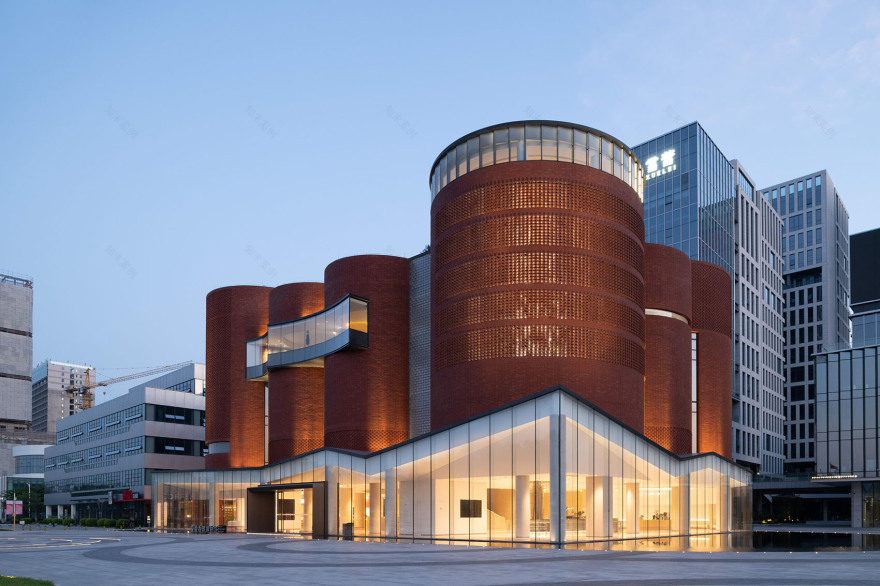
自然界中各种生物的香气在空气中自由流动,形成了无形的“景观”。我们希望通过建筑设计的方式,重现这种自然界的气味流动过程。建筑的核心形态,源于对香氛工艺的建筑化诗意诠释 —— 八个大小不一的红砖圆筒围合而成的主体结构,是对香水蒸馏器的抽象转译,暗喻着香氛从原料到产品的淬炼过程。我们选择红砖作为核心材质,不仅因其敦厚肌理恰如香氛原料生长的土壤,更在于手工砌筑所承载的温度:通过砖花、拔砖、镂空砖等多元工艺,让墙面在光影变化中呈现出细腻层次,恰似香气在空间中的无形流动,为建筑注入了柔和的人文质感。
▼概念来源:蒸馏器、红砖与雪山,
Concept Origin: Distiller, Red Bricks, and Snow-Capped Mountains ©图源网络(侵删)

▼概念草图,Sketch ©肖诚

In nature, scents released by different organisms drift freely through the air, forming an invisible “landscape.” Our design seeks to spatialize this phenomenon—translating the movement of fragrance into an architectural experience. The building’s primary formal expression originates from a poetic architectural interpretation of fragrance craftsmanship. The central structure, composed of eight red-brick cylindrical volumes of varying scales, forms an abstract translation of a perfume distillation apparatus, metaphorically alluding to the process through which raw materials are refined into fragrance. Red brick was selected as the core material not only for its grounded, earthen texture—evoking the soil in which aromatic ingredients take root—but also for the human warmth embedded in handcrafted construction. Through a series of traditional and reinterpreted techniques, including patterned brickwork, recessed brick coursing, and perforated brick screens, the façade reveals nuanced layers of light and shadow. These subtle shifts echo the intangible movement of scent through space, infusing the architecture with a soft, tactile, and deeply humanistic sensibility.
▼建筑以圆筒为设计母题,The cylindrical form serves as the primary architectural motif ©直角建筑摄影

▼圆形母题,Circular Motif ©直角建筑摄影

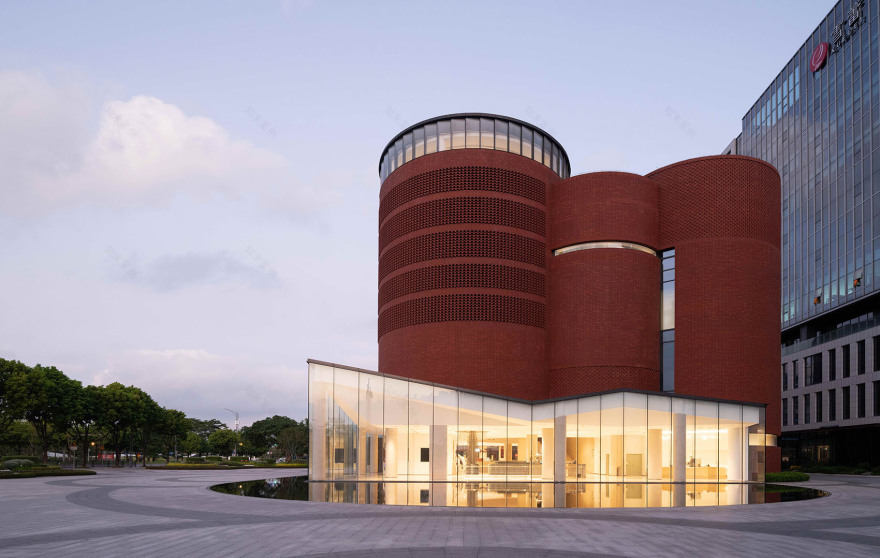
通透外向的建筑底层营造出一个城市客厅,面对广场、城市界面和往来的人们是欢迎与开放的态度;聚焦内向的圆筒是博物馆的展厅,更关注展览叙事、香氛流转与人们在空间中的感受与体验。红砖的厚重与玻璃的通透形成对话,呈现出“嗅觉的物质化”——气味在砖缝、光影与空气中流动,从而创造出一种无缝连接的氛围,平衡轻与重、虚与实的关系,使气味和空间彼此交织,形成和谐的整体。
The transparent and outward-oriented ground level shapes a civic living room, engaging the plaza, the urban frontage, and passing visitors with an open and welcoming attitude. In contrast, the inward-focused cylindrical volumes accommodate the museum’s exhibition spaces, prioritizing curatorial narratives, the flow of fragrance, and the sensory and spatial experience of visitors. The tectonic dialogue between the massiveness of red brick and the transparency of glass gives rise to what we describe as the “materialization of olfaction.” Scent flows through brick joints, shifting light, and moving air, generating a seamless atmospheric continuity that balances weight and lightness, opacity and transparency. In this way, smell and space become mutually entangled, forming a coherent and harmonious whole.
▼镜面水池中的建筑倒影,Reflections of buildings in the mirror-like pool ©直角建筑摄影

建筑底层的折动玻璃界面构成了一场精妙的视觉反差实验——由彩釉玻璃拼接而成的通透立面,让室内的装置陈列与人群活动,与镜面水池中的建筑倒影、天空云影交织成动态画面,仿佛无形的香气正从建筑内部向城市肌理缓缓弥漫。
At the ground level, the fractured glass interface becomes an experiment in visual contrast. A transparent façade composed of enamel-coated glass panels reveals interior installations and human activity, while simultaneously reflecting the building’s silhouette and drifting clouds in the mirrored water courtyard. These layered images—movement, reflection, and atmosphere—animate the space, as if the invisible fragrance were slowly diffusing outward from the museum into the urban fabric.
▼厚重与轻盈,Heaviness and Lightness ©直角建筑摄影
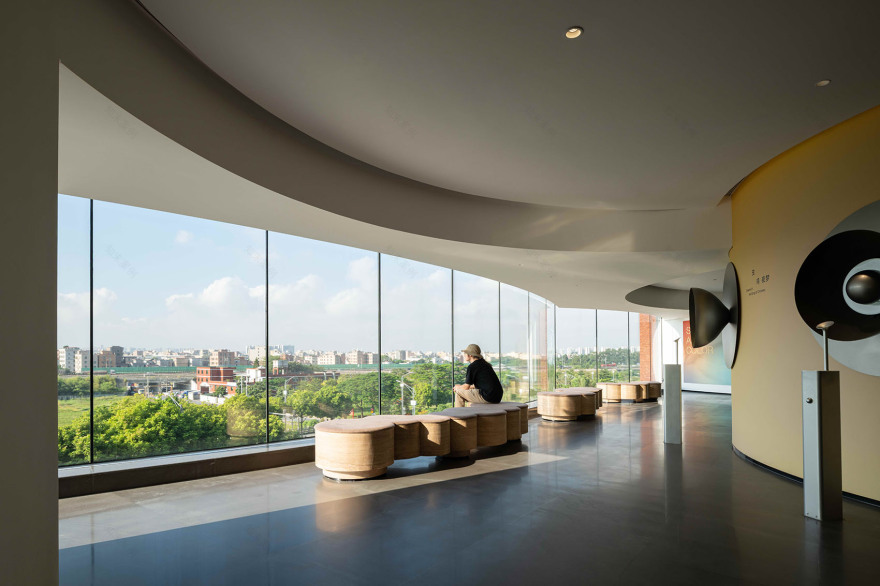
这种 “重” 与 “轻” 的材质对话,在四层的反弧玻璃长廊中得到延续——这条悬浮于建筑表面的长廊既是观景平台,可将民科园绿轴的景致尽收眼底;又成为建筑的 “开窗”,让人们得以窥见博物馆内的香氛叙事,形成看与被看的互动关系。
This dialogue between “heavy” and “light” materials is further extended in the four-storey concave glass sky corridor suspended along the building envelope. Functioning both as an elevated viewing platform overlooking the green axis of the MinKe Park and as a perceptual “window” into the museum, the corridor allows glimpses into the interior fragrance narrative, establishing a dynamic relationship of seeing and being seen between architecture and city.
▼玻璃长廊,The Glass Corridor at Night ©直角建筑摄影

▼四层的玻璃长廊内部,Inside the four-story glass corridor ©直角建筑摄影
圆筒交汇处刻意保留的窄长条形窗,更如传统香器的透气孔隙,让光与空气如同香气般自然渗透进建筑内部。当阳光穿过玻璃在红砖墙上投下斑驳陆离的光影,整个建筑便化作一首关于气味、时空与记忆的立体建筑诗篇。
At the junctions of the cylindrical volumes, slender vertical apertures are deliberately preserved—like the breathing vents of traditional perfume vessels—allowing light and air to permeate the interior as naturally as scent itself. When sunlight filters through the glass, casting shifting patterns across the red brick surfaces, the architecture becomes a spatial poem of fragrance, time, and memory—an immersive experience where material and atmosphere intertwine.
▼弧形长窗,Curved long window ©深圳华汇设计

▼阳光穿透中庭,Sunlight streams through the atrium ©直角建筑摄影
空间营造:五感沉浸的香氛叙事剧场
Spatial Atmosphere: A Multisensory Theater of Fragrance
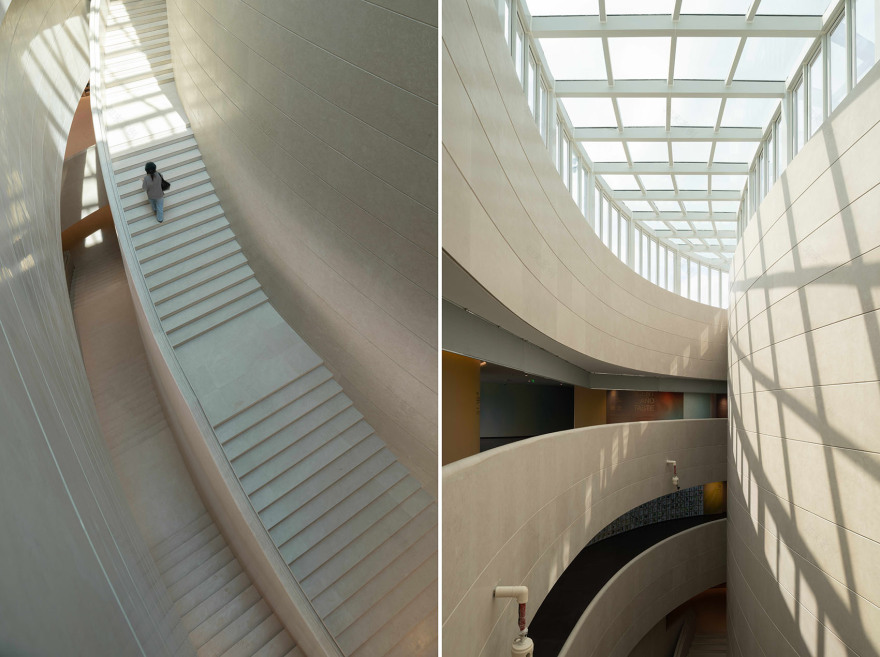
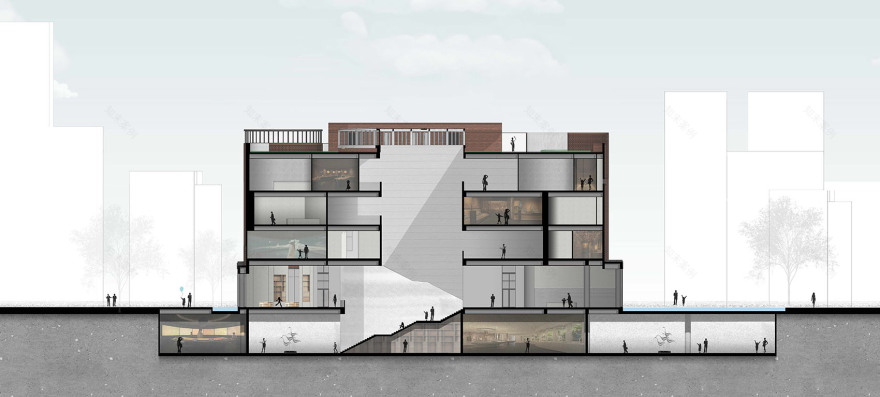
博物馆内部的空间序列宛如一场精心编排的嗅觉叙事剧场。7000 平方米的展示空间分层布局:负一层的报告厅与临时展厅承担学术交流功能;首层导览大厅通过开阔前厅与镜面水池的过渡,完成从城市公共空间到香氛秘境的心理转换;五层通高的中庭以弧面墙体与顶部天光的巧妙设计,营造出“踏入香氛世界” 的仪式感。贯穿各层的弧形楼梯串联起完整的参观流线,整体空间设计强调流线型的布局和层次分明的功能区分。建筑内部空间的设计灵感来源于香氛流动的节奏,每个展区都像是香气的不同“停留点”,各自拥有独特的氛围与体验。▼空间轴测图,Axonometric drawing ©深圳华汇设计

The interior of the museum unfolds as a carefully choreographed olfactory narrative, where visitors move through space as they would through a performance. Across 7,000 square meters of exhibition area, the program is layered vertically: the basement houses lecture halls and temporary galleries, supporting academic exchange and knowledge dissemination; the ground floor establishes a sensory threshold, where the open lobby and reflective water court mediate the transition from urban public realm to an intimate world of scent; above, a five-story atrium—with its curved walls and sculpted skylight—creates a ceremonial moment of entry, inviting visitors to “step into the realm of fragrance.” A sculptural curved staircase weaves through all levels, binding the museum into a continuous, intuitive circulation. The interior is conceived as an embodiment of fragrance in motion—each exhibition zone becomes a “pause” in the diffusion of scent, endowed with its own atmosphere and sensory character.
▼光庭局部,Partial view of the light court ©直角建筑摄影
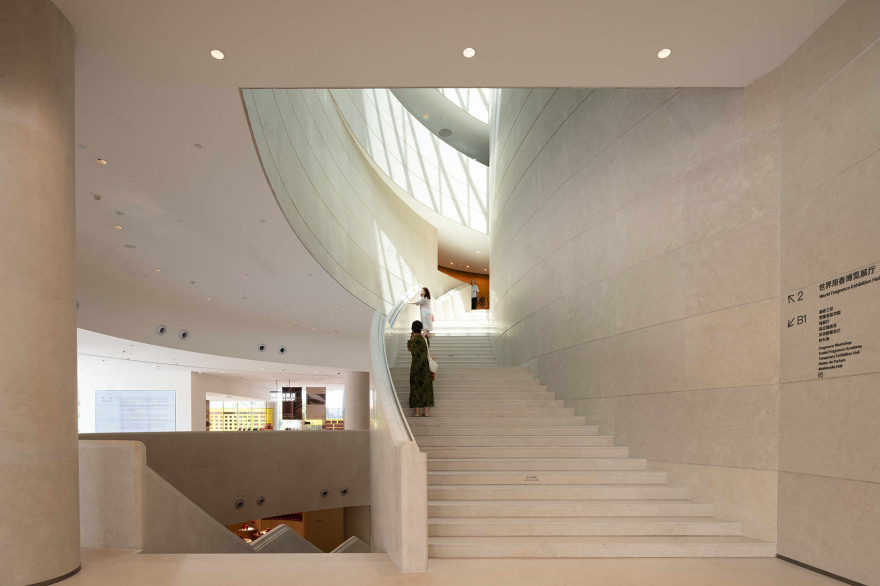
▼光庭局部,Light court detail ©直角建筑摄影

馆内共设置了 18 个主题展区,从香氛历史脉络的系统梳理,到嗅觉、视觉、听觉的跨界实验,再到 AI 智能调香与手工调香工坊的互动体验,构建起完整的香氛文化展示体系。工艺展示区采用玻璃墙体设计,将蒸馏、萃取、调配等香水制作全流程透明化呈现,让参观者在视觉观察与嗅觉感知的双重体验中,深度理解产业的工艺精髓。
The museum accommodates 18 thematic exhibition zones, forming a comprehensive system for the presentation of fragrance culture—from a chronological exploration of olfactory history, to cross-sensory experiments integrating smell, vision, and sound, and further to interactive experiences in AI-assisted perfumery and artisanal fragrance workshops. The craft demonstration zone, enclosed by full-height glass walls, renders the entire process of perfume production—distillation, extraction, and blending—fully transparent, allowing visitors to gain an in-depth understanding of the industry’s technical essence through the dual experience of visual observation and olfactory perception.
▼贯穿四层的旋转楼梯和巨型装置,A spiral staircase and a giant installations spanning four floors ©直角建筑摄影

建筑顶端的屋顶香氛花园,则是这场感官旅程的收尾 —— 自然植物香气与人工调香创意交融,完成人与自然的香气对话,也让空间体验回归本真。
At the crown of the building, the rooftop fragrance garden serves as the poetic finale of this multisensory journey. Here, the natural aromas of living plants intertwine with the crafted creativity of perfumery, completing a sensory dialogue between humans and nature. It is within this open-air landscape that the spatial experience returns to its most authentic and elemental state, allowing scent, atmosphere, and perception to gently converge.
▼香氛花园,Fragrant Garden ©直角建筑摄影

▼香氛花园,Fragrant Garden ©肖诚

▼自然本真,Natural Authenticity ©直角建筑摄影

▼由圆形母题构成的花园空间,A garden space formed by a circular motif ©直角建筑摄影

材料与细节:构建无形的气味环境
Materials and Detailing: Crafting the Invisible Scent Environment
香氛的体验不仅仅是与空气接触,它也与环境中的材质密切相关。在雪蕾香氛博物馆的设计中,红砖的真实性与手工砌筑感,对应着香水产业对工艺精度的极致追求。我们希望通过不同的砌筑方式,让建筑表皮成为可被“阅读”的工艺表象,回应香氛产业中“时间沉淀”与“精细匠造”的精神内核。
Experiencing fragrance is not only a matter of air; it is intimately tied to the materials that shape the environment. Within the design of the Xuelei Fragrance Museum, the authenticity of red brick and the tactile presence of handcrafted masonry directly correspond to the perfume industry’s relentless pursuit of craft precision and material integrity. Through varied masonry techniques, the façade becomes a “readable” expression of craftsmanship, echoing the perfume industry’s values of time, patience, and meticulous creation.
▼红砖细节,Red Brick Details ©直角建筑摄影

在雪蕾香氛博物馆的整体设计中,构造呈现的美感是由内而外的。建筑主体是典型的混凝土框架结构,外立面呈现的红砖,即为建筑的围护结构的主要材料。为兼顾红砖砌筑的真实性与美观性,建筑主体混凝土梁与构造梁柱体系位置关系均经过细致设计,来适应砖墙肌理凹凸变化的立面关系。通过对博物馆整体构造体系的审慎设计,圆弧形砖墙与混凝土梁柱构成了清晰的构造关系,材料本身已具备极佳的美感与表现力。而在经过与业主商讨后,还是认为需要首先满足香氛展品的策展需要,最终手工砖墙在室内虽未能得到直观呈现,但内部展览空间仍然延续了建筑的圆形母题。
▼建造过程,Construction Process ©深圳华汇设计

Across the project, the beauty of construction is expressed from the inside out. The building is fundamentally structured as a reinforced concrete frame, while the red brick façade serves as the primary enclosure and spatial skin. To reconcile the material authenticity of brickwork with formal clarity, the positioning of concrete beams, structural members, and construction joints was meticulously calibrated to accommodate the subtle relief and modulation of the brick surface, allowing structural logic and material expression to operate in precise alignment. Through the careful and deliberate design of the museum’s overall structural system, a clear tectonic relationship is established between the curved brick walls and the concrete beams and columns, allowing the material system itself to possess a high degree of inherent aesthetic and expressive power. After extensive discussions with the client, it was ultimately agreed that the curatorial and exhibition requirements of the fragrance collections should take precedence. As a result, the handcrafted brick walls are not directly exposed within the interior spaces. Nevertheless, the interior exhibition sequence continues to carry forward the building’s circular formal motif, ensuring spatial continuity between architectural structure and curatorial narrative.
▼中庭与展廊,Atrium and Gallery ©直角建筑摄影

▼展厅,Exhibition Hall ©直角建筑摄影

为了呈现红砖的工艺质感,设计采用了砖花、拔砖、镂空砖等多种砌筑形式。砖花与拔砖采用纯砌筑工艺,通过砖体的模数组合形成丰富立面肌理,拔砖处的墙体向内凹进,使砖体边缘与主墙体齐平,让红砖圆筒呈现出虚实相生的立体效果。每一块砖的“让位”都是对光与空气的邀请,使立面呈现出微妙的阴影层次,也让建筑获得了有机的呼吸节奏。镂空砖则采用干挂幕墙工艺,砖体穿插金属龙骨形成大片透气墙体,形成具有通透性的立面界面。阳光与风从砖隙间自由穿行,赋予室内以柔和的光影与自然通风,让建筑的皮肤成为环境与内部体验的调节层。红砖的多种砌筑方式,共同构成了建筑的“手工语法”——它们通过当代技术的再演绎,使红砖在新时代的语境下焕发新的文化与感性价值。
▼红砖样式,Red Brick Style ©深圳华汇设计

To articulate the material craftsmanship and tectonic richness of brick, the design incorporates multiple masonry techniques, including patterned brickwork, recessed brick courses, and perforated brick screens. The patterned and recessed brickwork is executed entirely through traditional masonry construction, where modular brick compositions generate a highly textured façade. At the recessed zones, the wall surface subtly retreats inward so that the brick edges align flush with the primary wall plane, allowing the cylindrical brick volumes to achieve a dynamic interplay of solidity and void. Each intentional “withdrawal” of a brick becomes an invitation for light and air, producing delicate layers of shadow while endowing the building with an organic, breathing rhythm. The perforated brick façade, by contrast, is realized through a dry-hung curtain wall system, in which bricks are interwoven with a concealed metal substructure to form expansive, breathable surfaces. Sunlight and wind pass freely through the brick apertures, delivering soft daylight and natural ventilation to the interior, transforming the building envelope into a mediating membrane between environment and spatial experience. Together, these diverse brick techniques constitute the project’s “handcrafted grammar”—a contemporary reinterpretation through which traditional masonry is reactivated with renewed cultural and sensorial value.
▼阳光下的红砖筒体,Red Brick Cylinder in the Sunlight ©直角建筑摄影

▼红砖的细部表现,The Detail of Red Bricks ©直角建筑摄影

在建筑首层,为表达建筑的通透与轻盈,玻璃采用整片直接到顶的构造方式,其中单片玻璃最高达7.8m。连续的超白玻璃最大限度降低了建筑的存在感,室内外通过浅水池的照映连成一体。玻璃釉点由上而下形成渐变,有如隐约弥漫在空气中的香气分子,为建筑笼罩上一层浪漫氛围。
At ground level, to express the building’s transparency and lightness, full-height glazing is employed with uninterrupted floor-to-ceiling construction, reaching a maximum single-pane height of 7.8 meters. Continuous ultra-clear glass minimizes the perceptual weight of the architecture, visually dissolving the boundary between interior and exterior as reflections from the shallow water pool fuse the two realms into a unified spatial field. The fritted glass features a vertical gradient pattern, evoking fragrance molecules diffusing through the air and casting a subtle romantic veil over the building.
▼渐变彩釉玻璃营造浪漫氛围,Gradient-colored glazed glass creates a romantic ambiance ©直角建筑摄影

在中庭处,石材均经过多重工艺打磨,形成连续的弧面拼接。中庭天光的引入给弧形的坚硬石材镀上一层温润感,传递着香氛世界中柔软与刚强、温暖与清冽的双重性。人们穿行其中,同时获得了视觉和触觉的双重体验。
Within the central atrium, stone surfaces are meticulously polished through multiple stages of craftsmanship, forming a continuous composition of curved planes. The introduction of overhead daylight tempers the hardness of the stone with a warm, luminous softness, expressing the dual nature of the olfactory world—tender yet intense, warm yet crisp. As visitors move through the space, they experience a simultaneous dialogue between vision and touch.
▼光影在中庭中营造出丰富的明暗层次,Light and shadow create rich layers of light and dark in the atrium ©直角建筑摄影

香氛与建筑的交融:重塑感官的边界
The Fusion of Fragrance and Architecture: Redefining Sensory Boundaries
雪蕾香氛博物馆是一个展示香氛艺术的场所,更是一个重塑感官边界的实验空间。它让我们重新审视建筑空间如何通过嗅觉、视觉、触觉等多维感官相结合,创造出一个富有情感的体验环境。建筑不再是单纯的容器,而是成为了感官交流、记忆延续和情感表达的载体。
The Fragrance Museum is more than a venue for showcasing olfactory art—it is an experimental space that redefines the boundaries of human perception. It invites a reconsideration of how architecture can integrate multiple senses—smell, sight, and touch—to create an emotionally resonant environment. Here, the building transcends its role as a mere container, becoming a medium for sensory exchange, memory, and emotional expression.
▼霞光里的建筑,Architecture bathed in sunset glow ©直角建筑摄影

▼黄昏中的博物馆,Museum at Twilight ©直角建筑摄影

为普及香氛文化,宣传企业理念,雪蕾企业投资建成这座世界最大的香氛博物馆。博物馆内融汇香氛香水的科普展示、工艺展示、数字互动、现场制作体验及香氛课堂等多重功能,容纳各类文化展览与活动,成为面向公众的香氛艺术客厅,象征着企业从制造者到文化传播者的转变。这座香氛博物馆的价值,早已超越建筑本体,香氛产业的工艺本质与文化基因融入每一处空间细节。当参观者在红砖与玻璃构筑的空间中感知气味层次、时间流转与文化积淀时,实则是在体验一场关于香氛产业的历史、现在与未来的建筑叙事。在这座香气流动的城堡中,人们得以感知香氛,感知时间,感知文化,感知自我。
In order to promote the culture of fragrance and spread the corporate philosophy, Xuelei company invested in the establishment of the world’s largest fragrance museum. Integrating multiple functions such as science popularization exhibits of fragrances and perfumes, craft displays, digital interactions, on-site production experiences, and fragrance workshops, the museum accommodates a variety of cultural exhibitions and activities. It has become a public fragrance art salon, symbolizing the company’s transformation from a manufacturer to a cultural communicator. The value of the fragrance museum ultimately extends far beyond the architectural object itself. The project embeds the industrial essence and cultural DNA of the fragrance industry into every spatial detail. As visitors perceive layers of scent, traces of time, and cultural memory within the architecture of brick and glass, they are, in fact, participating in a spatial narrative that bridges the history, present, and future of the fragrance world. In this flowing castle of fragrance, one perceives scent, time, culture, and self.
▼夜幕中的博物馆,The Museum at Night ©直角建筑摄影
▼夜晚建筑安静伫立在水中,The building stands quietly in the water at night ©直角建筑摄影

▼夜晚的挑廊视窗,Cantilevered corridor at night ©直角建筑摄影

▼夜景中的厚重与轻盈,Heaviness and Lightness at night©直角建筑摄影

▼东侧夜景,East Side Night View ©直角建筑摄影

▼总平面图,Master Plan ©深圳华汇设计

▼一层平面图,First Floor Plan ©深圳华汇设计

▼二层平面图,Second Floor Plan ©深圳华汇设计
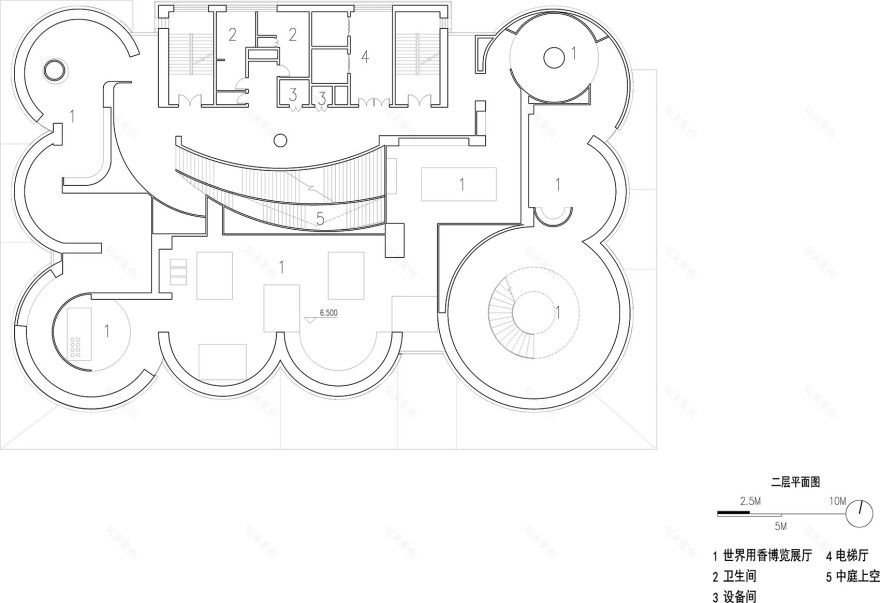
▼三层平面图,Third Floor Plan ©深圳华汇设计

▼四层平面图,Fourth Floor Plan ©深圳华汇设计
▼五层平面图,Fifth Floor Plan ©深圳华汇设计
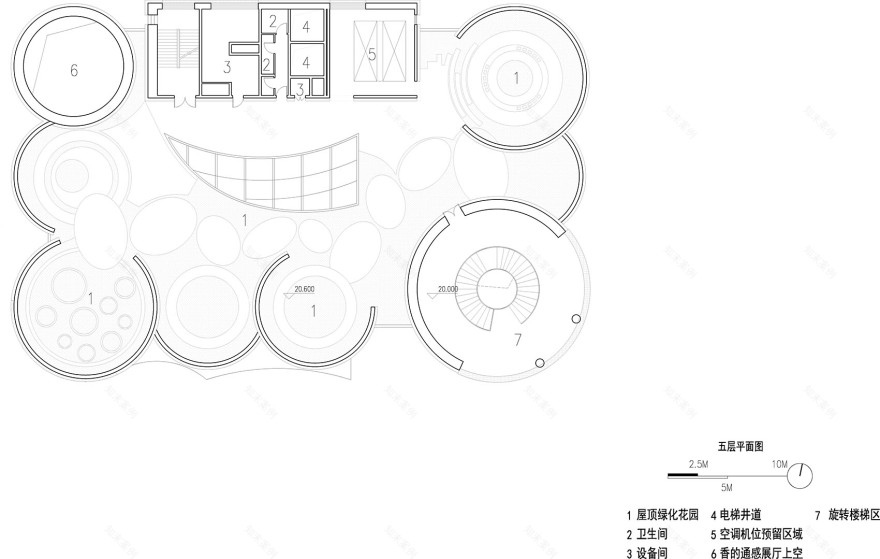
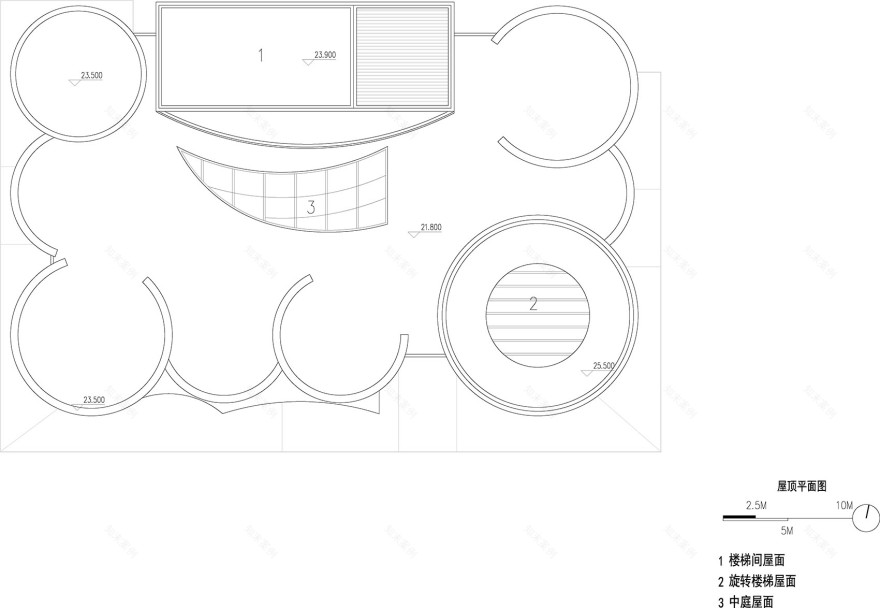
▼屋顶平面图,Roof Plan ©深圳华汇设计
▼剖面,Section ©深圳华汇设计
▼大样图,Architectural Detail Drawings ©直角建筑摄影+ 深圳华汇设计


项目名称:广州雪蕾香氛博物馆
建筑设计:HHD深圳华汇设计
主创建筑师:肖 诚
设计团队:廖国威,梁子毅,李钰,钟舒鹏,王文凯,肖佩敏,徐牧(结构),赵婷婷(结构)
项目地点:广东省广州市白云区
设计时间:2022年1月
竣工时间:2025年7月
建筑面积:9500㎡
业主单位:广州雪蕾香氛博物馆
策展单位:广州雪蕾香氛博物馆
室内全案设计:立品设计
施工图设计:广州新城建筑设计院有限公司、基准方中建筑设计股份有限公司
幕墙设计:深圳市中筑科技幕墙设计咨询有限公司
景观设计:棕榈设计有限公司
灯光设计:北京远瞻照明设计有限公司、汉都设计顾问(深圳)有限公司
建筑摄影:直角建筑摄影
Project Information
Project Name: Guangzhou Xuelei Fragrance Museum
Architectural Design: Shenzhen Huahui Design
Chief Architect: XIAO Cheng
Design Team: LIAO Guowei, LIANG Ziyi, LI Yu, ZHONG Shupeng, WANG Wenkai, XIAO Peimin, XU Mu (Structural), ZHAO Tingting (Structural)
Project Location: Baiyun District, Guangzhou City, Guangdong Province
Design Period: January 2022
Completion Date: July 2025
Gross Floor Area: 7,000 m²
Client: Guangzhou Xuelei Fragrance Museum
Curation: Guangzhou Xuelei Fragrance Museum
Interior Design: Leaping Creative
Construction Drawings: Guangzhou Xincheng Architectural Design Institute Co., Ltd.,JZFZ Architectural Design Co.,Ltd
Curtain Wall Design: Shenzhen Zhongzhu Technology Curtain Wall Design Consulting Co., Ltd.
Landscape Design: Palm Design Co., Ltd.
Lighting Design: z design and planning, Handu Design Consultants Shenzhen Co., Ltd.
Photography: Right Angle Image

南京喵熊网络科技有限公司 苏ICP备18050492号-4知末 © 2018—2020 . All photos and trademark graphics are copyrighted by their owners.增值电信业务经营许可证(ICP)苏B2-20201444 苏公网安备 32011302321234号
苏公网安备 32011302321234号客服
消息
收藏
下载
最近