

创作上传
VIP
收藏下载
登录 | 注册有礼
查看完整案例

收藏

下载

分享
项目背景与场地认知
Project Background and Site Understanding
项目位于浙江省遂昌县王村口镇乌溪江畔的一处临水高地,背山面水,下方连接天然石滩。明清时期,这里曾是王村口重要的水运码头,承担区域商贸往来的节点功能;进入近代,周边又成为浙西南红色革命的重要活动区域。曾经的这里人流密集、功能活跃,而随着时代变迁,建筑逐渐荒废,场地的公共属性也随之消隐。
The project is located on an elevated riverside site along the Wuxi River in Wangcunkou Town, Suichang County, Zhejiang Province. Backed by hills and facing the water, the site descends toward a natural stone riverbank. During the Ming and Qing dynasties, it served as an important water transport dock and a regional trade node. In modern times, the surrounding area became a significant site for revolutionary activities in southwestern Zhejiang. As time passed, the building fell into disuse, and the public character of the site gradually faded.
▼周边环境,Surrounding environment©奥观建筑视觉 AOGVISION

▼项目概览,Overall of the project©奥观建筑视觉 AOGVISION

在多次踏勘中我们发现,尽管王村口镇被河流贯穿,但沿河岸线多被连续民居占据,可供村民亲近水面的公共空间十分有限。本次改造的老屋恰好位于一处小广场与河岸之间,却因自身的封闭性,长期阻断了村庄与江水的联系。项目由此提出一个明确的目标:通过更新这栋老屋,将“隔绝”转化为“连接”,为村民释放一处可被自由使用的滨水公共空间。
Through repeated site visits, we observed that although Wangcunkou Town is shaped by its rivers, most riverbanks are occupied by continuous residential buildings, leaving very limited public access to the water. The old house selected for renovation sits between a small public square and the riverbank, yet its enclosed form had long blocked the connection between the village and the river. The project therefore sets a clear objective: to transform separation into connection by renewing the old house and releasing a waterfront public space that can be freely used by the community.
▼老屋改造后鸟瞰,Aerial view after renovation ©奥观建筑视觉 AOGVISION
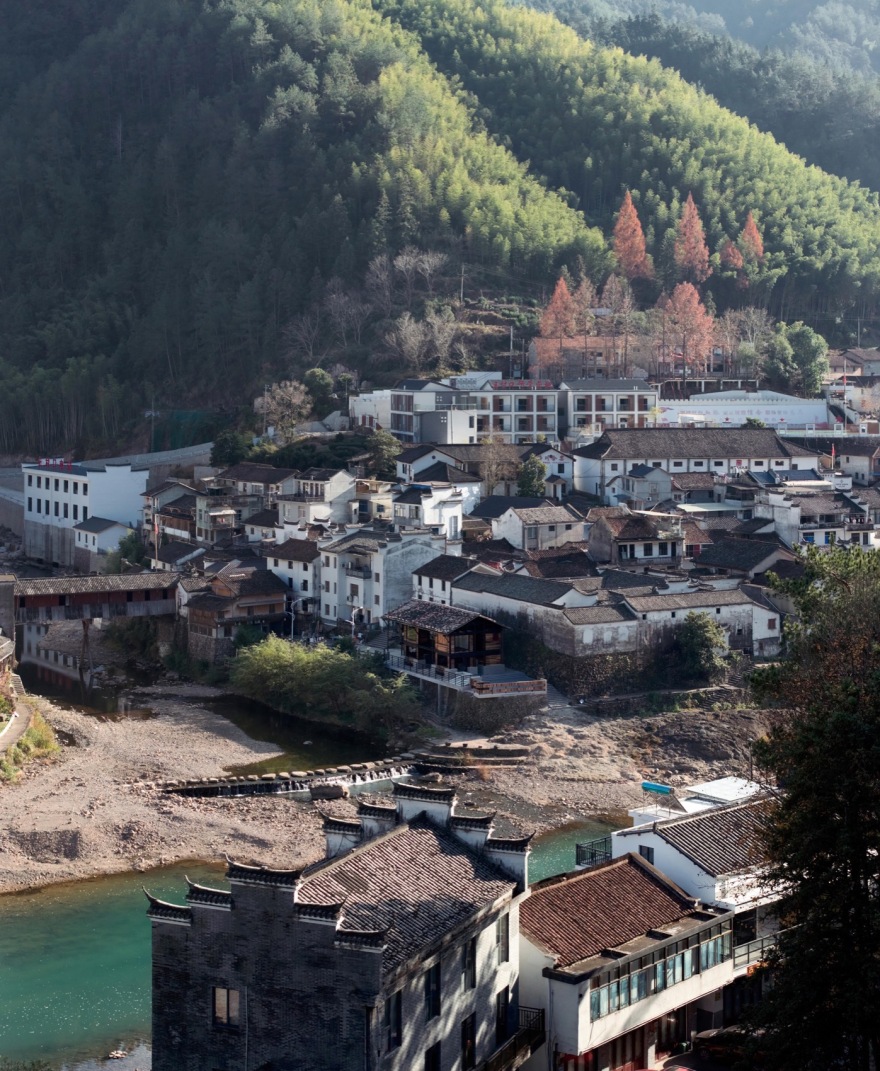

▼老屋与水岸,The old house and the river©奥观建筑视觉 AOGVISION


▼老屋改造后,After renovation ©奥观建筑视觉 AOGVISION
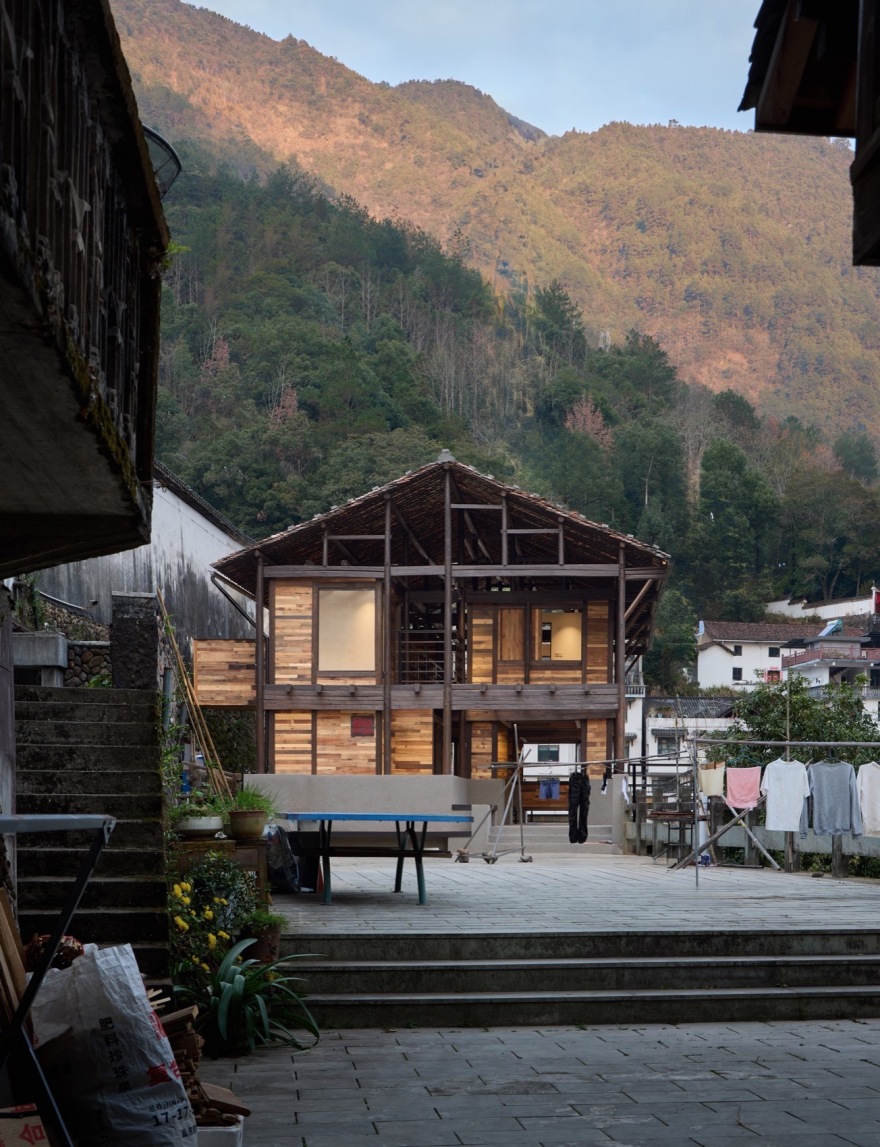
设计策略:基于原有结构的空间重组
Spatial Reorganization Based on the Existing Structure
场地核心是一栋两层传统木结构老屋。其木作框架保存较为完整,但外围围护体系老化严重,空间尺度与使用方式已难以适应当下需求。设计并未选择以新建筑取代旧屋,而是将更新视为一次基于原有结构条件的再组织。
At the core of the site stands a two-story traditional wooden house. While its timber frame remains largely intact, the peripheral enclosure had deteriorated, and the original spatial organization no longer met contemporary needs. Rather than replacing the old house, the renovation is approached as a reorganization based on the existing structural conditions.
▼老屋改造前,Before renovation ©参照建筑 Ref Architects

▼老屋原始风貌,Original condition of the old house ©参照建筑 Ref Architects
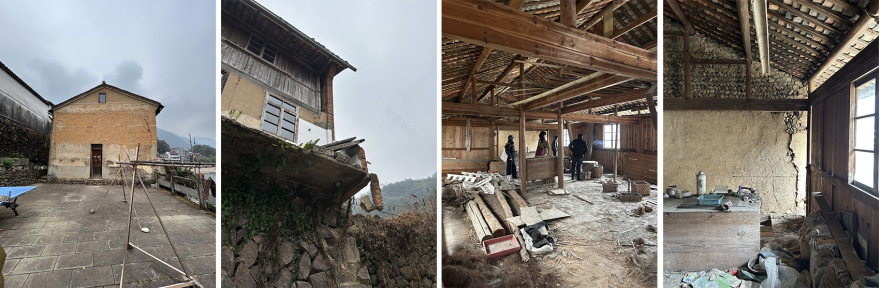
原有木作框架被完整保留,失效的外围构件被拆除,在老屋内部嵌入四个功能性木盒单元,通过“新盒嵌入旧架”的方式重新组织空间秩序。这一介入并非对旧结构的覆盖,而是在既有构造逻辑之内展开。
The original timber frame was fully retained, while the ineffective peripheral components were removed. Four functional wooden box units were inserted within the old house, reorganizing the spatial order through a strategy of embedding new volumes within the old frame. This intervention unfolds within the existing structural logic rather than covering it.
▼保留原有木作框架,拆除失效的外围构件,Frame preserved, enclosure removed ©参照建筑 Ref Architects

四个木盒的置入,既引入了新的使用可能,也在结构层面参与到原有木框架的加固之中。它们在既有框架内部形成新的支点,与原有木构共同构成稳定的结构体系,使空间更新与结构强化在同一过程中完成。
The insertion of the four wooden boxes introduces new possibilities of use while also contributing to the reinforcement of the original timber frame. Acting as new points of support within the existing structure, they work together with the old timber construction to form a stable structural system, allowing spatial renewal and structural strengthening to occur simultaneously.
▼“新盒嵌入旧架”,“New boxes embedded within the old frame”©参照建筑 Ref Architects

空间组织:公共性的重新建立
Re-establishing Publicness
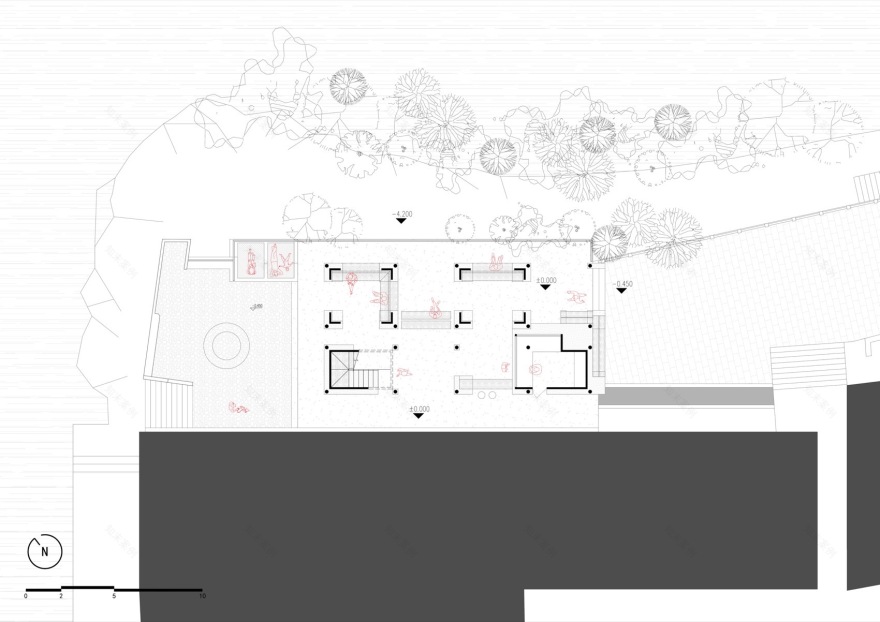
建筑首层被定义为一个可被自由穿行的公共层。木盒在平面与高度上的错动,形成多条非线性的流线与视线关系,人可以从不同方向进入,在木盒之间穿行、停留,并与江岸及石滩建立直接联系。首层更接近一种被不断使用的片段化场所,而非完整封闭的建筑空间。
▼首层的公共性被重新建立,Public accessibility re-established on the ground floor ©奥观建筑视觉AOGVISION

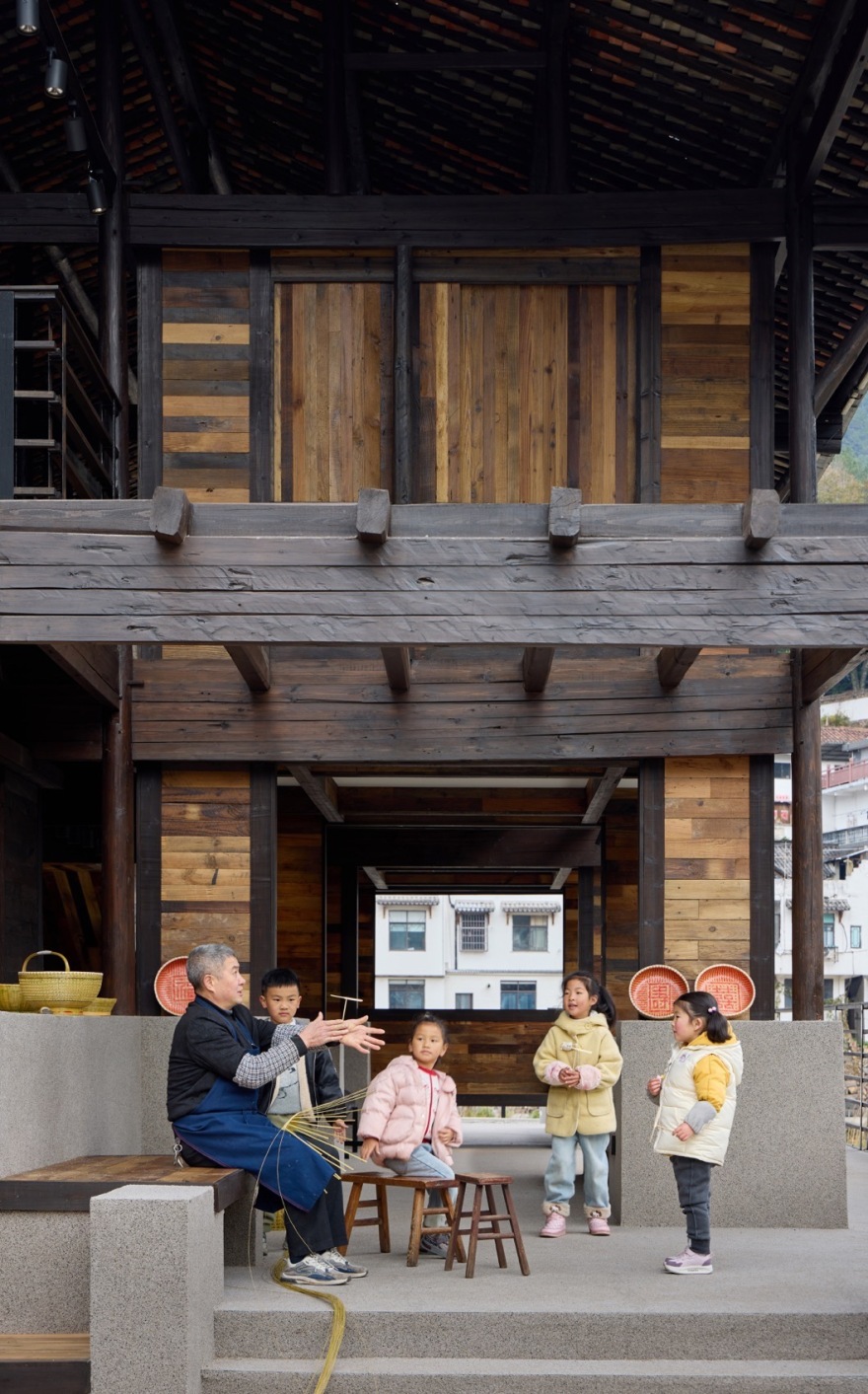
▼可被自由穿行的公共层,A publicly accessible layer that can be freely traversed ©奥观建筑视觉AOGVISION

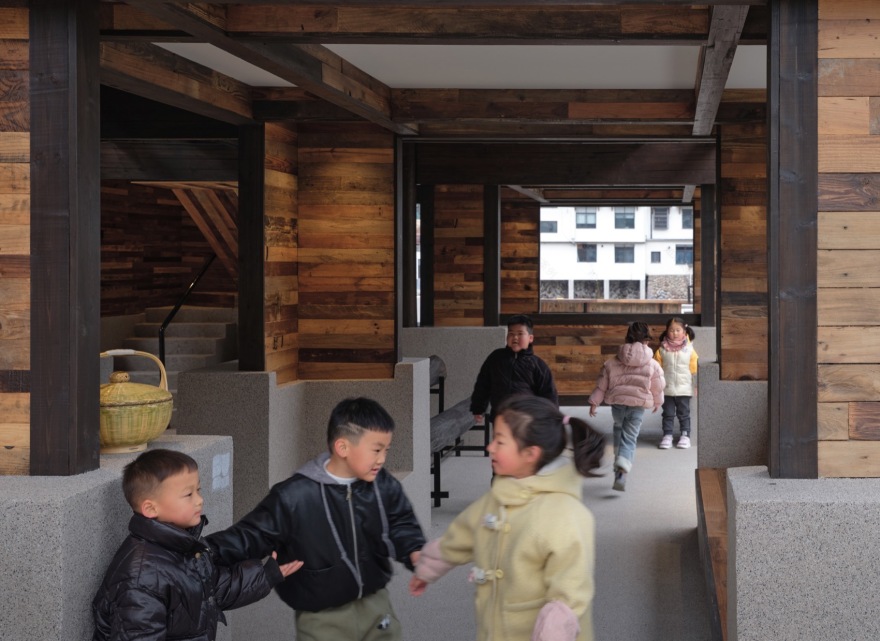
▼在木盒之间穿行、停留,People move between the boxes, pause and linger©奥观建筑视觉AOGVISION


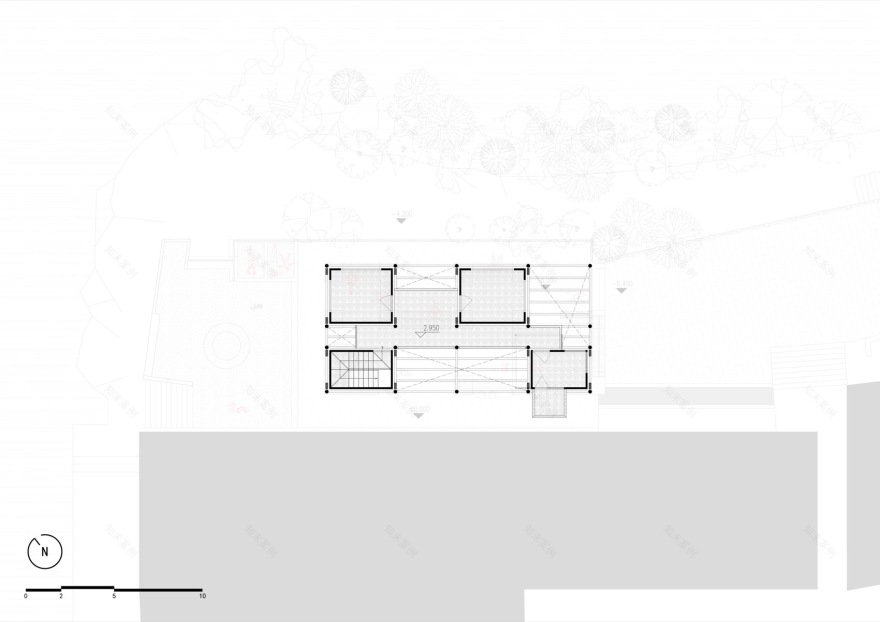
二层空间相对收敛。三个独立木盒朝向乌溪江展开,视线被引导向远处山水;同时,下方裸露的木构体系仍清晰可见,使人在停留时感知到建筑在时间与尺度上的叠加关系。
The second floor is comparatively more restrained. Three independent wooden boxes open toward the Wuxi River, directing views toward the surrounding landscape. At the same time, the exposed timber structure below remains visible, allowing occupants to perceive the layering of time and scale embedded within the building.
▼三个独立木盒朝向乌溪江展开,Three independent wooden boxes open toward the Wuxi River©奥观建筑视觉 AOGVISION


▼裸露的木构体系,Exposed wooden structure system©奥观建筑视觉 AOGVISION

▼二层相对独立,The second floor remains relatively independent ©奥观建筑视觉 AOGVISION

▼二层空间,The second floor ©奥观建筑视觉 AOGVISION

场地条件回应与材料态度
Response to Site Conditions and Material Approach
针对乌溪江上游水库不定期泄洪的现实条件,建筑在结构层面作出回应-给木构穿上“雨靴”。相对室外广场标高1.45米以下部分整体设置为混凝土基座系统,用以托举柱脚与上部木盒,确保结构在水位变化下的安全与稳定。基座形成沉稳的下盘,与上部相对轻盈的木构形成清晰对比。
In response to periodic water discharge from upstream reservoirs, the building adopts a clear structural strategy. All components below 1.45 meters above the adjacent plaza level are constructed as a concrete base system, lifting the column bases and upper wooden boxes to ensure safety and stability under fluctuating water levels. The solid base forms a calm counterpoint to the lighter timber structure above.
▼混凝土基座系统与木制结构,Concrete base system and wooden structure ©奥观建筑视觉 AOGVISION
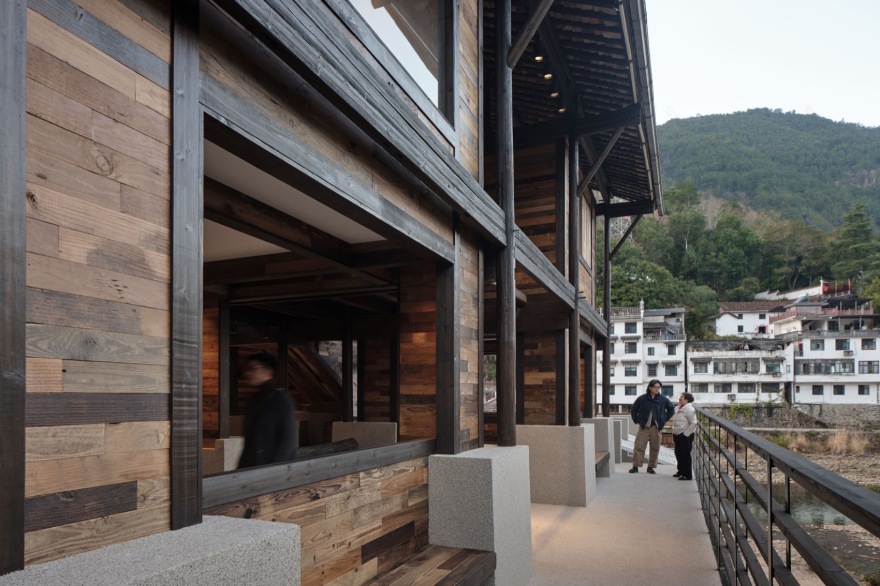

在材料使用上,拆除下来的旧木板被重新整理、修缮,并再次用于建筑内部搭建,使老屋的物质记忆得以延续。
In terms of material use, timber boards dismantled from the original building were carefully sorted, repaired, and reused in the interior construction, allowing the material memory of the old house to continue.
▼老屋的物质记忆得以延续,The material memory of the old house has been preserved©奥观建筑视觉 AOGVISION

▼“雨靴”与“旧木”,“Concrete base” and “reclaimed timber” ©奥观建筑视觉 AOGVISION

▼室内细部,Details of interior©奥观建筑视觉 AOGVISION


结果
Result
通过一次克制而精准的介入,这座老屋在不改变其基本气质的前提下,重新参与到当下的公共生活之中。建筑不再只是历史的遗存,而成为连接山水、村落与记忆的现实节点,在新的结构关系中持续被使用与理解。
Through a restrained and precise intervention, the old house re-enters contemporary public life without altering its fundamental character. No longer merely a historical remnant, it becomes a spatial node connecting landscape, village, and memory, continuing to be used and understood through renewed structural relationships.
▼老屋继续,The old house continues ©奥观建筑视觉 AOGVISION


▼一层平面图,First-Floor Plan ©参照建筑 Ref Architects
▼二层平面图,Second-floor plan ©参照建筑 Ref Architects
项目名称:江边的老屋
项目类型:复合公共空间
项目地点:浙江省丽水市遂昌县王村口镇
设计单位:参照建筑 Ref Architects + 离宅半米 0.5m Studio
设计团队: 胡文渊、方尧、汤珺如、王娇儿
建筑面积: 240m²
设计时间:2025.1-2025.8
施工时间:2025.10-2025.12
业主:遂昌王村口镇,Backland 般岚文化
摄影:奥观建筑视觉AOGVISION
Project Name: The Riverside Old House
Project Type: Hybrid Public Space
Location: Wangcunkou Town, Suichang County, Lishui, Zhejiang, China
Design Firm: Ref Architects + 0.5m Studio
Design Team: Wenyan Hu, Yao Fang, Junru Tang, Jiaoer Wang
Gross Floor Area: 240 m²
Design Period: Jan 2025 – Aug 2025
Construction Period: Oct 2025 – Dec 2025
Client: Wangcunkou Town, Suichang, Backland Culture
Photography: AOGVISION
南京喵熊网络科技有限公司 苏ICP备18050492号-4知末 © 2018—2020 . All photos and trademark graphics are copyrighted by their owners.增值电信业务经营许可证(ICP)苏B2-20201444 苏公网安备 32011302321234号
苏公网安备 32011302321234号客服
消息
收藏
下载
最近