

创作上传
VIP
收藏下载
登录 | 注册有礼
查看完整案例

收藏

下载

分享

翻译
Architects:Studio GAB
Area:250m²
Year:2025
Photographs:Nate Cook Photography
Category:Residential Architecture,Houses
Office Lead Architects:Katarzyna Osipowicz-Grabowska, Piotr Grabowski
Design Team:Studio GAB
City:Gmina Mosina
Country:Poland

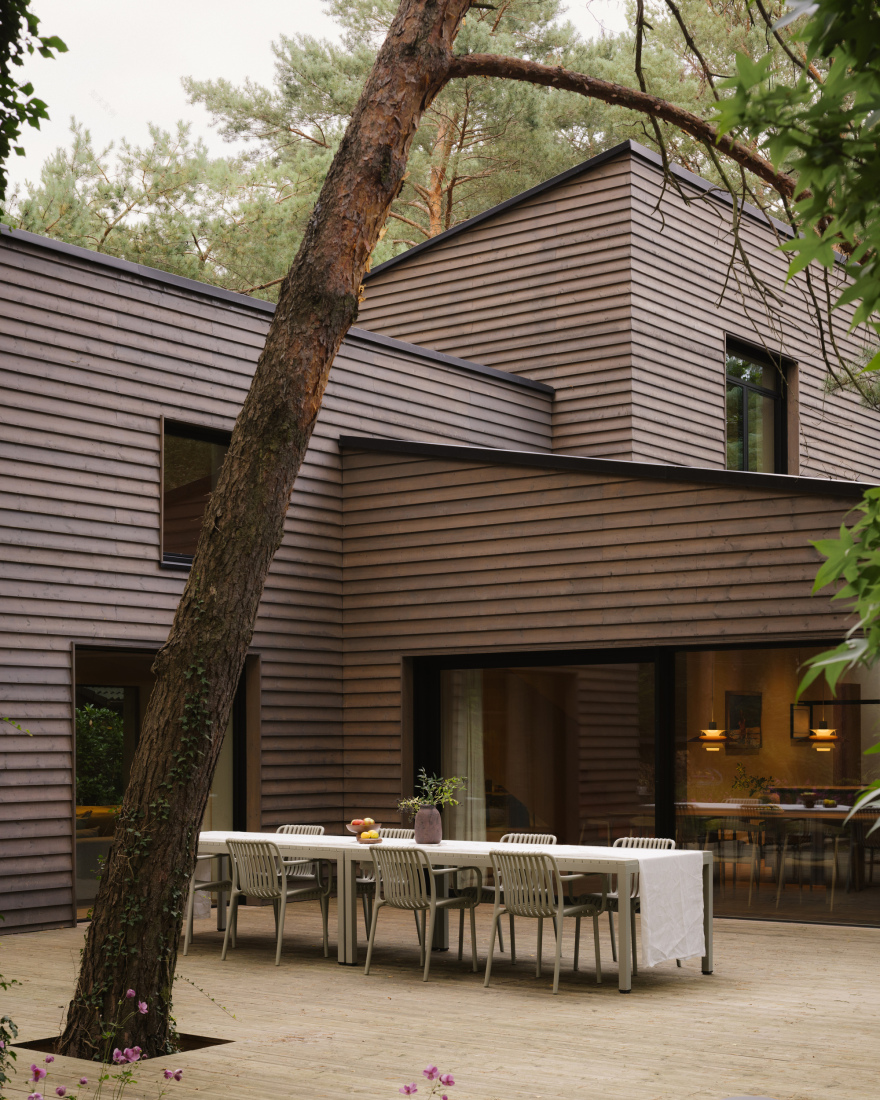
Text description provided by the architects. The main idea behind the house design was to fit an extensive functional program into a long plot bordering the Wielkopolska National Park while maximizing daylight in as many living spaces as possible. This resulted in an elongated form composed of three overlapping, truncated volumes. An equally important goal was dividing the house into lifestyle-based zones so that, despite its size, it would not dominate the surrounding development. Through careful layout and use of local conditions, the house blends naturally into its context.

The plot was originally densely wooded, so the design deliberately preserved mature trees and integrated the building into the existing greenery. This approach is visible in the separation between the house and the carport at the front, whose volume shields the interior from the street. The carport helps form a semi-private entrance terrace connecting the study with a workshop. Three tall pine trees define this space, offering shade and visual separation. A similar strategy was applied in the garden, where trees were incorporated into the terrace, intensively used by the client for DIY activities.

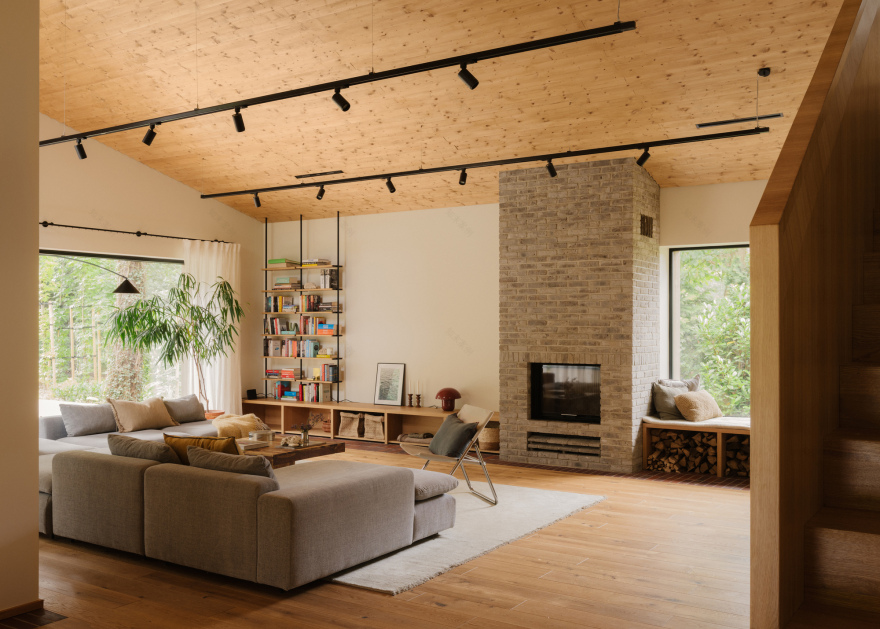
The entrance, tucked around a corner, leads through a copper-clad door into a hall organized along a gray brick wall that visually connects the interior spaces. This wall also forms the fireplace and chimney, extending beyond the roofline toward the garden.


On the ground floor, a study near the entrance doubles as a guest room. The master bedroom is located further inside, with windows facing north. This arrangement reflects the client's irregular lifestyle as a physician, allowing proximity to the house's center while maintaining acoustic separation from the living area through a walk-in closet and bathroom.

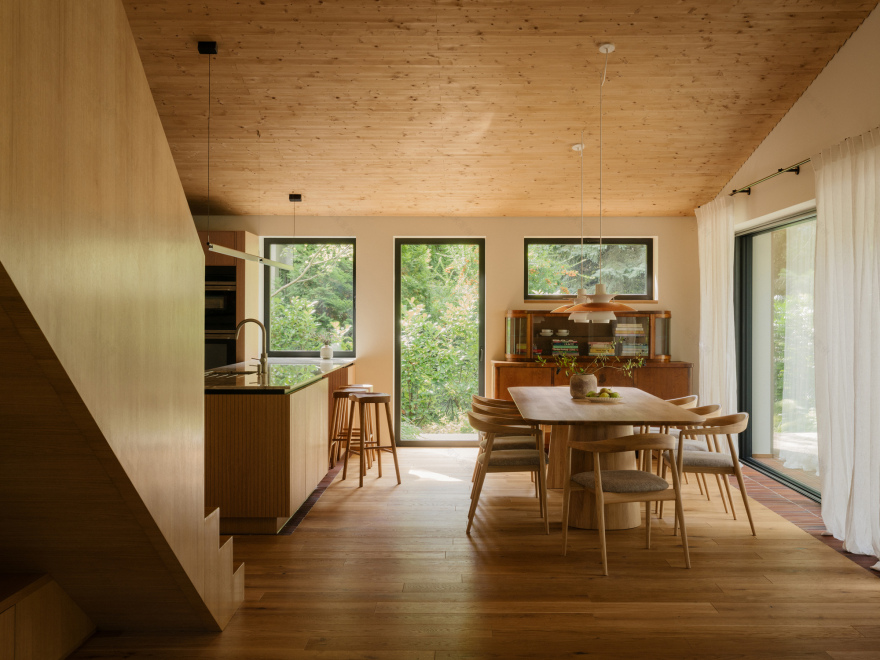
The living area consists of two zones: a kitchen with dining space and a lounge. Differing roof heights and slopes distinguish these areas acoustically and spatially. The lower kitchen and dining zone feels intimate despite its size, reflecting the client's passion for cooking. Oak cabinetry, quartzite countertops, and clinker brick flooring give it a timeless, durable character.


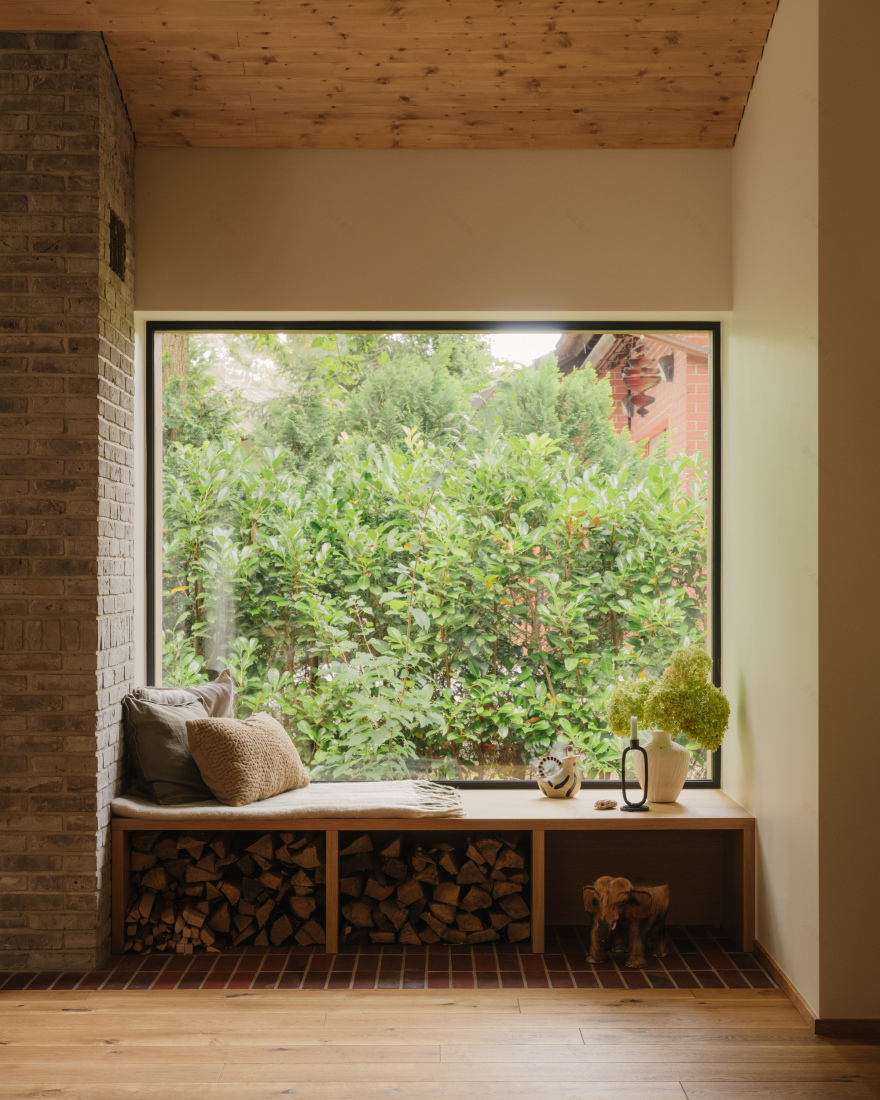
The lounge occupies the far end of the house, opening toward the garden and terrace. Centered around a gray brick fireplace, the space includes a window niche functioning as a bench or daybed. Additional daylight enters through varied window arrangements and an open staircase linking the ground floor to the upper level. Upstairs, an oak staircase leads to a shared children's living area separated by glass, which enhances daylight and visual connection between floors. The remaining spaces include two children's bedrooms and a compact bathroom.

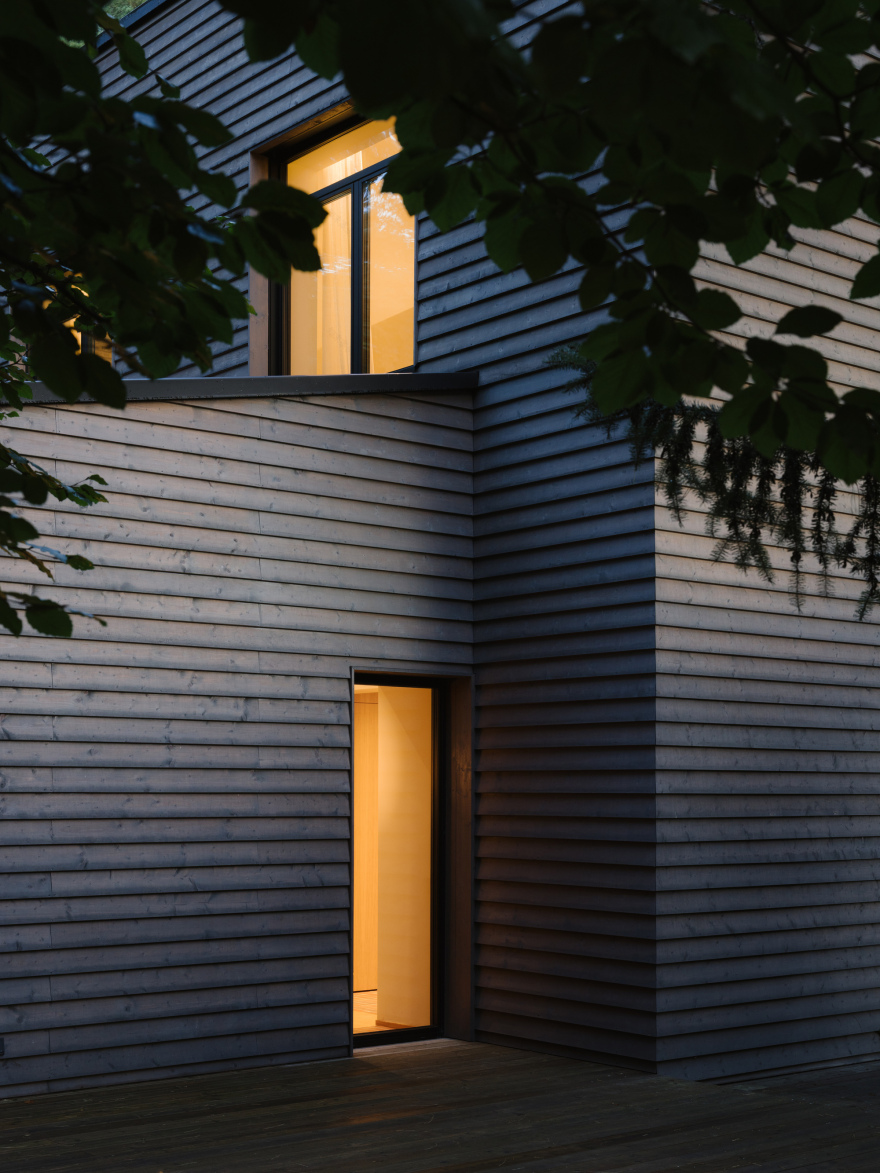
Oak plank flooring runs throughout most of the house, while clinker tiles mark areas connected to the terrace, entrance, and utility rooms. The exterior facade is clad in horizontally arranged Scandinavian spruce boards treated with natural wood tar, with distinctive 45-degree corner details.

The house relies entirely on renewable energy, using a ground-source heat pump supported by photovoltaic panels. Designed for a family close to the architects, the project benefited from close collaboration and extensive mockups, resulting in a refined, timeless home focused on quality rather than trends.

Project gallery







南京喵熊网络科技有限公司 苏ICP备18050492号-4知末 © 2018—2020 . All photos and trademark graphics are copyrighted by their owners.增值电信业务经营许可证(ICP)苏B2-20201444 苏公网安备 32011302321234号
苏公网安备 32011302321234号客服
消息
收藏
下载
最近