

创作上传
VIP
收藏下载
登录 | 注册有礼
查看完整案例

收藏

下载

分享

翻译
Architects:Juliana Camargo,Prumo projetos
Area:450m²
Year:2025
Photographs:Manuel Sá
Manufacturers:Lumini,Pedras Morumbi,Portobello,todeschini campo belo,unilux cortinas
Lead Architects:Thiago Natal Duarte, Julliana Camargo
Category:Residential Architecture,Houses
City:Itu
Country:Brazil

Text description provided by the architects. The Flamboyant House emerges from a dialogue with a partially occupied territory. Situated on a 3,000 m² plot, the proposal begins with the recognition of three significant pre-existing elements: a constructed "L"-shaped house, an existing swimming pool, and a large flamboyant tree on the site. These conditions are not treated as limitations but embraced as structuring elements of the project, guiding decisions regarding placement, volumetry, and spatiality.

From the outset, architecture and interiors have been conceived as an inseparable whole, operating as a single system capable of articulating space, materiality, landscape, and experience. The new house is organized as a set that weaves together distinct times, clear volumes, and the natural surroundings, attributing new significance to the existing ensemble.

The building consists of two main, autonomous, and clearly defined volumes. The first houses the social spaces of the living room, dining room, and kitchen, which are integrated as a continuous and fluid environment. This volume generously opens up like a corner to the expansive living terrace and the swimming pool, reinforcing the direct relationship between the interior and exterior. Large floor-to-ceiling glass panels dissolve physical and visual boundaries, allowing the landscape to act as a constitutive element of the internal space.

The second volume concentrates the intimate program, with three suites designed to ensure privacy, environmental comfort, and quality views of the existing vegetation. Both volumes are constructed with suspended metal structures, a solution that allows for indirect light, enhances ventilation, and imparts lightness to the ensemble. The freijó wood ceiling runs continuously through the spaces, providing thermal and visual comfort while reinforcing the horizontal nature of the architecture.

The integration between these two bodies occurs through an extensive lower slab, a horizontal element that articulates the volumes, defines pathways, and establishes an intermediate scale between architecture and landscape. Beneath this slab, a transitional space is configured, protected and permeable, accommodating everyday uses such as a TV room and sitting areas. More than just a connection, this plane acts as a space of permanence, where interior and exterior merge into a continuous experience.

By surrounding the existing flamboyant tree, this slab creates an especially welcoming outdoor environment. Under the tree's canopy, the space transforms into a true outdoor living room, naturally shaded and protected, encouraging social interaction throughout the day. At this point, the garden ceases to be a backdrop and becomes a direct extension of the architecture, reinforcing the sensitive relationship between construction, landscape, and climate.

The interiors reinforce and deepen the architectural strategies of the project. Thought out from the beginning in conjunction with the architecture, they do not present themselves as a posterior layer, but as a constitutive part of the spatial construction. The continuity of the wood ceiling, the presence of exposed metal structures, and the modulation of openings organize the internal space, defining uses, pathways, and atmospheres.

The integrated kitchen takes on a central role in the social volume, functioning as an articulating element between the environments. The Paraná marble countertop dialogues with the building's structure, while the cabinetry in shades of green establishes a direct relationship with the external vegetation, enhancing the visual continuity between the interior and garden. The freijó wood, present in the ceilings, built-in furniture, and cabinetry, introduces warmth and coziness, balancing the robustness of the materials and enriching the everyday experience.


Color emerges as an architectural element throughout the project. Shades of green act as analogues of the natural surroundings, while the entrance portal in yellow metal sheet and the colorful internal planes serve as spatial and visual markers, guiding pathways and giving identity to the ensemble. More than an aesthetic resource, color actively participates in the construction of space.
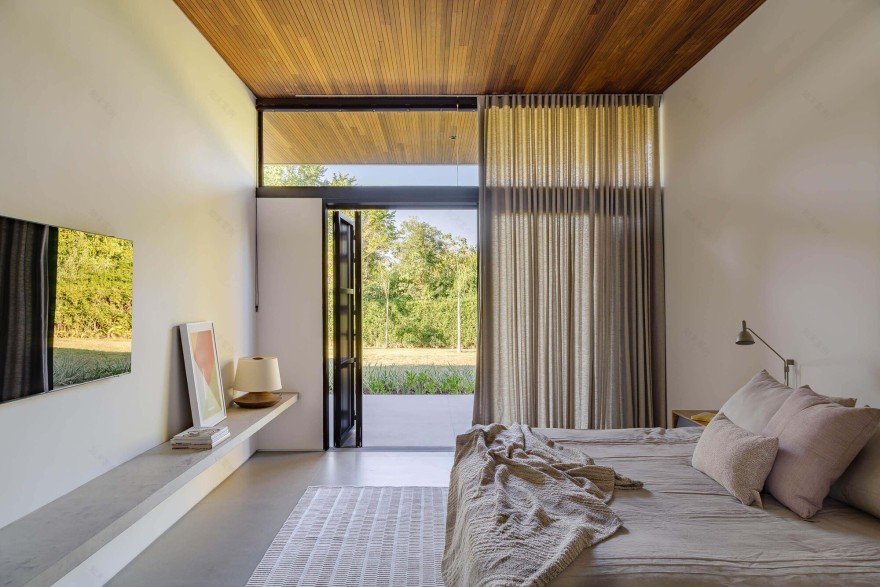
On the street-facing facade, the burnt brick defines a continuous and solid plane, establishing the predominant materiality of the house and ensuring greater privacy. In contrast, the internal facades are characterized by the transparency of large glass panels, which allow control of natural light and direct interaction with the green surroundings. Thus, Flamboyant House is constructed as an operation of reconciliation between the new and the existing. In the gaps between volumes, in the transitional spaces, and in the integration of architecture, interiors, and landscape, the project proposes a form of living that is clear, sensitive, and enduring, where space is defined less by boundaries and more by the relationships it establishes.

Project gallery


南京喵熊网络科技有限公司 苏ICP备18050492号-4知末 © 2018—2020 . All photos and trademark graphics are copyrighted by their owners.增值电信业务经营许可证(ICP)苏B2-20201444 苏公网安备 32011302321234号
苏公网安备 32011302321234号客服
消息
收藏
下载
最近