

创作上传
VIP
收藏下载
登录 | 注册有礼
查看完整案例

收藏

下载

分享
在城市化进程以均质化面貌快速推进的今天,场所精神的存续与唤醒,成为空间设计的重要使命。祯厨娘城市食堂静静坐落于珠海一隅,离海不远。它不只是一个吃饭的地方,更像一座以食物为语言、以空间为媒介的驿站,悄然缝合着城市人与这片土地之间淡去的记忆。我们选择了“珠海渔村”作为故事的底色。渔村的日子,是一场与海的长久对话,所有的生活都绕不开“编织”二字:织网捕鱼,编竹盛物,人与人之间的依存,也如经纬交织。我们从这片海的生活中,拾取了三种沉默的见证——渔网的绳结、温润的竹编、岸边的蚝壳。它们不只是物件,更是呼吸着的智慧。我们试图让它们走出往昔的语境,在现代的食空间里重新表达。
In an era of rapid urbanization characterized by homogenization, the preservation and revival of the “genius loci”have become a vital mission in spatial design. Zhen Chuniang Urban Canteen quietly nestles in a corner of Zhuhai, not far from the sea. It is more than just a place to eat; it resembles a way station that uses food as its language and space as its medium, subtly mending the fading memories between city dwellers and this land. We chose the “Zhuhai Fishing Village”as the narrative foundation of the space. Life in the fishing village is a long, quiet dialogue with the sea, where all daily existence revolves around the act of “weaving”— weaving nets to catch fish, weaving bamboo to hold goods, and weaving interdependence among people, much like warp and weft intertwining. From this seaside way of life, we have gathered three silent witnesses — the “knots of fishing nets”, the “warmth of woven bamboo”, and the “oyster shells”along the shore. These are not merely objects; they are breathing wisdom. We sought to lift them from their past context and let them speak anew within a modern dining space.
The Core Design Strategy: “A Contemporary Translation of Memory”
To avoid superficial accumulation of symbols, we delved into the fabric of traditional and modern life in Zhuhai—once a fishing village rooted in symbiotic coexistence with the sea. At the heart of this life lies the wisdom of “weaving”: weaving nets for harvest, weaving bamboo for vessels, and even weaving the social ties formed through living with the sea.
▼南立面,South elevation © 堺工作室

设计的核心策略在于 “记忆的当代转译”。为了避免符号的直白堆砌,我们深入了解了珠海曾经做为一个渔村的传统与现代生活的肌理,渔村的生活,本质上是与海洋共舞的生存智慧,一切皆与“编织”有关:编织渔网以收获,编织竹器以盛载,甚至与海共生所形成的社区纽带,也是一种社会关系的编织。于是我们从这一点出发提取出“渔网绳结”、“非遗竹编”、“蚝壳”这三种极具代表性且蕴含工艺智慧的元素。通过对其材料特性、制作工艺及文化意义的再思考,将其从原有的生产与生活语境中释放,置于现代建筑的空间逻辑中进行重塑。它们不再是附加的装饰,而是构筑空间氛围、界定区域性格、引导行为模式的结构性要素。绳网的“联结”,竹编的“空间庇护”,蚝壳的“沉淀”,共同编织出一张覆盖整个场所的、细腻而坚韧的情感网络。最终,我们构建了一个不仅仅只满足高效就餐功能的场所,更是一个充满叙事张力、激发多元本土化体验的“情感容器”。
Ultimately, what has been created is not merely a functional dining venue, but an “emotional vessel”—rich in narrative tension and capable of evoking diverse, localized experiences. The core design strategy is “the contemporary translation of memory.” To avoid a literal accumulation of symbols, we delved deeply into the fabric of traditional and modern life in Zhuhai as a former fishing village. Life here is essentially a survival wisdom in harmony with the sea—everything revolves around the concept of “weaving”: weaving fishing nets for harvest, weaving bamboo vessels for storage, and even the community bonds formed through coexistence with the sea, which represent a weaving of social relationships. Starting from this, we extracted three highly representative elements rich in artisanal wisdom: “fishing net knots,” “intangible cultural heritage bamboo weaving,” and “oyster shells.” By re-examining their material properties, craftsmanship, and cultural significance, we liberated them from their original productive and everyday contexts and reimagined them within the logic of modern architectural space. They are no longer mere decorative additions but structural elements that shape the spatial atmosphere, define the character of different zones, and guide behavioral patterns. The “connection” of knotted nets, the “spatial shelter” of bamboo weaving, and the “sedimentation” of oyster shells together weave a delicate yet resilient emotional network that envelops the entire space. Alternatively, we created not only a venue that efficiently serves dining functions but also an “emotional vessel”—rich in narrative tension and capable of inspiring diverse, localized experiences.
▼西立面,West elevation © 堺工作室

渔网绳结的光影
Light and Shadow of Fishing Net Knots
渔网绳结,是渔村最具代表性的视觉符号与劳动智慧。在设计转化中,我们极力避免其沦为肤浅的图形点缀,而是挖掘其作为“联结单元”的本质。入口处,一面巨大的绳墙垂落。我们以现代编织技术,创作了一面大型的、具有立体感的绳结艺术墙面。这并非传统的渔网,而是对其结构美学的抽象化提炼。选用耐久且质感天然的麻绳与合成纤维混合材料,在控制造价,遮盖原有建筑设备间的同时,形成了极具冲击力和识别度的第一印象。它如同一枚巨大的“本土文化印章”,宣告了空间的独特基因。
The fishing net knot, the most iconic visual symbol and embodiment of labor wisdom in a fishing village, must be transformed beyond a superficial decorative motif. Our design delves into its essence as a “unit of connection.” At the entrance, a large, sculptural rope wall cascades down. Utilizing modern weaving techniques, we created a large-scale, three-dimensional knot art installation. This is not a traditional fishing net but an abstracted refinement of its structural aesthetics. Made from durable, naturally textured mixed materials of hemp rope and synthetic fibers, it balances cost control while concealing the original building’s mechanical room. The result is a powerful and highly recognizable first impression—like a grand “local cultural seal” that declares the space’s unique identity.
▼入口处的绳结墙,Knot Wall at the Entrance © 堺工作室

光,也被我们织进了空间。灯泡如鱼,被粗细不一的麻绳悬吊,从天花缓缓垂下。灯亮时,绳影投在墙与地上,轻轻摇曳,仿佛水下晃动的波光。工业的照明在此退场,光的本身,成了温暖的叙事。这一设计,将功能性照明彻底转化为氛围营造的艺术装置,柔化了空间的边界。
Light, too, has been woven into the fabric of this space. Bulbs, like scattered fish, are suspended from ropes of varying thicknesss, hanging softly from the ceiling. When lit, their shadows cast gently swaying patterns upon walls and floors, mimicking the shimmering, refracted light beneath water. Here, industrial lighting recedes; light itself becomes a tender form of storytelling. This design transforms functional illumination into an atmospheric art installation, softening the edges ofspace.
▼麻绳悬吊的灯泡,Lighting Woven into Narrative Bulbs Suspended by Hemp Ropes © 堺工作室

竹编-通透的庇护
Bamboo Weaving – Translucent Shelter
竹编技艺是珠海市三灶的传统手工编织技艺,是广东省非物质文化遗产代表。其历史悠久,相传起源于明嘉靖时期,清光绪《香山县志》中已有“竹盒竹篮之类大小不一,编竹丝为之细密精致”之记载。竹编工艺,蕴含着东方美学中对于“间隙”与“通透”的深刻理解。我们与本地匠人合作,将这一传统技艺推向一个的大尺度的空间应用场景。空间中,数个手工竹编檐以群落的方式悬浮。它们有方形的,也有圆弧形的,大大小小,高高低低,错落成一片片柔和的屋檐。这种布置模拟了渔村建筑群自然生长的、错落有致的屋顶天际线,打破了标准化吊顶的单调,赋予了空间丰富的视觉层次与节奏感。
▼竹编檐轴测图,Bamboo Weaving Canopy – Axonometric Diagram © 堺工作室

The bamboo weaving technique of Sanzao, Zhuhai, is a traditional hand-weaving craft and a representative intangible cultural heritage of Guangdong Province. With a long history tracing back to the Jiajing period of the Ming Dynasty, it is recorded in the Qing Dynasty’s Xiangshan County Chronicle: “Bamboo boxes and baskets vary in size, woven with fine and exquisite bamboo strands.” This craft embodies the profound understanding of “interstices” and “translucency” in Eastern aesthetics.
▼高低错落的竹编,Bamboo Weaving Canopy in different height © 堺工作室

在每一个竹编檐的下方,我们都配套设计了定制化的座椅组合。巨大的竹罩如同“屋中屋”,其投射下的光影区域自然形成了一个心理上的归属范围。人们坐在其下,会获得一种被轻柔包裹的“领域感”与“庇护感”。然而,竹编通透的缝隙又保证了视觉的穿透,实现了物理分隔与视觉连贯的完美统一,即“隔而不断”。这种模糊的边界,鼓励了不同区域就餐者之间微妙的视线交流与空间对话,避免了绝对私密带来的封闭感。
▼被竹编檐包裹的格式空间轴测图,Axonometric Diagram: A Modular Space Enveloped by BambooCanopies © 堺工作室

In collaboration with local artisans, we have elevated this traditional technique to a large-scale spatial application. Within the space, several handwoven bamboo canopies are suspended in clusters—some square, some curved, varying in size and height, resembling a series of soft, floating eaves. This arrangement mimics the naturally growing, staggered roofline of a fishing village, breaking the monotony of standardized ceilings and imbuing the space with rich visual layers and rhythmic dynamism. Beneath each bamboo-woven canopy, we have paired customized seating arrangements. The expansive bamboo structure functions like a “house within a house,” and the interplay of light and shadow beneath it naturally delineates a psychological zone of belonging. Sitting underneath, people experience a gentle sense of enclosure—a feeling of “territoriality” and “shelter.” Yet, the permeable gaps in the bamboo weaving ensure visual connectivity, achieving a perfect balance between physical separation and visual continuity—truly “divided yet connected.” This blurred boundary encourages subtle visual exchanges and spatial dialogues among diners in different areas, avoiding the sense of isolation that absolute privacy might bring.
▼竹编檐空间,BambooCanopies Space © 堺工作室


▼竹编檐下的桌子,Table Under BambooCanopies © 堺工作室


竹编的缝隙本身成为光的过滤器。白天,自然光被切割成细碎的光斑,在地面晃动;夜晚,内部隐藏的暖光灯泡透过编织间隙洒下,营造出星罗棋布、“渔火点点”的温暖景象。光线在这里经历了第二次“编织”,变得愈发柔和与富有情感。
The gaps in the bamboo weaving themselves become filters for light. During the day, natural light is sliced into delicate, scattered specks that sway and dance across the floor. At night, warm bulbs hidden within softly glow through the woven interstices, creating a scene reminiscent of scattered stars or the gentle flicker of fishing boat lights across a dark sea. Here, light undergoes a second act of “weaving”, becoming ever softer and more imbued with emotion.
▼弧形竹编檐,Curved Bamboo-Woven Canopy © 堺工作室
蚝壳·凝固的潮汐
Oyster Shells · Frozen Tides
蚝壳,也是珠海这一沿海地区特有的产物,承载着海洋的赠与与岁月的洗礼。我们将它做为墙体的一部分,视为一种“时间的沉积岩”来处理。我们收集了本地废弃的蚝壳,经过清洗、消毒、筛选,美化,保留其最本真的形态与色泽。将蚝壳不规则地置入铁网中,像大海的波浪。其曲面自然形成丰富的光影凹凸,粗粝、坚硬的触感,与竹编的温润、麻绳的柔软形成极具张力的对比。靠近时,甚至能依稀感受到海风带来的微咸气息的想象。它是一面可触摸的“地方皮肤”,直接唤醒人们对海洋材质最原始的触觉记忆。为整个轻盈的空间注入了一份厚重的质感。
Oyster shells, a distinctive product of Zhuhai’s coastal region, carry within them the gifts of the sea and the passage of time. We have incorporated them as part of the wall, treating them as a kind of “sedimentary rock of time.” We collected discarded local oyster shells, cleaned, sterilized, sorted, and refined them while preserving their most authentic forms and hues. The shells are irregularly embedded into metal mesh, resembling the waves of the sea. Their curved surfaces naturally create rich variations of light and shadow, while their coarse, hard texture forms a striking contrast with the warmth of bamboo weaving and the softness of hemp ropes. When approached, one can almost imagine the faint salty scent brought by the sea breeze. It is a tangible “skin of place,” directly awakening people’s most primal tactile memory of marine materials, and infusing the entire ethereal space with a touch of weighty substance.
▼像海浪的蚝壳墙,Oyster Shell Wall A Frozen Wave © 堺工作室

空间如诗,段落自成
Space as Poetry, Paragraphs Self-Formed
基于对现代都市人多重就餐需求的洞察,我们将空间流线组织成一段富有节奏的叙事序列,整个食堂的流动,也仿若渔村一日。▼平面轴测图,Axonometric Floor Plan © 堺工作室

Guided by an understanding of the diverse dining needs of modern urbanites, we have organized the spatial flow into a rhythmic narrative sequence. The movement through the entire canteen mirrors a day in the fishing village—from the crisp light of dawn to the gentle stillness of twilight.
▼入口,Entrance© 堺工作室
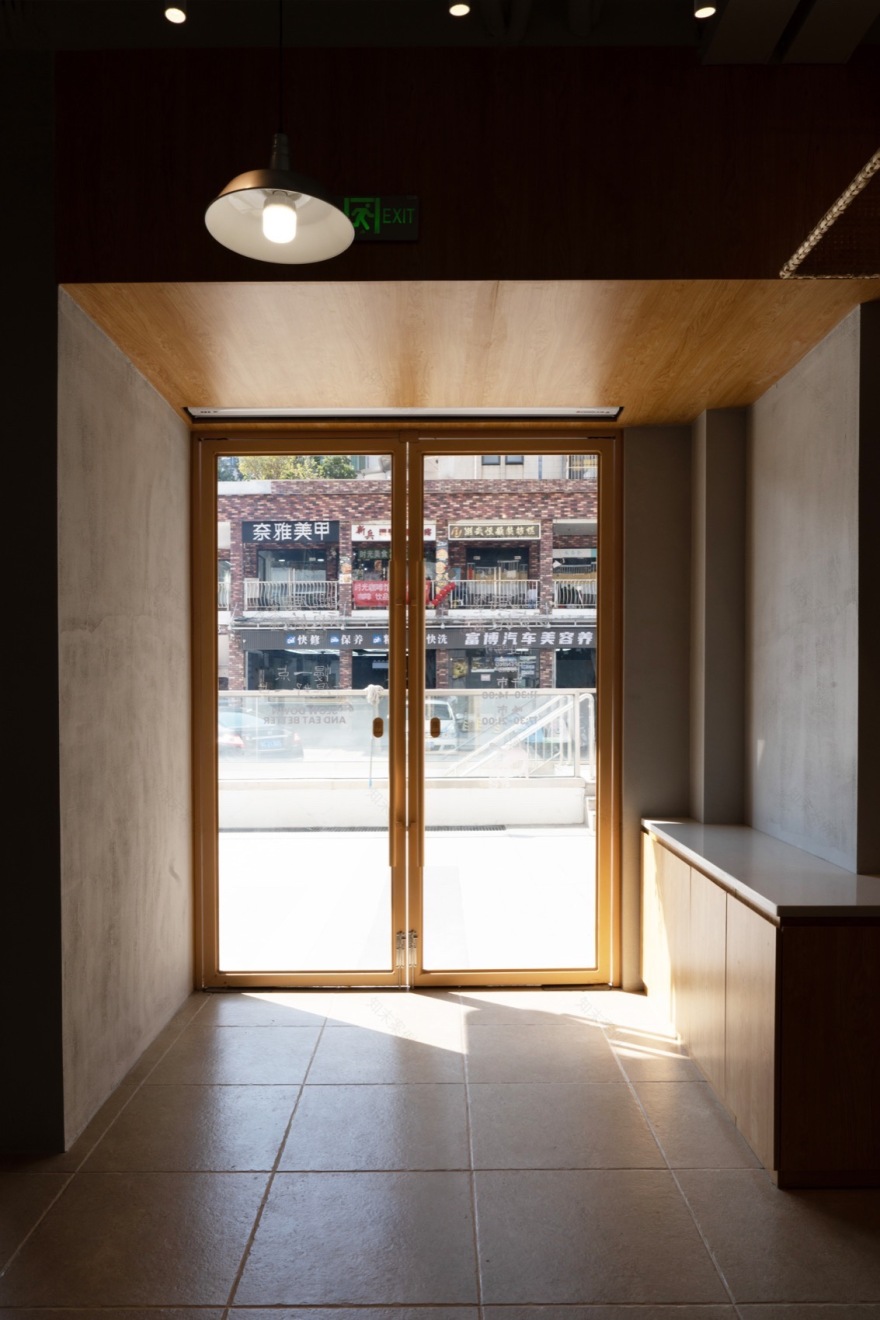
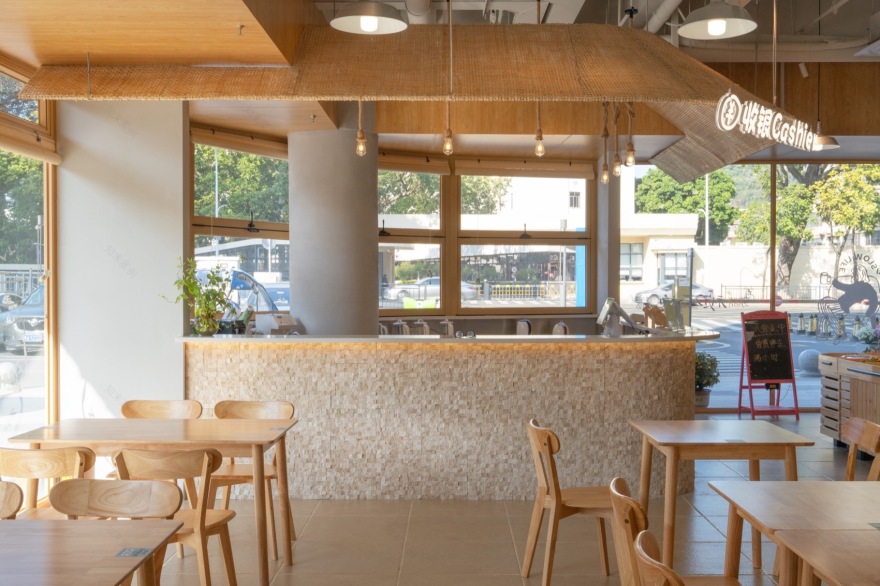
前区是快食区,竹罩高悬,桌椅轻快。是为匆忙的人备下的停顿,简单而明亮。这里座椅以灵活的四人位与双人位为主,排列紧凑但不拥挤。照明明亮而均匀。材质选择上,更多地使用柔和的木质桌椅。该区域服务于追求效率的上班族、商务客或独自用餐者。往里走,光线渐柔,竹编的群落低垂,缓食区围合出卡座与圆桌。灯光被竹编柔和地过滤后,形成静谧、温暖的光晕,如同南方午后透过芭蕉叶洒下的斑驳阳光。这里是朋友聚会、家庭聚餐或需要稍事休憩的顾客的首选。竹编罩创造的半围合感,提供了恰到好处的心理私密性,唤起了在渔村老屋屋檐下,摇着蒲扇、喝茶聊天的闲适记忆。吧台则如一座弧形的岛,被竹编轻轻环抱。酒水在此传递,故事在此交汇。
The front area is designed as a quick-service dining zone, with bamboo canopies suspended overhead and lightweight furniture arranged for efficiency. It serves as a brief yet bright pause for those in a hurry—simple and functional. Seating here consists mainly of flexible four-person and two-person tables, arranged compactly without feeling crowded. The lighting is bright and evenly distributed, creating an energizing atmosphere. Material choices lean toward soft-toned wooden tables and chairs, adding warmth without compromising on practicality. This area caters primarily to office workers, business visitors, or solo diners seeking a swift and satisfying meal.
▼连廊,Corridor © 堺工作室

▼就餐区,Dining area © 堺工作室

往里走,光线渐柔,竹编的群落低垂,缓食区围合出卡座与圆桌。灯光被竹编柔和地过滤后,形成静谧、温暖的光晕,如同南方午后透过芭蕉叶洒下的斑驳阳光。这里是朋友聚会、家庭聚餐或需要稍事休憩的顾客的首选。竹编罩创造的半围合感,提供了恰到好处的心理私密性,唤起了在渔村老屋屋檐下,摇着蒲扇、喝茶聊天的闲适记忆。
Moving inward, the light gradually softens. Clusters of bamboo canopies hang lower, defining the slow dining area with booth seats and round tables. Light is gently filtered through the woven bamboo, creating tranquil, warm halos reminiscent of the dappled sunlight that filters through banana leaves on a southern afternoon. This area is preferred for gatherings of friends, family meals, or customers seeking a moment of rest. The semi-enclosed feeling created by the bamboo canopies provides just the right level of psychological privacy, evoking memories of leisurely moments under the eaves of an old fishing village house—chatting over tea, perhaps with a palm-leaf fan swaying gently.
▼缓食区,Slow-Dining Area © 堺工作室

吧台则如一座弧形的岛,被竹编轻轻环抱。酒水在此传递,故事在此交汇。
The bar, like a curved island, is gently embraced by woven bamboo. Drinks are passed here, and stories converge in thisspace.
▼弧形吧台,Curved bar © 堺工作室


末 End
祯厨娘城市食堂的落成,是我们对于在地性”设计方法论的一次深入实践。真正的文化传承并非仿古复刻,而是在深刻理解本土精神内核的基础上,进行创造性的当代转译。绳结、竹编、蚝壳,这些朴素甚至被视为“廉价”的材料,因其承载的集体记忆与手工温度,在不同的设计手法下,也能焕发出它们的情感力量与美学价值。这或许便是所谓的“在地”——不是将传统供奉起来,而是让它走进日常,麻绳会在触摸中变得温润,竹色会在时光里渐渐深沉,蚝壳的缝隙也许会藏进新的故事。在每一次凝视、每一次触摸、每一次坐下吃饭的时刻,轻轻醒来。
The completion of Zhen Chuniang Urban Canteen represents a deep practical exploration of our “locality-based” design methodology. True cultural heritage is not about replicating the past, but about engaging in creative contemporary translation based on a profound understanding of the essence of local spirit. Knots, bamboo weaving, oyster shells—these humble, even “low-cost” materials, because of the collective memory and handmade warmth they carry, can also radiate emotional power and aesthetic value through different design approaches. This may be what is meant by “rooted in place”—not enshrining tradition, but letting it enter daily life. Hemp rope grows smoother to the touch, bamboo deepens in color over time, and the gaps between oyster shells may gather new stories. In every gaze, every touch, every moment of sitting down to eat, they gently awaken.
▼造性的当代转译,Creative Contemporary Translation © 堺工作室

项目名称:珠海祯厨娘城市食堂
设计方:堺工作室
完成时间:2025年10月-2025年12月
室内设计:成潜魏,张卓群,李敏智
品牌设计:至上品牌工厂
Branding Design:Jiejia Zhang
项目地址:中国广东 珠海
Location:Zhuhai, Guangdong, China
建筑面积:总建筑面积410㎡
摄影版权:堺工作室
Project Name: Zhuhai Zhen Chuniang Urban Canteen
Design Firm: SakaiAtelier
Completion Period:October 2025 – December 2025
Interior Design:Cheng Qianwei, Zhang Zhuojun, Li Minzhi
Brand Design: Zhishang Branding Factory
Brand Designer:Zhang Jiejia
Project Location:Zhuhai, Guangdong, China
Gross Floor Area:410 sqm
Photography Credits:SakaiAtelier
南京喵熊网络科技有限公司 苏ICP备18050492号-4知末 © 2018—2020 . All photos and trademark graphics are copyrighted by their owners.增值电信业务经营许可证(ICP)苏B2-20201444 苏公网安备 32011302321234号
苏公网安备 32011302321234号客服
消息
收藏
下载
最近