

创作上传
VIP
收藏下载
登录 | 注册有礼
查看完整案例

收藏

下载

分享

翻译
Architects:Skupaj Arhitekti
Area:120m²
Year:2025
Photographs:Ana Skobe
Manufacturers:TON,Artemide,Donar,Flos,Ligne Roset,Rex Kralj
Category:Residential Architecture,Houses
Design Team:Tomaž Ebenšpanger
Landscape Architecture:Studio TSK
Engineering & Consulting > Structural:Inženiring Biro Armatura
Engineering & Consulting > Electrical And Mechanical:REing, Rational Energy
Country:Slovenia

Text description provided by the architects. Set at the edge of the Murska Sobota plain, this single-family house is conceived as a pavilion in the landscape, where daily life unfolds between interior space and garden. Rather than standing apart from its surroundings, the house opens itself to them.
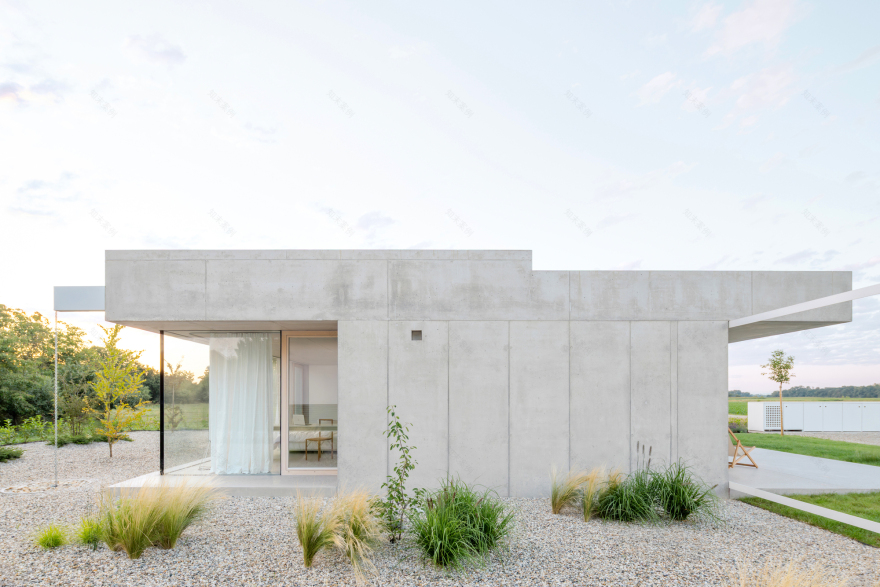
The project is shaped by a local tradition of low-rise living embedded in greenery and by strict urban planning regulations governing siting, scale, and height. The challenge was to meet these constraints while preserving openness, spatial continuity, and a strong relationship to the landscape. The design draws from the modernist legacy of Murska Sobota, not as a formal reference, but as a set of principles rooted in clarity, restraint, and precision.
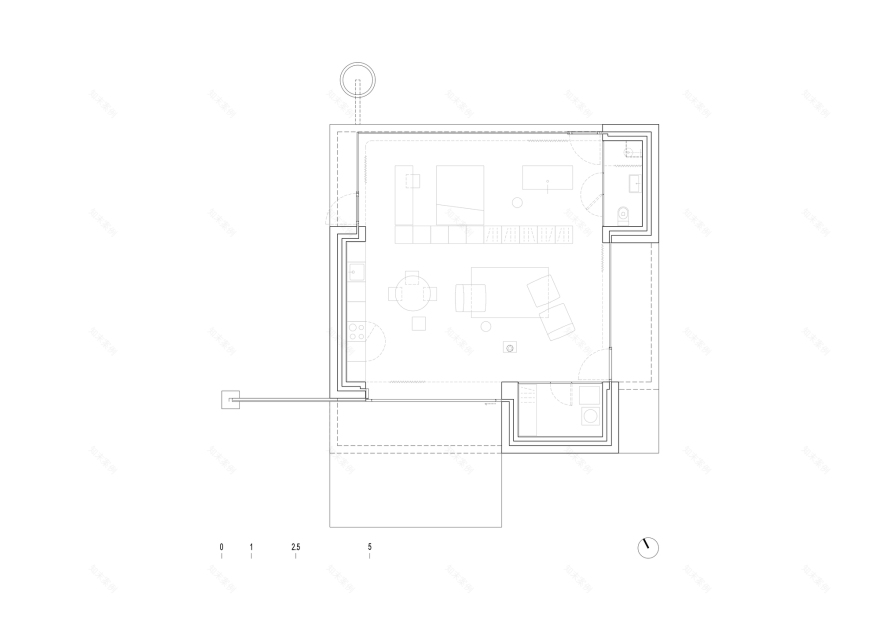
The house is organized around three reinforced-concrete cores that function as both structural supports and technical hubs, accommodating the bathroom, utility spaces, and kitchen. These cores carry a flat reinforced-concrete slab with edge beams, freeing the remaining floor area from load-bearing elements and enabling a fully open, flexible plan.


Living and dining spaces face the southwest garden and terrace, creating a direct physical and visual connection to the landscape. Private sleeping and working areas are oriented toward the quieter northeast garden. A long, double-sided storage wall separates and connects these zones, organizing circulation without disrupting spatial flow.

A subtle fold in the roof structure at the northwest corner introduces a raised beam and a fully glazed, structurally liberated corner. Together with a large timber sliding panorama window on the southwest façade, the house can open entirely to the garden, reinforcing its pavilion-like character.

"The house is not designed as an object, but as a framework that allows life, light, and landscape to shape the space."

Materiality reinforces this approach. Exposed concrete façades and interior walls, cast with local Mura river gravel, create warm, tactile surfaces that reveal traces of reused formwork and the construction process itself. Polished concrete floors, built-in furniture, reused chairs, and simple lighting maintain a restrained interior, while a compact cast-iron stove anchors the living space in winter.

Rather than seeking monumentality, the house achieves quiet confidence through structural clarity, material honesty, and careful detailing. It offers a contemporary interpretation of residential living where architecture acts as a mediator between everyday life and the changing landscape.

Project gallery




南京喵熊网络科技有限公司 苏ICP备18050492号-4知末 © 2018—2020 . All photos and trademark graphics are copyrighted by their owners.增值电信业务经营许可证(ICP)苏B2-20201444 苏公网安备 32011302321234号
苏公网安备 32011302321234号客服
消息
收藏
下载
最近