

创作上传
VIP
收藏下载
登录 | 注册有礼
查看完整案例

收藏

下载

分享
In essence, both architecture and literature are fundamentally about humanity.

黎里 |中金家弄 Lili | zhongJin lane
苏州
黎里古镇坐落于吴头越尾之地,地处太湖之滨。形成于南宋,自唐末名为梨花村起,历经宋之集市、明之繁华,沉淀下千年的历史底蕴。
小桥流水旁,深巷幽弄中,一座典型江南水乡文化古镇。
Suzhous Lili Ancient Town is located at the convergence of the Wu and Yue regions, nestled along the shores of Taihu Lake. Its origins trace back to the Southern Song Dynasty, evolving from a village known as Pear Blossom Village since the late Tang Dynasty. Through its development as a marketplace in the Song era and its flourishing during the Ming and Qing dynasties, it has accumulated millennia of historical heritage. With small bridges spanning flowing streams and deep lanes winding through quiet alleyways, it stands as a quintessential cultural water town of Jiangnan.

清末黎里 © Donald Mennie(1876-1941)

场地鸟瞰 © Smage


▲古镇风貌 © Smage
中金家弄位于古镇中部,黎川市河南岸,俗称下岸,为小说《繁花》作者金宇澄先生曾祖辈购置、翻建,属于典型“明基清建”,在经历各种历史变故后成为公有大杂院,多年空置。踏勘时已是颓残垣,日渐圮废。
Zhongjin Lane lies in the heart of the ancient town, on the southern bank of the Lichuan River. Originally acquired and renovated by the ancestors of Mr. Jin Yucheng, author of the novel Blossoms, the lane embodies a classic Ming-era foundation with Qing-era construction. After undergoing various historical transformations, it became a publicly owned mixed-use compound and stood vacant for many years. By the time of the initial survey, the site had already fallen into disrepair, with dilapidated rooms and crumbling walls gradually succumbing to decay.

沿河外观
© Smage
设计原点
Design Origin
繁花
书房
作为当地政府出资打造的公共文化场所,原有空间功能由私人居住空间转向公众开放的主题性公共空间,这种功能属性的转化要求建筑做出空间契合与身份主题双重锚固的回应。
As a publicly funded cultural venue commissioned by the local government, Blossoms Study was transformed from a private residential space into a themed public space open to all. This shift in functional identity required the architecture to respond through a dual anchoring of spatial adaptation and thematic embodiment.

沿老街入口 © Smage 隐没 Blend into
建筑外观尊重古镇风貌,保留老街民居一门一窗一弄的传统制式。建筑隐身于河岸之侧群落之中,不事张扬,如同父子两身份标签:一位前中共地下情报工作者,一位小说界“潜伏者”。入口挂有作家手刻的木质门牌。
The exterior of the building respects the style of the ancient town and retains the traditional pattern of one door, one window and one lane of the old street dwellings. The building blends into the community by the riverbank, unassuming, just like the identity labels of two generations of father and son: one was a former underground intelligence worker, and the other is a lurker in the literary world. A wooden doorplate hand-carved by the writer hangs at the entrance.

窗景内外
© Smage
开放立体
Open and Three-Dimensional
原有一进为两层低矮、狭小空间,设计通过局部钢结构置换,挑空中部,在二层形成展览环廊,沿河阅读空间设玻璃观景窗,窗景拾阶而上,步移景异。
The original first courtyard was a low, narrow two - story space. Through partial steel structure replacement, the central area was opened up to create an exhibition gallery corridor on the second floor. A long glass viewing window was installed along the riverside reading area, allowing the scenery outside to unfold step by step as one ascends along the window - facing stairs, with the view changing at every turn.

场地建筑原貌
思域设计

轴侧解析图
思域设计
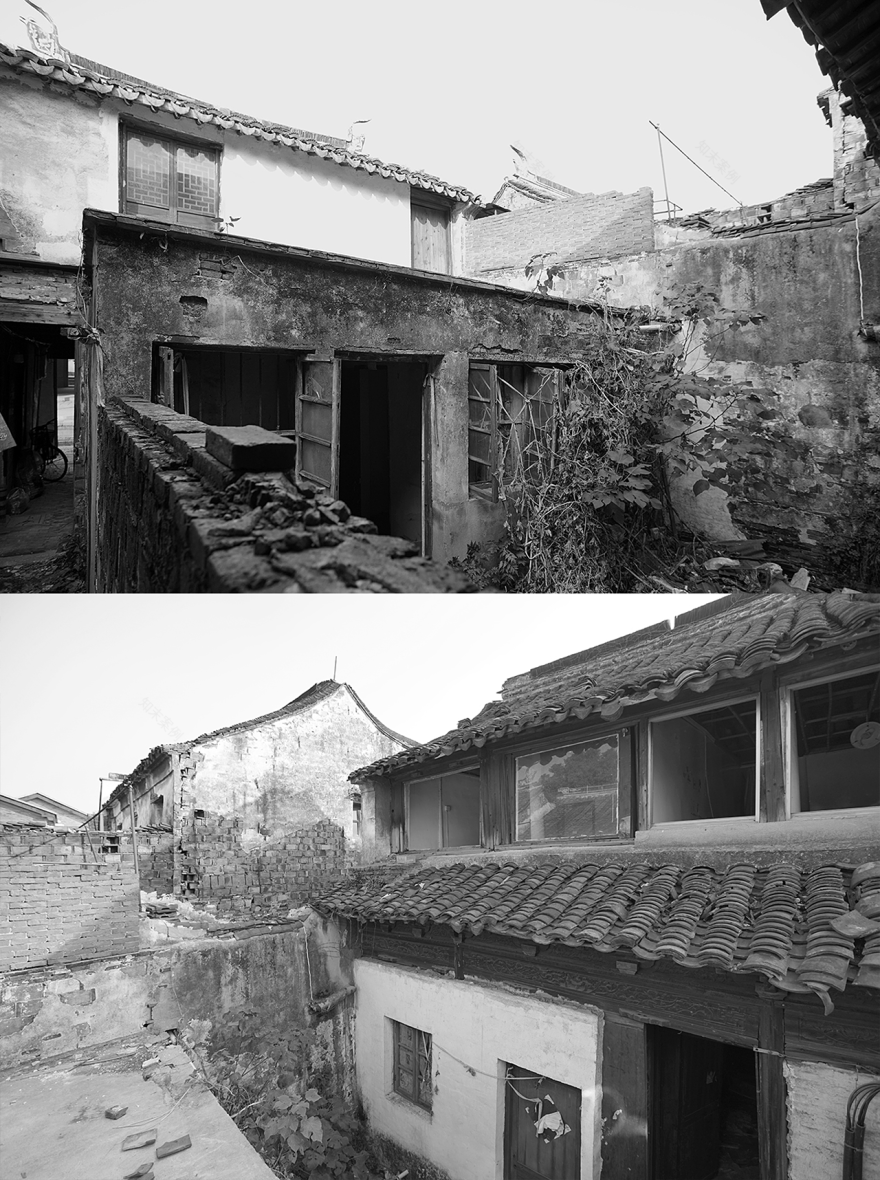
▲一进改造前 思域设计
南向增加天窗,光线引至一层,暗弄之间开设洞口,增加采光互动,原本阴暗压抑、封闭扁平空间转化成开放明亮、立体空间。
A south-facing skylight was added to draw natural light down to the first floor, and openings were introduced between the dark passageways to enhance lighting interaction. This transformed the originally dim, oppressive, and confined flat space into an open, bright, and three-dimensional environment.

一进空间整体 © Smage

新旧空间结构嵌套
© Chong
化零为整
consolidate fragmented spaces
一二进整体采用化零为整的策略,后部暗弄并入,将原本封闭的一进与二进完全打开,形成以新建阳光厅为核心的整体大空间,包含阅读、展览、 画廊、文学讲堂、艺术沙龙、咖啡等复合功能
The entire first and second courtyards adopt a strategy of consolidating fragmented spaces, incorporating the back passage discreetly. This approach completely opens up the originally enclosed first and second courtyards, forming a unified grand space centered around the newly constructed Sunlight Hall. The integrated area encompasses multiple functions such as reading, exhibitions, gallery displays, literary salons, art forums, and a café.

“化零为整”设计策略
思域设计
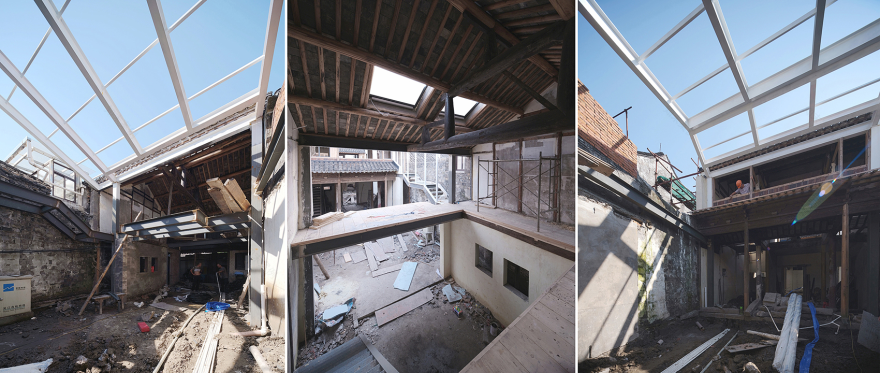
▲结构置换施工现场

多功能阳光厅
© Smage
同时,通过增加一进二层挑、二进画廊长窗、桥建立空间关系,构建上下两层三面围合立体舞台式场所,为阳光厅举办文学讲堂和艺术沙龙等公共活动创造了生动的空间条件。
Additionally, spatial connections are enhanced by introducing a second-floor overhanging platform in the first courtyard, elongated gallery windows in the second courtyard, and connecting bridges. These elements create a three-dimensional, stage-like venue enclosed on three sides across two levels, providing a dynamic spatial environment for hosting public activities like literary salons and art forums in the Sunlight Hall.


▲以上一进挑空 © Smage 结构嵌套空间 Structure-Nested Spac
二进西侧原有墙体倾斜严重,新建混凝土结构盒子在加固同时用结构形成独立画廊空间。由于当地清水混凝土施工经验带来的瑕疵粗粝,反而使得新旧关系变得融合。画廊大玻璃因整块无法搬入,金属条做了十字形压缝,让人想起卡斯帕·大卫·弗里德里希(Caspar David Friedrich)的绘画与路易斯·巴拉甘(Luis Barragán)自宅。
The original western wall of the second courtyard was severely tilted. A new concrete structural box was embedded to reinforce it while also creating an independent gallery space defined by the structure itself. The imperfections and roughness resulting from the lack of experience in fair - faced concrete construction unexpectedly enhanced the integration between the old and the new. The large gallery glass panel, too big to be moved in as a whole, was fitted with a cross - shaped metal joint—a detail reminiscent of the works of Caspar David Friedrich and the residence of Luis Barragán.

二进院改造前
思域设计
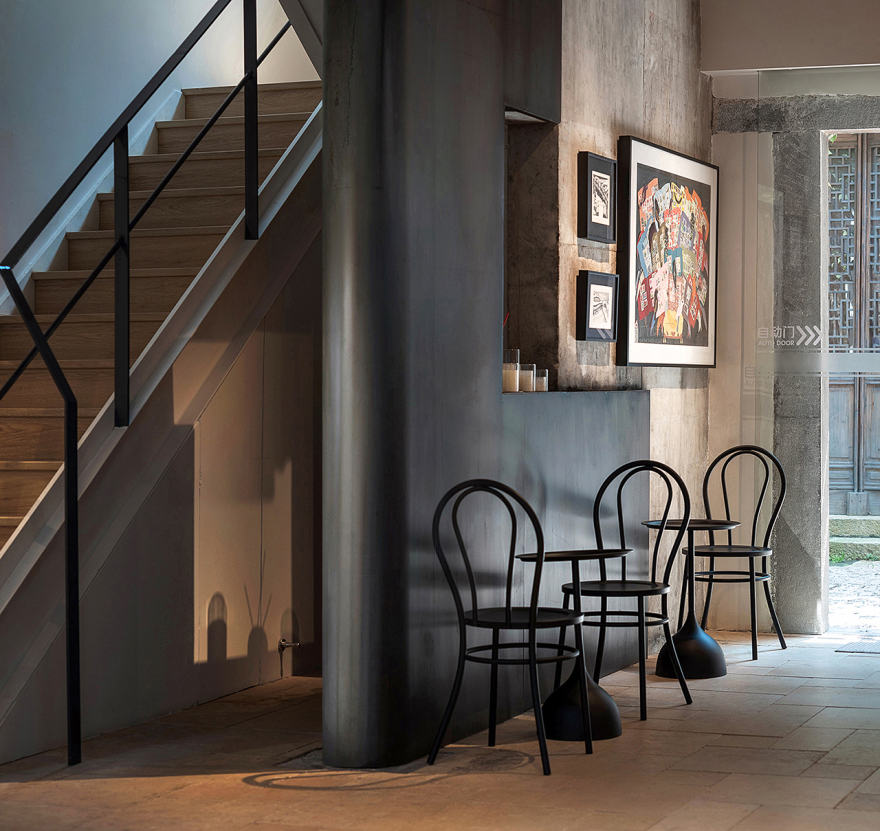
二进一层 © Smage


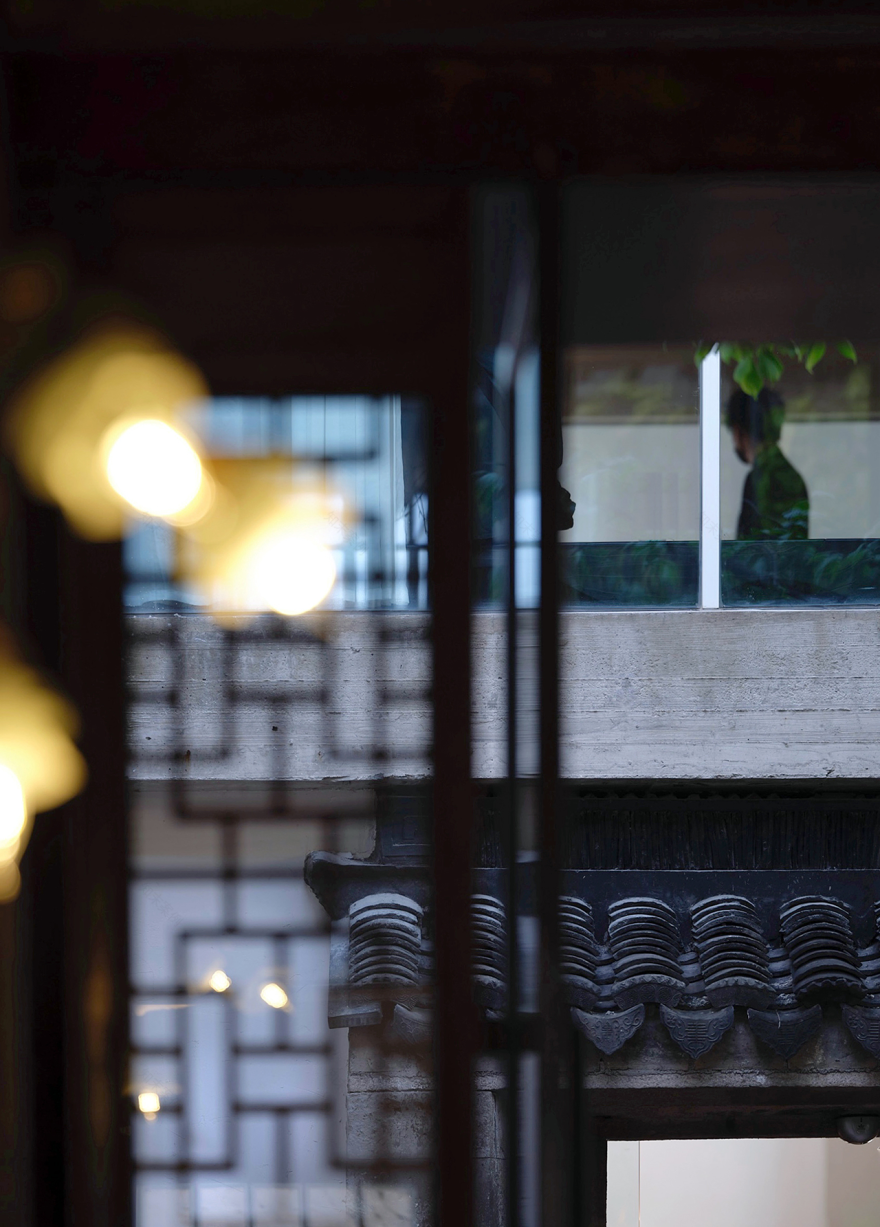
▲以上二进外观©Smage
痕迹 Trace
二进院内新植柿树一颗,院落西侧架设连廊,连廊下设树院咖啡,三进北向二层退让出阳台,树院画廊互动。损毁木构采用建筑拆下旧木修复,利旧产生的规格形式不统一,在热轧钢板、玻璃门的协同下进行对称性分组。在江南潮湿的环境下,新水景与旧墙很快融为一体。
A persimmon tree is planted in the second courtyard, while a covered corridor is installed along the western side of the yard. Beneath the corridor, a tree courtyard café is arranged. On the northern side of the third courtyard, the second level recedes to form an interior balcony that interacts with the tree courtyard gallery. Damaged wooden structures are repaired using salvaged timber from the building itself. The resulting inconsistencies in size and form from repurposing old materials are organized into symmetrical groupings with the help of hot - rolled steel plates and glass doors. In the humid environment of Jiangnan, the new water feature and the old wall quickly blend into one.

三进改造前后对比 © Smage

▲三进外观 © Smage

三进外观 © Smage

水景 mage 三进与三进院合并为扩大三进阅读展览空间,留出芭蕉天井为两侧空间提供自然采光与景观。利用屋面形成两层室外露台,首层露台与整体空间形成游园式的参观洄游动线,第二层露台与屋顶相连,回应《繁花》中的片段“两个人从假三层爬上屋顶,瓦片温热”。
The third courtyard is merged with its adjacent yard to expand into a reading and exhibition space. A plantain courtyard is preserved to provide natural light and views for the spaces on both sides. The roof design forms two outdoor terraces—the first-floor terrace integrates with the overall space to create a garden-like, circulating visitor path, while the second-floor terrace connects directly to the roof, echoing a scene from Blossoms: “The two climbed from the attic up to the roof, where the tiles were still warm.”


▲以上繁花画廊©Smage


▲以上扩大三进©Smage
月亮与六便士
The Moon and Sixpence
四进
修缮时避让院内新发现的夏鹭井,将围墙门窗做了平移互换。院东侧围墙垮塌大半,设计未按常规方式砌完整,于背面重新做了新墙加固映衬残墙。镂空月亮造型是当地传统花窗透景另一种独特表达方式,更是与对面围墙顶部高高在上的铜钱形成了文学的隐喻。
During the restoration of the fourth courtyard, the positions of the doors and windows along the wall were shifted and exchanged to preserve the newly discovered Xialu Well within the yard. Most of the eastern wall had collapsed. Instead of following conventional repair methods to fully rebuild it, a new wall was constructed behind the remaining ruins to reinforce and complement them. The hollow moon-shaped motif offers a unique interpretation of the traditional framed-view lattice window, while also creating a poetic juxtaposition with the elevated coin-shaped tile window atop the opposite wall—a literary metaphor woven into the architecture.

四进阅读空间
Chong
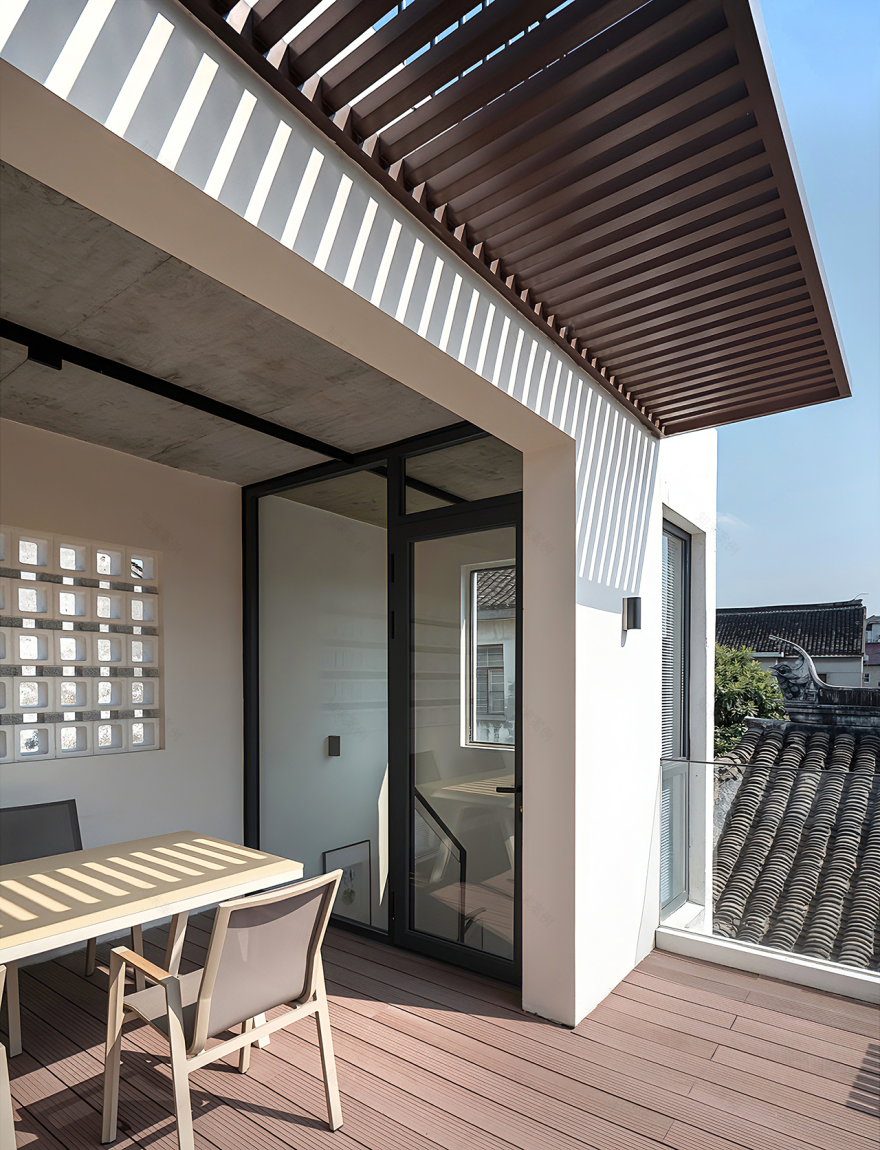


▲以上露台 © Smage

夏鹭井院改造前 © 思域设计

夏鹭井院月墙©Chong

夏鹭井院通往画室©Chong
后记
Epilogue
从来古意,可以新诗,于设计者与使用者而言,繁花书房不是的场所,也不是人的场所,是物与人纽带的情感场所。
Amidst timeless grace, new verses find their place. To both the designer and the user, Blossoms Study is neither merely a space of objects nor solely a space for people—it is an emotional realm where objects and individuals intertwine.

▲南院雨棚 © Smage

材料与细部
思域设计
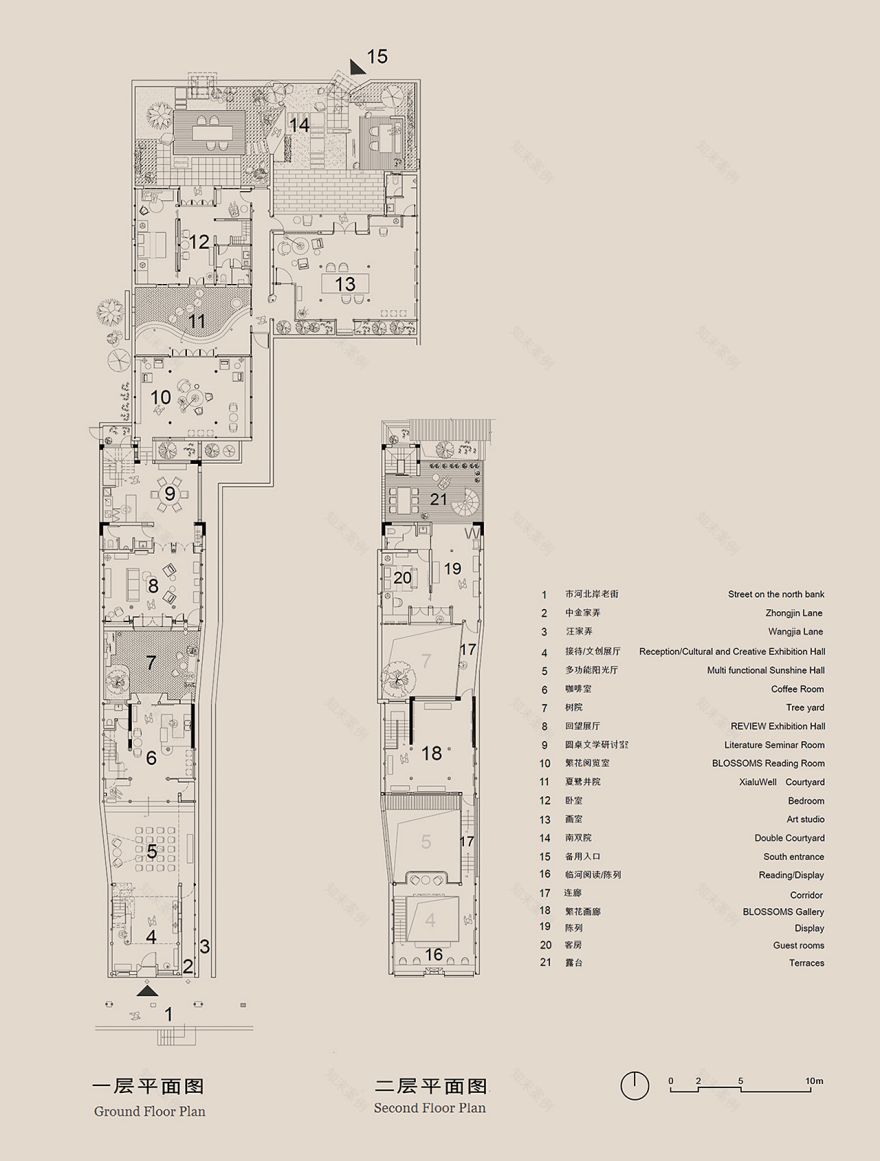
一二层平面图
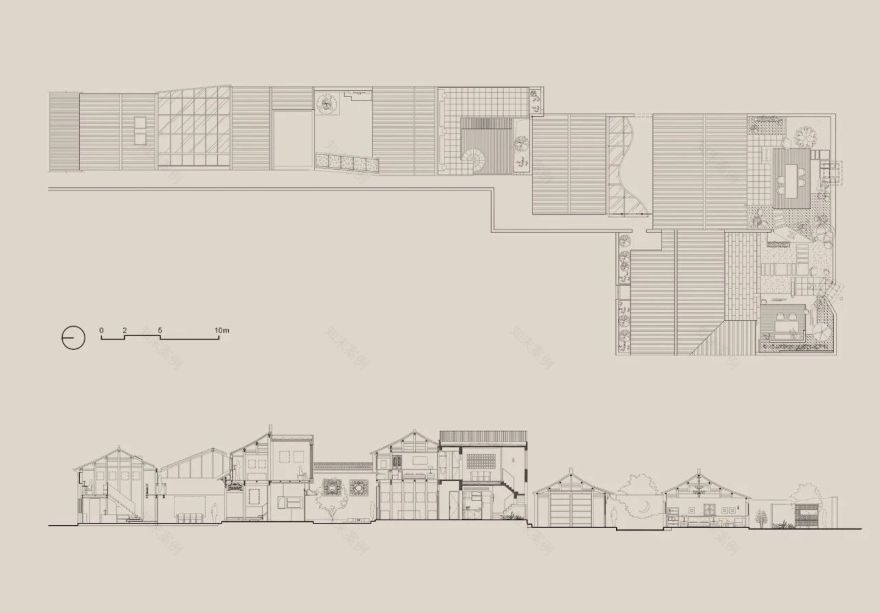
屋顶平面及剖面图
项目信息
项目名称 | 繁花书房(中金家弄改造)
地理位置 | 苏州市吴江区黎里古镇建新街38
建筑、室内、景观设计 | 上海思域设计
主持建筑师 | 宋毅
设计成员 庄子冲、金群佳、煜、磊、沈维安、陈诺、王南钢、王洁、张龙
建设单位 | 黎里古镇保护开发管理委员会
统筹管理 | 陈园、琦、张育英、凌芬
古建修缮设计 苏州太湖古典园林建筑有限公司
结构设计 | d杰地设计上海
家具展陈布置 金宇澄和他的朋友们
技术支持 | 上海汉室设计股份
建筑施工 | 江苏江都古典园林建设有限公司
装饰施工 | 苏州苏明装饰股份有限公司
地方文献支持 | 李海珉、尔冬强
结构类型 | 砖木混合、钢结构、混凝土结构
建筑材料 | 玻璃、清水混凝土、水洗石、水磨石、玻璃砖、莱姆石、树脂格栅
建筑面积 | 640平方米
占地面积 | 721平方米
竣工时间 2024
项目摄影 | mage hong、Yuan Zonglei
设计师

宋毅 SDTD(上海思域设计)创始人、宋毅建筑工作室主持建筑师、国家一级注册建筑师、高级室内设计师。
宋毅先生拥有良好的建筑专业背景,从事建筑与室内设计近30年,先后获得国内外三十余项设计奖项及“国家设计人物”、“中国杰出室内建筑师”等多项荣誉,并担任多所高校专业课程评图客座教师以及全国大学生设计竞赛、首届中国设计星等评审导师。作为设计理想主义者,坚信设计是改变社会的重要力量,倡导设计师的专业精神与社会责任感并重, “思”是乐事,惟“悟”得新。同时也是首位在Governmental institutional Public Interior(政府公共机构室内设计) 领域获得荷兰Frame Awards及美国《Interior Design》BEST OF YEAR AWARDS最高设计奖项的国内设计师。

SDTD(思域设计)由宋毅先生2006年创立于在上海,既拥有大型文化、教育、医疗、交通等项目的综合统筹设计能力,同时对中小型艺术、商业、办公、机构、住宅等空间也具有高品质的设计实践。先后完成了上海国际航运中心、阿里巴巴支付宝公司、上海国际集团(SIG)、上海浦东市民中心、展志集团、赛领资本、盛大网络总部、法兰桥创意园区、木里木外生产基地、昆山市公共卫生中心、市行政服务中心、市税务总局、市福利院、繁花书房、边廊美术馆、地铁商业、汇如意花园餐厅、加州硅谷私人住宅等设计作品,累计完成设计面积超过0万平方米。
南京喵熊网络科技有限公司 苏ICP备18050492号-4知末 © 2018—2020 . All photos and trademark graphics are copyrighted by their owners.增值电信业务经营许可证(ICP)苏B2-20201444 苏公网安备 32011302321234号
苏公网安备 32011302321234号客服
消息
收藏
下载
最近