

创作上传
VIP
收藏下载
登录 | 注册有礼
查看完整案例

收藏

下载

分享
PLAT ASIA设计的火山里·到达者酒店和火山里游客中心于2025年冬落成,项目位于锡林浩特白银库伦草原火山旅游度假区。火山里·到达者酒店以单体群落的形式散落在这座喷发于第四纪的火山锥南坡上,面向东南的草原、湖泊和沙地景观。© 南迪@PLAT ASIA
PLAT ASIA designed the Volcano-In Hotel of Arrivals and the visitor center, which was completed in December 2025. The hotel is situated on the south slope of a volcano that erupted during the Quaternary Period, within the Baiyinkulun Steppe & Volcano Tourism Resort. It overlooks the steppe, lake, and sandy land to the south.
▼项目概览,overall of the project © 存在建筑-建筑摄影


▼项目鸟瞰,aerial view of the project© 存在建筑-建筑摄影


恢复生态的选址
Site: Ecological Restoration
设计团队及业主在2022年为酒店选址考察时,即在这座火山南侧发现了一片只生长蒿与苋菜的地块,相比周围上百座火山丰富的物种群落,这里的植被过于单一,究其原因,这座呈C型开口的火山遗迹经过约15万年的风蚀雪侵,其锥体逐渐剥落成九个被草原覆盖的柔缓山丘。酒店地块处于该火山的东南侧,是西北风的下风口,这里的洼地坡面背风积雪,吹来的沙土逐渐聚积停留,故此难以负荷植物生长。因此酒店特别选址在这处深约2m的沙土存积处,既避免影响其他区域,也意在通过酒店来改善并最终消除这片沙土,最终恢复地块的生命力。具体解决策略包括利用每间单体的弧形挡雪墙在冬季留存积雪、丰沛水土,为春季的植被生长创造养分环境,以改变这片曾受风蚀而扩大的沙土区域。
The design team and clients observed that the southern area of this volcano, supporting only sparse herb species, contrasted sharply with the lush vegetation surrounding the volcanoes. Collaborating with geologists and local herders, the team investigated the cause. The site has undergone erosion for approximately 150,000 years. The volcanic cone slumped into nine hills, now covered in soft grassland, and blended into the steppe. Located southeast of the cone, the hotel site is leeward to the northwest wind, resulting in snow and sand accumulation. Harsh soil conditions make plant growth difficult. Therefore, the hotel was deliberately sited over two-meter-deep sand pits to prevent their expansion, replace them with a new ecosystem, and restore vitality. Strategies include a snow barrier wall to retain water, protect the soil, and create a better environment for planting.
▼远景,viewing the project at distance© 存在建筑-建筑摄影


火山景观的群落
Cluster: Volcanic Landscape
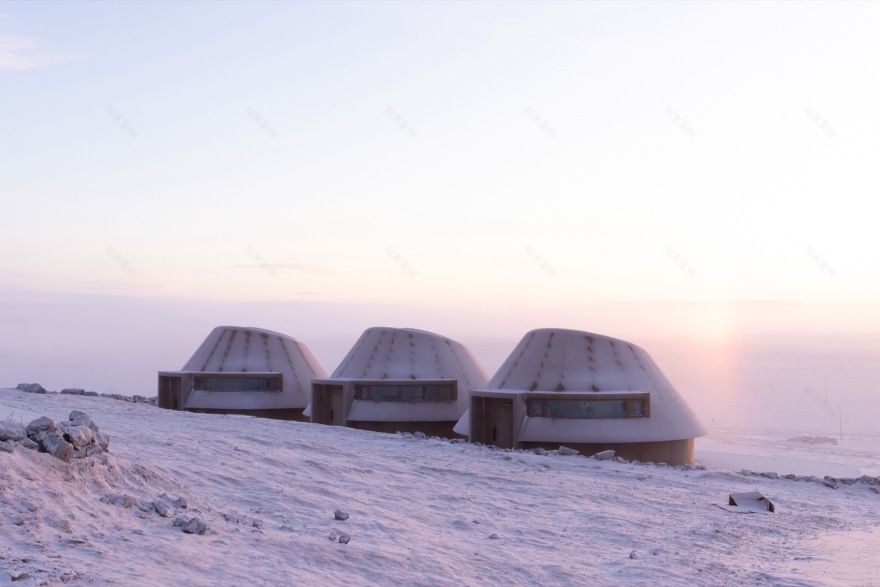
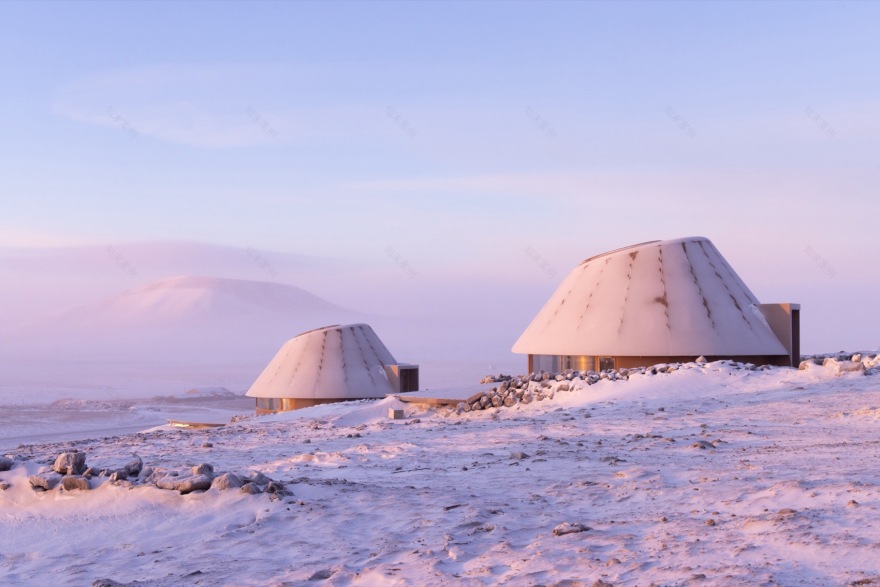
酒店单体的灵感源自火山的喷发形式。地壳深处的岩浆顺着树状的通道孔隙喷薄溢流而出,冷却凝聚成一个个火山锥体,建筑师边保阳喻为“火山之子”的酒店单体群落则成为建筑表达火山的媒介,建立人与火山的场所链接。酒店区域的交通流线由火山石汀步小径以树状枝脉的纹理组成。每个酒店单体由火山型客房、室外露台,及火山石垒砌的弧形挡雪墙庭院组合而成。经过空间排布与视觉点位的精确调整,每间酒店单体都拥有独属开阔的自然景观面。锥型的酒店单体建筑由火山褐色的铝单板屋面覆盖,立面由玻璃景窗组成,抬升的基础平台下垒砌天然火山石,让每个酒店单体景观融入火山的熔岩肌理。
The design of the Hotel of Arrivals is inspired by volcanic eruption patterns. Lava flowing from branch tunnels rapidly forms volcanic cones. Architect Bian Baoyang envisions the hotel as the “Son of Volcano,” comprising a cluster of volcanic forms. As an approach to the volcano, the hotel cluster build a place that connects people to the landscape. Circulation within the hotel zone features a branch-like path paved with volcanic rock. Each hotel unit includes a guest suite, terrace, and snow barrier wall. The layout is carefully arranged so that every unit features a full-view window. Topped with a cone-shaped aluminum veneer roof and encircled by a glass curtain wall, each unit has a russet surface resembling volcanic rock and appears to levitate above the ground. The volcanic rock landscaping integrates the hotel into the volcanic context.
▼“火山之子”的酒店单体群落,the hotel cluster of “Son of Volcano” © 存在建筑-建筑摄影


人文地理的体验
Experience: Cultural Context
建筑色系的研究基于熔岩喷出冷却过程中矿物的结晶顺序(鲍文反映序列),不同结晶顺序构成了火山岩丰富多彩的样貌,设计提取其中暖色调的火山褐作为建筑外表皮,以明亮的赤璋塑造室内浑然一体的“火山内部”体验。酒店单体包括三个景窗:椭圆天窗,横卷长窗,立轴景窗。建筑师通过景窗将横亘的草原、湖泊、沙地、天空四重景观绘入人的视野。
Color tone research is based on Bowen’s Reaction Series, which describes the order of crystallization in cooling lava. The rock displays varied textures and colors that inform the architectural surfaces in russet color and a bright hue calledChiZhang, offering an immersive volcanic crater experience in interiors. Each unit features three window types: an oval skylight, a horizontal scroll window, and a hanging scroll window—their dimensions inspired by traditional Chinese painting. The natural landscape of steppe, lake, sandy land, and sky unfolds in orderly layers within the window frames, offering contemplative views.
▼雪景中的草原与建筑,steppe and building in snowy scene© 存在建筑-建筑摄影
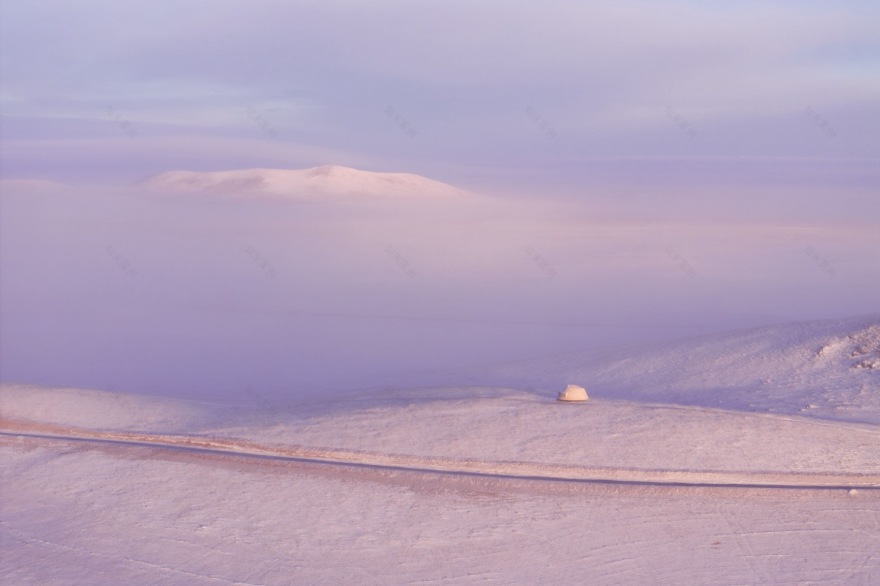


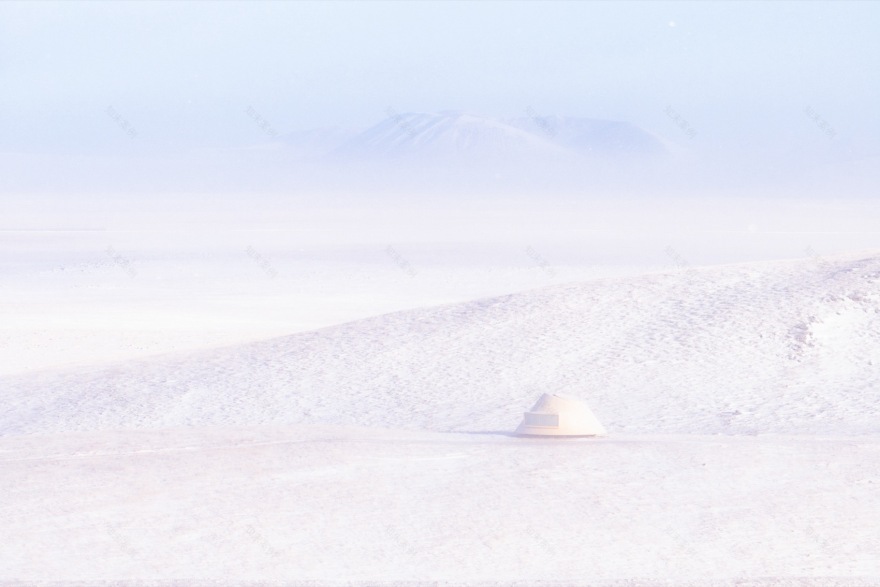
酒店所在的火山里与东南的元代鲁王城相距8公里,建筑师边保阳在项目设计期间曾多次到访这座属于祥哥剌吉鲁国大长公主驻地的故城遗址,这里记录着这位元代女性收藏家对汉文化的崇尚,她曾广邀文人雅士共襄雅集,其藏品之一包括著名的黄庭坚《松风阁诗》卷:依山筑阁见平川,夜阑箕斗插屋椽。这一诗意场景表达了星幕下卧眠到达者号时建筑师最直观的感触:澄澈浩瀚的星空在椭圆天窗不舍昼夜地上演着斗转星移的宇宙现场,箕宿在夏季午夜清晰可见,北斗七星则全年可见,而春季最为明显。
▼酒店视线分析图,hotel line of sight analysis chart © PLAT ASIA

The Yingchang City Relics is located about 8 kilometers southeast of the hotel. During the design phase, Architect Bian Baoyang frequently visited this site, once part of the feudal estate of Princess Supreme of Lu, Sengge Ragi, a renowned female collector of the Yuan Dynasty. The princess greatly admired traditional Han nationality culture, often inviting artists and poets to cultural gatherings and curated exhibitions. Among her classic collections is the famous handscroll Poem on the Hall of Wind and Pines by Huang Tingjian. The opening lines, translated by Alfreda Murck, read: Next to a mountain was raised a hall that surveys a level stream, / Late at night, Sieve and Dipper stick between the rafters. This poetic imagery resonates with the experience of lying in the room and gazing at the starry sky through the skylight, where the clear, deep night reveals the Sieve (Winnowing Basket) and Dipper (Big Dipper) asterisms—especially vivid on summer nights and throughout all seasons.
▼近景,closer view © 存在建筑-建筑摄影
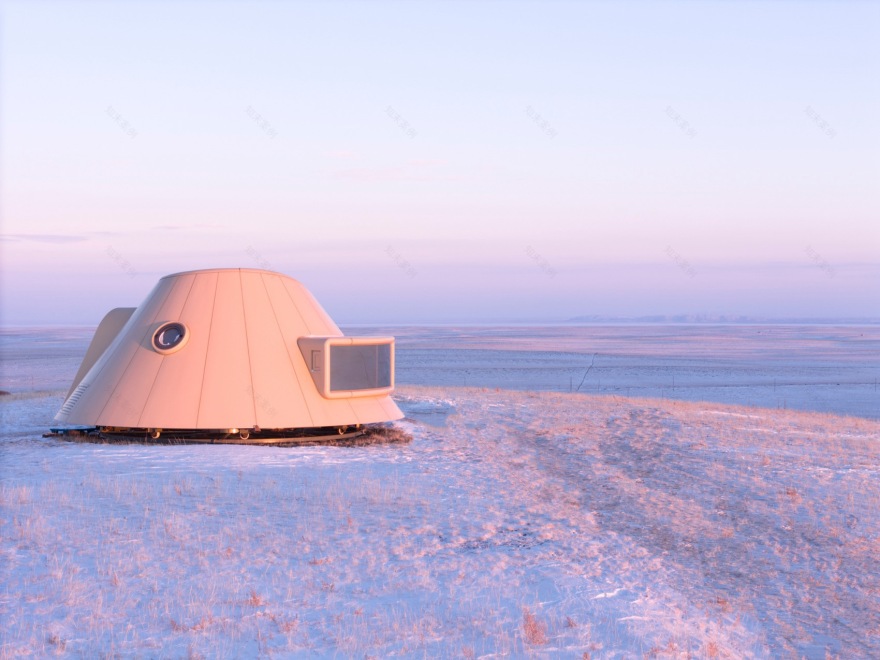

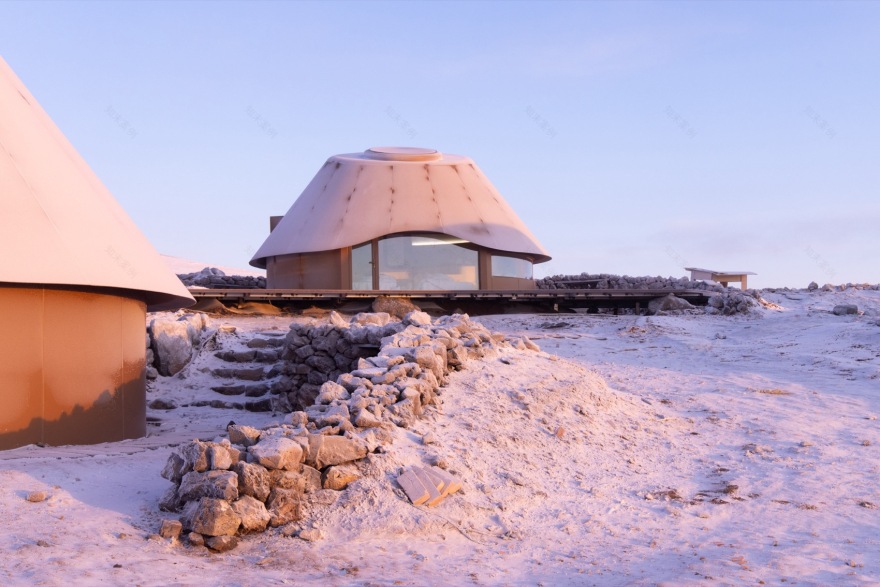
横卷长窗的图景源自卷轴在画案的横展,设计分析了手卷《千里江山图》(高51.5cm),《游春图》(高43cm)的画幅,据此选择45cm作为横卷长窗的高度及3m的长度收入风景,酒店的弧形挡雪墙也随着深入“画卷”长窗。立轴景窗的尺寸则取自郭熙《早春图》(高158cm)等经典立轴的尺寸,选择150cm的高度,构成室内观赏自然山水的图景。锥型建筑屋面轮廓和窗景为人定义了在室内坐卧,贴近大地的适然场景,和敬畏、怀想,被治愈的自然画境。
▼景窗分析,view window analysis © PLAT ASIA

The horizontal scroll window derives from the Chinese handscroll paintings. Based on an analysis of works such as Wang Ximeng’sA Thousand Li of Rivers and Mountains(height 51.5 cm) and Zhan Ziqian’sStroll About in Spring(height 43 cm), the window is set at a height of 45 centimeters and a length of 3 meters to frame the vista. The curved snow barrier wall even has been a part of the sight at the edge of the pictorial space. The hanging scroll window adopts a typical height of 150 centimeters, seen in works such as Guo Xi’sEarly Spring. These windows frame the wild natural landscape, while the curved lines and viewing apertures encourage a reclining or seated posture, fostering a sense of reverence, imagination, and healing that connects people to the land.
▼酒店单体群落近景,the hotel clustercloser view© 存在建筑-建筑摄影


一道文明的曙光
Dawn: Light of Civilization
建筑师边保阳在对白银库伦草原火山文脉的深入研究过程中,提出“中华文明的一道曙光”是这里未曾揭示的独特人文地标。拨开地质演变与文明史考的迷雾,草原火山东侧的红山文化(距今6500年-5000年)作为中国迄今发现的最早的史前文化之一,是中华文明半月形文化传播带(童恩正于1986年《文物与考古论集》中提出)的起点,孕育红山文化的西辽河则由发源于浑善达克沙地的西拉木伦河与发源于七老图山的老哈河共同汇流,白银库伦草原火山作为这一文明源头见证的高地,在每个日出时刻都眺望着这其中一道中华文明的曙光,照亮这片生命丰茂的自然原野。
Architect Bian Baoyang conducted extensive research on the Baiyinkulun Steppe and its volcanic context. He regarded it as “a ray of light among Chinese civilization.” Geological, evolutionary, and archaeological studies show that the Hongshan Culture (6500–5000 years ago) is one of China’s earliest prehistoric cultures. As a cradle of Chinese civilization, the crescent moon-shaped culture belt (proposed in 1986 by Tong Enzheng inThe Collection of Artefact and Archaeology) originates from the West Liao River, formed by the Xar Moron River—which rises in the Otindag Sandy Land—and the Luu Moron River, originating from the Qilaotu Mount in the Yanshan range. The Baiyinkulun Steppe and Volcano have witnessed this cultural development and greet the light of civilization each dawn, as the sunrise illuminates this vast and flourishing land.
▼日出时刻,sunrise © 存在建筑-建筑摄影

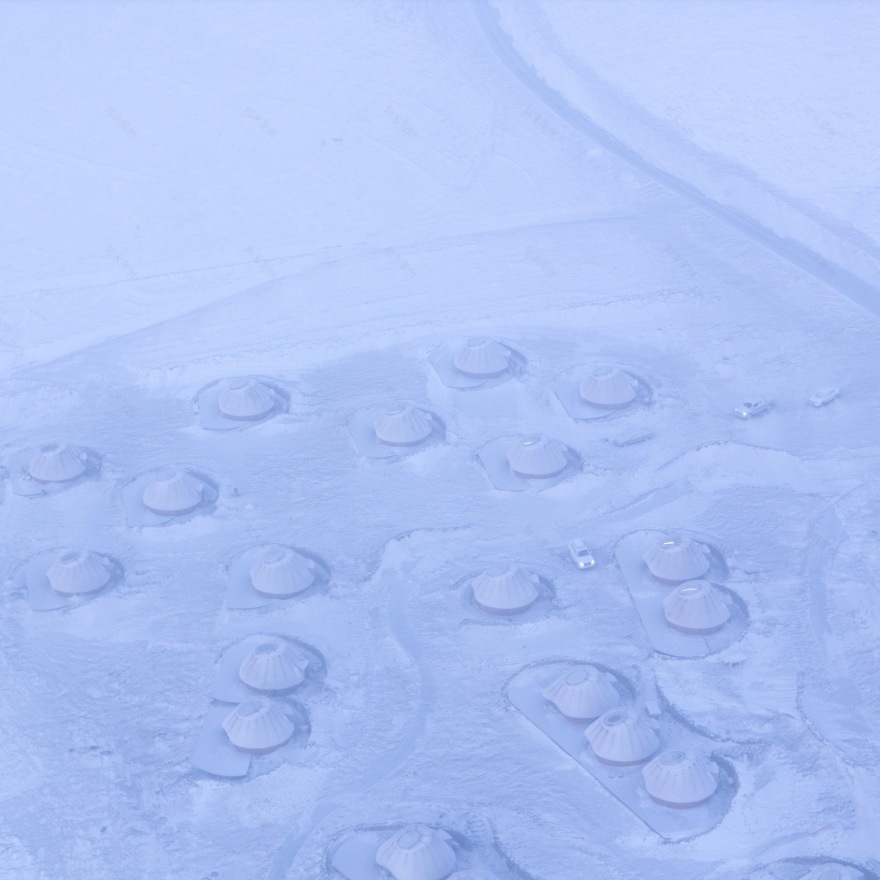
▼鸟瞰,aerial views© 存在建筑-建筑摄影


到达者号的孤寂
Arrivals: Solitary Vigil
酒店单体的设计经历了从帐篷原型到到达者号的两次演变,到达者号同样经历两次迭代,其一代是旋转建筑,2024年5月,首个到达者号(一代)运送至现场拼接吊装完成,坐落在到达者酒店(二代)群落北边的山丘,东侧是天火台,西北是游客中心。建筑采用点状基础支撑旋转电机,旋转装置让单体漂浮在火山之上,提供了建筑追随日光、可环视360度的草原火山景观。二代到达者号的迭代保留了一代的火山型,同时扩大室内空间,增加室外露台和独立庭院,以满足度假环境中人对空间尺度和功能的需求。从酒店群落区回望矗立在山顶的第一个到达者号,它的拓荒与先行虽然孤独,但也率先享受胜景的礼赠。
The hotel unit evolved from a tent prototype into a volcano-shaped “Arrival,” with two generations of design. The first generation (Gen One) is a rotating structure. In May 2024, the first Arrival was transported to the site, assembled, and suspended on the north hilltop overlooking the Gen Two cluster. To its east stands the Flame Art Installation of Volcano, and to the northwest, the visitor center. Its pivotal base supports a rotating mechanism, allowing the building to float above the earth and follow the sun for 360-degree views. The Gen Two Arrival retains the volcanic form while expanding the space to include a terrace and courtyard, meeting hospitality needs for function and scale. Looking up at the Gen One Arrival on the hilltop from the Hotel of Arrivals, one senses the solitude of pioneering work—yet it meets the grand vista from the very beginning.
▼烟花与建筑,fireworks and building© 存在建筑-建筑摄影

火山里·到达者酒店从恢复生态的选址目的出发,以分体群落的形式回应所处的火山场地、设计最低程度影响环境的原则,将大地景观、自然气象与时序物候的野奢感知带给现场体验的每一刻、每一幕,予人创造沉浸火山梦境之旅。
The Volcano-In Hotel of Arrivals aims to restore ecology and environment; its clustered layout responds to the volcanic site with low-impact principles. By engaging with geology, climate, and meteorology, it invites people to experience the wilderness honestly and sensitively in every moment and scene, creating an immersive journey into the volcanic dream.
▼总平面,master plan© PLAT ASIA

▼到达者1.0图纸,Arrival 1.0 drawing© PLAT ASIA

▼到达者2.0图纸,Hotel of Arrival 2.0 drawing© PLAT ASIA

项目信息
项目名称:火山里·到达者酒店
项目地点:内蒙古锡林浩特市白银库伦草原火山旅游度假区
占地面积:5540sqm
建筑面积:1634sqm
客房数量:45
委托单位:内蒙古大蒙神州旅游开发有限公司
设计单位:PLAT ASIA
设计范围:建筑,室内,景观,照明,软装,标识
主持建筑师:边保阳
项目建筑师:马璇,郭露露
驻场建筑师:苏勒德
建筑及室内设计团队:刘鑫威,杨璐,董子绢,张朝伟,冉浩宇,张凯杰
景观设计团队:张小战,王晓春
建筑施工图:北京中天建中工程设计有限责任公司
室内施工图:PLAT ASIA
景观施工图:PLAT ASIA
钢结构设计:北京今盛杰膜结构科技有限公司
玻璃幕墙及屋面工程顾问:同创华健集团有限公司
照明顾问:北京五色国际照明科技有限公司
施工单位:内蒙古天龙建设有限公司
项目摄影:存在建筑-建筑摄影
项目撰文:赵冰心@PLAT ASIA
建筑材料:铝单板,四玻两腔Low-E玻璃,火山石,微水泥
设计时间:2024.3-2024.12
建设时间:2024.6-2025.12
建成时间:2025.12
Project Information
Project name: Volcano-In Hotel of Arrivals
Project location: Xilinhot, Inner Mongolia, China
Site area: 5540 sqm
Building area: 1634 sqm
Guestroom Suites: 45
Clients: Inner Mongolia Da Meng Shen Zhou Tourism Development Co., Ltd.
Architects: PLAT ASIA
Design scopes: Architecture, Interior, Landscape, Lighting, Decoration, Signage
Principal architect: Bian Baoyang
Project architect: Ma Xuan, Guo Lulu
Site architect: Su Lede
Architecture & Interior design team: Liu Xinwei, Yang Lu, Dong Zijuan, Zhang Chaowei, Ran Haoyu, Zhang Kaijie
Landscape design team: Zhang Xiaozhan, Wang Xiaochun
Architecture construction design: Beijing Zhongtian Jianzhong Engineering Design Co., Ltd.
Interior construction design: PLAT ASIA
Landscape construction design: PLAT ASIA
Steel structure design and construction: Beijing Jinshengjie Membrane Structure Technology Ltd., Co.
Glass curtain wall and roof construction: TONGCHUANGHUAJIAN Group
Lighting consultant: Beijing Wuse International Lighting
Construction contractor: Inner Mongolia TianLong Construction Co., Ltd.
Photo: Arch-Exist Photography
Video: Nandin@PLAT ASIA
Text: Zhao Bingxin@PLAT ASIA
Building materials: Aluminum veneer, Four Glass Panes Two Cavities Low-E glass, volcanic rock, micro-cement
Design period: Mar 2024-Dec 2024
Construction period: Jun 2024-Dec 2025
Completed: Dec 2025




南京喵熊网络科技有限公司 苏ICP备18050492号-4知末 © 2018—2020 . All photos and trademark graphics are copyrighted by their owners.增值电信业务经营许可证(ICP)苏B2-20201444 苏公网安备 32011302321234号
苏公网安备 32011302321234号客服
消息
收藏
下载
最近