

创作上传
VIP
收藏下载
登录 | 注册有礼
查看完整案例

收藏

下载

分享
本项目旨在对位于巴塞罗那波布雷诺(Poblenou)区 Palo Alto 工业园区内的一座19世纪工厂建筑进行修复与再利用。该场地曾是重要的工业遗址,本次介入在修复这座具有显著遗产价值、受保护的旧仓库的同时,引入全新的功能——科技型商业孵化器。建筑最具辨识度的特征之一是其郁郁葱葱的绿色立面,这一立面同样受到遗产保护。该方案在一次公共建筑竞赛中脱颖而出,并获得评审团一致认可。
The aim of the project is the refurbishment of a 19th-century factory building located within the Palo Alto industrial complex, a former industrial site in the Poblenou district of Barcelona. The intervention seeks to restore this protected former warehouse—of notable heritage value—while introducing a new programme: a technological business incubator. One of the building’s distinctive features is its lush green façade, which is also heritage-protected. The project was the winning proposal in a public architectural competition with a jury.
▼项目概览,overall of the project© Adrià Goula Sardà

城市策略
Urban strategy
设计旨在将新的功能设施更好地融入周边社区,打破 Palo Alto 作为“私人园区”的固有印象,使 E 栋建筑中的部分新空间能够承载补充性的公共活动。为此,首层设置了一系列多功能空间,以促进基地与城市之间形成新的协同关系。在不破坏园区整体概念的前提下,原有的应急出口被重新组织,转化为通向新建筑及内部庭院的直接入口;在特定时间与受控条件下,该庭院亦可转变为公共市民空间。
The proposal aims to integrate the new facility into the neighbourhood, overcoming the idea of Palo Alto as a “private” compound, so that part of the new spaces in building “E” can be used for complementary public activities. To this end, a series of multipurpose rooms are placed on the ground floor to foster new synergies between the site and the surrounding city. Without breaking the concept of the compound, the current emergency exit is reconfigured as a direct access to the new building and the inner courtyard, which can also, at specific moments and in a controlled way, become a civic space.
▼外立面,exterior facade© Adrià Goula Sardà


建筑与遗产策略
Architectural and heritage criteria
原有室内空间曾被大量隔墙与后期改造所割裂,设计通过拆除非必要构件,恢复空间最初的通透性。首先,以最小干预的方式对既有结构进行加固与提升,最大化利用其承载能力,从而延长结构生命周期。此外,针对此前拆除形成空缺的厂房局部,设计引入一套新结构以补齐缺失的楼板。该新结构采用钢—木混合体系,作为独立构件嵌入其中,不与历史墙体接触,形式上呼应工业建筑中常见的夹层结构,并在结构逻辑上延续原有体系的节奏,采用中央主梁与两跨布置。在新旧结构之间的空隙中,嵌入一处新的交通核心,设置开放式金属楼梯,满足疏散需求。
The interior—heavily partitioned and altered—is cleared of walls and added elements to recover the original openness of the space. First, the existing structure is enhanced, reinforced, and valued using minimally invasive strategies, maximising the load-bearing capacity of the existing systems to extend their life cycle. In addition, part of the nave where a void existed due to previous demolition is reoccupied with a new structure completing the missing floor slabs. This new structure, built with a mixed steel-and-timber system, is inserted as an independent element, without touching the historic walls, reminiscent of industrial mezzanines. It is designed in coherence with the historical structural layout, with a central beam and two bays. Between the new and old structures, the void is used to insert a new core with an open metal staircase that provides evacuation.
▼底层空间,ground floor space© Adrià Goula Sardà
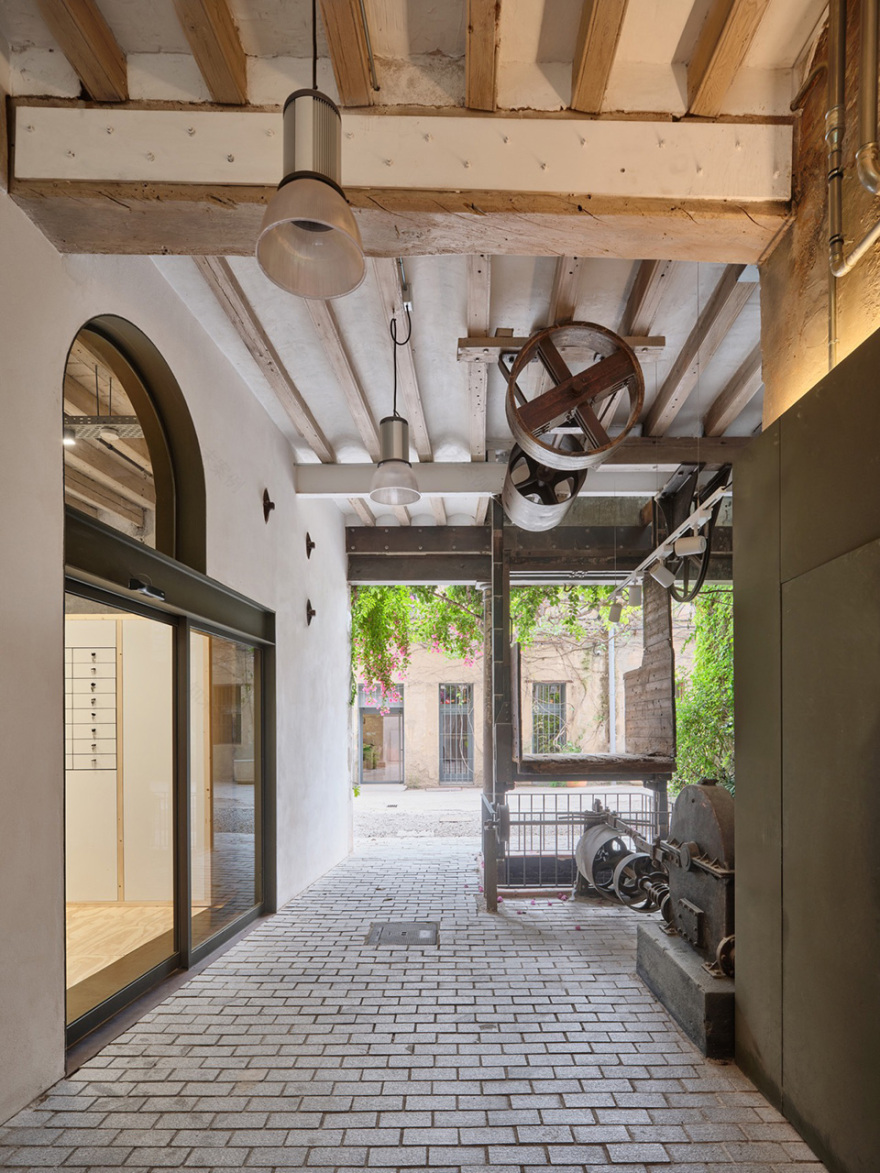


在结构整合完成后,一个新的构件被“叠加”其上——被称为“地毯”的系统,通过一次整体性的手势来回应功能需求,同时在不触及既有历史结构的前提下,强化厂房空间的整体感(如天花连续性、窗洞节奏等)。这一“地毯”通过折叠形成可封闭与开放两种区域,生成不同类型的工作空间,同时作为平台修正原有楼板的不平整,并承担设备整合与隐藏的技术功能,成为一套“技术性地毯”。
Once the structure has been consolidated, a new element is superimposed over it (a “carpet”) to solve the programme with a single gesture and facilitate spatial understanding of the nave (continuity of ceilings, window rhythm…) without touching the pre-existing fabric. This element folds to create a defined “closeable” area and an open one, generating two types of workspaces. It also regularises the current slab deformations as a platform and acts as a technical element, supporting or concealing the installations—a technical carpet.
▼新旧的融合,integration of the old and the new© Adrià Goula Sardà

▼保留下来的工业痕迹,the remaining industrial traces© Adrià Goula Sardà

▼楼梯,staircase© Adrià Goula Sardà

功能策略
Functional criteria
首层可独立于整栋建筑使用,其空间与入口大厅及内庭院直接相连,被视为可向室外延展活动的开放场所。工作空间的布置遵循清晰的逻辑:沿街一侧为封闭空间(模块化办公单元、会议室),庭院一侧为开放办公区。“地毯”定义的区域被设计为灵活的模块化系统,由一组平行排列、每单元5平方米的结构网格组成,任何空间都可按这一最小单元进行扩展或缩减(1人=5平方米)。这种模块体系有效化解了传统“盒子式”或固定模块布局的僵化问题。高度通透的立面设计使不同工作空间之间形成直接的视觉联系,增强社区成员之间的熟悉感,促进企业间的协作与联动。
▼分析图,analysis diagram© Taller 9S Arquitectes

The ground floor can be used independently from the rest of the building. The ground-floor rooms directly relate to the lobby and inner courtyard, conceived as open spaces that allow activities to extend outdoors. The workspaces are arranged systematically: enclosed areas along the street-facing bay (modules, meeting rooms) and open areas facing the courtyard. The defined “carpet” area is designed as a flexible modular system, composed of a structural grid of parallel 5 m² bays, allowing any space to be expanded or reduced according to this minimum unit (1 person = 5 m²). The modular system resolves the rigidity of module- or “box”-based layouts. The system, with a highly glazed frontage, enables direct visual connection between different workspaces, encouraging familiarity among community members and fostering synergies between companies.
▼封闭空间(模块化办公单元、会议室),enclosed areas along the street-facing bay (modules, meeting rooms)© Adrià Goula Sardà


▼新结构采用钢—木混合体系,the new structure adopts a steel-wood hybrid system© Adrià Goula Sardà

▼二层空间,upper floor space© Adrià Goula Sardà


▼木制结构,wooden structure© Adrià Goula Sardà

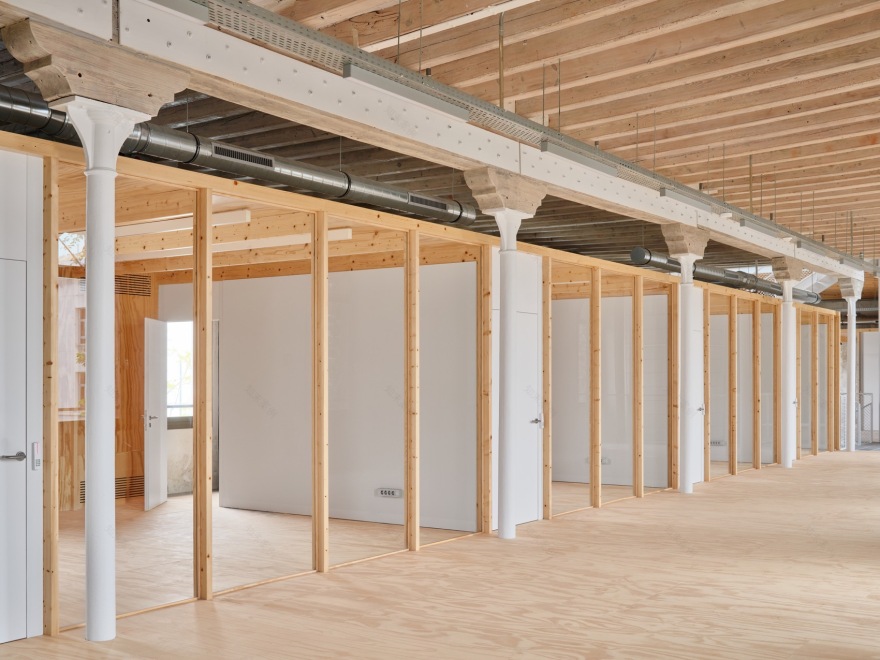
▼室内视角,interior view© Adrià Goula Sardà

建造策略
Constructive criteria
室内表面通过加固与清理,去除后期涂层,重新显露原始灰泥饰面,呈现建筑的历史痕迹。楼板与梁体得到结构加固,梁间的平瓦天花被稳定处理。历史楼梯与货梯被完整保留并修复,部分陶砖地面亦得到修补。原本包覆混凝土加固层的铸铁柱被重新解放出来,这得益于对上层钢柱体系的转换——这些钢柱是在20世纪90年代末一次改造中加建的,如今被整合为一套新的芬克式桁架结构。
▼分析图,analysis diagram© Taller 9S Arquitectes

The interior surfaces are consolidated, removing added paint layers and revealing the original stuccoes that reflect the building’s history. Floor slabs and beams are reinforced, and the flat-tile ceilings between beams are stabilised. The historic staircase and goods lift are preserved and restored, and some sections of ceramic flooring are repaired. The cast-iron columns, clad with a concrete reinforcement, are freed thanks to the conversion of the steel columns on the upper floor —added during a renovation in the late ’90s—into a new Fink-type truss.
▼钢制楼梯,steel staircase© Adrià Goula Sardà


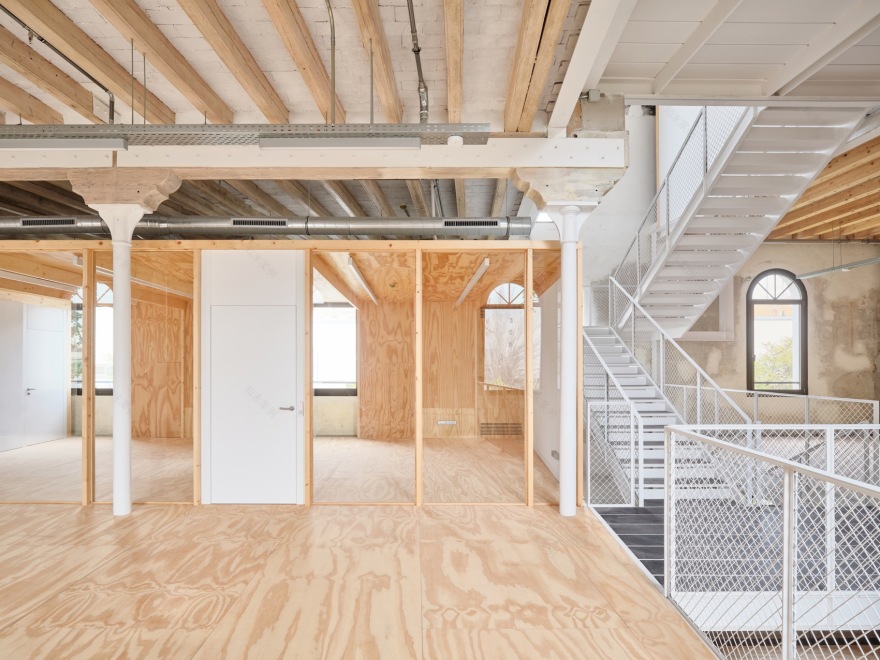
▼楼梯细部,details of the staircase© Adrià Goula Sardà


▼钢结构与木结构的结合,combination of steel structure and wood structure© Adrià Goula Sardà

新介入的建筑系统采用干式装配方式,由模块化木构件组成,在空间感受上与原有厚重的工业结构形成对比。该系统被设计为可在使用周期中不断调整,确保空间的长期灵活性——一种可逆、可拆卸的模块化体系。
The new architecture is designed as a dry-assembled system, built with modular timber elements that contrast with the massiveness of the pre-existing space. It is conceived so that it can be altered over its lifespan, ensuring flexibility of use—a flexible, reversible, and demountable modular system.
▼可逆、可拆卸的模块化体系,flexible, reversible, and demountable modular system© Adrià Goula Sardà

能源策略
Energy strategy
在不损害遗产价值的前提下,对历史围护结构进行有针对性的优化,以实现高能效表现。窗户更换为带隔热断桥的钢制窗系统,降低空气渗透;屋面升级为新的通风构造;新建地面结构等。同时,通过电动窗系统实现自然的交叉通风。
Strategic interventions are made on the historic envelope to achieve a highly efficient building without compromising its heritage values. Windows are replaced with steel elements featuring thermal breaks and low infiltration; the roof is upgraded with a new ventilated system; a new ground slab is built, and so on. Natural cross-ventilation mechanisms are created through motorised windows.
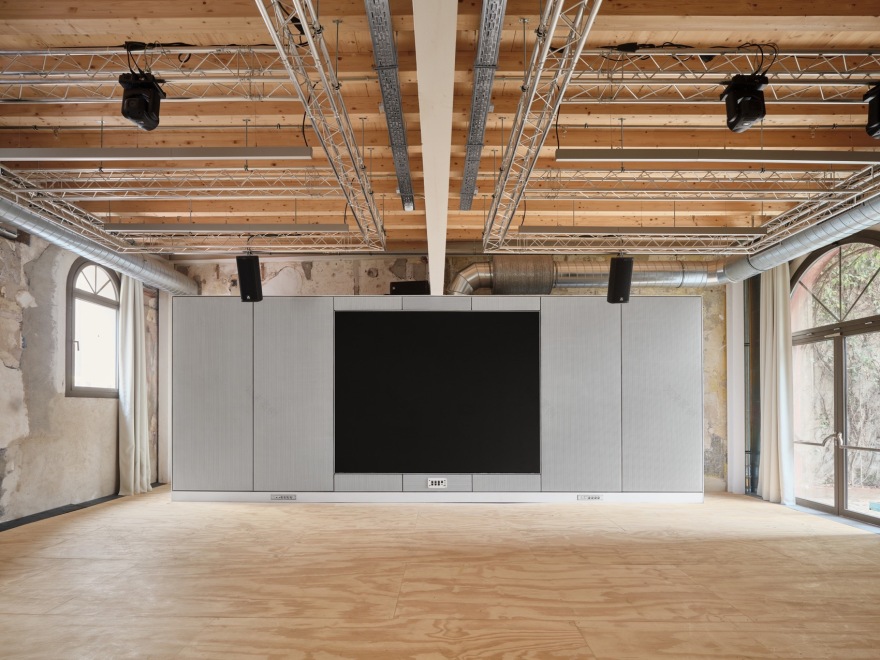
▼大跨度的空间,large-span space© Adrià Goula Sardà

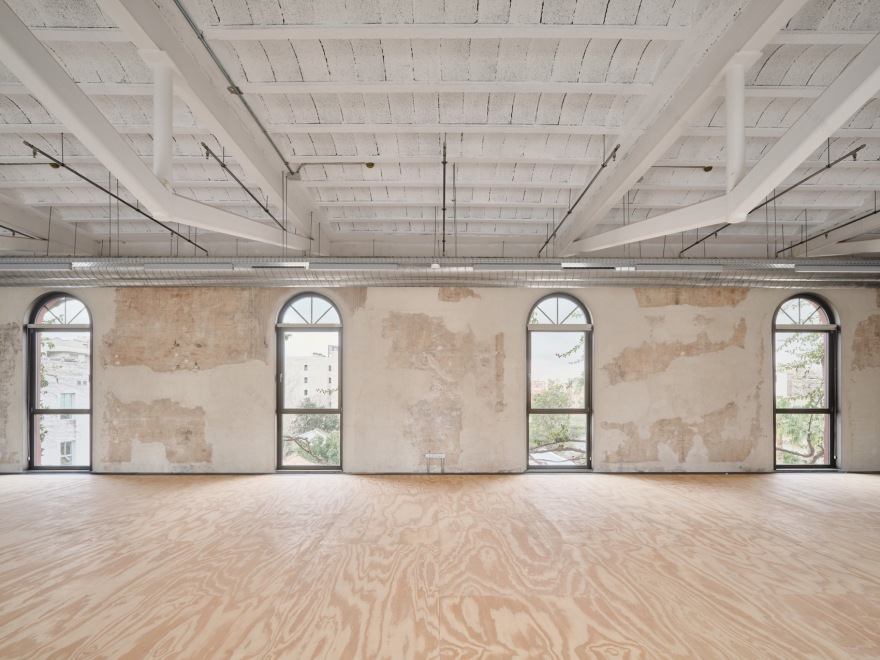
▼卫生间,toilets© Adrià Goula Sardà

在沿街立面,增加基于生态型水硬石灰的外保温系统;而在庭院立面,由于遗产保护限制无法进行内外改造,设计对绿色立面的生物气候性能进行了专项研究,证明其同样能够显著提升建筑的能源表现。通过引入高效的暖通空调系统,以及屋顶装机容量为40.5 kWp的光伏阵列,建筑最终达到 A 级能效标准。与改造前相比,一次能源消耗降低了96.7%,并在西班牙全国范围内提交的500个项目中,于国家 PIREP 计划中排名第21位。
On the street façade, external insulation with an ecological hydraulic-lime-based system is added, while on the courtyard façade—where neither internal nor external intervention was possible for heritage reasons—the bioclimatic performance of the vegetal façade is studied, demonstrating that it allows the building to achieve excellent energy performance. With the installation of new efficient HVAC systems and a rooftop photovoltaic array with a capacity of 40.5 kWp, the building achieves an A energy rating, reducing primary energy consumption by 96.7% compared to its original state and ranking 21st in the national PIREP Plan among 500 projects submitted across Spain.
▼沿街立面,the street façade© Adrià Goula Sardà


▼总平面图,site plan© Taller 9S Arquitectes

▼一层平面图,ground floor plan© Taller 9S Arquitectes

▼二层平面图,first floor plan© Taller 9S Arquitectes
▼剖面图,section© Taller 9S Arquitectes

PROJECT DATA
Situation
Ferrers 11-15, Recinte de Palo Alto
Districte de Sant Martí, Barcelona
Architects
Oriol Cusidó i Garí, architect
Irene Marzo Llovet, architect
(TALLER 9s ARQUITECTES)
Promoter
BIMSA / Barcelona Town Council
Collaborators
Maria Auquer, architect
Eradio Larosa & Carla Alexandre, technical architects (Works)
Joan Olona, technical architect (project)
Manel Fernàndez, architect, structure design
Xavier Abella, facilities engineer
Construction company
CONSTRUCTORA D’ARO
Project
November 2021
Works
2022–2025
Total Budget
4.280.285 € (VAT included)
Built surface
2.092,90 sq.m
Photographer
Adrià Goula Sardà
()


南京喵熊网络科技有限公司 苏ICP备18050492号-4知末 © 2018—2020 . All photos and trademark graphics are copyrighted by their owners.增值电信业务经营许可证(ICP)苏B2-20201444 苏公网安备 32011302321234号
苏公网安备 32011302321234号客服
消息
收藏
下载
最近