

创作上传
VIP
收藏下载
登录 | 注册有礼
查看完整案例

收藏

下载

分享
重庆是一座由山与水共同塑造的城市。复杂的地形条件与密集的城市基础设施在此叠合,高架道路、山体与水岸共同构成了一种高度张力化的城市景观。项目位于麓悦江城这一山水交汇的场所之中,以一座小型咖啡厅的形式嵌入环境,尝试通过一种轻盈而克制的建筑介入,回应城市基础设施、自然地形与日常公共生活之间的关系。
© A8设计中心
Chongqing is a city shaped by the continuous interplay between mountains and water. Its complex topography overlaps with a dense infrastructural network, where elevated roads, steep terrain, and waterfronts together form a highly charged urban landscape. Located at the convergence of these conditions, the Luxi Lake Café is conceived as a small architectural insertion that responds to the relationships between urban infrastructure, natural geography, and everyday public life through a light and restrained spatial intervention.
▼项目概览,overall of the project © 三棱镜

▼项目鸟瞰,aerial view of the project © 三棱镜


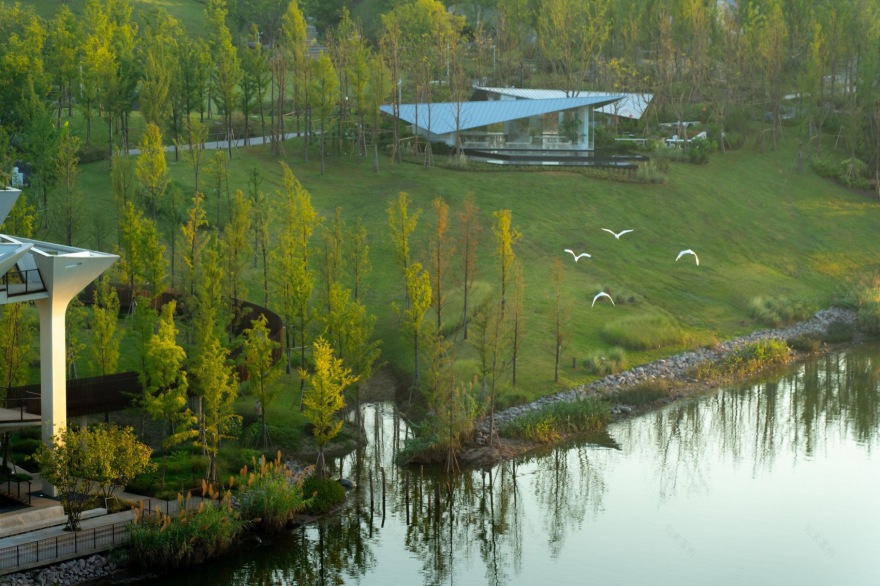
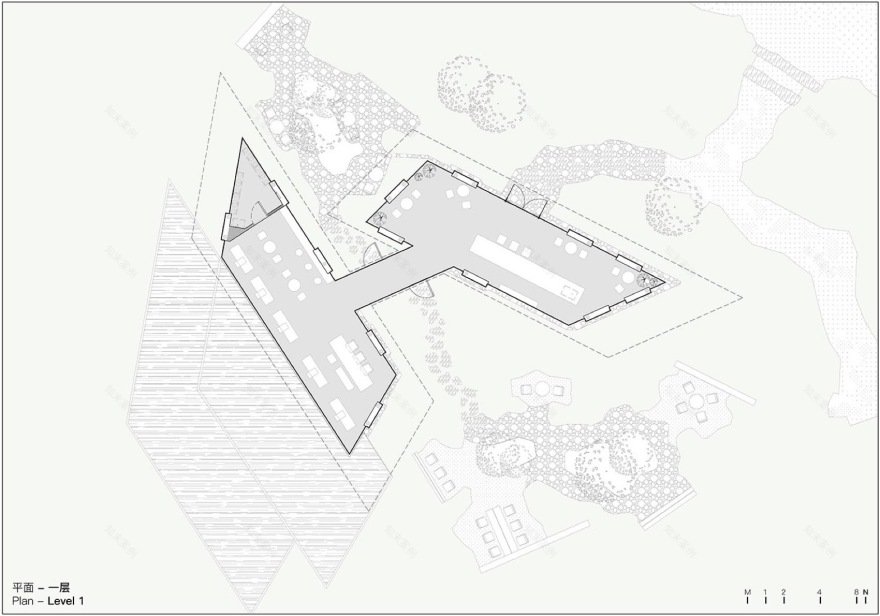
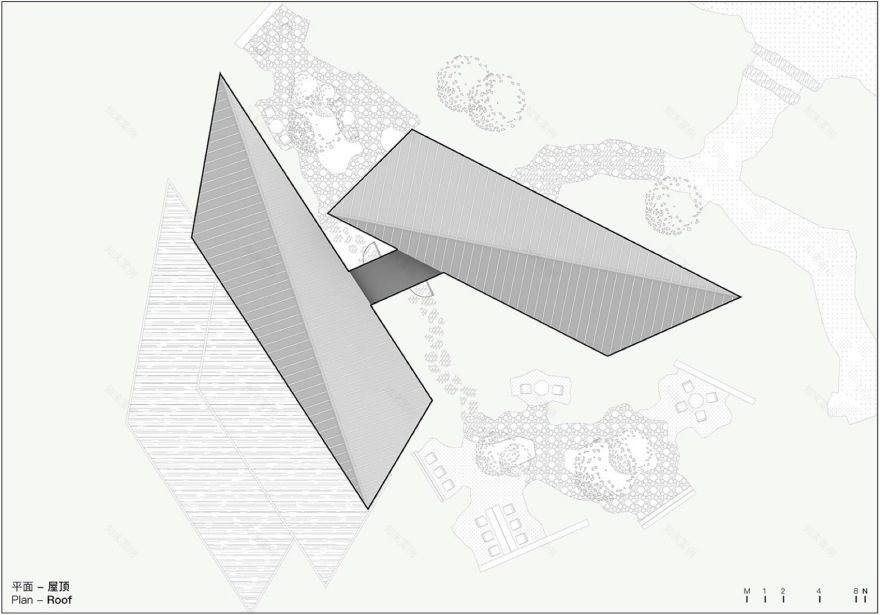
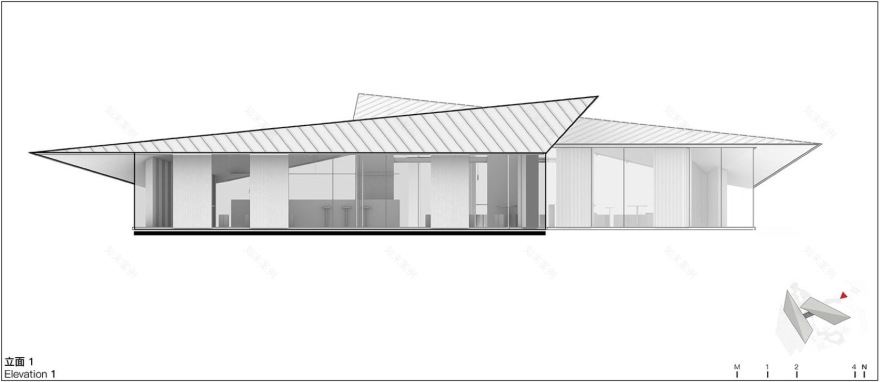
建筑整体由两片折叠的三角形屋顶构成。屋顶以约三十度的夹角展开,彼此呼应又保持相对独立,形成清晰而简洁的建筑轮廓。临公园一侧的屋顶贴近地面展开,姿态低矮而内敛,在尺度与方向上与周边水杉林形成对照;临湖一侧的屋顶则向外舒展,指向观鸟塔与远处江面,回应更为开阔的景观视野。两片屋顶之间形成一处半室外的灰空间,既作为室内外的过渡,也为停留、就坐与观景提供了多种可能。建筑通过最基本的几何构成,生成了富有层次的空间关系。
The building is defined by two folded triangular roof planes. Set at an angle of approximately thirty degrees, the roofs face one another while maintaining a degree of independence, forming a clear and concise overall silhouette. On the park-facing side, the roof extends close to the ground, adopting a low and inward posture that echoes the scale and direction of the surrounding metasequoia trees. On the lakeside, the roof opens outward toward the birdwatching tower and the distant river, responding to a more expansive landscape view. Between the two roof planes, a semi-outdoor transitional space emerges, functioning as a threshold between interior and exterior while offering multiple possibilities for sitting, pausing, and viewing the surroundings. Through the most fundamental geometric operations, the building generates layered and dynamic spatial relationships.
▼三角形屋顶,triangular roof planes © 存在建筑

▼入口,entrance© 三棱镜

室内空间延续了建筑整体的轻盈逻辑。通过围护墙体的组织方式,弱化了室内柱网对空间的干扰,使内部空间保持连续而纯净的状态。玻璃与实体墙体的组合在提供必要围合的同时,模糊了室内外的边界,周围的自然景观得以渗透其中,光线与视线在空间中自由流动,使日常的停留行为与自然环境建立直接联系。
The interior continues the building’s lightweight architectural logic. By organizing the enclosure through perimeter walls, the presence of interior columns is minimized, allowing the space to remain continuous and visually uncluttered. A combination of glass and solid walls provides necessary enclosure while softening the boundary between inside and outside. The surrounding landscape permeates the interior naturally, enabling light and views to flow freely and establishing a direct connection between everyday activities and the natural environment.
▼玻璃与实体墙体,glass and solid walls © 存在建筑


▼周围的自然景观渗透其中,the surrounding landscape permeates the interior naturally © 存在建筑


室内主要由两个功能空间构成。沿道路一侧布置接待与操作台,与道路方向平行;沿河一侧为座椅区,同样与水岸平行,设置了多种不同组合方式的座位形式。两个空间通过中部的一条玻璃廊道连接,在保持联系的同时形成适度的空间分离。玻璃廊道两侧可通向由两处体量围合形成的室外空间,使室内外空间得以延续与渗透。通过体量与环境之间的相互回应,建筑自然生成了丰富而连续的空间体验。
The interior is organized into two primary zones. Along the road-facing side is the reception and service counter, arranged parallel to the street. On the riverside, the seating area runs parallel to the water, accommodating a variety of seating configurations. These two zones are connected by a central glazed corridor that links them while maintaining a subtle spatial separation. From this corridor, access is provided to outdoor spaces formed between the two building volumes, allowing interior and exterior spaces to extend seamlessly into one another. Through the building’s volumetric response to its surroundings, a rich spatial sequence emerges naturally.
▼接待与操作台,the reception and service counter © 存在建筑

▼座椅区,the seating area © 存在建筑


▼玻璃廊道,glazed corridor © 存在建筑


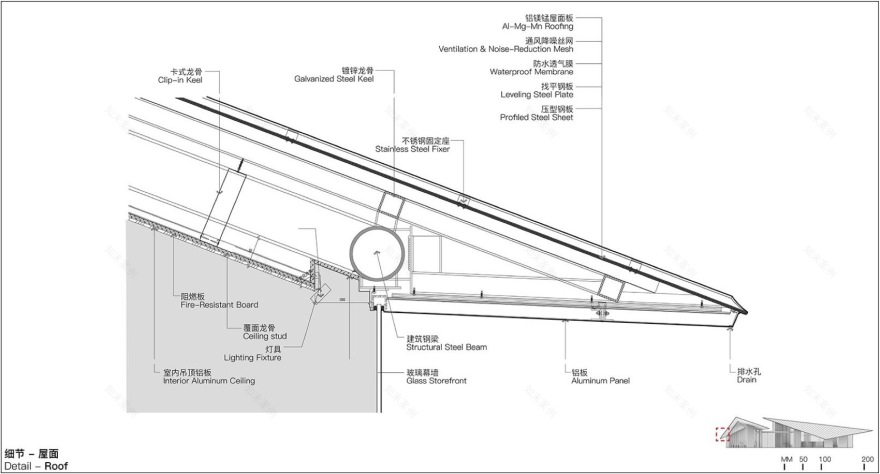
在材料选择上,项目进一步强化了轻盈而克制的建筑表达。整体采用钢结构体系,屋面为直立锁边铝镁锰板系统,围护系统为超白玻璃幕墙。室内地面采用白色水磨石,墙面为白色竖向长城板,天花则以银色铝板处理,以呼应折叠屋顶的几何形态,并在室内空间中延续结构的张力。南侧立面设置的水幕在开启时可对室内起到降温作用,同时在玻璃表面形成一层动态界面,使空间在通透与朦胧之间切换。
Material choices further reinforce the project’s restrained and lightweight expression. The structure is composed of steel, with a standing-seam aluminum-magnesium-manganese roof system and an ultra-clear glass curtain wall enclosure. The interior floor is finished in white terrazzo, while walls are clad in vertical white panels. The ceiling is treated with silver aluminum panels that echo the geometry of the folded roof, extending its structural tension into the interior. A water curtain integrated into the southern façade provides passive cooling when in operation and introduces a dynamic surface layer across the glass, allowing the space to shift between transparency and translucency.
▼白色竖向长城板,vertical white panels © 存在建筑

▼水幕,water curtain © 三棱镜

▼黄昏下的建筑,building at dusk© 存在建筑

▼夜景鸟瞰,aerial view at night© 存在建筑

▼夜景,night view© 存在建筑

尽管体量有限,这座咖啡厅试图以小见大。它既是麓悦江城公共生活体系中的一个补充节点,也是一处对重庆山水城市语境的轻声回应。通过轻盈而清晰的构筑语言,建筑与周边粗犷的地形与交通结构形成对比与共鸣,为日常生活提供了一处可停留、可感知城市与自然关系的公共空间。
Despite its modest scale, the café seeks to achieve a broader architectural resonance. It functions both as a complementary node within the public life of Luyue Jiangcheng and as a quiet response to Chongqing’s distinctive mountain-and-water urban context. Through a light yet precise architectural language, the building establishes both contrast and dialogue with the surrounding rugged terrain and infrastructural systems, offering a place where people can pause and experience the relationship between the city and nature in everyday life.
▼模型,model©直现建筑


▼场地平面,site plan©直现建筑

▼首层平面,ground floor plan with green©直现建筑
▼屋顶平面,roof plan with green©直现建筑
▼立面,elevation©直现建筑


▼屋顶细部,roof details©直现建筑
项目名称: 重庆麓悦江城咖啡厅
项目地址: 重庆麓悦江城麓溪湖畔
项目类型: 公共建筑-咖啡厅
完成年份: 2025.11
建筑面积: 200 平米
业主: 重庆万悦置业有限公司
建筑及室内设计: 万华研发 + 直现建筑
建筑施工图设计: UDG联创设计
景观设计: WTD纬图设计
摄影师: 存在建筑、三棱镜
Project Name:Chongqing Luxerivers Café
Location: Chongqing, China
Program: Public Building / Café
Completion: 2025.11
Area: 200 m²
Client: Chongqing Wanyue Real Estate Co., Ltd.
Architecture & Interior Design: Wide Horizon + Epiphany Architects
Construction Documentation: UDG
Landscape Design: WTD
Photography: ARCH-EXIST, PrismImage


南京喵熊网络科技有限公司 苏ICP备18050492号-4知末 © 2018—2020 . All photos and trademark graphics are copyrighted by their owners.增值电信业务经营许可证(ICP)苏B2-20201444 苏公网安备 32011302321234号
苏公网安备 32011302321234号客服
消息
收藏
下载
最近