

创作上传
VIP
收藏下载
登录 | 注册有礼
查看完整案例

收藏

下载

分享

翻译
Architects:Hinzstudio
Area:255m²
Year:2023
Manufacturers:Steel (Removed),Terrazzo tiles,Textured paint,Wood (Removed)
Lead Architects:Phan Văn Trần Tuấn
Category:Houses
Lead Team:Phan Văn Trần Tuấn
City:Da Nang
Country:Vietnam

Text description provided by the architects. The house in Da Nang is designed as an open and flexible living environment, where light, ventilation, and family connection are carefully reorganized to respond to the tropical climate and the constraints of a narrow urban townhouse. The project is located on a vacant 5 × 21 m plot within a residential neighborhood in Da Nang. The clients are a young family of four, a couple and their two children, seeking a simple and convenient home that supports everyday family life while encouraging interaction and togetherness.

With no adjacent buildings at the time of construction, the site benefits from generous access to natural light and ventilation. However, the main challenge was to control the degree of openness in order to effectively harness these advantages while maintaining privacy, and to address typical limitations of a five-meter-wide townhouse, such as insufficient daylight, poor airflow, and a sense of spatial confinement.


Design concept & spatial organization – The ground floor is organized as an open plan, creating a continuous connection between the living room, kitchen, and dining area. This layout minimizes spatial fragmentation, improves functional efficiency, and allows daily activities to flow seamlessly, ensuring that family members remain aware of each other's presence throughout the house. Upper levels accommodate the bedrooms and shared family spaces, arranged in a split-level configuration and connected by a central staircase. This structure strengthens visual and spatial relationships between floors while establishing a balanced transition between private areas and communal living spaces.


Microclimate strategies – To adapt to Vietnam's hot and humid climate, the house incorporates both a front yard and a rear yard as buffer zones, reducing direct heat gain and enhancing cross-ventilation along the full length of the house. A centrally located skylight provides stable natural daylight to the kitchen and dining area while promoting vertical air circulation. The split-level system further supports air movement between spaces, helping the house remain cool and well ventilated throughout the day.

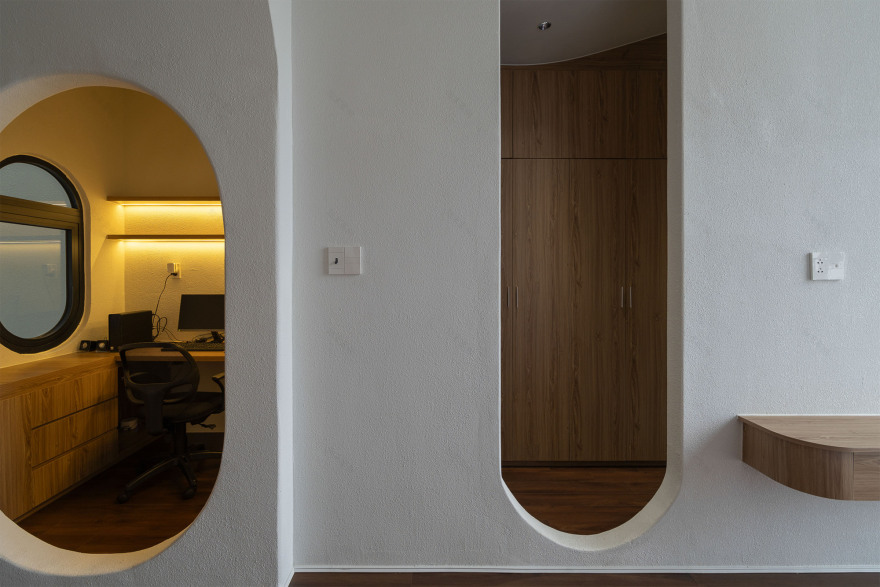
Curved language & spatial experience – Curved forms are applied consistently across balustrades, arches, wall surfaces, ceilings, and the façade to soften sharp edges and establish a cohesive architectural language. Beyond safety considerations, these curves directly influence how occupants move through and interact with the space. Rounded surfaces allow circulation to flow smoothly, reducing abrupt directional changes and helping users intuitively perceive boundaries between functional zones. Visually, curves soften transitions between spaces, mitigating the sense of fragmentation often found in townhouses. By rounding corners, light and sightlines are drawn deeper into the interior, enhancing the perception of spaciousness and comfort.
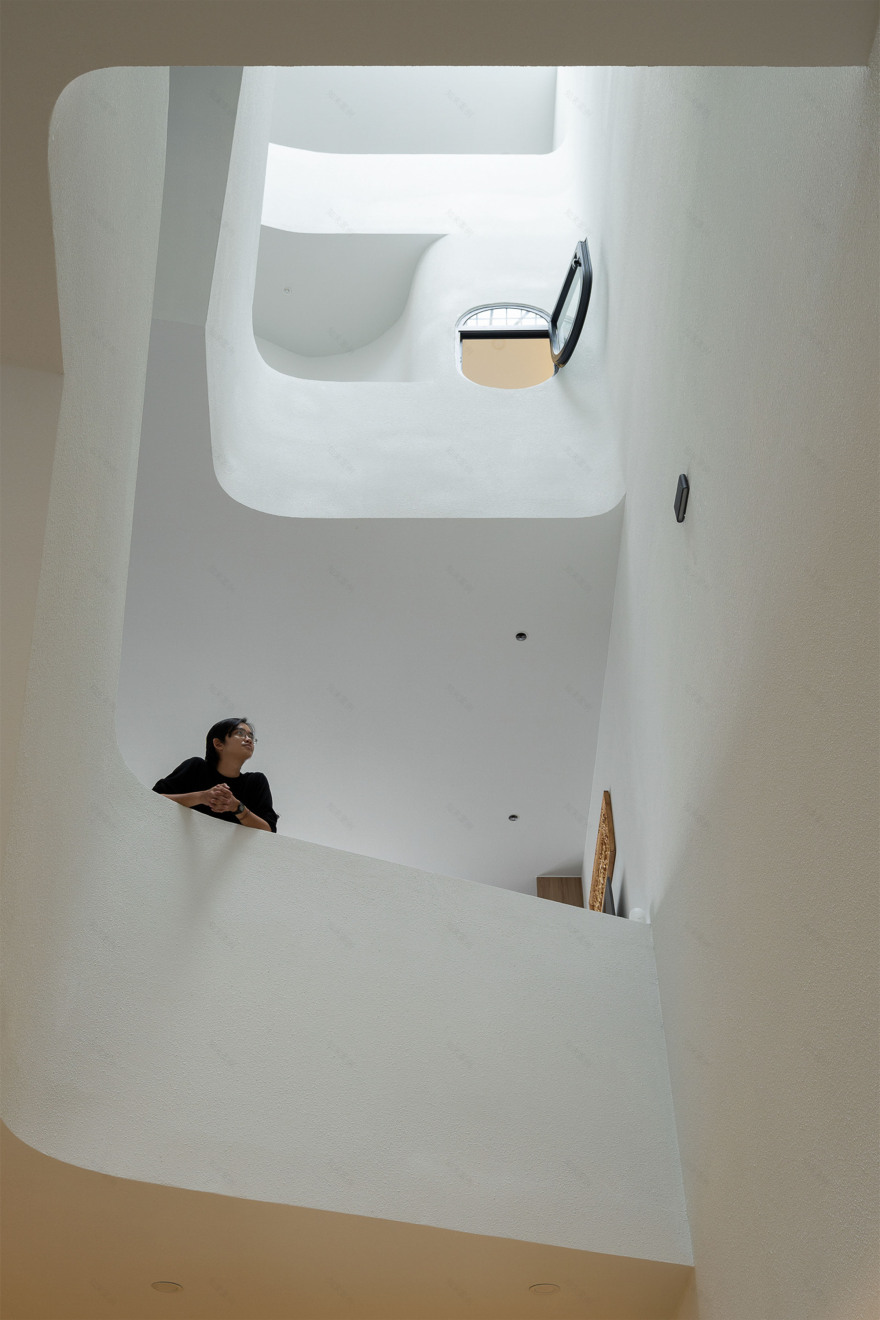
Materials – The material palette is selected to emphasize a raw yet durable character, aligning with the overall spirit of the project. Wood, textured paint, terrazzo flooring, and steel details are combined to achieve a balance between aesthetics, durability, and long-term usability.

Project gallery




南京喵熊网络科技有限公司 苏ICP备18050492号-4知末 © 2018—2020 . All photos and trademark graphics are copyrighted by their owners.增值电信业务经营许可证(ICP)苏B2-20201444 苏公网安备 32011302321234号
苏公网安备 32011302321234号客服
消息
收藏
下载
最近