

创作上传
VIP
收藏下载
登录 | 注册有礼
查看完整案例

收藏

下载

分享
自然的场所
A Natural Place
武夷山保存着中国境内最完整的中亚热带森林生态系统,1979年被设立为国家级自然保护区;1999年,武夷山作为世界文化与自然双重遗产被列入《世界遗产名录》;2021年成为中国首批国家公园。月亮湾瀑布位于武夷山国家公园的门户,是进入公园后的首个自然风光景点。2023年CLAB Architects受当地政府委托为月亮湾瀑布建造一处观景台。
Mount Wuyi preserves one of the most complete mid-subtropical forest ecosystems in China. It was designated a National Nature Reserve in 1979, inscribed on the UNESCO World Heritage List as a mixed cultural and natural site in 1999, and became one of China’s first National Parks in 2021.
▼鸟瞰,aerial view© 合造社CLAB

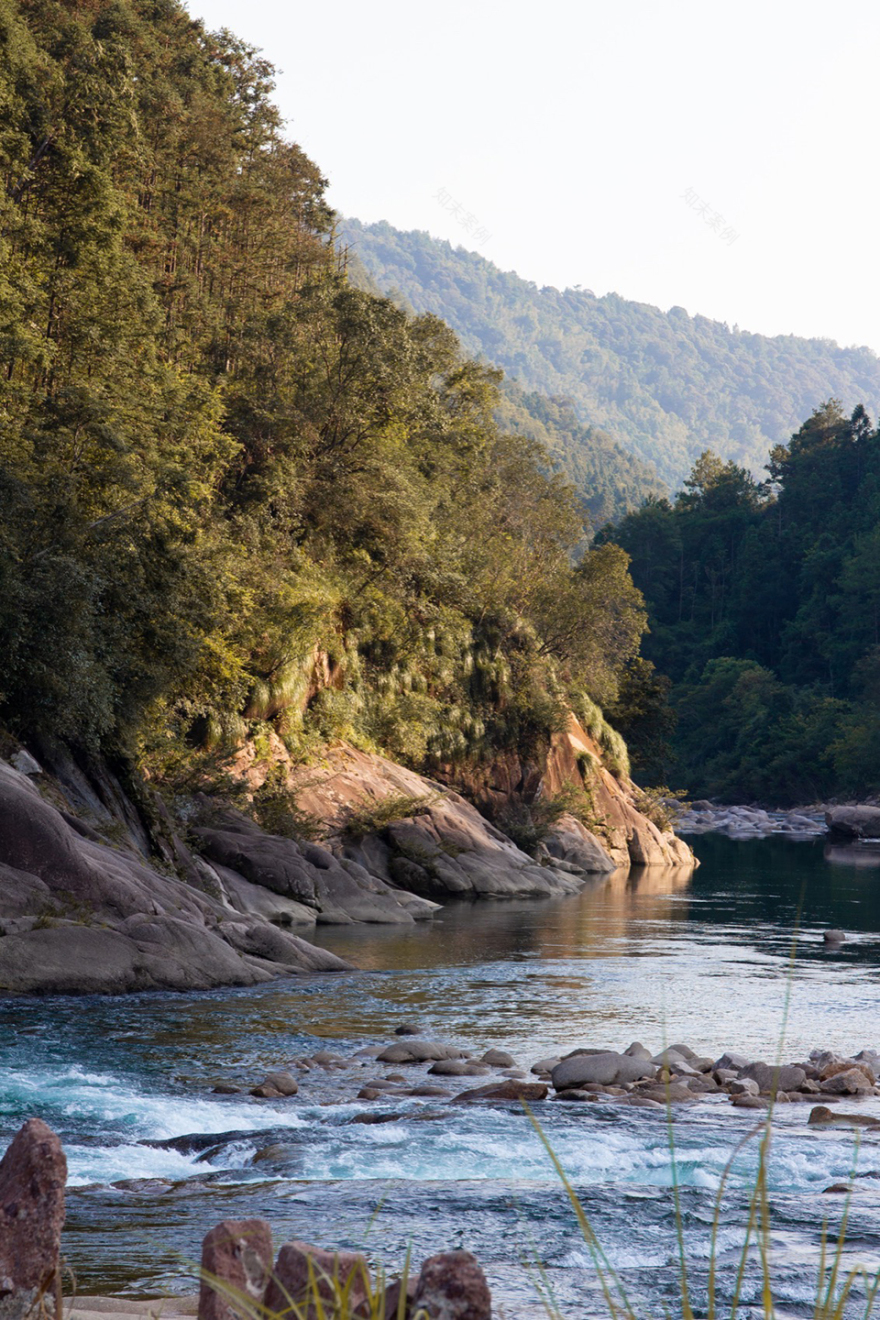
月亮湾瀑布是一处建造于1979年的人工大坝,用于调节保护区内的水文资源。它形如弯月,月亮湾因此而得名。经历近半个世纪人工和自然的相互影响,月亮湾瀑布已经完全溶于自然。瀑布的上游是一处安静的小湖面,而下游,经历了瀑布的冲洗,两岸露出了巨大的天然河石,和人工大坝一起共同构成了一处现象学意义上的场所:虽然它匍匐在大地上,但它却是这个场域连接天与山的中心。在建筑师进入这个场所的时候,一个显而易见的感受油然而生:在纯粹自然之中创造的人工空间,似乎不是生硬的“闯入”,而是隐匿在自然背后,但为自然轻轻的画上一条下划线,让自然凸显。月亮湾瀑布便是这条在阅读自然的时候勾勒的“下划线”。
Moon Bay Waterfall is located at the threshold of Mount Wuyi National Park and constitutes the first natural landscape encountered upon entering the park. In 2023, CLAB Architects was commissioned by the local government to design and construct a viewing platform for the waterfall. The waterfall itself originates from an artificial dam built in 1979 to regulate hydrological resources within the protected area. Crescent-shaped in plan, the dam gave Moon Bay its name. Through nearly half a century of interaction between human intervention and natural processes, this artificial structure has been fully absorbed into its environment. Upstream, the water forms a calm and placid surface; downstream, continuous erosion has exposed massive natural river stones along both banks. Together with the dam, these elements constitute a place in the phenomenological sense: although it lies close to the ground, it becomes the center through which sky, mountain, and water are brought into relation. Within this setting, human intervention does not appear as an act of intrusion. Rather, it resembles a line drawn discreetly beneath nature—a subtle underline that does not assert itself, but allows nature to emerge more clearly in perception. Moon Bay Waterfall itself can be understood as such an underline, traced while reading the landscape.
▼外观,appearance© 合造社CLAB

▼由观景台看瀑布,viewing the waterfall from the project © 合造社CLAB
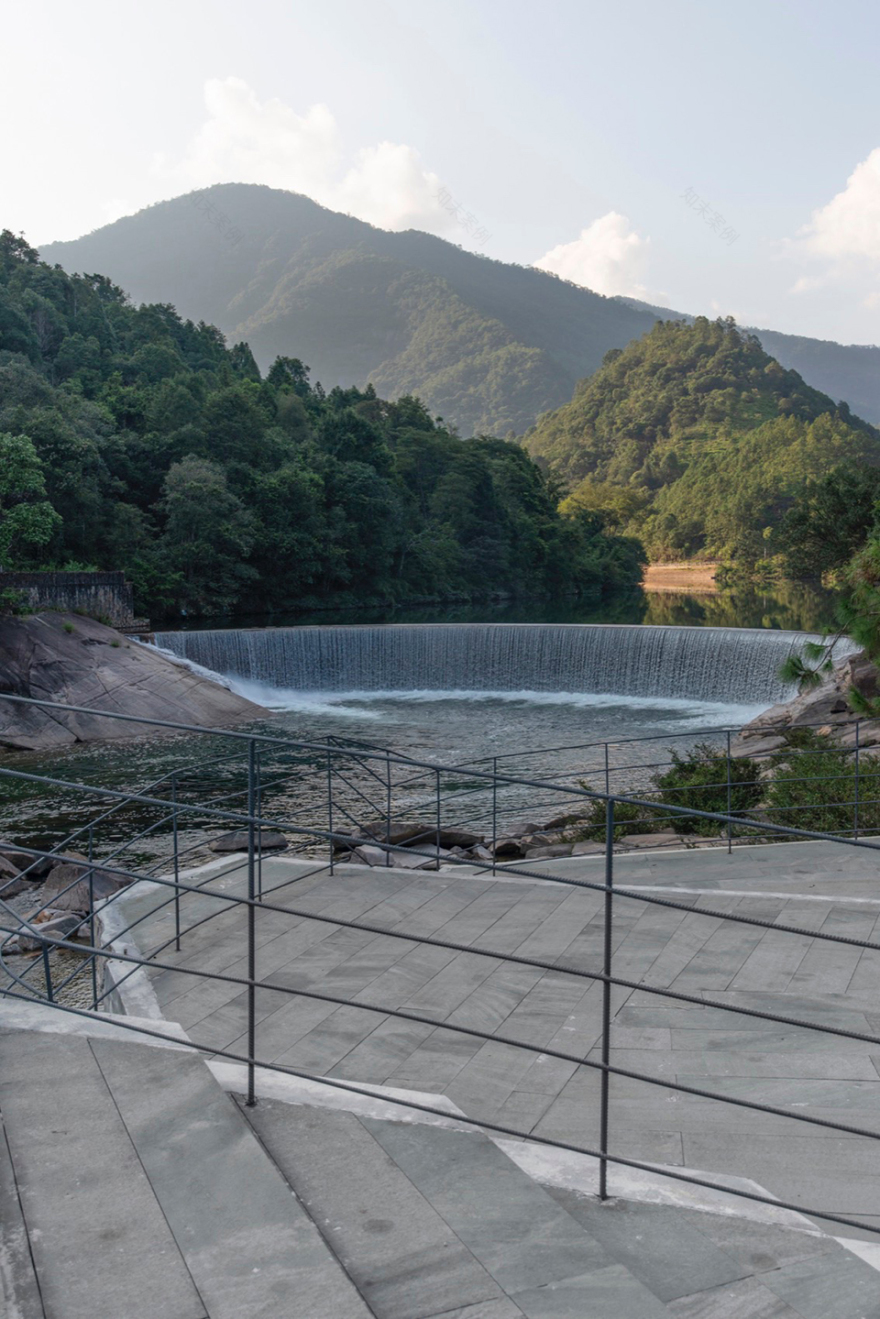

这种感受构成了这处观景平台设计的认知背景,并在我们勘察现场时形成了设计的直觉:它将这条为自然勾勒的下划线的延续,一处回应河流和河床石头的空间,一处模糊了自然和人工边界的场所。
This understanding formed the conceptual ground of the viewing platform and was translated, through close engagement with the site, into a clear architectural intention: to extend this underline into space—creating a place that responds to the river and its stones, and that deliberately blurs the boundary between the natural and the artificial.
▼观景台下方,under the platform© 合造社CLAB

形态与功能
Form and Use
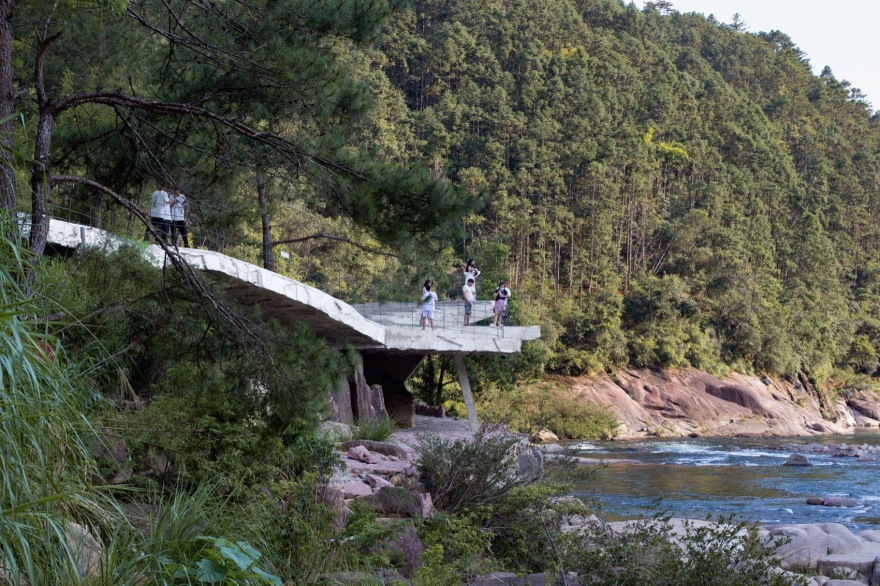
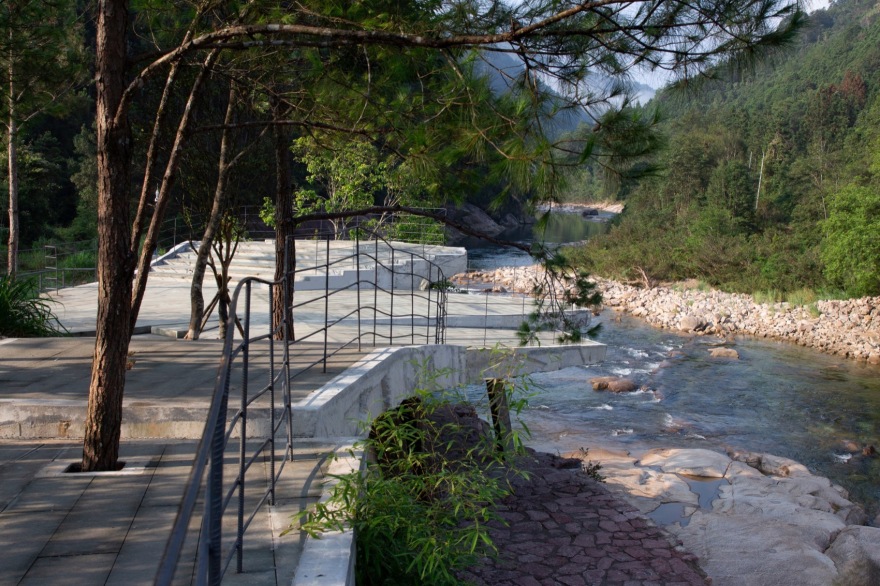
观景平台的选址位于瀑布前方唯一处较平坦的小块台地,由原生的岩石分割出上下两阶。较高处的台地和进入的车道处于同一标高,观景平台也由此进入。较高台地中有16棵树,隔离了进入平台和瀑布之间的视线,但也提供了进入景观平台的自然氛围。国家公园的保护政策严格保护每一颗树,因此建筑的形态围绕着这16棵树展开设计,并形成一个在树林背后从岩石处向瀑布挑出的观景台。四个独立的多边形体量相互插入彼此,每个体量都有略微的坡度倾斜,在几何关系上形成褶皱,犹如被河水冲刷后露出水面的河床巨石。在这些“巨石”交叠的褶皱处,是为原生的树木留出的空间,树木就像它们在石缝中长出那样和平台共生。
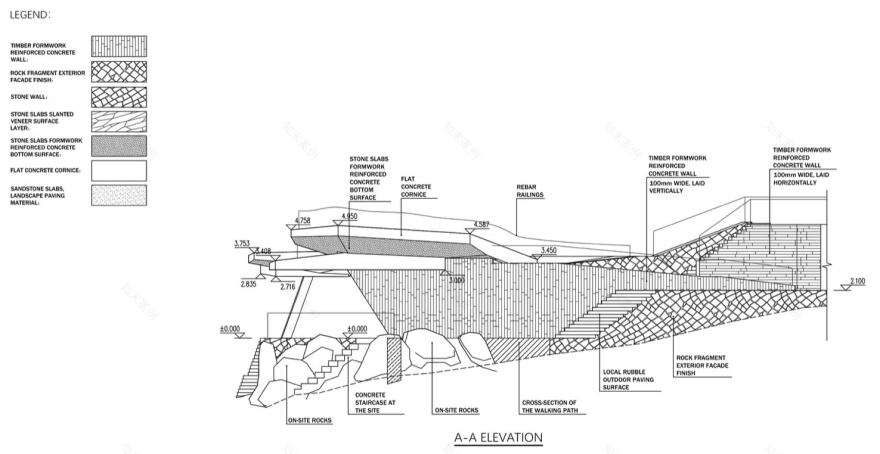
▼立面图,elevations© 合造社CLAB
The viewing platform is located on the only relatively flat piece of terrain in front of the waterfall, a small terrace naturally divided into two levels by native rock formations. The upper terrace aligns with the access road and serves as the main entry level of the platform. Sixteen mature trees grow on this terrace, forming a visual buffer between the arrival sequence and the waterfall, while also establishing a restrained and gradual spatial atmosphere. As national park regulations require the preservation of every tree, the architectural form was conceived from the outset in response to their presence. The platform thus takes shape as a structure concealed behind the trees, projecting toward the waterfall from within the rocky terrain. Four independent polygonal volumes interlock with one another, each slightly inclined, forming a folded geometry reminiscent of riverbed boulders revealed by flowing water. At the folds created by the overlapping volumes, space is left for the existing trees, which coexist with the platform much as trees grow naturally from fissures in stone.
▼远观,viewing the project at distance© 合造社CLAB

国家公园内仍然住着不少村民,建造月亮湾瀑布观景台的这个地方是村民夏季傍晚乘凉和跳舞的场地,因此这个观景平台其中的一块“巨石”被设计成为一处台阶看台,在建造完成后,村民的这一活动可以继续保持。
Local villagers continue to inhabit the national park, and the site of Moon Bay Waterfall has long served as an informal gathering place for evening leisure and dancing during the summer months. One of the architectural “boulders” is therefore shaped as a stepped seating platform, allowing this everyday communal activity to persist after construction.
▼观景台由混凝土浇筑,viewing the platform made of concrete© 合造社CLAB

▼看台“巨石”,“boulder” © 合造社CLAB

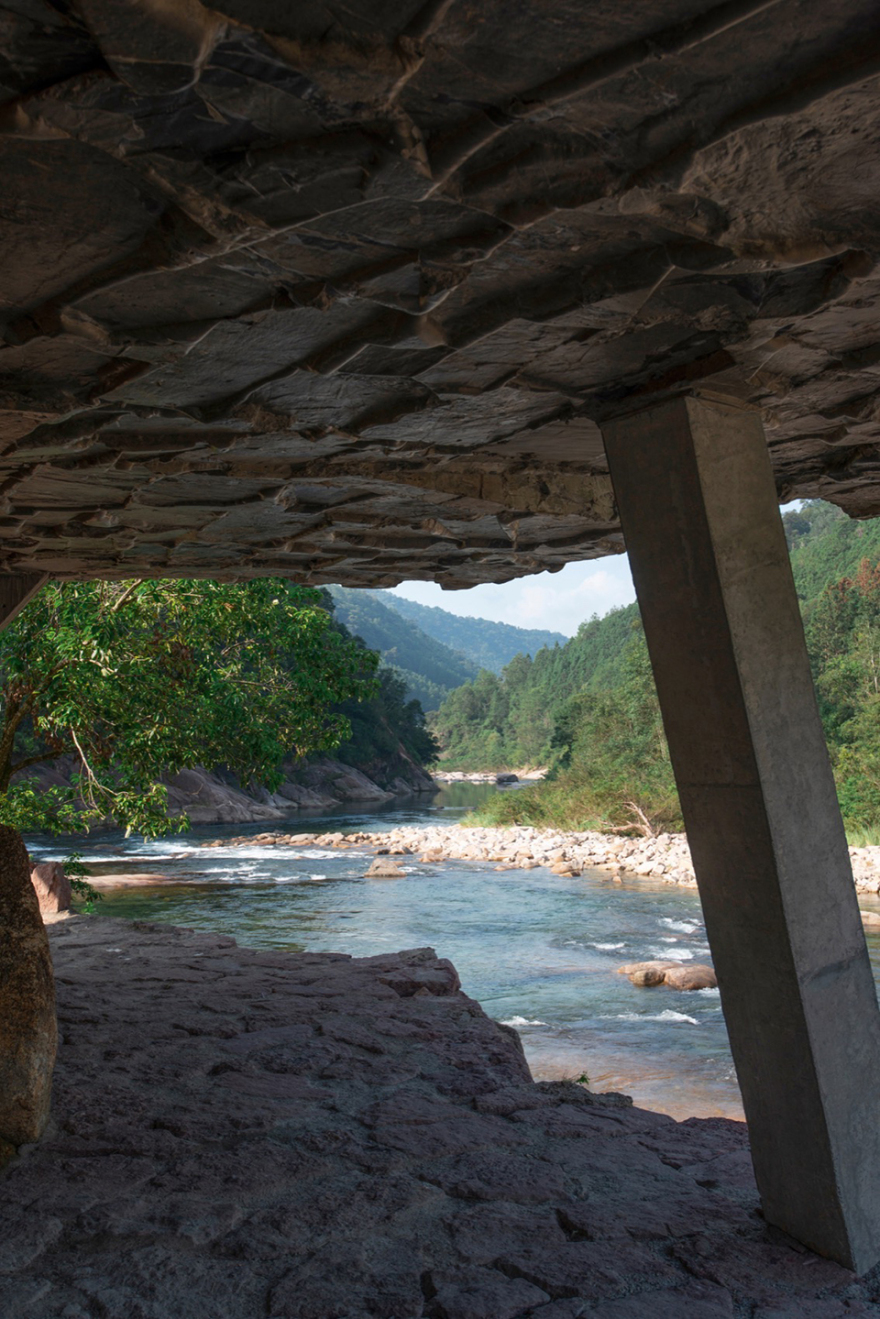
另一条路径从看台“巨石”的一侧下至较低的台地,这里是为专业溯溪团体设计的观景平台,也是游历整个建筑的高潮。一方面,它更靠近瀑布和河床,河床石被冲刷的纹理触手可及,自然就在眼前和身边;另一方面,出挑的平台为这个空间提供了一处包被(enclosure, Norberg-Schulz),形成一个类似洞穴般的空间,将人的体验在纯粹自然中带回人的原始的空间经验。
A secondary route descends from the side of the stepped “boulder” to the lower terrace. Designed primarily for canyoning and stream-tracing groups, this lower platform also constitutes the climax of the architectural experience. On the one hand, it brings visitors closer to the waterfall and riverbed, where the textures carved by water erosion are within arm’s reach. On the other, the cantilevered form creates a distinct sense of enclosure (Norberg-Schulz), evoking a cave-like space that draws human perception—amidst pure nature—back toward a primordial spatial experience.
▼由观景台下方看瀑布与溪流,viewing the waterfall and the creek from below of the platform© 合造社CLAB


建造:混凝土拓印
Construction: Imprinting Concrete
在一处自然直地建造一处空间,一个更重要的诘问是,人工构筑的空间如何成为自然。这构成了我们创作这处场所最重要的冲动,月亮湾观景平台希望从建造行为中找到路径,那便是“拓印自然”。
To construct a space within an untouched natural environment inevitably raises a fundamental question: how can an artificial structure become part of nature? This question lies at the core of the Moon Bay Waterfall Viewing Platform, and the response is sought through the act of construction itself—by imprinting nature.
▼人工构筑的自然空间,an artificially constructed natural space© 合造社CLAB


▼近景,closer views© 合造社CLAB


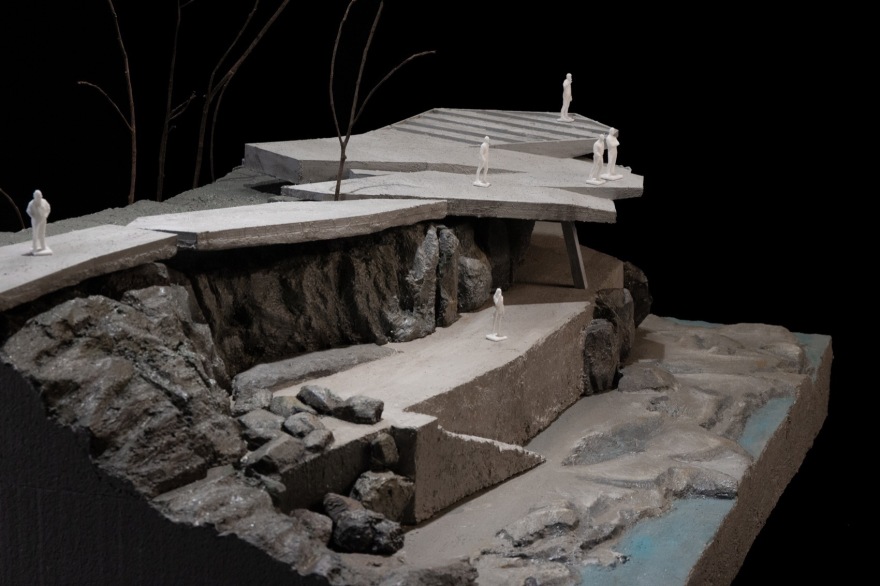
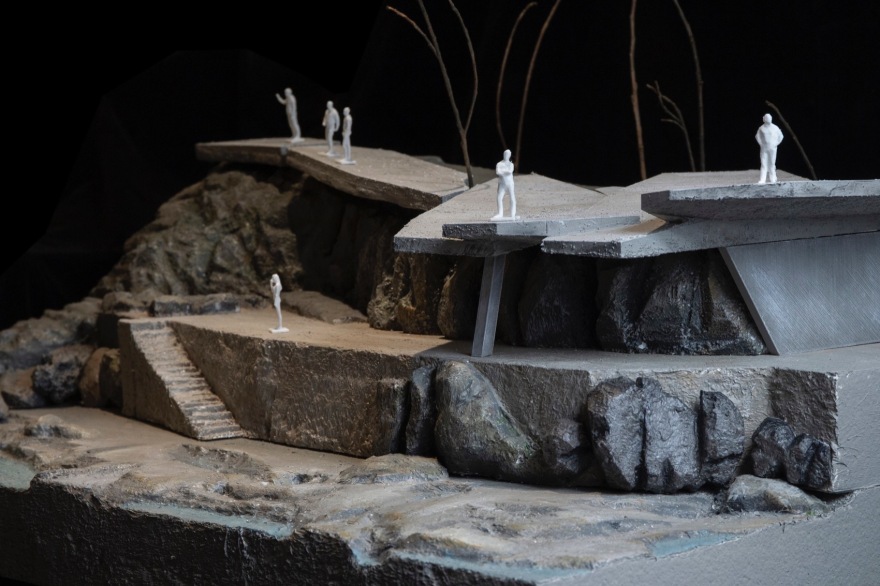
整个建筑由混凝土浇筑建造,但不同的是我们想用自然的石材来塑形混凝土。这一想法最初在模型中得到验证。搭建模型的过程也是对建造过程的设计,我们用切割成石片状的硬纸板相互叠放在木质脚手架上作为浇筑混凝土的模板。纸片相互叠放的纹理最终拓印在混凝土模型的表面。在真实建造中,纹理更加丰富的石片被叠放在木模板上,这些石片的纹理、相互搭接的褶皱最终在观景平台的底面呈现出来。当这些石片被拆除后,观景平台的底面就像是被自然雕琢的原石。而这些被拆除的自然石模板又被铺装到观景平台下方的台地上,塑造了一个如洞穴般的空间。在此,人工与自然的边界被破除,建筑不再是建筑,而是自然的镜像。
The entire structure is cast in concrete. Rather than relying on smooth, standardized industrial formwork, natural stone was used to shape the concrete surface. This approach was first tested through physical models. The process of model-making became a parallel exploration of construction: cardboard pieces cut into stone-like fragments were layered onto wooden scaffolds to serve as formwork, and their overlapping textures were transferred directly onto the concrete surface of the model. In the actual construction, natural stone pieces with richer textures were placed onto wooden formwork. The inherent grain of the stones and the folds formed through their overlapping were fully imprinted onto the underside of the viewing platform. Once the stone formwork was removed, the concrete surface appeared as if carved by natural forces. These dismantled stones were then reused to pave the ground beneath the platform, further shaping a cave-like space. Here, the boundary between the artificial and the natural dissolves, and architecture no longer stands as an object, but as a mirror of nature.
▼整个建筑由混凝土浇筑建造,the entire structure is cast in concrete© 合造社CLAB

▼混凝土与石材的呼应,the harmony between concrete and stone© 合造社CLAB

▼混凝土表面的纹理,texture on the surface of the concrete© 合造社CLAB


结构:一根纤细的混凝土柱
Structure: A Slender Concrete Column
建造完成的观景平台为体验者留下一个谜题,在下层平台显眼的位置,可以看到仅有一根纤细的混凝土柱子斜向支撑着四块相互插入的人工“巨石”。力量被汇聚在这根柱子传递至地面,但同时也引起某种感知层面的紧张:如此巨石何以被单柱支撑?这种感知同样也在提示自然力量的强大与野性。
Upon completion, the viewing platform presents visitors with a structural enigma. At a prominent position on the lower level, a single slender concrete column is seen diagonally supporting four interlocking artificial “boulders” above. Structural forces are concentrated and transferred to the ground through this one column, generating a perceptual tension: how can such mass be supported by a single element? This tension subtly echoes the latent power and wildness of natural forces themselves.
▼平台由单根混凝土柱支撑,the platform is supported by a single concrete column© 合造社CLAB

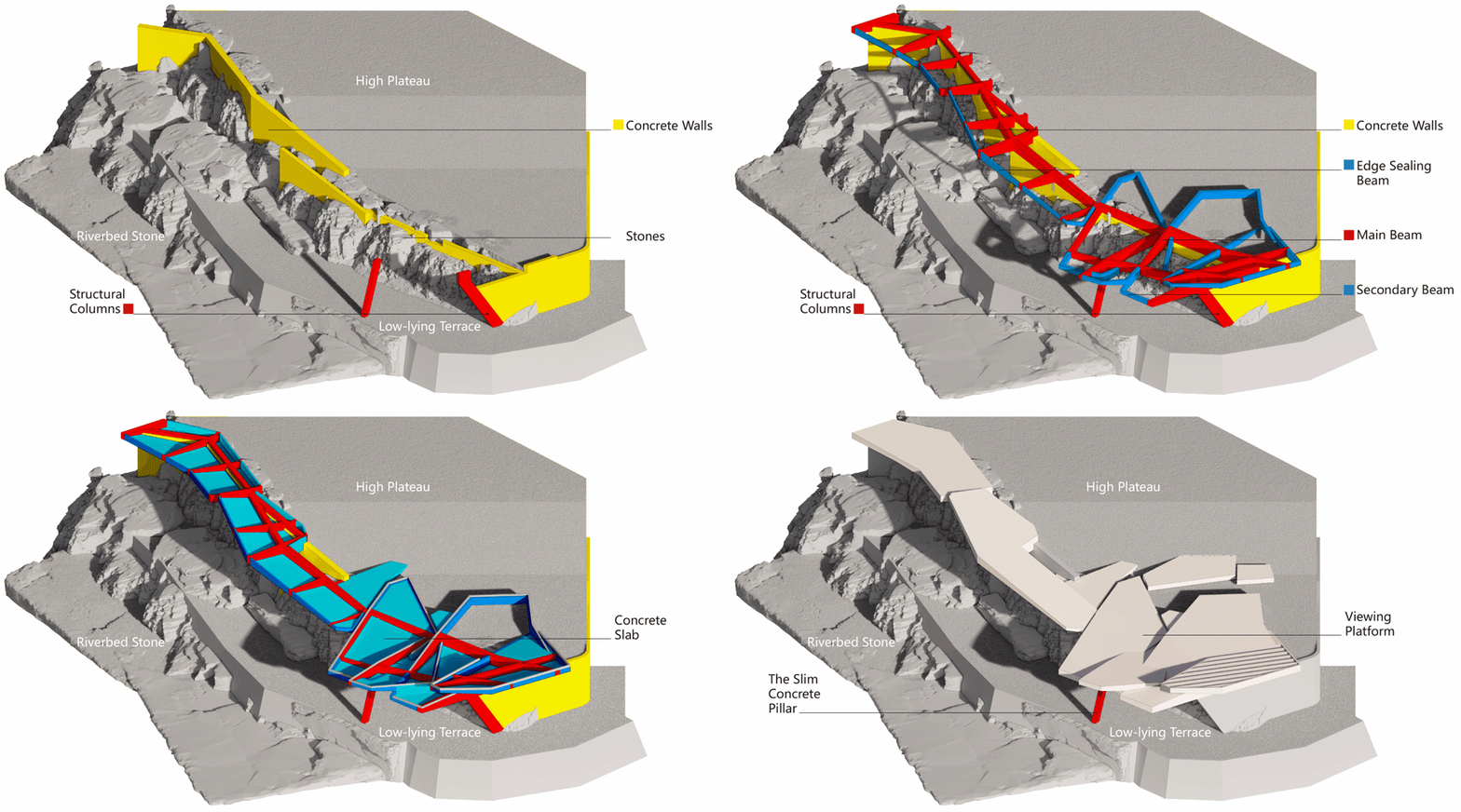
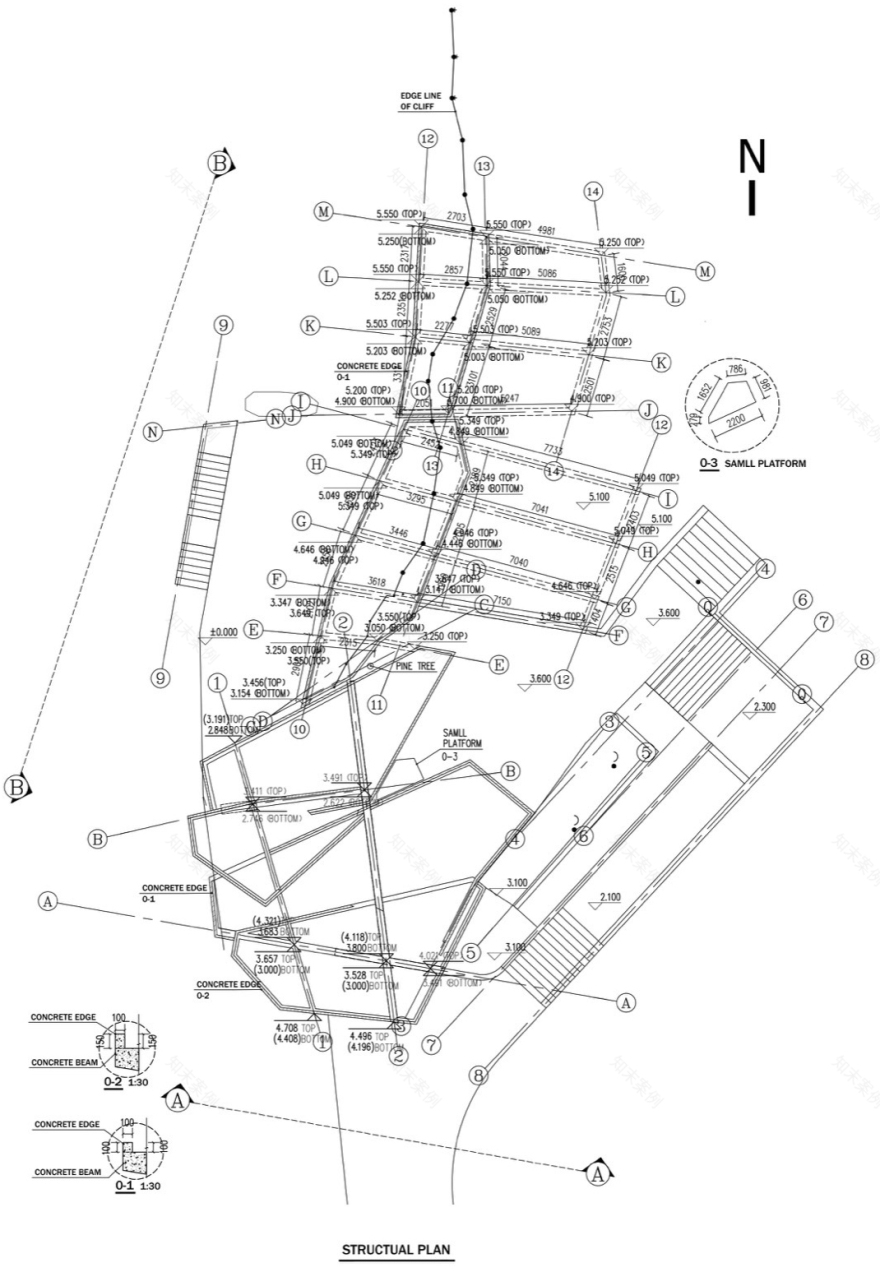
但在事实上的技术层面,这是一处被精心设计的结构表演。观景台的结构由稳定的混凝土框架体系完成,它的一侧被安放在由原生石作为基础的墙体上,另一侧则由两个斜向的柱子完成框架另一侧的支撑点。但其中一个柱子被隐藏在了墙体里,并且从石墙根部向外倾斜用以支撑顶部的框架梁。这一结构体系旨在降低造价,避免了从二层平台往外的过度悬挑所带来的技术和造价问题。
At the technical level, however, the structure is the result of careful calculation and deliberate expression. The platform is supported by a stable reinforced-concrete frame system. One side rests on a wall founded directly on native rock, while the opposite side is supported by two inclined columns. One of these columns is concealed within the wall, extending outward from its base to support the upper frame beam. This structural strategy reduces construction costs and avoids the technical challenges associated with excessive cantilevering from the upper platform.
▼近景,closer views© 合造社CLAB


▼细部,details© 合造社CLAB


那颗被凸显出来的单柱表面未作任何修饰,它在及其明显的位置以及其人工的方式出现,而它的周围是纯粹的自然,或者是已经成为自然的人工构筑。这颗柱子就像是一处签名,一处建筑师和结构工程师的签名,或者是一处建造它的人工技术的签名。它是为自然勾画并强调的下划线,引发关于自然与人的关系的哲思。
The exposed column, left entirely untreated, appears with unmistakable artificial clarity. Surrounded by pure nature—or by artificial elements that have themselves become natural—it stands as a deliberate signature: a signature of the architect and structural engineer, and of the constructive act itself. Once again, it draws an underline beneath nature, prompting reflection on the relationship between humanity, technology, and the natural world.
▼施工过程,construction process© 合造社CLAB


▼模型,model© 合造社CLAB




▼总平面图,master plan© 合造社CLAB

▼平台铺地平面图,platform pave floor plan© 合造社CLAB

▼石板框架图,stone slabs framework drawing© 合造社CLAB

▼结构平面图,structural plan© 合造社CLAB
▼立面图,elevations© 合造社CLAB

项目名称:月亮湾瀑布观景台
项目类型:公共空间 建筑 景观
设计方:合造社建筑设计事务所
项目设计:2024年1月(设计)
完成年份:2024年3月(建成)
设计团队:徐浪、石佳馥伊、乔侨、李健
项目地址:福建省南平市武夷山市星村镇红星村月亮湾观景平台
建筑面积:500㎡
摄影版权:合造社CLAB
合作方:福建省建筑设计研究院有限公司
客户:武夷山市星村镇
材料:清水混凝土
Project name: Moon Bay Waterfall Viewing Platform
Project type: public space Architecture Landscape
Design:CLAB Architects
Design year:2024.01
Completion Year:2024.03
Leader designer & Team: Xu Lang、Shi Jia Fu Yi、Qiao Qiao、Li Jian
Project location: Hongxing Village, Xingcun Town, Wuyishan City, Nanping City,Fujian Province, China
Gross built area: 500㎡
Photo credit: CLAB Architects
Partner:Fujian Provincial Architectural Design & Research Institute Co., Ltd.
Clients:Xingcun Town, Wuyishan City
Materials:fair-faced concrete


南京喵熊网络科技有限公司 苏ICP备18050492号-4知末 © 2018—2020 . All photos and trademark graphics are copyrighted by their owners.增值电信业务经营许可证(ICP)苏B2-20201444 苏公网安备 32011302321234号
苏公网安备 32011302321234号客服
消息
收藏
下载
最近