

创作上传
VIP
收藏下载
登录 | 注册有礼
查看完整案例

收藏

下载

分享

翻译
Architects:Alsar Atelier,El Lider S.A.S,INGEACERO,SCRD
Area:900m²
Year:2025
Category:Cultural Architecture,Temporary Installations
Design:Alsar Atelier
Assignment:SDRD
Execution:El Lider S.A.S
Manufacturing And Construction:Ingeacero + Terra
City:Bogotá
Country:Colombia

"The Memory of the River" is a project located at the intersection of public art and ephemeral architecture, conceived as a transitory infrastructure capable of reactivating urban spaces in the city of Bogotá through cultural uses. The initiative arises from the Secretariat of Culture, Recreation and Sports (SCRD) with Secretary Santiago Trujillo, the Director of Art, Culture, and Heritage Diego Parra, and structured by the Subdirectorate of Infrastructure and Cultural Heritage of the Secretariat, led by Edgar Figueroa, with a team composed of: Edgar Bernal, Emmanuel Guerra, Juliana Mendoza, Diego Rodríguez, and Juan Sebastián Robayo. They advocate for a temporary intervention—instead of a permanent one—as a strategy to decentralize cultural uses and allow different neighborhoods in the city to host their activities.
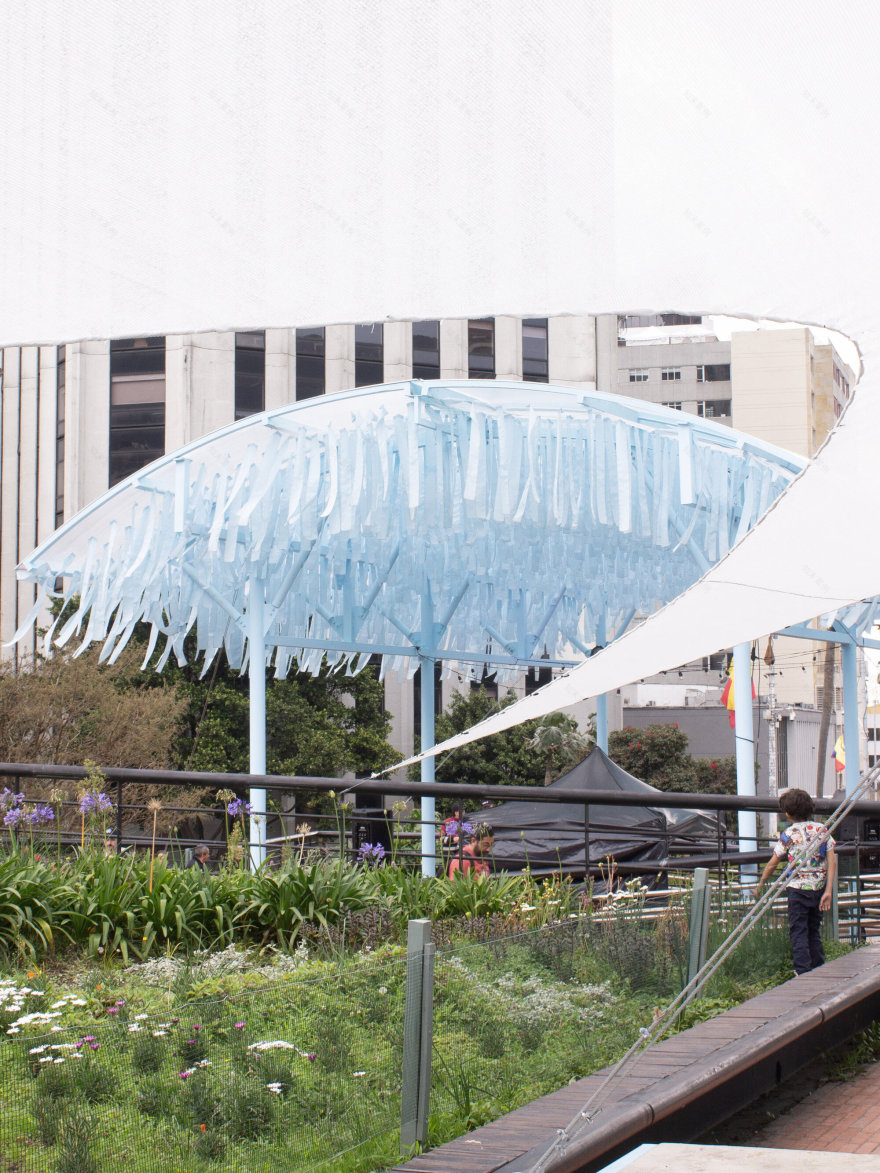
The concept of the proposal references the water systems of the city, particularly the rivers, natural infrastructures that have historically been underutilized during Bogotá's urban growth. These systems, originating in the Eastern Hills, are characterized by their dynamic condition and their ability to adapt to different spatial and temporal conditions. This phenomenology served as the foundation for conceptualizing a modular, flexible, and adaptable cover, whose fluid materiality seeks to evoke and celebrate the water systems of the savanna.

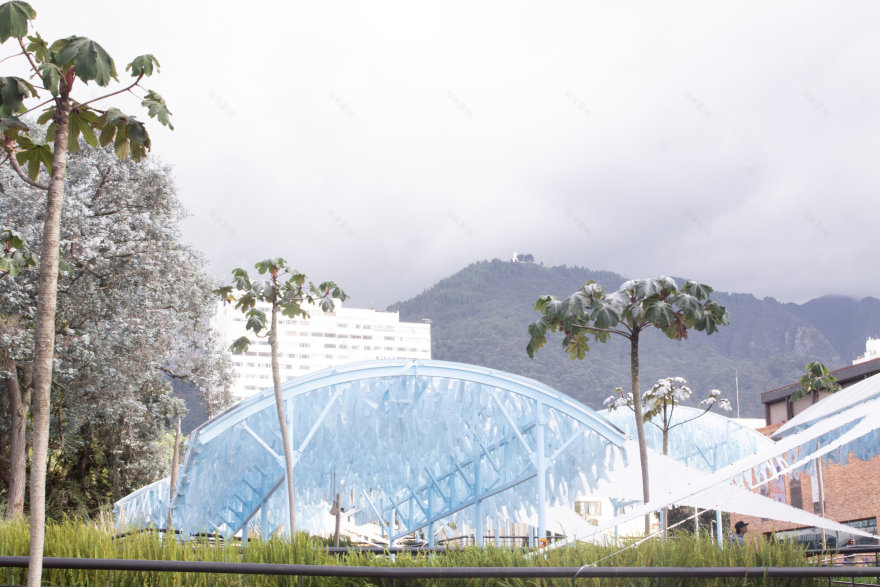
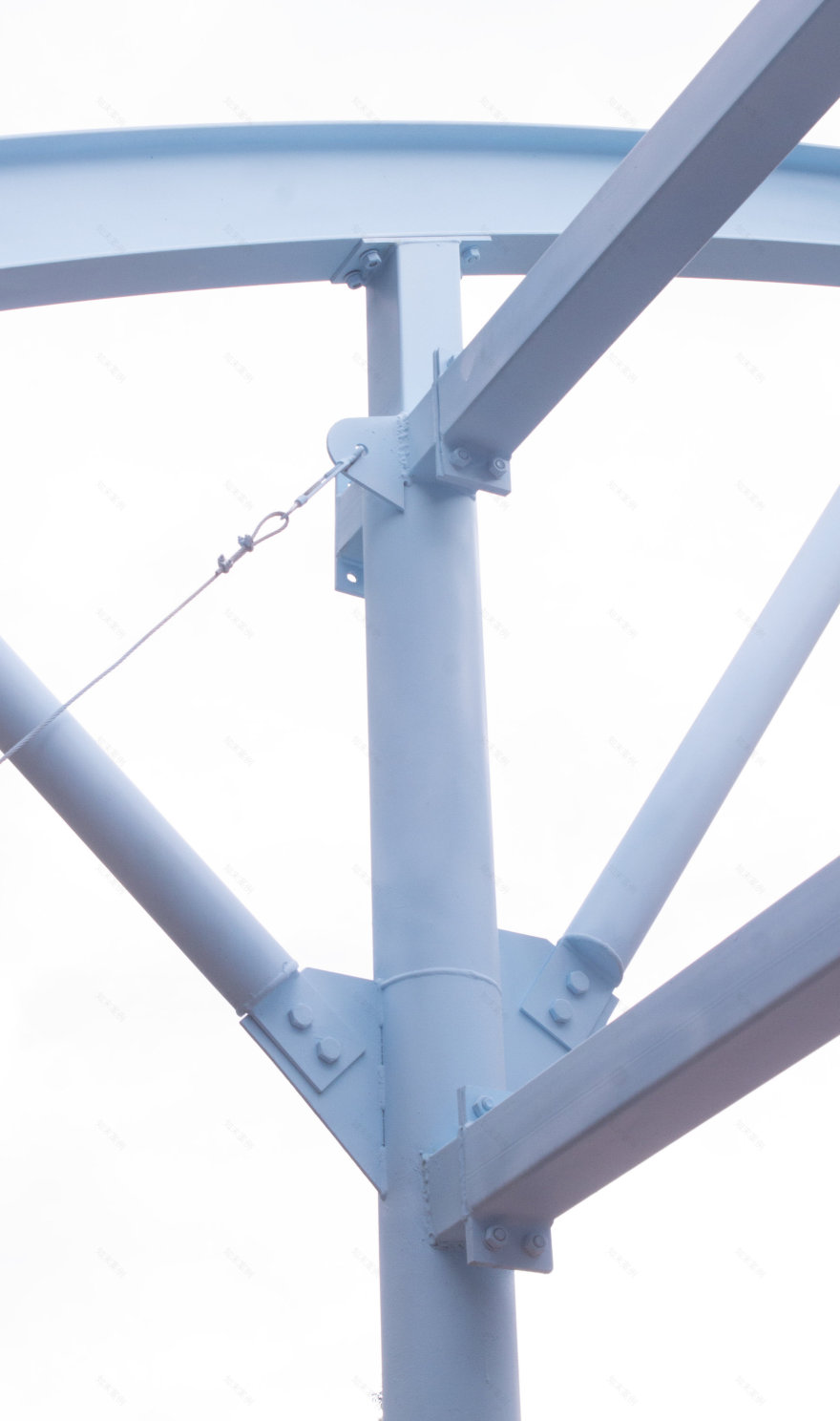
Based on these conceptual guidelines, the team composed of El Líder S.A.S., INGEACERO, and Alsar-Atelier developed a module measuring 6 meters long, 8 meters wide, and 5 meters high, with unidirectional expansiveness defined by a vaulted elevation. The construction system, based exclusively on dry joints, allows the module to function as an assemblable piece, capable of being implemented in various urban contexts—streets, squares, or courts—and adapting to different spatial configurations. Additionally, the module can be subdivided to simultaneously activate different spaces in the city. Without permanent anchors, the structure can be installed even in heritage environments without causing irreversible effects, reinforcing its condition as reversible architecture, capable of appearing and disappearing, leaving a mark only through memory.


In line with this conceptual framework, the interior atmosphere of the project seeks to abstractly represent the behavior of water, paying homage to the memory of the rivers through the figure of a "phantom river" suspended in the cover. Water, understood as a liquid material composed of particles in constant motion, is translated in the ceiling through 15,000 fragments of blue fabric. The displacement generated by the wind establishes a direct dialogue with the physical properties of the river and, when situated under a transparent polycarbonate cover, produces a changing atmosphere based on plays of light, shadow, and transparency.

As an initial implantation site and test of functionality, Bicentenario Park, designed by architect Giancarlo Mazzanti, was selected, located between Independence Park and the Museum of Modern Art of Bogotá. In an environment characterized by the absence of a clear dimensional order and by variable topography, "The Memory of the River" adapts analogously to how a river accommodates itself within a valley. With a construction time of four weeks, the project has already hosted various cultural activities, including gastronomic, circus, and artistic and theatrical presentations. During the first half of 2026, it will remain at this location and subsequently will be implemented itinerantly at different points in the city, consolidating itself as a mobile cultural infrastructure.

More than a temporary structure, The Memory of the River is envisioned as a public sculpture for the arts: an ephemeral architecture that accompanies the rhythms of the city and seeks to reconnect Bogotá with the memory of its rivers, demonstrating the transformative potential of culture in urban space.
Project gallery




南京喵熊网络科技有限公司 苏ICP备18050492号-4知末 © 2018—2020 . All photos and trademark graphics are copyrighted by their owners.增值电信业务经营许可证(ICP)苏B2-20201444 苏公网安备 32011302321234号
苏公网安备 32011302321234号客服
消息
收藏
下载
最近