

创作上传
VIP
收藏下载
登录 | 注册有礼
查看完整案例

收藏

下载

分享

翻译
Architects:AATISMO
Area:132m²
Year:2025
Photographs:Sato Shinya
Manufacturers:Lumina
Lead Architects:Eriko Masunaga, Keita Ebidzuka, Daiki Nakamori
Category:Houses
Lead Team:Eriko Masunaga, Keita Ebidzuka, Daiki Nakamori
Engineering & Consulting > Structural:TECTONICA, Mitsuhiro Kanada
Engineering & Consulting > Lighting:DAISUKI LIGHT
Engineering & Consulting > Other:Imajo Sakan, Sasaki Research Institute, Studio Bead, Panasonic BRIDGEHEAD
General Contractor:Yukari Kensetsu
City:Kamakura
Country:Japan

Text description provided by the architects. 1. Opening Hook – Haniyasu House is a two-family residence that reconnects living and making through an architecture shaped by earth, craft, and shared daily life.

2. Context and Challenge – Haniyasu House is located in Kamakura, Japan, at the edge of a yato valley surrounded by steep cliffs carved with ancient horizontal cave tombs known as yagura. This landscape strongly conveys the physical and historical presence of the earth. The project was designed for the architects themselves and their parents, ceramic artists who moved to Kamakura fifteen years ago in search of an environment dedicated to working with clay. The challenge was to create a dwelling that could support multiple generations and creative practices while responding directly to the site's geological and cultural character.

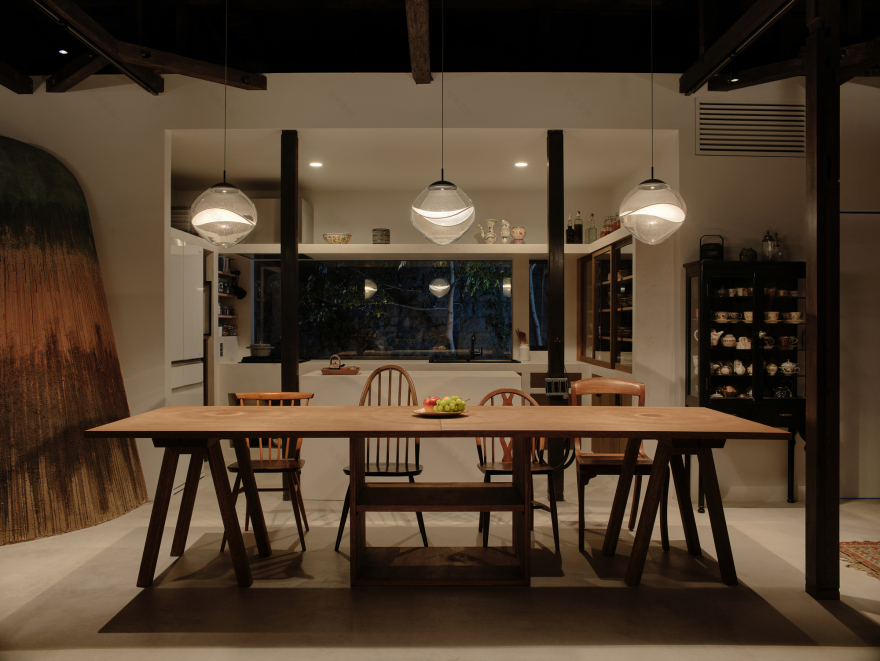
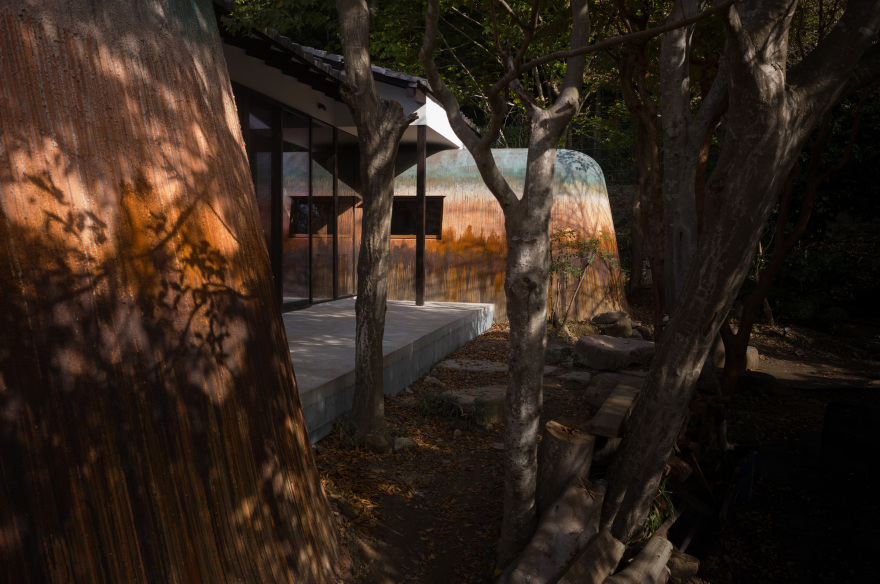
3. Design Concept and Spatial Organization – Conceived as a place for lives centered on making, the house was envisioned as a primordial dwelling—one from a time when living and creating were inseparable. All interior walls and ceilings of the existing single-story wooden house, built in 1967, were removed to form a single, open space connected to the surrounding landscape. New rooms were added at the four corners, their forms evoking masses of earth rising from the ground. Together, the open core and enclosed additions form a composition reminiscent of a small settlement.

4. Rooms and Ways of Living – Within the corner additions, each individual sleeps and works in a cave-like, enclosed space, while the central open area functions as a shared plaza for gathering, conversation, and meals. The father's room, located to the northwest, is primarily used for pottery-making. Finished in deep brown tones using soil from the site, it connects directly to the kiln and outdoor glazing area, allowing the entire ceramic process to take place within one zone. The mother's room, to the southwest, is more restrained, finished with lime mixed with bisque-fired clay and equipped with underfloor storage and built-in cabinetry.


The architects' room, the largest volume, features lowered earthen floors and cantilevered desks displaying furniture and lighting produced through their broader design practice. A guest room is designed as a tea room, with tatami mats, a tokonoma, clay-rich walls mixed with bamboo charcoal, and soft daylight introduced from above.


5. Materials and Construction – Material experimentation formed the basis of the architectural process. Soil from the site and discarded clay from the father's ceramic practice were crushed, fired, glazed, and tested repeatedly. In the final construction, layers of site soil and bisque-fired clay were combined with plaster mixed with iron and copper powders and poured onto the exterior walls, allowing oxidation to generate color over time. Structurally, the four corner additions also function as seismic reinforcements, concentrating shear walls within new foundations while preserving the original columns that support the tiled roof.


6. Impact and Conclusion – Named after Haniyasu, a Japanese deity of earth and pottery, the house seeks to transcend the boundaries between land, architecture, and craft. Accepting chance, weather, and time, Haniyasu House is an attempt for architecture to regain its material force and to reestablish a harmonious relationship between making, living, and the ground.

Project gallery



南京喵熊网络科技有限公司 苏ICP备18050492号-4知末 © 2018—2020 . All photos and trademark graphics are copyrighted by their owners.增值电信业务经营许可证(ICP)苏B2-20201444 苏公网安备 32011302321234号
苏公网安备 32011302321234号客服
消息
收藏
下载
最近