

创作上传
VIP
收藏下载
登录 | 注册有礼
查看完整案例

收藏

下载

分享

翻译
Architects:NZI Architectes
Area:6575m²
Year:2025
Photographs:Frederic Delangle
Lead Architect:NZI Architectes
Structural Engineering:I+A
Environmental Quality:Etamine
MEP Consulting:B52
HQE:Etamine
Category:Social Housing
Client:RIVP / HÉNÉO
Existing Area:4.125 m2
Proposed Area:2.450 m2
Certifications / Labels:NF Habitat HQE Effinergie Renovation, E3C1, Bio-based Building Label – Level 1, BIM Level 2
Budget:€9 million (excl. VAT)
General Contractor :Genere
Cost Consultancy:ECALLARD
Building Services:B52
City:Paris
Country:France

Text description provided by the architects. At 29 rue Nollet in Paris (17th arrondissement), for the Régie Immobilière de la Ville de Paris (RIVP), the client, the architectural firm NZI Architectes (Sandra de Giorgio, Gianluca Gaudenzi) completed in December 2025 the conversion of an obsolete car park into a social housing residence comprising 83 units. Gross floor area: 2,450.1 sq m.

More specifically, within the former car park, NZI inserted two buildings, in addition to the street-facing structure, accommodating 83 studio-type housing units (T1 and T1 bis), shared spaces and administrative offices to ensure the proper functioning of the residence, as well as a ground-floor activity space. The whole project is organized around a newly landscaped, planted courtyard with open-air circulation spaces.

ContextLocated at the corner of rue Nollet and rue de la Condamine, the highly enclosed site originally comprised a street-front car park and a main building at the heart of the block. Dating from the 1930s, the ensemble was built along the plot boundaries over four levels above ground floor, with translucent openings providing natural light to the car park.

The first three levels, built in concrete, were in good condition, while the top two levels featured a steel structure with generous ceiling height beneath the ridge. The garage roof consisted of asbestos cement panels, while the street-facing building was covered with tiled roofing.

The plot is surrounded on all four sides by neighbouring buildings at close proximity and adjoins eight co-owned properties with limited visual depth. On such a fully constrained site, a new construction would have resulted in a highly restrictive outcome dictated by setback regulations, creating direct overlooking views with neighbouring party walls and a predominantly north-facing orientation for many dwellings. Moreover, total demolition would have generated significant waste, dust and disturbances.

By contrast, despite its nearly century-long presence and its heritage qualities—such as artist-studio-type openings on the party walls—the building's sound structure was well suited to accommodate the proposed programme.
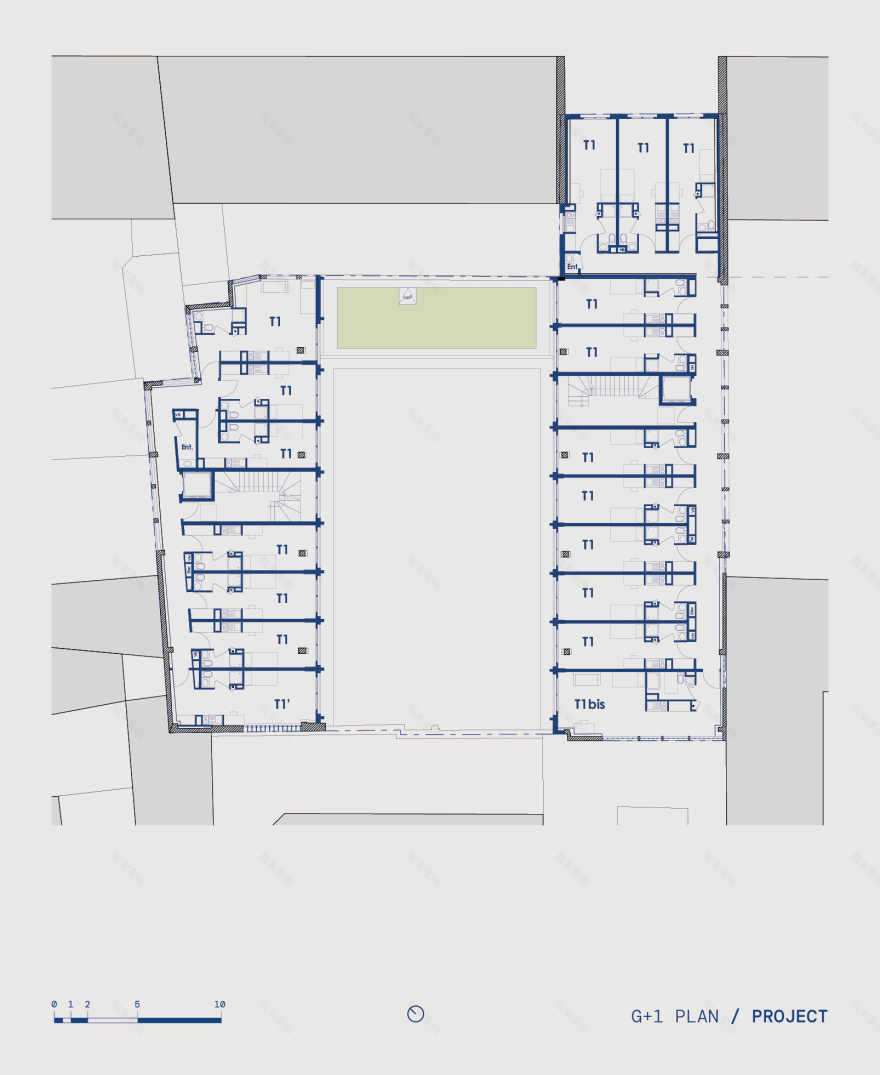
Design ApproachThe demolition of a complete structural bay along a north–south axis made it possible to create two distinct buildings and introduce direct sunlight into the heart of the block. This intervention allowed multiple dwellings to benefit from south-east light and enabled the creation of a true ground-level garden with restored soil, around which shared spaces—such as the leisure room, bicycle storage and staff offices—are organised, providing interfaces for collective life. All these spaces benefit from natural daylight.

The garage structure and steel trusses were retained, preserving the memory of the site, while the two new building volumes follow the structural logic of the existing framework. Set more than 14 metres apart and overlooking the new landscaped courtyard, they offer a high level of residential comfort.

This new north–south axis also opens up new visual corridors and, within a previously enclosed plot, provides neighbouring buildings with deeper and more open views, all the more so as the project fits within the existing R+4 volume without any additional height.
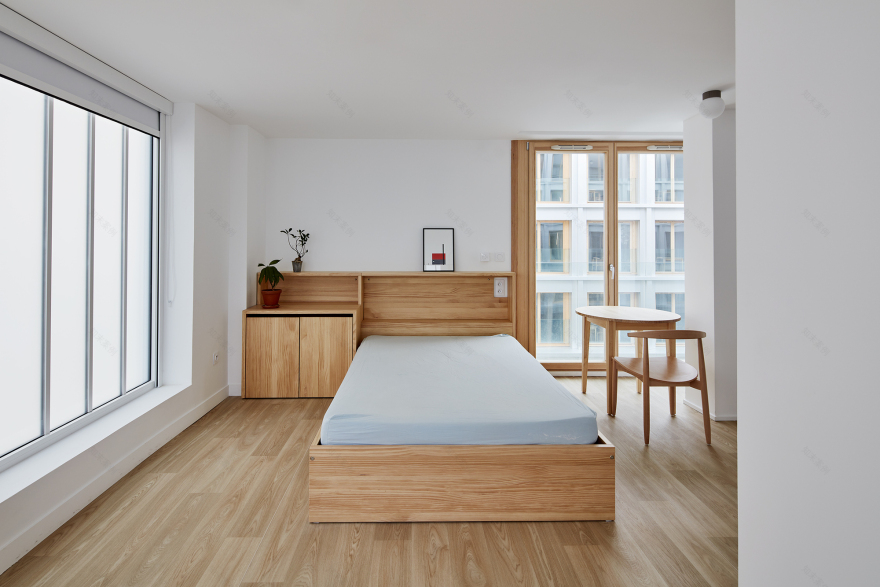
Integration of the programme into the siteAt the heart of the block, two sufficiently spaced buildings are thus freed. The first, west-facing, is connected to the street-front building and follows the volumetric continuity of the existing structure. Its roof was fully renovated, replacing tiles with standing-seam metal roofing.

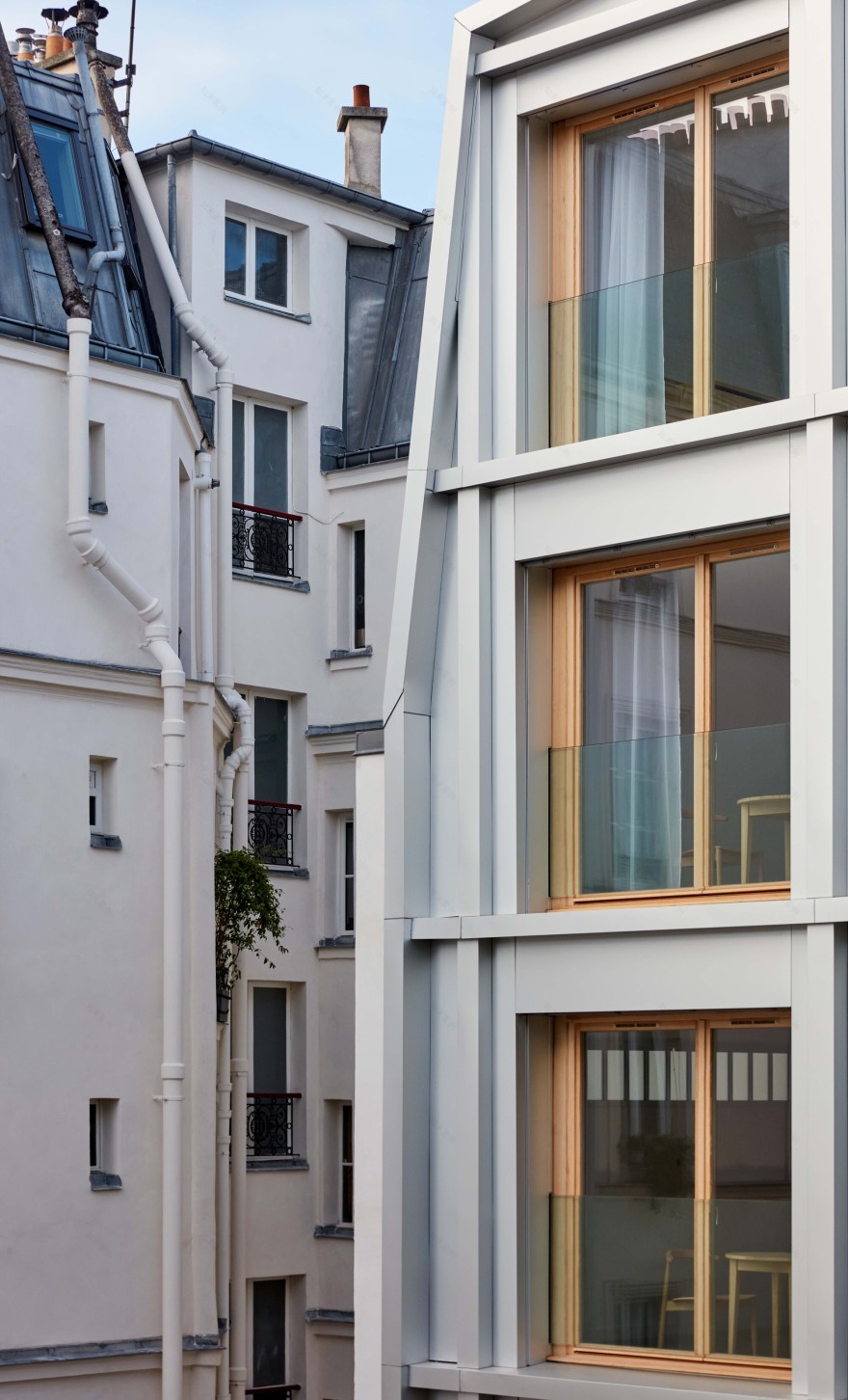
The street-facing building was entirely reconstructed using CLT timber panels (external walls, partitions and load-bearing walls), insulated with wood fibre. All window frames are made of wood. The housing layouts are simple, clear and oriented east–west with views onto the courtyard. No dwelling faces north.

Access and circulationThe entrances to the housing units and the activity space, both located directly on rue Nollet, are clearly separated. The entrance hall, visually open through to the heart of the block, reveals the depth of the plot from the street. The permeability of the circulation spaces towards the courtyard opens views onto the garden level, which is visually connected to all shared areas. All circulation spaces are 100% naturally lit.

The ground floor of the street-facing building acts as a catalyst for movement. Access to staff areas (offices) is distinct from public and residents' access. The reception desk, strategically positioned, oversees the entrance hall and access to both buildings. The waste storage room is located along residents' exit routes, as is the laundry room, which—considered a key shared space—also benefits from natural light. Finally, the common room is easily accessible from the entrance hall.

Each building is served by a naturally lit stairwell and an elevator. The existing basement beneath the street-front building was renovated and now houses technical rooms, storage areas and changing rooms.

The project includes 6 T1 bis units (average 33 sq m), 21 T1 units (average 18 sq m) and 56 T1' units (average 21 sq m), for a total of 83 rooms and a net residential area of 1,765 sq m, including 5% of units designed for accessibility (PMR) at ground level—all within the existing building envelope.

Project gallery



南京喵熊网络科技有限公司 苏ICP备18050492号-4知末 © 2018—2020 . All photos and trademark graphics are copyrighted by their owners.增值电信业务经营许可证(ICP)苏B2-20201444 苏公网安备 32011302321234号
苏公网安备 32011302321234号客服
消息
收藏
下载
最近