

创作上传
VIP
收藏下载
登录 | 注册有礼
查看完整案例

收藏

下载

分享
由 Sordo Madaleno 联合 építész stúdió 与 Buro Happold 组成的团队,在国际设计竞赛中脱颖而出,赢得匈牙利自然历史博物馆位于德布勒森的全新藏品中心设计权。该项目建筑面积约 43,000平方米,是一个具有地标意义的科学研究设施,同时也标志着这家第三代墨西哥建筑事务所首次在欧洲落地文化类项目。Sordo Madaleno 目前在伦敦与墨西哥城均设有事务所。德布勒森是匈牙利第二大城市,近年来正经历一轮重要的城市与大学基础设施升级,其中包括将匈牙利自然历史博物馆从布达佩斯迁至德布勒森大森林边缘。由 Sordo Madaleno 联合 építész stúdió 与 Buro Happold 设计的新藏品中心,主要用于超过1100万件馆藏的受控储存与研究,选址位于德布勒森大学科学园区内,距离新建的自然历史博物馆主体约4公里。
Sordo Madaleno with építész stúdió and Buro Happold have been selected to design the 43,000 sqm New Debrecen Collection Centre of the Hungarian Museum of Natural History. Appointed from a shortlist of 12 architects, this marks the first European cultural project for the third-generation Mexican architecture practice, which operates studios between London and Mexico City.
Debrecen, the second largest city in Hungary, is the focus of major urban and university infrastructure development that includes the relocation of the Hungarian Museum of Natural History from Budapest to the edge of Debrecen’s Great Forest. The Museum’s New Collection Centre by Sordo Madaleno with építész stúdió and Buro Happold is focussed on the controlled storage and study of over 11 million objects and its site lies within the University of Debrecen Science Park about 4km from the new Natural History Museum building.
▼项目概览,overall of the project © Sordo Madaleno + építész stúdió + Buro Happold
建筑作为空间的“容器”
Architectural concept – Building as Vessel
德布勒森藏品中心的设计灵感,源自匈牙利传统陶土器皿的朴素逻辑与优雅功能——一种用于保护与孕育的容器。设计团队通过对当地工艺传统与材料历史的研究发现,陶罐与土器长期以来被用于保存农产品与自然资源。由此诞生的建筑呈现为一座 141米 × 83米 的修长矩形体量,整体形态坚实、克制而恒久,具有强烈的原型性。
The New Debrecen Collection Centre follows the simple logic and elegant utility of the traditional Hungarian clay vessel: a building intended to protect and incubate. Drawing from the design team’s research into the region’s craft traditions and material histories—where clay vessels and earthenware have long been used for conserving produce— the 141m by 83m elongated rectilinear building reads as a solid, elemental and timeless design.
▼远景,view of the project at distance © Sordo Madaleno + építész stúdió + Buro Happold
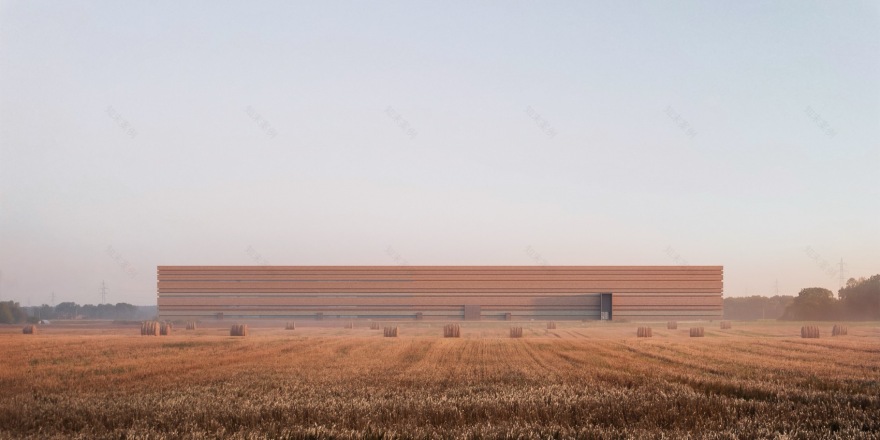
建筑针对高标准受控储藏、科研效率与知识的长期生产与保存进行了系统优化。其最具标志性的特征,是层理分明的砖立面:所用砖材的原土取自匈牙利不同地区,回应国家的地质与材料历史。砖色的微妙变化也隐喻着藏品中心所涵盖的学科维度——地质、化石、动物生命、人类活动与生态系统——以及其理解喀尔巴阡盆地乃至整个地球生物与地质多样性的使命。这些细微差异为整体近乎纪念碑式的体量注入层次感,使建筑自然延展至周边低矮开阔的田野与地平线之中。低调而克制的入口进一步强化了其作为安全、保管与保护之所的属性。
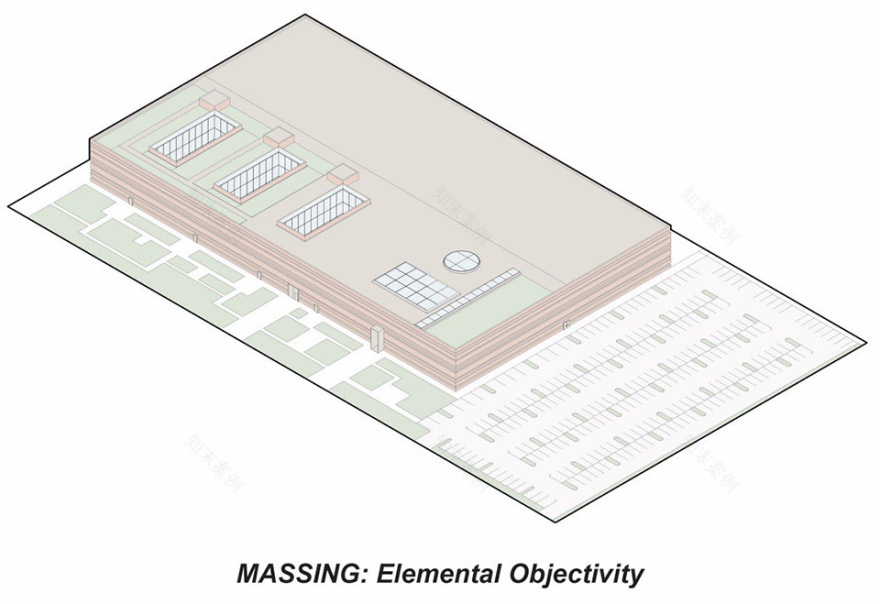
▼分析图,analysis diagram © Sordo Madaleno + építész stúdió + Buro Happold

The Centre is optimized for controlled storage, efficient research operations, and the long-term production and preservation of knowledge. The centre’s defining feature is its stratified brick façade referencing Hungary’s geological and material history with the soils used for the manufacturing its bricks originating from different regions of the country. The brick tones, too, create a material representation of the Collection Centre’s disciplines – geology, fossils, animal life, human activity, and ecology – and its mission to understand the bio- and geodiversity of not only the Carpathian Basin but also the entire earth. These subtle variations enliven the building’s monolithic form which extends the surrounding landscape with its low-lying fields and wide horizons. A discrete arrival point reinforces the notion of a building designed for security, collections care, and conservation.
▼外观,exterior appearance © Sordo Madaleno + építész stúdió + Buro Happold

▼建筑立面采用了赤陶,
the building facade is decorated with terracotta © Sordo Madaleno + építész stúdió + Buro Happold

▼立面近景,closer view of the facade © Sordo Madaleno + építész stúdió + Buro Happold

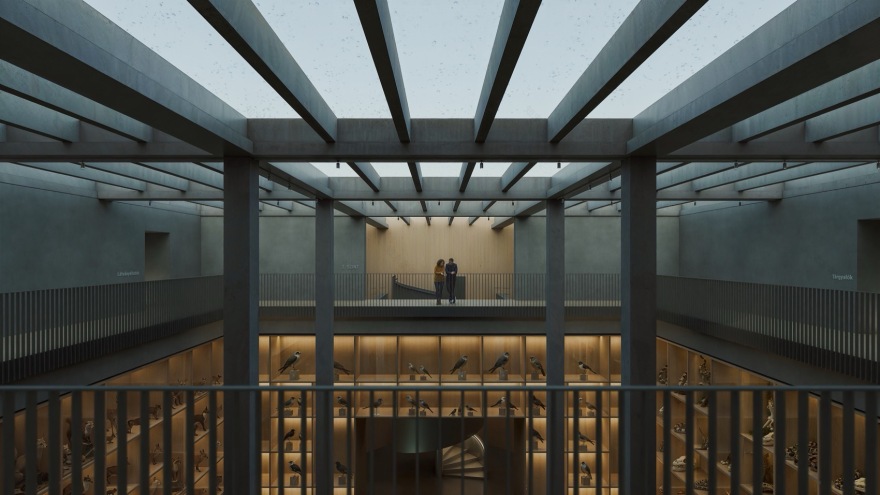
平面布局极为清晰而直接,确保了卓越的环境性能与技术性能。建筑包含地上三层与一层地下空间,整体划分为三大核心功能区域:其中 28,000 平方米 为档案馆藏储存空间,6,000 平方米 为研究与学习空间(包括文物保护实验室),以及一处用于接待学生团体与科研人员的 三层通高中庭。在这座由顶部采光的中庭中,博物馆馆藏中的精选展品被陈列展示,形成展览与画廊空间,并与相邻的报告厅相连,可同时用于各类活动。这一设置使其成为面向研究人员、学生及教育团体的理想公共空间。在工作人员日常使用频率最高的研究与实验区域,建筑通过内部庭院引入受控的自然采光与通风,在不削弱博物馆级文物保护严苛标准的前提下,确保了舒适的工作环境,并提供开阔的对外视野。
The plan is radically lucid, ensuring optimal environmental and technical performance. There are three key areas over three floors and a basement level. These are divided into 28,000 sqm of storage for the archive, 6,000 sqm of study spaces including conservation laboratories, and a welcoming triple-height atrium for visiting student groups and research professionals. Within the top-lit atrium, selected items from the Museum’s collection are displayed, creating an exhibitions and gallery space with adjoining lecture halls that can also be used for events. This makes it an ideal public offering for researchers, students, and educational groups. Within the study and laboratory areas most used by staff day-to-day, controlled light and ventilation is introduced through internal courtyards, thereby ensuring workspace comfort with generous views outdoors and without compromising on the rigorous museum-standard conservation requirements.
▼室内概览,overall of interior © Sordo Madaleno + építész stúdió + Buro Happold

▼展览空间,exhibition area © Sordo Madaleno + építész stúdió + Buro Happold

▼储存空间,storage area © Sordo Madaleno + építész stúdió + Buro Happold

Fernando Sordo Madaleno 如此描述该项目:“藏品中心的工作人员是这些对象的守护者,而建筑本身成为这种守护关系的延伸。在这一层层叠合的照护生态中,藏品不再是孤立的物件,而是承载生命世界与景观关系的存在。建筑通过这种互惠性,将保管者、利益相关者、空间与环境联结为一个整体。”
Fernando Sordo Madaleno describes the project, “The Centre’s staff are stewards of the objects, and the architecture becomes an extension of that stewardship. Within this layered ecology of care, the object is framed not as an isolated artefact but as an embodiment of life-worlds and landscapes that nourish reciprocal relationships. Our building reflects this mutuality, providing a space of unity between conservator, stakeholder, architecture, and environment.”
▼报告厅,lecture hall © Sordo Madaleno + építész stúdió + Buro Happold

评审团指出,Sordo Madaleno 联合 építész stúdió 与 Buro Happold 的获胜方案,在空间组织上精准回应了藏品储存、研究与实验功能的需求,同时确保了馆藏的长期保存、科研工作的高效运行以及国际科学合作的顺畅开展。评审团特别强调,设计团队在可持续性、安全性以及与馆藏相关的创新物流系统方面投入了高度关注,使该中心具备成为匈牙利自然历史博物馆科学支撑核心的卓越潜力。
Jury Comment: The jury highlighted that the winning design by Sordo Madaleno with építész stúdió and Buro Happold meets the role of the support institution well with its optimal spatial organisation for the stores, study spaces and laboratories while ensuring the long-term preservation of the collections, the smooth operation of research as well as the efficient conduct of international scientific cooperation. It was said that the design team paid special attention to sustainability, security and innovative logistics solutions relating to the collections, so the Centre can excel in serving as the scientific support base of the Hungarian Museum of Natural History.
▼夜景,night view © Sordo Madaleno + építész stúdió + Buro Happold

Client:
Municipality of the City of Debrecen
Hungarian Museum of Natural History
Competition organiser:
Debreceni Infrastructure Development Ltd
Project Team:
Sordo Madaleno: Javier Sordo Madaleno Bringas, Javier Sordo Madaleno de Haro,
Fernando Sordo Madaleno, Tamara Munoz, Jaime Sol, Carlos Reyes, Rick Liu, Audrey Tseng de Melo Fischer,
Juliana Biancardin, Marissa Glauberman, Castana Arango, Ann Dingli, Luis Frausto, Diego Velazquez, Aaron Sanchez
Epitezs Studio: Honich Richard, Szántó Hunor
Buro Happold: Thomas Kirchner, Neil Francis, Tom Headley, Nick Greenwood, Nicholas Trowles
CGI: BsArq

南京喵熊网络科技有限公司 苏ICP备18050492号-4知末 © 2018—2020 . All photos and trademark graphics are copyrighted by their owners.增值电信业务经营许可证(ICP)苏B2-20201444 苏公网安备 32011302321234号
苏公网安备 32011302321234号客服
消息
收藏
下载
最近