

创作上传
VIP
收藏下载
登录 | 注册有礼
查看完整案例

收藏

下载

分享
这间公寓单元,位处一座18层住宅的17层。这也是电梯所能到达的最高楼层。18层的邻居要通过角落里的楼梯回家。所以感受上,虽然是次顶层,却像在楼顶。从窗户看出去,在树木掩映下,绵延两个街区的使馆矮矮的匍匐在地上,很难进入视野。最近的高楼也退到1.5公里外的三里屯街边。因为没有遮挡,这个房间一年四季都沐浴在耀眼的阳光下,还享有被使馆区茂密树冠滤过的风。
▼建筑外景,Exterior of the building©成直

This apartment unit is located on the 17th floor of an 18-story residential building. This is also the highest floor accessible by the elevator. Neighbors of the 18th floor must use the staircase at the corner to reach their homes. So, although it is a penultimate floor, it feels as if it is at the very top. Looking out from the window, tucked away behind trees, the embassy compound stretches across two city blocks, its low structures crouching close to the ground and barely visible. The nearest high-rises retreat to Sanlitun Street, about 1.5 kilometers away. With no obstructions, the room is bathed in dazzling sunlight all year round, and it also enjoys breezes filtered through the dense canopy of trees in the embassy district.
▼室内环境,Interior environment©成直


有方向的空间
Directional Space
公寓楼建于1985年,是那个城市扩张早期,常见的两梯七户高层住宅。为了容纳更多居民,7个户型面积都很小,几乎一字排开争夺南向的采光。山顶洞之家41平方米建筑面积,又是这其中最小的一个,被委屈在一个南北向的长条里。最南端,是原户型的阳台,北端是入户门和隔着一条走廊的间接采光窗。除了一头一尾,单元中间不再有任何引入自然光线的机会。整个室内是个有明确方向感的空间。向南走,走向光亮的洞口,退一步就进入阴翳的“洞中”
The apartment building, constructed in 1985, is a typical high-rise residential building from the early years of the city’s augmentation, featuring two elevators servicing seven households per floor. To accommodate more residents, all seven unit layouts are small, almost aligned in a row competing for southern sunlight. Our unit, with a 41-square-meter floor area, is the smallest of them all, squeezed into a narrow space. At the southern end is the original balcony, and at the northern end is the entrance door, with an indirect lighting window separated by a corridor. The narrow layout offers no other opportunity to introduce natural light except at the two ends. The entire interior is a space with a clear sense of direction. Moving south leads toward a bright opening, while stepping back brings one into the shadowy “cave.”
▼洞中,Cave©成直


主人在这里已经居住了17年,他时常感受到,像是住在一个山顶长长的洞穴里。南侧的洞口像望远镜一样,望向远方。
The owners have lived here for 17 years and often feel as though they are residing in a long cave on a mountaintop. The southern opening acts like a telescope, gazing out into the distance.
▼室内采光,Interior daylighting©成直
洞穴中的守护和观望
The Gazing and Beholding of the Cave
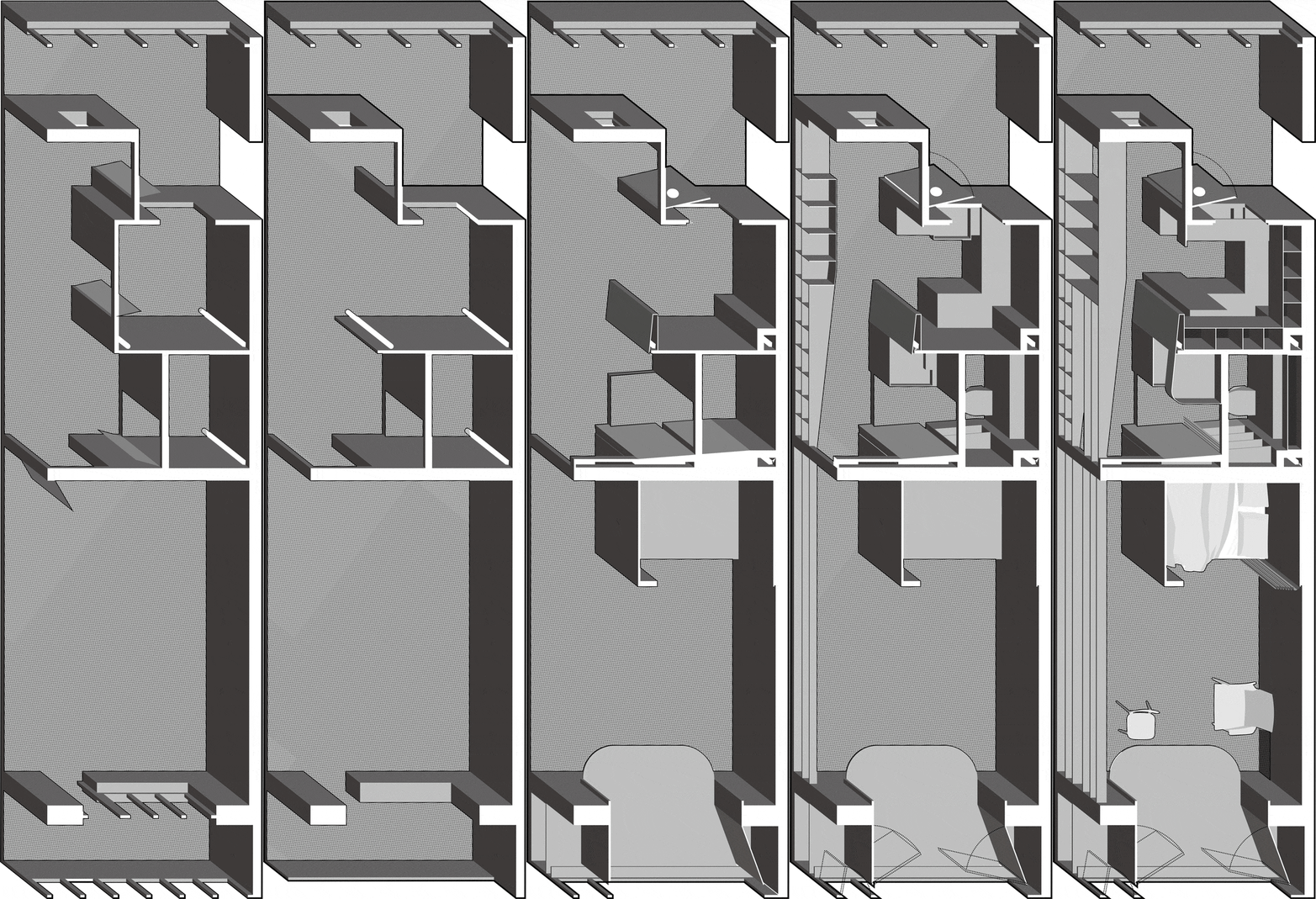
人们对洞穴空间的感受,据说来自对子宫的记忆。加斯东.巴什拉(Gaston Bachelard)在其著作《空间诗学》中提到,洞穴往往象征亲密,庇护和安全。这些城市中的高密度住宅,当我们忽略邻里空间所包含的内容,把整幢大楼想象成一个巨大的外部实体,那么,似乎大山和大楼没有两样。“洞穴”身处一个巨大实体当中。
▼概念生成,Concept generation ©察社办公室


The sensation people experience in cave spaces is often said to stem from memories of the womb. Gaston Bachelard, in his work The Poetics of Space, suggests that caves often symbolize intimacy, shelter, and security. In these high-density urban residential buildings, when we overlook the space that the neighborhood might offer and imagine the entire building as a massive external entity, it seems as if a mountain and a building are no different. A “cave” is enclosed within a massive entity.
▼昏暗的卧室,A dim bedroom ©成直

这种包裹带来的不单是庇护,也像监牢一样把人们幽闭其中。在大卫霍克尼依据格林童话创作的蛋中男孩画作中,似乎男孩并没有从这个完美庇护所里得到完全的心安。如果在蛋壳上方抠出一个可以窥探外界的孔洞,蛋壳也就不再是那个小小的监牢。向外张望的蛋中男孩,对照了我们对改造结果的想象。设计应该回应“山顶的洞穴”,而不寄期待于转变场地的自有禀赋,转变这个可以向外窥探的阴翳场所变为光明开阔之地,或者其他不属于它的假象。
The enclosure not only provides shelter but also serves to confine individuals like in a prison. In David Hockney’s painting The Boy Hidden in an Egg, inspired by Grimm’s fairy tales, it seems that the boy does not seek complete peace within this perfect shelter. If a hole were to be made above the eggshell, allowing a view to the outside world, the shell would no longer be that tiny prison. The boy looking outward from the egg contrasts with our imagined outcome for renovation. The design should respond to the “mountain cave,” rather than hoping to transform the space into a bright and open place or any other fake illusion.
▼走廊顶灯,Corridor ceiling light ©成直

洞口
The Opening
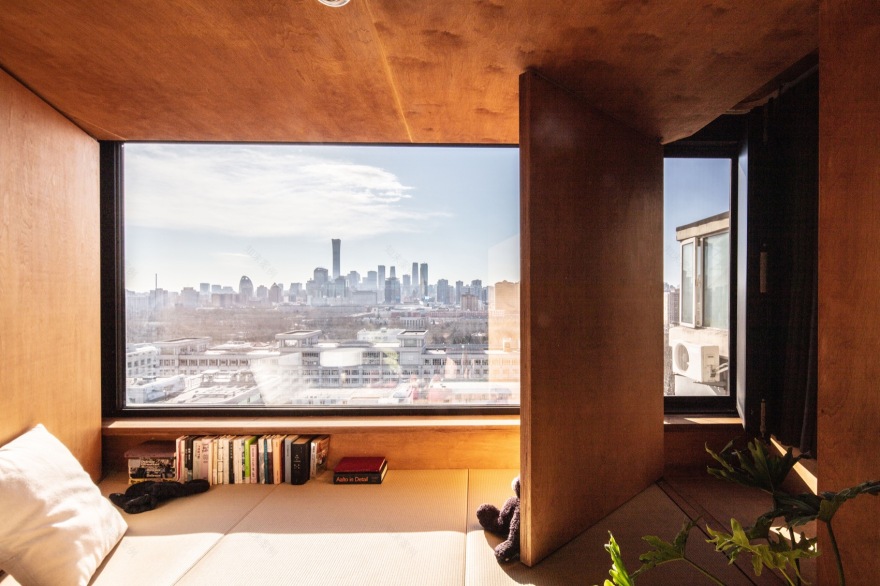
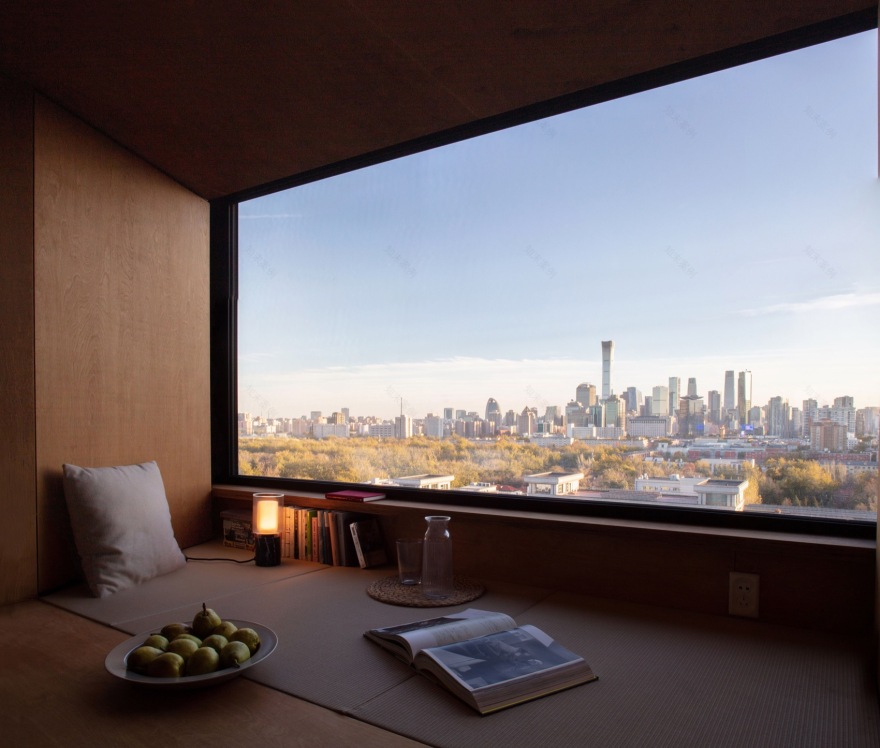
在今天的城市生活中,阳台往往成为鸡肋。反而双层立面,为光线黯淡的室内空间又戴上了一层额外的面纱。人们通常会去掉内侧的门窗。但物业不允许拆除的窗下墙,成为障碍物,并不能把阳台空间有效融入到室内当中。改造依据窗下墙的高度,搭建平台。平台成为一个巨大飘窗,可以让人们或座或卧在洞口,同时也扮演了一张巨大的桌子。这也是这个尺度极小的家里,唯一的桌子。台子下面埋伏了一组收纳空间;上面的窗洞口被一整块玻璃覆盖。两侧旋转门界定这个“桌子”的边界,而窗户开启扇藏在旋转门的背后。没有横竖窗框的干扰,真正实现了“洞口”一样的视野,光照和空间体验。
In today’s urban life, balconies are often seen as a wasted feature. On the contrary, double facades add an extra layer of veiling to the already dimly lit interior space. People often remove the inner windows and doors. However, the wall below the window, which cannot be removed due to property restrictions, becomes an obstacle, preventing the balcony space from blending effectively with the interior. The renovation takes the height of the wall below the window into account and constructs a platform. The platform becomes a large bay window where people can sit or lie down at the opening, while also functioning as a large table. This is the only table in this tiny space. Beneath the platform, there is a hidden storage space, while the window opening above is covered by a large piece of glass. The rotating doors on either side define the boundary of the “table,” with the open panel hidden behind the rotating door. Without the interference of horizontal or vertical window frames, it truly achieves the view, light, and spatial experience of an “opening.”
▼洞口的风景,The scenery at the openof the cave ©成直

▼阳光照进洞内,Sunlight come into the cave ©成直

洞壁
The Cave Walls
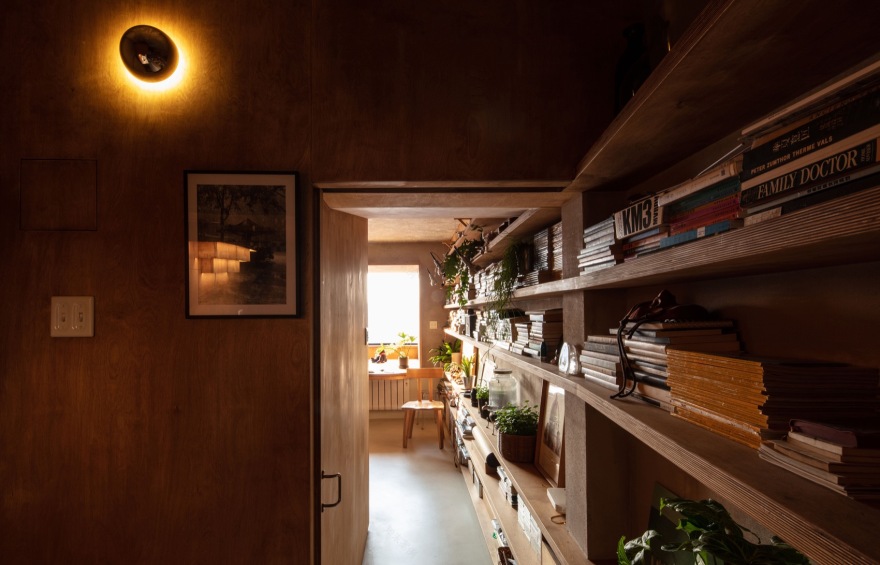
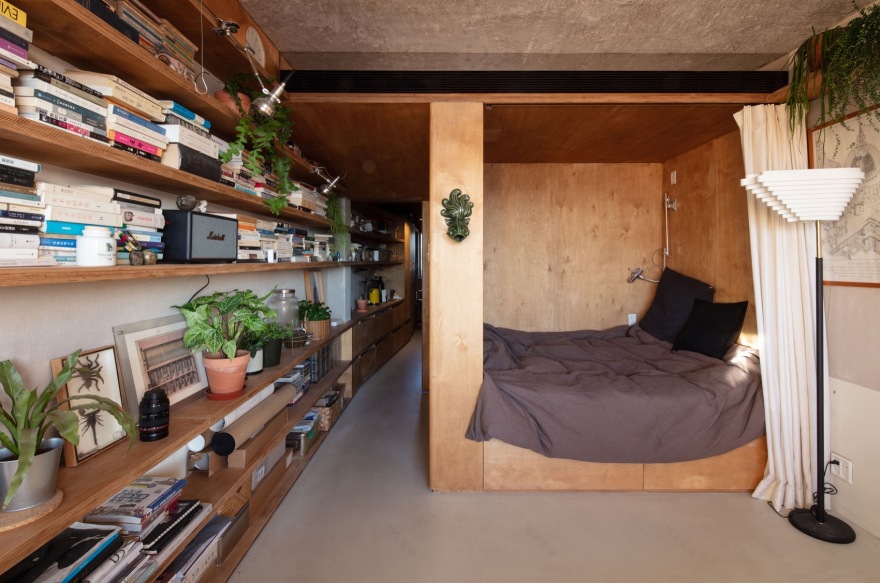
房间狭小又要满足足够的收纳功能。主人夫妇的日常用品,衣物鞋帽,书籍资料等等诸多杂物,都需要被妥善安置。改造选择放弃在大房间中分割储藏区域,而深度挖掘北侧走廊。走廊被挤压成阴翳细长的通道。收纳空间被或左或右安置在两侧。原来正交的走廊,因此发生转折。西侧洞壁被连续的书架和书定义。人们从两个方向进入走廊,视线上,书架都延伸到洞穴深处。这种连续感模糊了空间的边界。唯一的分割门由平开变成推拉,关门的时候,门板顶在书架上,留下一些缝隙。光线可以在缝隙两侧互相渗透。
▼空间改造,Interior renovation©察社办公室
The room is small but needs to accommodate plenty of storage. The owner couple’s daily items—clothes, shoes, books, and various other miscellaneous objects—need to be neatly organized. The renovation chose not to divide the larger room for storage. Instead, they deeply explore the northern corridor. The corridor is compressed into a narrow, shadowy passage. Storage spaces are placed on either the left or right sides. The original orthogonal corridor now takes a turn. The western cave wall is defined by continuous bookshelves and books. People enter the corridor from two directions, and visually, the bookshelves extend deep into the cave. This continuity blurs the boundaries of the space. The only partition door was changed from a swing door to a sliding one, and when it is closed, the door panel presses against the bookshelf, leaving small gaps through which light can penetrate, allowing light to filter through the cracks from both sides.
▼洞壁内的装饰,Decorations on the cave walls ©成直


▼过道,Corridor©成直


▼洞内的休闲时光,Leisure time inside the cave wall ©成直

洞中之洞
Caves Within a Cave
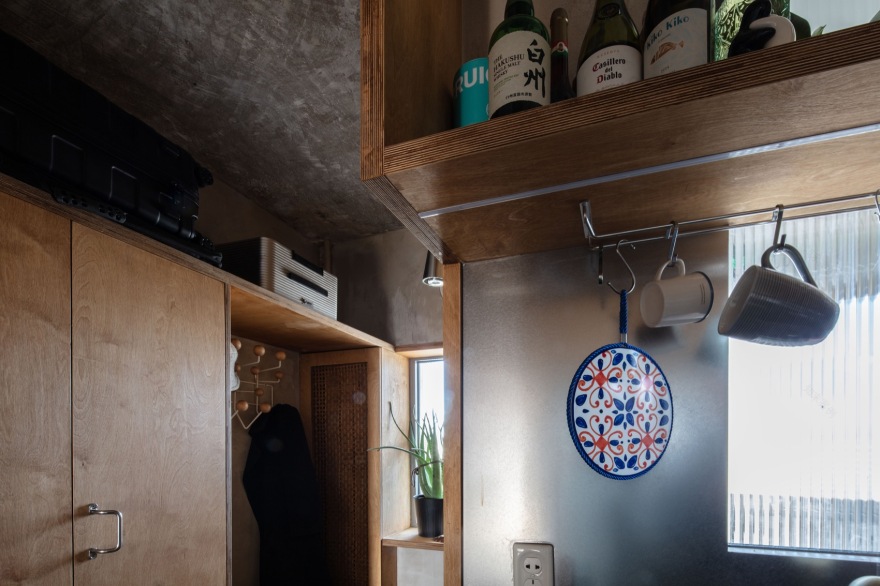
为了避免狭窄通道的压抑,“洞壁”上也被部分打开,取消的隔墙和柜门,把厨房,卫生间,玄关换鞋处,变成一系列的凹龛。马桶和淋浴是唯一被封闭起来的空间。入口被故意设置成1.75米高,人进出甚至要低头。这两个最最隐私的功能,仿佛被隐藏在洞中的洞中。
To avoid the depressive feeling of a narrow corridor, parts of the “cave wall” were also opened up. The removed walls and cabinet doors turn the kitchen, bathroom, and entrance area into a series of niches. The toilet and shower are the only enclosed spaces. The entrance was deliberately set at a height of 1.75 meters, forcing people to bend their heads when entering or exiting. These two most private functions seem to be hidden deep inside, like caves within the cave.
▼厨房,Kitchen ©成直


▼卫生间,bathroom©成直


同样的方式被运用在卧室。所谓卧室,是个被板材包裹的盒子。朝向房间一面可以拉上帘子,变成一个更加隔绝隐私的空间,就像中国古代的架子床或者拔步床。山顶洞之家的改造,是在一个极小空间里,一边挖掘场地自身的禀赋,一边探索“家”的意义和可能。“山顶的洞穴”其空间特征被放大,把家具转化成连续的体量或者界面。在橱柜,书架,马桶和床这一系列日常用物之间,通过光线引导,尺度放缩,强化庇护所一般的亲密和安全感。同时观望的洞口被强调,单一方向的光线在洞穴深处幽幽地渗透,附和着那毫无遮挡的视线,这一切似乎把居住者和自然再一次强力的连接在了一起。
The same approach was applied to the bedroom. The so-called bedroom is a box wrapped in panels. One side facing the room can be covered with curtains, turning it into a more private space, similar to the ancient Chinese “canopy bed”.The renovation of the Upper Cave Home explores the meaning and possibilities of “home” while excavating the inherent qualities of this tiny space. The spatial characteristics of the “upper cave” are amplified, transforming the furniture into continuous volumes or interfaces. Through light guidance, scale adjustments, and reinforcing the intimacy and sense of security of a shelter, everyday objects such as cabinets, bookshelves, toilets, and beds were integrated into the design. At the same time, the viewing opening is emphasized, and the single direction of light softly penetrates deep into the cave, in harmony with the unobstructed view. All of this seems to reconnect the inhabitants with nature in a powerful way.
▼夜晚的卧室,The bedroom at night ©成直


▼建筑平面,Building plan©察社办公室

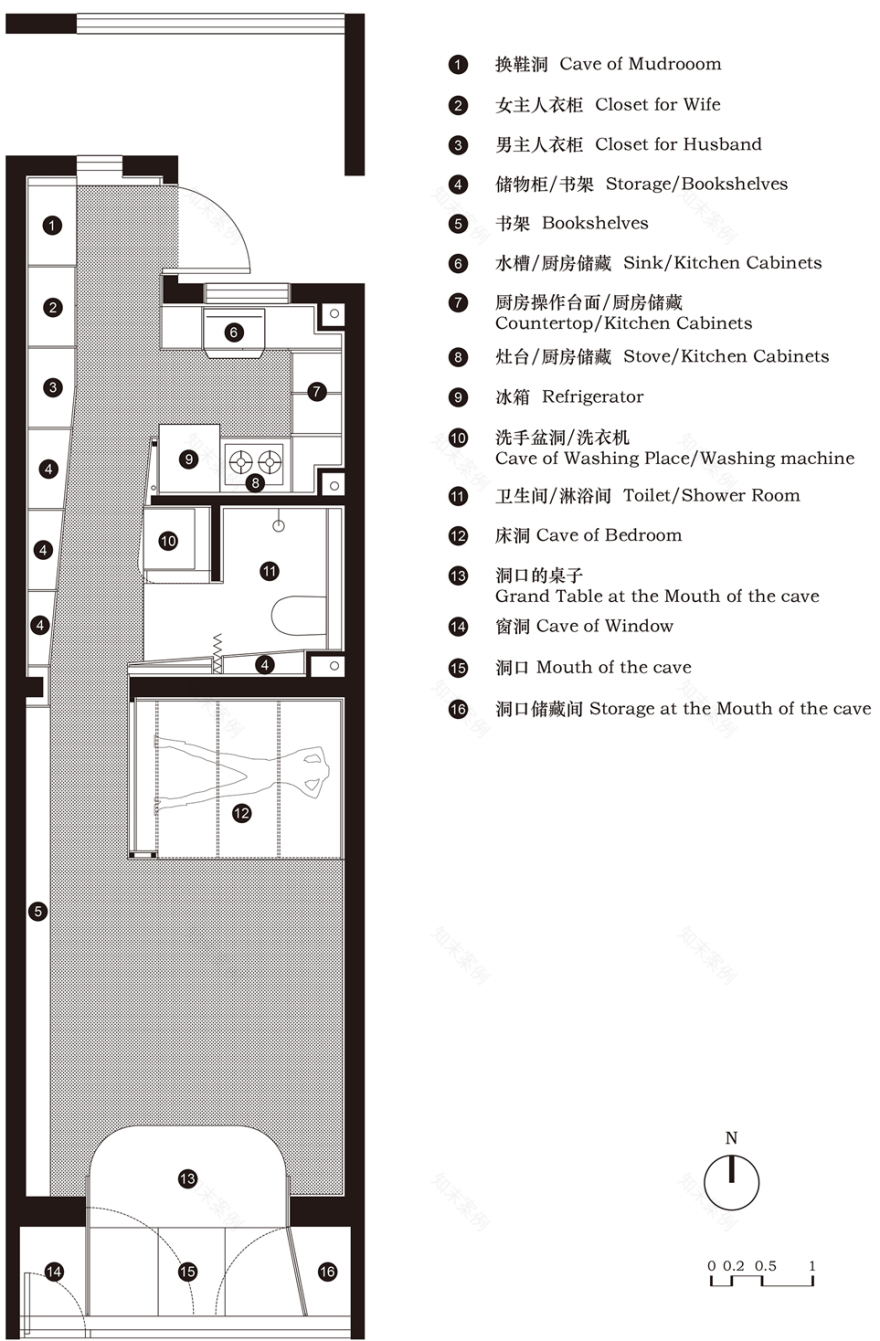
▼公寓平面,Apartment plan©察社办公室
项目名称:山顶洞之家-老破小里的庇护和观望
项目类型:室内设计
设计方:察社办公室chaoffice.info
项目设计:2024
完成年份:2025
设计团队:成直
项目地址:北京市朝阳区三里屯北小街
建筑面积:41㎡
摄影版权:成直
合作方:施工负责人 黄晶胜
客户:
材料:柳桉木胶合板 断桥铝门窗
品牌:东方港木业, 京驰
Project name:Chamber of Mountain Cave – Sheltering and Gazing
Project type:Interior Design
Design:chaoffice chaoffice.info
Design year:2024
Completion Year:2025
Leader designer & Team:CHENG Zhi
Project location: Sanlitun Beixiaojie Road, Chaoyang District, Beijing, P.R.China
Gross built area: 41㎡
Photo credit: CHENG,Zhi
Partner:Head of construction: HUANG,Jingsheng
Clients:
Materials:laminated eucalyptus plywood / Bridge-cut-off Aluminium Alloy Window
Brands:东方港木业 / 京驰


南京喵熊网络科技有限公司 苏ICP备18050492号-4知末 © 2018—2020 . All photos and trademark graphics are copyrighted by their owners.增值电信业务经营许可证(ICP)苏B2-20201444 苏公网安备 32011302321234号
苏公网安备 32011302321234号客服
消息
收藏
下载
最近