

创作上传
VIP
收藏下载
登录 | 注册有礼
查看完整案例

收藏

下载

分享

翻译

Architecture studio Metrooffice Architetti has renovated an abandoned Italian factory for fashion brand Balenciaga, creating a sculptural reinforced-concrete building where "nothing is concealed or decorative".
The 8,000 square-metre complex, in the town of Cerreto Guidi in Tuscany, will function as a manufacturing hub for Balenciaga with a special focus on leather goods.
Previously abandoned, it comprises three buildings – the Main Plant, the Training Centre and the Bridge – which were built between the 1960s and 80s and have now been renovated and updated by Metrooffice Architetti.

The factory is located in Tuscany, Italy
"The concept is based on the idea of continuity: between past and present, industrial memory and new production, and the agricultural landscape and contemporary productive architecture," Metrooffice Architetti told Dezeen.
"The intervention goes beyond a simple functional renovation, instead seeking to reinterpret the existing buildings by enhancing their structure, proportions, and distinctive features, while integrating new spatial, technological, and environmental solutions."
One of the main interventions was made to the Main Plant, which was given a new double roof, intended as a statement piece that would look like it was suspended among the area's olive trees.

It was originally built in the 1960s to 80s
The studio carefully restored the buildings' original reinforced concrete, which was then juxtaposed with glass and aluminium elements and resin floors.
"The selection of materials was guided by the desire to preserve and clearly express the original structure, integrating it with contemporary materials capable of entering into dialogue without overlapping or competing with it," Metrooffice Architetti said.
"Exposed reinforced concrete, a defining element of the complex, was restored and enhanced rather than concealed: it embodies the site's industrial memory and forms the material foundation of the project."
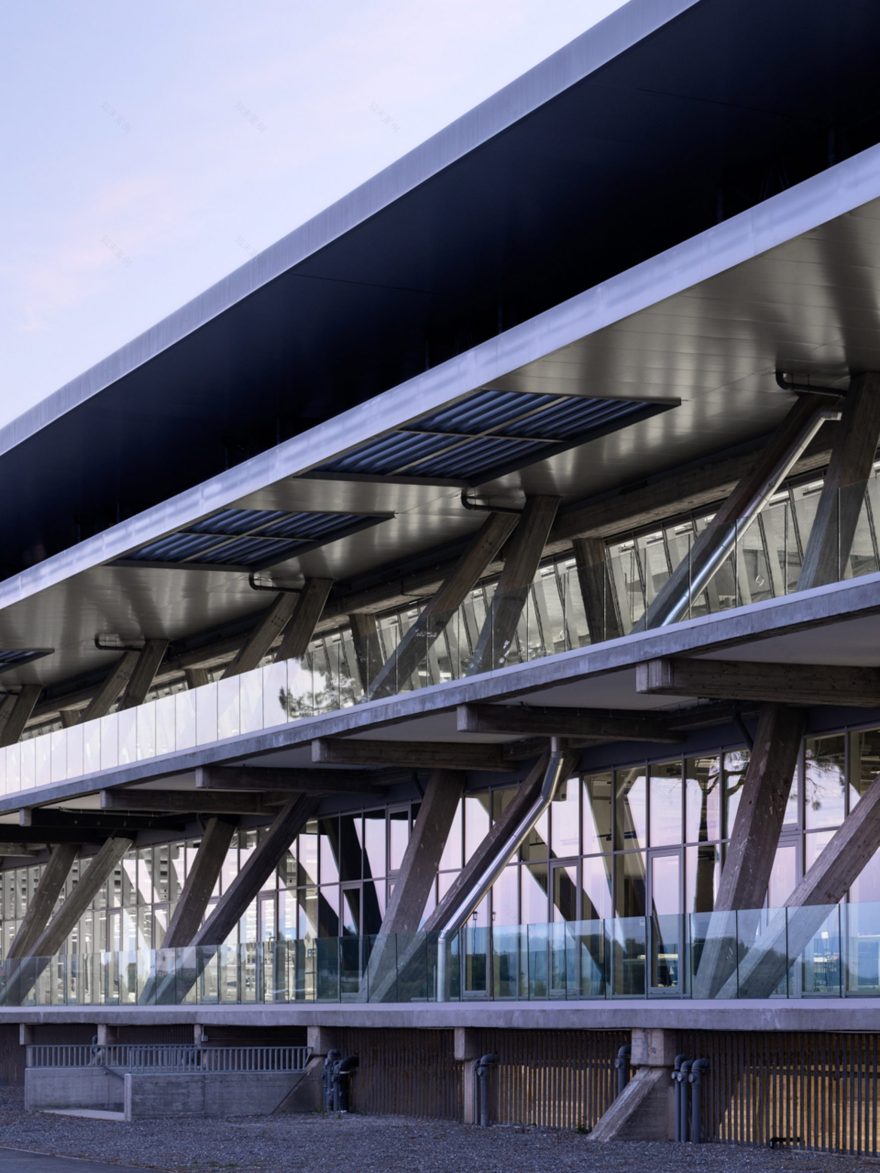
Metrooffice Architetti "restored and enhanced" its reinforced-concrete structure
Throughout the three buildings, beams, columns and technological components were left exposed.
The Main Plant's ground floor holds a reception with a striking stainless-steel reception desk and wall panelling that contrasts against the raw concrete pillars.

A stainless-steel reception area welcomes visitors
On the first floor, the building was designed without internal pillars to create space for assembly.
The second floor has a glazed lobby and connects to a relaxation area through which people can access the garden and the Training Center building.
The reinforced concrete "is complemented by a palette of essential materials, chosen for their functional, aesthetic, and long-term performance qualities: glass, metal, aluminium, continuous resin flooring, and polycarbonate," the studio explained.
"Glass strengthens the relationship between interior and exterior, between production spaces and the landscape; polycarbonate, used in roof light wells and technical areas, was selected for its ability to evenly diffuse natural light, improving the quality of workspaces while also acting as a visual screen for technical zones."

The manufacturing hub specialises in leather goods
The third and fourth floors of the Balenciaga factory's Main Plant form the double-layer roof. One of these holds technical terraces, the other 2,000 square metres of photovoltaic panels.
These supply around 20 per cent of the factory's total energy consumption, according to Balenciaga.

Parts of the building have an open-plan layout
Sustainability was also taken into account when it came to the roof and the interior partitions of all three buildings, which have thermo-acoustic insulation that was made out of recycled textile fibres from Balenciaga's trainer manufacture scraps.
"Overall, the design approach is honest and direct: structures and building systems are left exposed, defining a coherent, functional, and authentic architectural language," Metrooffice Architetti said.

Metrooffice Architetti followed Balenciaga's "raw architecture" concept for the design
The overall design aligns with Balenciaga's "raw architecture concept", which has an industrial feel and has previously been used in Balenciaga's Sloane Street store in London, as well as its first store in Berlin.
"The building embodies the concept of raw architecture through an approach that prioritises the authenticity of materials and the clear legibility of the construction process and its layers," the studio explained.
"Nothing is concealed or decorative: the reinforced concrete structure, building systems, technical surfaces, and functional elements become integral to the architectural expression."
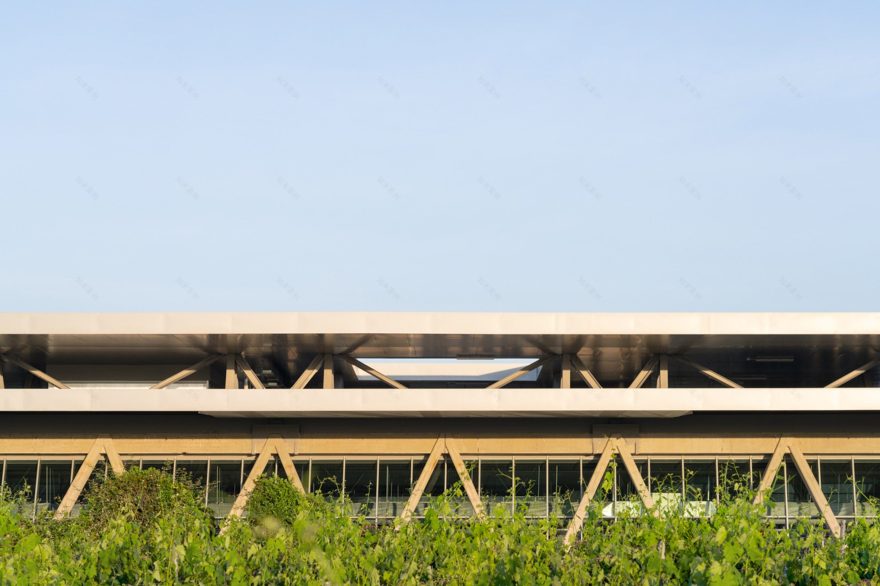
The factory was given a new double roof
The final result helps to underline Balenciaga's ethos, Metrooffice Architetti argued.
"The architecture becomes a physical expression of the brand's values: radicality, experimentation, coherence, and the tension between industry and culture, translating Balenciaga's language into a built, spatial dimension," the studio concluded.
The photography is by Marco Capelletti.
南京喵熊网络科技有限公司 苏ICP备18050492号-4知末 © 2018—2020 . All photos and trademark graphics are copyrighted by their owners.增值电信业务经营许可证(ICP)苏B2-20201444 苏公网安备 32011302321234号
苏公网安备 32011302321234号客服
消息
收藏
下载
最近