

创作上传
VIP
收藏下载
登录 | 注册有礼
查看完整案例

收藏

下载

分享

翻译
Architects:ErranteArchitetture
Area:320m²
Year:2025
Photographs:Luca Bosco
Category:Houses,Renovation
Design Team:Sarah Becchio, Paolo Borghino
Collaborators:Andrea Loi, Francesco Sordo, Ilaria Boggiatto, Emma Colella, Margherita Randazzo
Site Construction Supervision:Paolo Borghino
Structural Design And Construction Site Safety:Fabio Borello
Window/Door Frames:BrunettoLegno
Timber Construction:Clen Legnami
City:Paesana
Country:Italy

Text description provided by the architects. At the entrance to the Po Valley, in the province of Cuneo, a house with a simple, compact profile reveals itself gradually. The construction does not appear to flaunt striking gestures, but rather blends discreetly among its neighbors — tall apartment blocks, clumsy detached houses, a constellation of buildings without particular quality. Yet appearances are deceiving. A radical transformation, partly concealed within its own volume, lies at the origin of ErranteArchitetture's project for Casa BM: an intervention that dismantles the existing structure to generate new spatial configurations and distinct atmospheres. It is an apparently paradoxical operation, conducted in the spirit of artistic research and self-construction practices.


The project originates from the recovery and extension of a disused two-story dwelling from the 1960s. ErranteArchitetture — the practice founded by Sarah Becchio and Paolo Borghino — worked extensively to give new life and identity to this structure, transforming it into an original family residence that fits soberly into the surrounding landscape. The slightly sloping plot lies only a few dozen meters from the Po River, opening westward toward pastures and mountains, with the peak of Monviso dominating the background.


Completed in early 2025, the house extends over approximately 450 square meters, distributed between the original building and a new one-story pavilion added on the eastern side. Before the intervention, the plan of the existing house favored its relationship with the valley road, toward which the kitchen and living area faced. To the east, a four-story apartment block loomed over the property's main portion, depriving this side of privacy and making it unwelcoming. The western side, facing the sunlit rear garden with open views of pastures, the riverbed, and the mountains, accommodated the sleeping area.

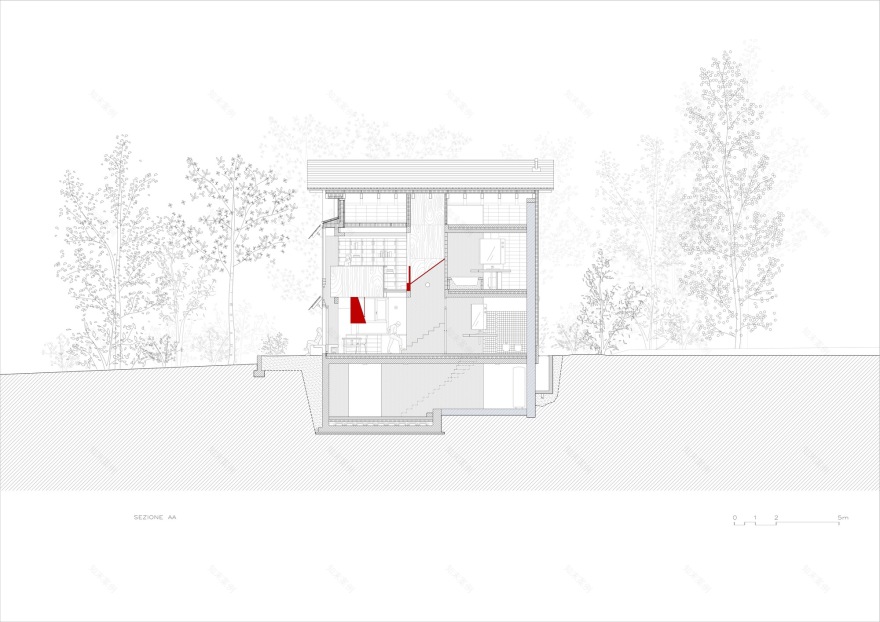
ErranteArchitetture's design redefined the pre-existing volume, expanding its functions through the addition of a lower pavilion connected to the main building on the east. The new volume accommodates the entrance and living area, along with a small study with independent access. The extension generates an L-shaped plan that reverses the original orientation: the main façade now opens southward toward the garden and landscape. Here, a full-height glazed façade connects the interior to the exterior, while a porch and terrace articulate the transition to the gently sloping terrain.

Of the original structure, only the external shell has been largely preserved, with targeted interventions on the openings and the addition of high-thermal-mass insulation. Within it, the kitchen and dining room now occupy the ground floor, while the upper level houses the study and sleeping area. The roof and slabs were replaced, enabling a broader reconfiguration of space and experimentation with architectural language. Externally, the northern and western elevations — those most visible from the road — retain the original character, unified by a monochrome plaster finish. To the south, however, the solid masonry gives way to a full-height glazed façade. The large composite timber frame establishes a strong visual connection between the interior, the garden, and the surrounding landscape. At the same time, much of the immediate context is deliberately screened off by an almost blind reinforced-concrete wall facing east.
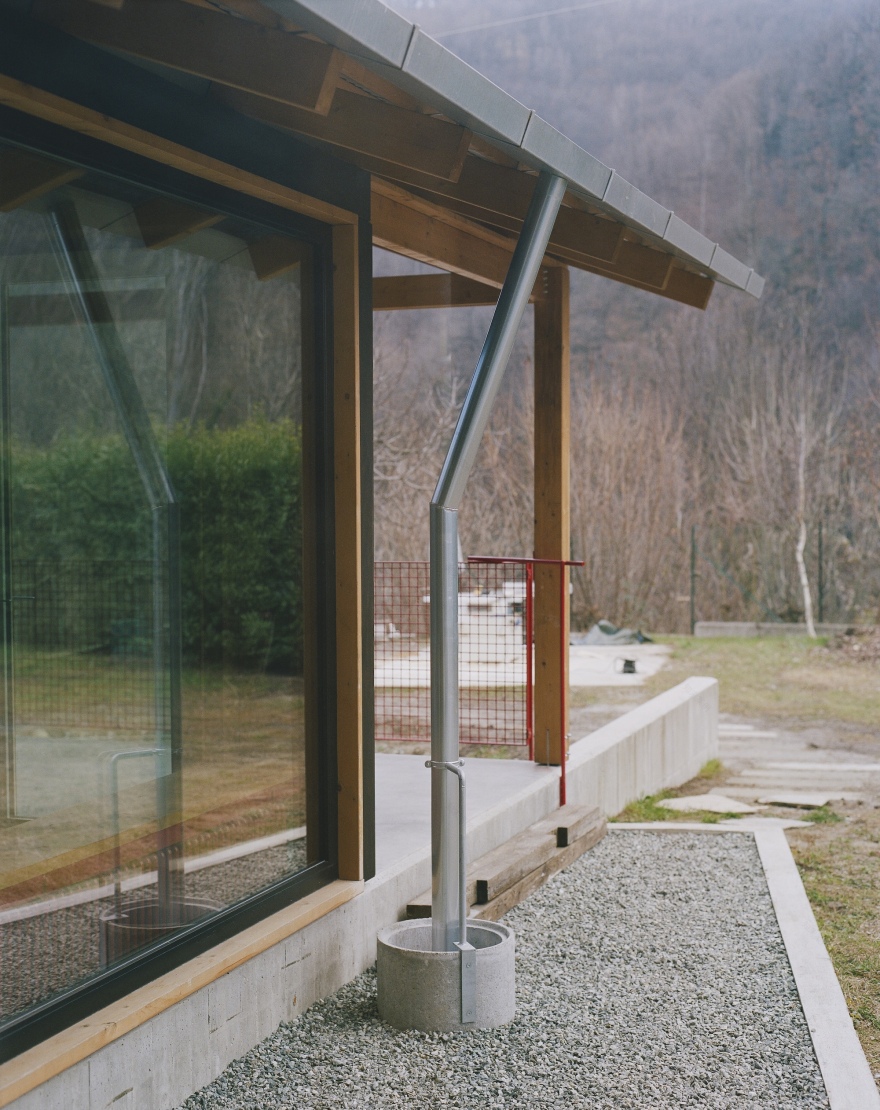
The articulation of the new pavilion follows the same logic. To the west, large glazed openings frame views of the garden and landscape, while to the east, the proximity of the neighboring building is mitigated by a covered passage alongside a reinforced-concrete wall, shielding the living spaces from direct view. The passage gradually widens into a porch sheltered by the continuation of the double-pitched roof. To the south, the covered terrace overlooks a further recessed area formed by the sloping connection between the garden and the workshop below. A large window, set deep within a loggia, brings daylight and views of the garden into the semi-basement workspace.


These design choices — rooted in ErranteArchitetture's ongoing exploration of form and construction through fragments of a broader architectural discourse — constitute a kind of reversal. The architects describe this as "an indispensable action to bring order to the site's contradictions and to redefine the building's relationship with its surroundings."

Inside, space is systematically subverted and recomposed through a sequence of environments that produce unexpected articulations. The new partition walls — particularly on the upper level — cut through the volume, disregarding the original envelope to strengthen the connection with the pavilion and optimize exposure and distribution. Simple and raw materials — exposed concrete, pine plywood panels, and concrete blocks — define the domestic and work areas, enriched by built-in furniture such as benches, shelves, and desks. Visual sequences, double heights, and diagonal perspectives enhance the perception of continuity between levels and between inside and outside. Many custom-designed details reveal an intent to experiment with ordinary elements: railings, gutters and downpipes, roof bracings, the fence along the road, and even the ridge beam of the existing building testify to a design attitude seeking unexpected potential within the commonplace.

Surprising yet familiar, Casa BM stands as an original but not alien construction, capable of redefining a peripheral fragment of territory by combining rigor and liveliness. The work of ErranteArchitetture thus defines itself through subtle deviation rather than contrast, suggesting the possibility of coexisting with the limits and contradictions of much of Italy's conventional suburban building fabric. This project enhances what already existed, restoring dignity to the built landscape of the Po Valley through a few decisive, carefully measured gestures.

Project gallery






南京喵熊网络科技有限公司 苏ICP备18050492号-4知末 © 2018—2020 . All photos and trademark graphics are copyrighted by their owners.增值电信业务经营许可证(ICP)苏B2-20201444 苏公网安备 32011302321234号
苏公网安备 32011302321234号客服
消息
收藏
下载
最近