

创作上传
VIP
收藏下载
登录 | 注册有礼
查看完整案例

收藏

下载

分享
位于日本兵库县芦屋市的眼镜店——Ashiya Optical Store 的室内设计。业主对建筑与设计抱有浓厚兴趣,希望打造一处不以单纯“售卖商品”为导向的空间,而是将顾客服务的场景以及眼镜的陈列本身,视为空间构成的一部分。项目选址于芦屋市一处安静的街角。新建筑的立面顺应道路与铁路的走向,以多重折角展开,其轮廓形态直接影响了内部的租赁空间。
The interior design of an Eyewear Store located in Ashiya, Hyogo, Ashiya Optical Store. The owner had a deep interest in architecture and design, and sought a place that was not based on conventional planning focused simply on selling products, but one in which scenes of customer service and the displayed eyewear could be regarded as part of the space itself. That location was tucked away in a quiet corner of the town of Ashiya. The facade of the new building was articulated through multiple angles, as it was planned along the road and the railway, and its outline directly influences the tenant space.
▼门头,storefront © Yoshiro Masuda

▼多重折角室内空间,multiple angles interior space © Yoshiro Masuda


在设计过程中,我们思考如何在不对建筑与室内进行传统区分的前提下,构建一种共享的空间节奏。沿着由多重折角构成的外墙结构,其几何关系被以细微错位的方式引入室内,由此生成一系列内部线条,并进一步形成室内墙体与展示家具。
We considered how a space could be designed with a shared rhythm, without conventionally separating architecture and interior. Following the structure of the exterior walls, articulated through multiple angles, the geometry was duplicated with subtle offsets. Through this process, a series of interior lines were generated, forming internal walls and display furniture.
▼室内概览,overview of the interior © Yoshiro Masuda


通过引入与建筑结构相近的角度关系,建筑的存在感得以逐步显现,并作为一种室内空间的象征发挥作用;顾客之间的互动,也通过一系列具有角度变化的室内元素被组织与表达。
By introducing angles similar to those of the architectural structure, we attempt to allow the presence of architecture to gradually emerge and function as an interior symbol. Customer interactions are also articulated through a series of angular interior elements.
▼陈列台,display platform © Yoshiro Masuda
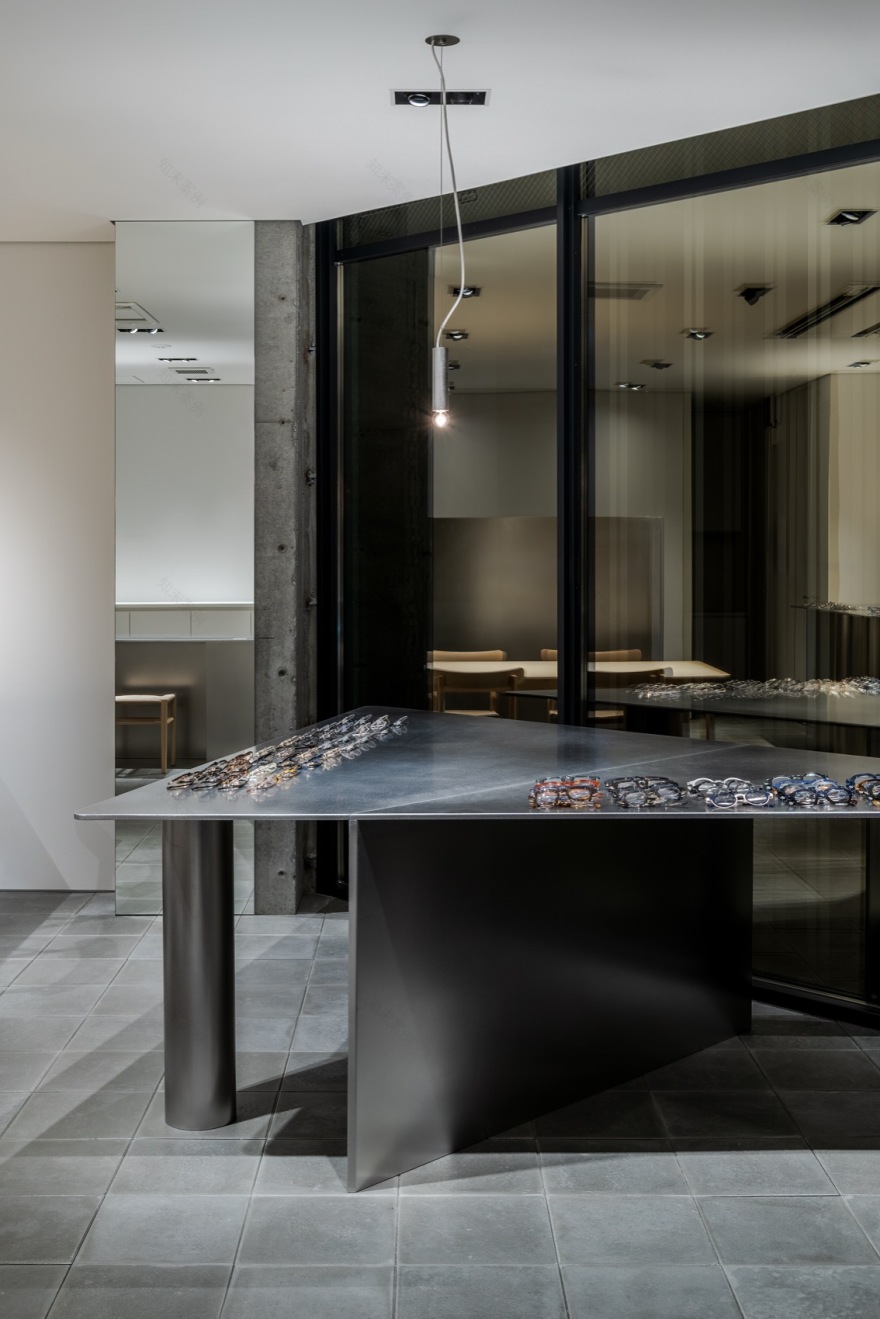

▼家具近景,furniture close view © Yoshiro Masuda

▼家具细部,furniture details © Yoshiro Masuda
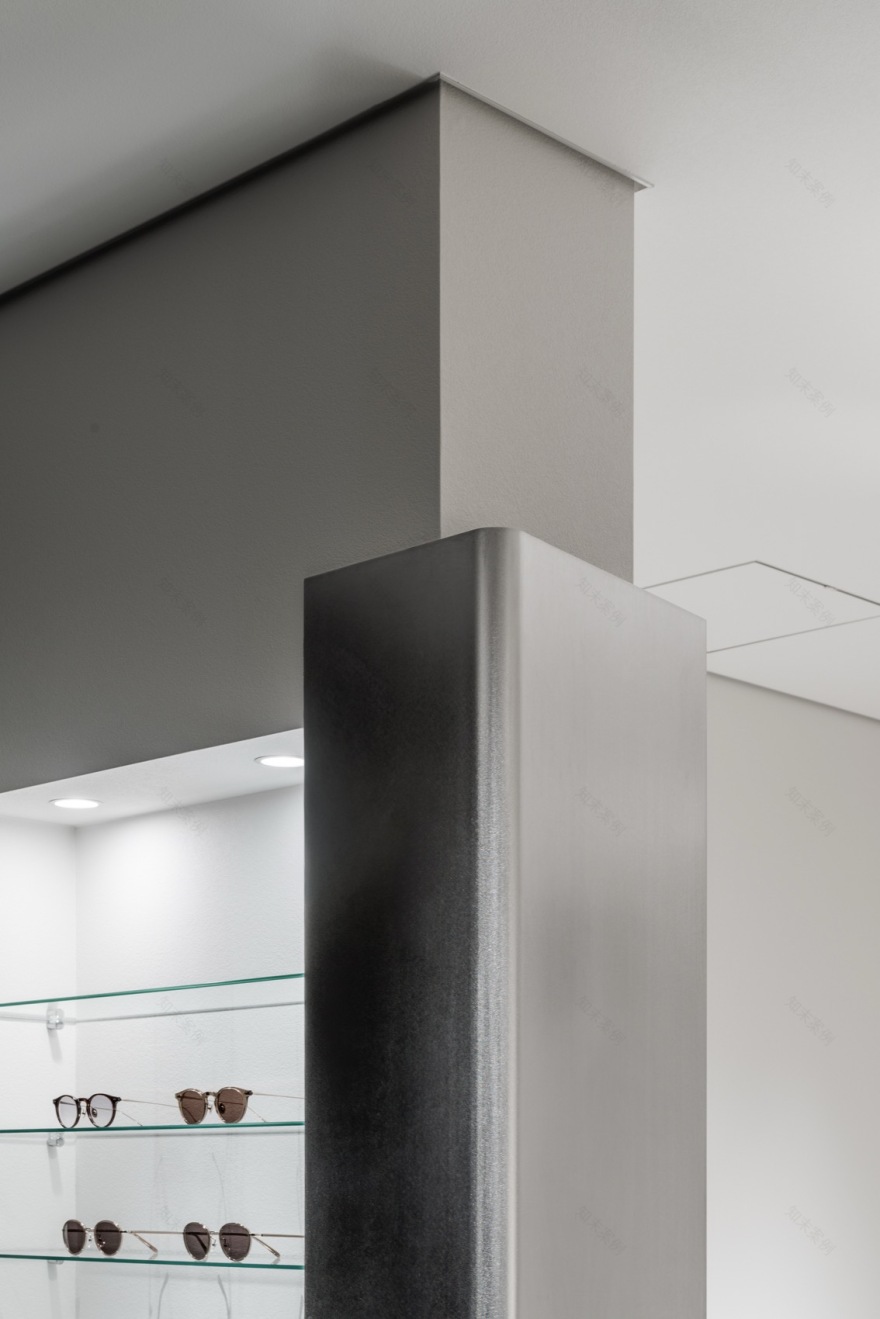


此外,设计并未通过暴露结构顶棚来强调空间的开放性,而是刻意控制了天花高度,将梁体隐藏其中,从而营造出更加平静、内敛的空间氛围。然而,完全包覆结构顶棚也可能削弱空间本身的动态特质。为此,设计在地面引入了 300 × 300 毫米的方形混凝土铺砖,以重新诠释并保留建筑的力量感。
Furthermore, rather than exposing the skeletal ceiling to emphasize openness, the ceiling height was deliberately controlled to conceal the beams, creating a calmer spatial atmosphere. However, enclosing the raw presence of the skeletal ceiling risks weakening the space by diminishing its dynamic character. To reinterpret and retain the architectural force, 300 × 300 mm square concrete paving slabs were introduced to the floor.
▼材料细部,material details © Yoshiro Masuda

▼方形混凝土铺砖,square concrete paving slabs © Yoshiro Masuda

▼吊灯,pendant light © Yoshiro Masuda

原有的吊灯被布置在与建筑与家具一致的轴线上,并采用与展示装置相同的材料。尽管灯具体量小巧,但通过钢丝悬挂的方式,柔化了灯座与电线之间的关系。通过让眼镜自然地融入整体空间,店铺旨在营造一处能够让每一副眼镜都被细致对待、被认真感知的场所。
The original pendant lights were positioned along the same line as the architecture and furniture, adopting the same materials used for the display fixtures. Although the light itself is compact, suspending it by wire softens the relationship between the socket and the cord. By allowing the eyewear to blend seamlessly into the space, the store aims to create a place where each pair of glasses can be approached with care and attention.
▼平面,plan © RID

Project Name : ASHIYA OPTICAL STORE
Type of Project : Interior
Category : Retail store
Location : Hyogo, Japan
Area : 57.78㎡
Period : Oct. 1st, 2025 ~ Dec. 12th, 2025
Date: Dec. 12th, 2025
Client : lool inc.
Design:RID®︎
Project Team : Reiichi Ikeda, Morishima
Lighting: ModuleX
Furniture: INTERACTIVE, maruni
Art: Rachel Adams (yoshimi Arts)
Photographer:Yoshiro Masuda

南京喵熊网络科技有限公司 苏ICP备18050492号-4知末 © 2018—2020 . All photos and trademark graphics are copyrighted by their owners.增值电信业务经营许可证(ICP)苏B2-20201444 苏公网安备 32011302321234号
苏公网安备 32011302321234号客服
消息
收藏
下载
最近