

创作上传
VIP
收藏下载
登录 | 注册有礼
查看完整案例

收藏

下载

分享
燧石小屋是一座面积仅 20 平方米的实验性木构居所,由 IAAC 生态建筑与先进建造硕士(2025 届)学生设计并建造,隶属于 Bio for Piri 计划。该计划由加泰罗尼亚拉佩德雷拉基金会(Fundació Catalunya La Pedrera)发起,在欧洲“下一代欧盟”(Next Generation EU)资金支持下,通过生物多样性基金会资助实施,旨在推动比利牛斯山脉(尤其是列伊达省阿利尼亚地区)的再生林业与本地木材的可持续利用。小屋位于比利牛斯山区的 MónNatura Sort,自然坡地之上,距离既有旅舍仅数步之遥。它为两人提供临时居住空间,包含睡眠区、工作区与卫浴空间,在紧凑尺度中实现完整的生活功能。
Forestone Cabin is a 20 m² experimental wooden dwelling designed and built by the 2025 cohort of IAAC’s Master in Ecological Architecture and Advanced Construction, as part of the Bio for Piri initiative. Led by the Fundació Catalunya La Pedrera and funded by the Biodiversity Foundation with European Next Generation funds, this initiative promotes regenerative forestry and the sustainable use of local timber from Pyrenean forests, specifically in Alinyà (Lleida). Located at MónNatura Sort, in the Pyrenees, the cabin sits on a sloping site just a few steps from the existing hostel, offering temporary accommodation for two people, with a sleeping area, workspace, and bathroom.
▼项目概览,Overall view© Alexander Herbig

▼秋日外观,exterior view at fall© Alexander Herbig


▼建筑与环境的相融,integration of architecture and environment© Alexander Herbig


栖息的岩石:当木材遇见比利牛斯
A resting rock: where wood meets the Pyrenees
小屋的雕塑形态源自比利牛斯山脉崎岖的岩石地貌。建筑被构想为一块从山坡滚落、最终静止于场地的“岩石体块”。其折面几何由倾斜墙体与斜屋面构成,既回应功能需求,也顺应气候条件与日照方向。在有限的建筑面积内,几何形态通过微妙的高差与比例调整,界定不同使用空间;精心布置的开口则框取山景,并形成有效的交叉通风。可开启的木质百叶在夜间实现完全遮光,避免光污染,同时支持场地的天文观测活动。
▼分析图,analysis diagram© IAAC Students of Master in Ecological Architecture and Advanced Construction

The cabin’s sculptural form is inspired by the rocky terrain of the Pyrenees. Conceived as a block of stone that appears to have rolled down the mountain and come to rest naturally on the site, its faceted geometry is composed of inclined walls and a sloping roof that respond to programmatic needs, climatic conditions, and solar exposure. The geometry subtly adjusts ceiling heights and spatial proportions to accommodate different uses within a compact footprint, while carefully positioned openings frame views of the surrounding mountains and enable cross-ventilation. Operable wooden shutters ensure complete darkness at night, preventing light pollution and supporting the site’s astronomical activities.
▼远景,viewing the project at distance©Adrià Goula


▼小屋的雕塑形态源自比利牛斯山脉崎岖的岩石地貌,the cabin’s sculptural form is inspired by the rocky terrain of the Pyrenees©Adrià Goula

▼外观,exterior views©Adrià Goula
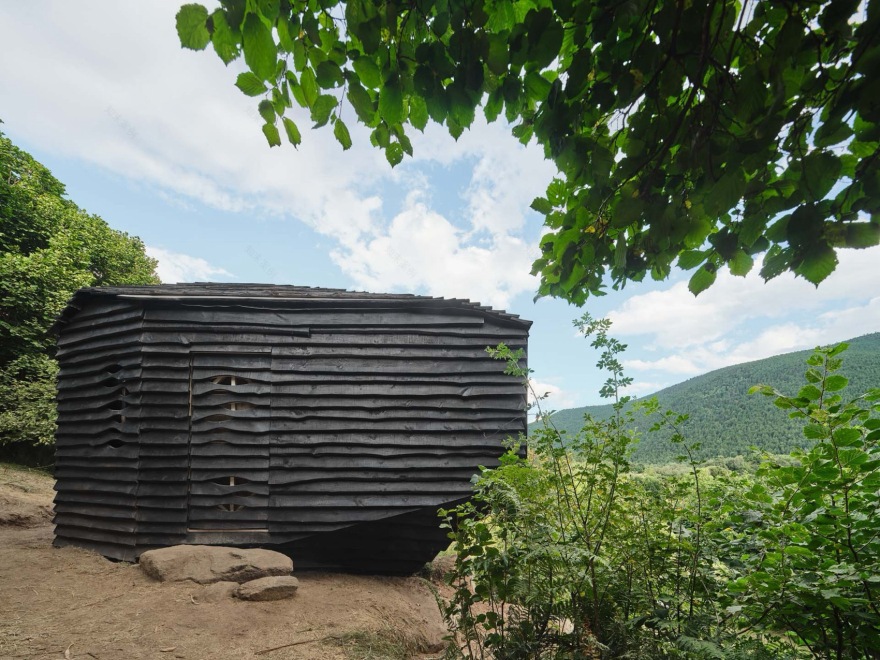

外立面采用保留自然边缘的松木板,并以日本传统的“烧杉”(Yakisugi / Shou Sugi Ban)工艺进行表面炭化处理。通过对木材表层的燃烧碳化,使其具备更强的抗虫、防水、防火与防霉性能。所有木板由学生亲自裁切与烧制,不仅提升了材料的耐久性,也象征性地回应了“火”的主题——在比利牛斯这一名称源于希腊语“Pyros”(意为“火”)的山脉中,火的管理与预防正是再生林业的关键议题。
▼分析图,analysis diagrams© IAAC Students of Master in Ecological Architecture and Advanced Construction

The exterior façade is made of pine boards with natural edges that have been charred following the Japanese Yakisugi or Shou Sugi Ban (焼杉) technique, which involves burning the surface layer of the wood to protect it from insects, water, fire, and mold. These boards, cut to size and charred by the students themselves, not only increase the durability of the material but also symbolically evoke fire management and prevention—an essential aspect of regenerative forestry in the Pyrenees, the mountain range that separates Spain and France and whose name, Pyros, comes from Greek and means fire.
▼外立面采用保留自然边缘的松木板,the exterior façade is made of pine boards ©Adrià Goula


以森林为家:双手、火焰与羊毛
Forging a home from the forest: hands, fire, and wool
进入室内,空间被完全包裹于木结构之中。定制的 CLT(交叉层压木)构件——包括床体、内嵌式家具、洗手台台面与座椅——均由学生在 Valldaura Labs 设计与制作完成。建筑、结构与家具融为统一的材料体系,体现了从设计到建造的实践式学习路径。
▼室内场景分析,interior using scenario© IAAC Students of Master in Ecological Architecture and Advanced Construction
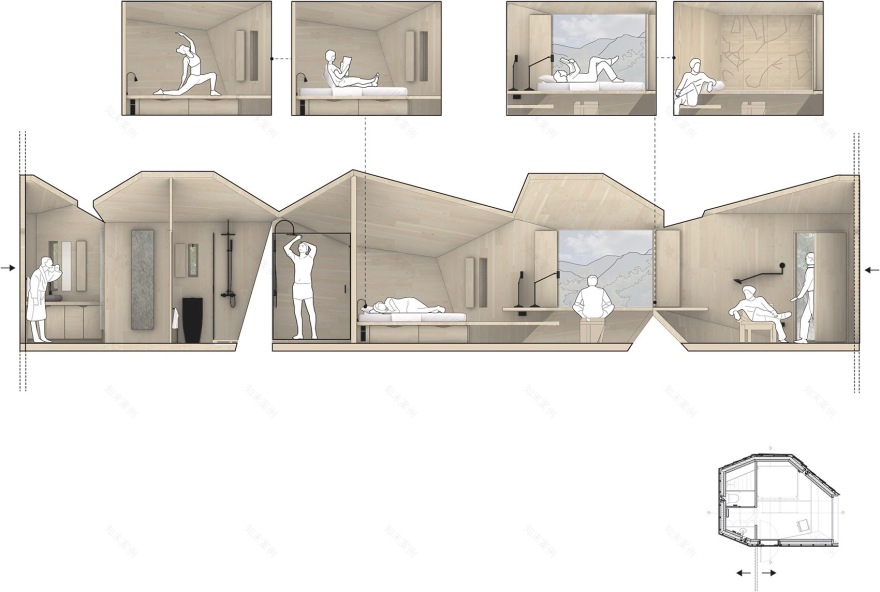
Inside, the cabin becomes a fully integrated wooden space. Custom-made CLT elements—including the bed, built-in furniture, washbasin counter, and seating—were designed and fabricated by the students at Valldaura Labs, reinforcing a hands-on approach in which architecture, structure, and furniture form a single material system.
▼室内概览,overall view of interior©Adrià Goula


▼定制的 CLT(交叉层压木)构件,custom-made CLT elements©Adrià Goula


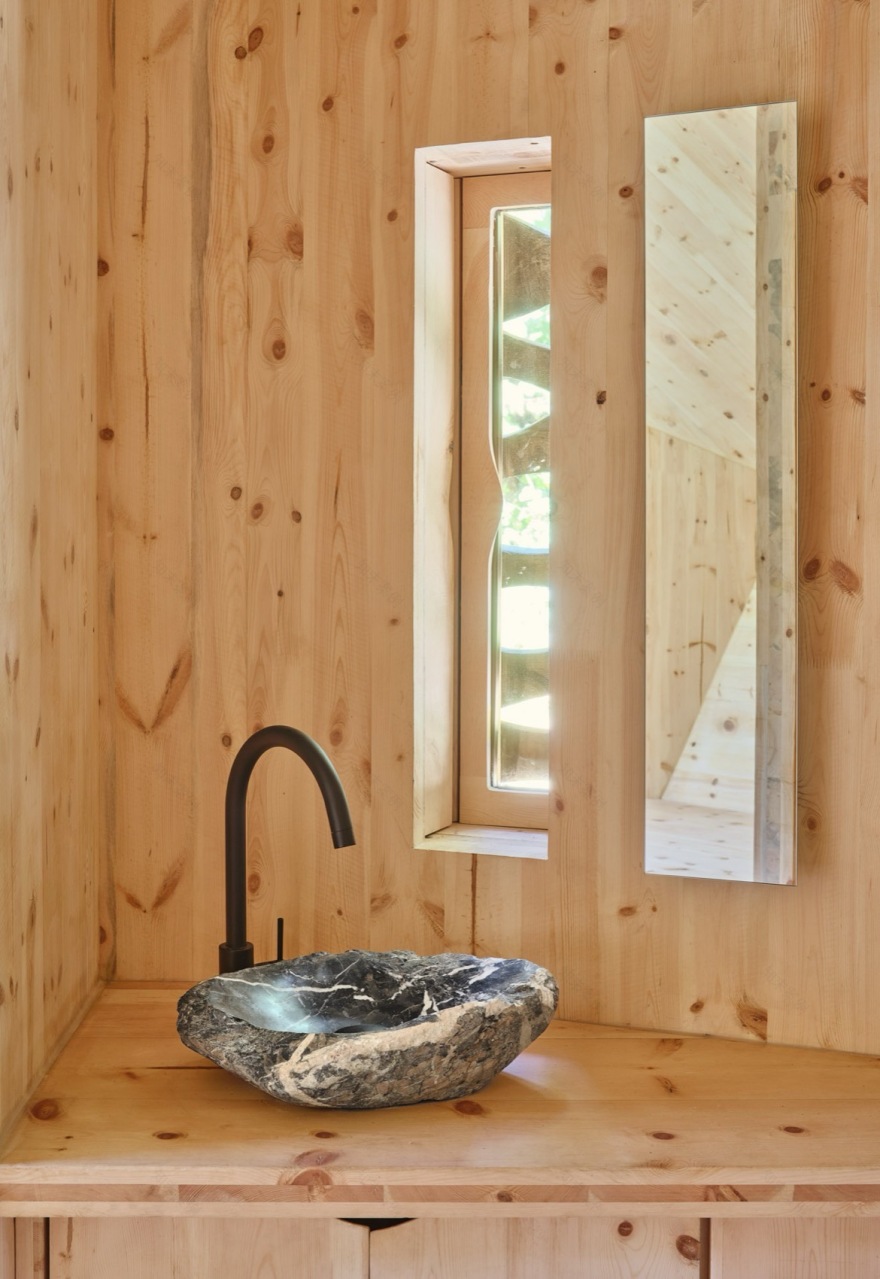
材料的循环不仅限于木材。在附近城镇 Sort 举办的年度羊毛节期间,学生与当地农民合作收集羊毛,随后在 Valldaura 清洗、晾干并制成毛毡,过程中得到荷兰艺术家 Rian van Dijk 的支持与协作。最终制作成的毛毯、地毯与枕套被用于小屋内部陈设,将地方手工艺与农业副产品融入建筑之中。同一次行程中,学生还从周边山地带回一块石材,并使用电动工具手工雕刻成独特的洗手盆,使项目在物质与象征层面上都更加紧密地嵌入其地理与文化语境。
▼分析图,analysis diagram© IAAC Students of Master in Ecological Architecture and Advanced Construction

The cycles of local materials extend beyond wood. During an annual wool festival in the nearby town of Sort, students collaborated with local farmers to collect sheep’s wool, which was later washed, dried, and transformed into felt at Valldaura, with the help and support of Dutch artist Rian van Dijk. The resulting blankets, rugs, and pillowcases furnish the cabin, integrating local craftsmanship and agricultural by-products into the project. On the same visit, students brought back a stone from the surrounding landscape, which they manually carved using power tools to create a unique washbasin, further consolidating the project’s connection to its geographical and cultural context.
▼建筑、结构与家具融为统一的材料体系,architecture, structure, and furniture form a single material system©Adrià Goula


▼学生与当地农民合作收集羊毛,students collaborated with local farmers to collect wool©Reuben Diamond


从项目伊始,燧石小屋即被设想为一座可复制的原型。它展示了小尺度建筑如何依托本地木材、区域知识与低影响建造方法,在不破坏既有生态系统的前提下栖居森林景观之中。模块化 CLT 构件、干式装配技术以及本地可获取材料的运用,使小屋能够根据需要进行适应性调整、复制或拆解,提供一种可持续的森林栖居模式,将建筑生产与长期环境管理相结合。
From the outset, the project was conceived with an emphasis on replicability. Forestone was designed as a prototype demonstrating how small-scale architecture can be built using local timber, regional knowledge, and low-impact construction methods, while inhabiting forest landscapes without altering existing ecosystems. The use of modular CLT elements, dry-assembly techniques, and locally available materials allows the cabin to be adapted, replicated, or dismantled as needed, offering a model of sustainable forest habitation that aligns architectural production with long-term environmental stewardship.
▼雪天远望,viewing the project at distance in winter© Nina Poort


▼雪天外观,exterior views on snow days© Nina Poort


燧石小屋展现了教育、地方产业、手工技艺与再生林业之间的深度整合。通过细致的构造表达、分层的建造逻辑与对场地的深度回应,该项目提出了一种在敏感景观中建造的替代路径——以地方资源为基础,以知识传递为方法,以生态责任为前提。自 2026 年 1 月起,小屋正式向公众开放,作为 MónNatura Pirineu(Planes de Son)的一部分迎接访客,使人们能够亲身体验这一原型与景观、材料与气候之间的真实关系。
Forestone exemplifies the integration of education, local industry, craftsmanship, and regenerative forestry. Through its careful detailing, layered construction, and deep connection to place, the project proposes an alternative approach to building in sensitive landscapes, grounded in local resources, knowledge transfer, and ecological responsibility. From January 2026, the cabin is open to guests at MónNatura Pirineu, in Planes de Son, offering visitors the opportunity to inhabit the prototype and experience firsthand its relationship with the landscape, materials, and climate.
▼分析图,analysis diagram© IAAC Students of Master in Ecological Architecture and Advanced Construction

▼草图 – 跌落山崖的小石头,sketch – A small stone falling down the cliff© IAAC Students of Master in Ecological Architecture and Advanced Construction

▼分析图,analysis diagram© IAAC Students of Master in Ecological Architecture and Advanced Construction

▼平面图,plan© IAAC Students of Master in Ecological Architecture and Advanced Construction

▼剖面图,section© IAAC Students of Master in Ecological Architecture and Advanced Construction

PROJECT CREDITS:
Direction: Vicente Guallart, Daniel Ibañez, Michael Salka
Developed by: The students of the Masters programme in Ecological Architecture and Advanced Construction, 2024/25 class: Alexander Bruce Herbig, Ateet Singh, Atticus Cummings, Breno Teixeira Martinelli, Dammes de Zoeten, Georgia Ann Hoyer, Isabel Flores, Jasper Runge, Magdalena Kurdzialek, Nina Poort, Pragyna Madhav Thondapu, Reuben Diamond, Shivani Edukulla, Shanon Shahan, Santosh Shyamsundar, Sipan Celiker Sporidis
Host: Mon Natura Pirineus, Fundació Catalunya la Pedrera
Valldaura Management : Laia Pifarré
Project Coordination: Esin Aydemir
Assisted by: Bruno Ganem, Oliver Needham, Alkis Avarkiotis
Structural assembly: Fustes Sebastia ( Sergi Sebastia, Emma Sebastia Sarroca, Estel Arnal Llunell) y Tallfusta (Ignasi Caus, David Valldeoriola)
Advised by: Miquel Rodriguez, Elena Orte, Guillermo Sevillano , Firas Safieddine, Rian van Dijk
With the support of: Fundació Catalunya-La Pedrera
Volunteers: Andrew Cardona, Grace Yang, Maeve Daley, Sam Hoshin
Photography: Adrià Goula, Alexander Herbig (Autumn series), Nina Poort (Winter series)
Drawings and diagrams: IAAC Students of Master in Ecological Architecture and Advanced Construction
Communication: Pati Nuñez Agency


南京喵熊网络科技有限公司 苏ICP备18050492号-4知末 © 2018—2020 . All photos and trademark graphics are copyrighted by their owners.增值电信业务经营许可证(ICP)苏B2-20201444 苏公网安备 32011302321234号
苏公网安备 32011302321234号客服
消息
收藏
下载
最近