

创作上传
VIP
收藏下载
登录 | 注册有礼
查看完整案例

收藏

下载

分享

翻译
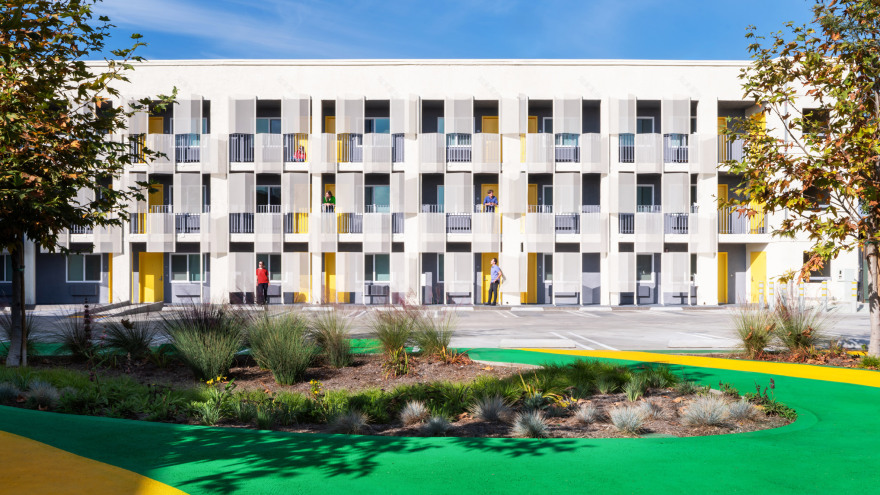
Bright colours and curvy pathways are found at a supportive housing complex in Los Angeles' East Compton neighbourhood, which was designed by US studio Kadre Architects to "strike a balance between a serious and playful feel".
The project involved transforming a neglected motel in East Compton – a community that lies just outside the city of Compton – into a 40-unit housing complex for tenants who were formerly unhoused.

Kadre Architects has converted a rundown LA motel into permanent housing for people experiencing homelessness
The design is meant to be suitable for people who have experienced trauma, and for people of varying ages.
"This community will be home to a mix of adults and families, so we needed to strike a balance between a serious and playful feel for the place," said Los Angeles-based Kadre Architects founder Nerin Kadribegovic.

The design is meant to be suitable for people who have experienced trauma
The site consists of two buildings – one with two levels, the other with three – arranged in an L-shape around a park-like courtyard. The site totals 22,000 square feet (2,044 square metres).
The building's facades were painted a creamy white, with accent colours – like concrete grey, yellow and green – used in certain areas.

Bright communal areas feature inside
A grid of custom, perforated-metal panels were placed on the exterior to provide shade and privacy.
"These panels help create arcade-like walkways that criss-cross the exterior of the property at each level, creating a liminal space between private dwellings and the communal courtyard below," the team said.

The building's facades were painted a creamy white
Kadre Architects said that when designing for people who have experienced trauma, one has to consider their comfort level with communal spaces and engaging with neighbours.
The in-between spaces allow for "concealed participation in community life" and help ease the process of integration into what was designed to be a residential community, the team said.

The in-between spaces allow for "concealed participation in community life"
The site's courtyard – envisioned as a "unifying central park" – was formerly a concrete parking lot riddled by dumpsters. It presented a significant opportunity for the design team, due to its centrality and connection to each unit.
"The site had an inefficient, downright dreadful parking lot which was ripe to leverage for a courtyard-driven campus, full of playful and meditative moments," said Kadribegovic.

Inside the complex, one finds 36 studio units
The lot was transformed into a welcoming outdoor space with seating, a play mound and a dedicated dog area.
Vivid yellow pathways wind through the site and connect to the living units, which have matching yellow doors. The pathways were informed by aerial photographs of amusement parks, taken by American photographer Alex MacLean.
Rain gardens capture stormwater, and a canopy structure helps shade the park and mitigate the heat island effect.
"Trees, grasses and colourful wildflowers are interspersed throughout, juxtaposed with the brightly painted hardscape and pathways to feed life into the space," the team said.

Each unit comes with a kitchenette
Inside the complex, one finds 36 studio units, along with four one-bedroom apartments geared toward families.
Each unit comes equipped with a kitchenette, a bathroom and built-in closets. Each is furnished with a bed, nightstand, television, coffee and dining table, and other essentials.
"Each unit has at least one operable window that's used for ventilation and egress," the team added.
The former motel lobby was converted into a space with offices and support services. Walls made of translucent polycarbonate panels enable natural light to flow through the interior.
"The panels also provide a silhouetted background, which enliven the halls while providing visual privacy for case-management meetings," the team said.
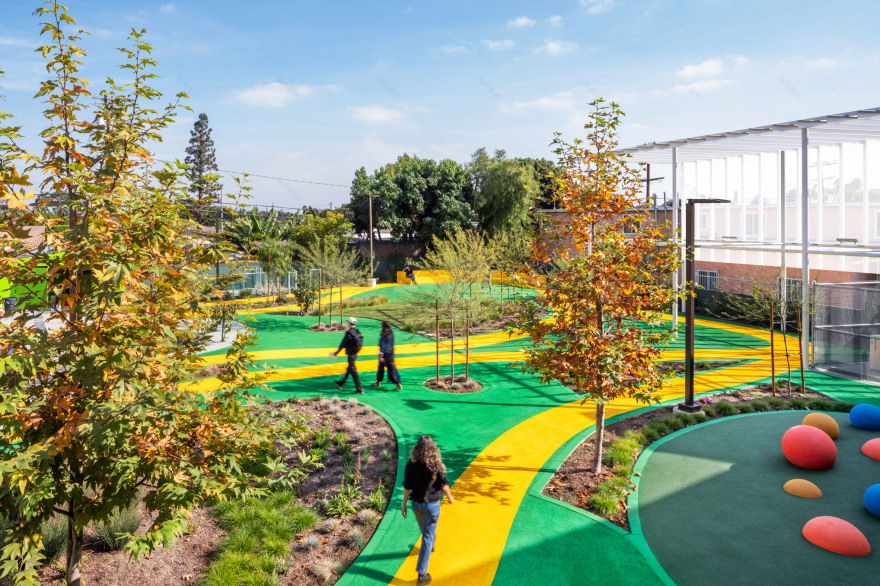
Vivid yellow pathways wind through the site
The building is designed to be fully electric, which required extensive trenching through the city to bring more power to the site. Electric elements include heat pumps, magnetic induction stoves and rooftop solar panels.
The project was backed by California's Project Homekey initiative, which helps fund the rapid creation of temporary or permanent housing for the homeless. The projects often involve old hotels and motels.
Established in 2022, Kadre Architects has converted a number of motels into supportive housing in Southern California.
In LA's Westlake neighbourhood, the studio converted a dilapidated motel into a homeless shelter featuring a blue-and-white graphic facade. In a desert city outside of LA, the firm transformed two rundown motels into supportive housing with shading devices and an array of bright colours.
The photography is by Paul Vu.
南京喵熊网络科技有限公司 苏ICP备18050492号-4知末 © 2018—2020 . All photos and trademark graphics are copyrighted by their owners.增值电信业务经营许可证(ICP)苏B2-20201444 苏公网安备 32011302321234号
苏公网安备 32011302321234号客服
消息
收藏
下载
最近