

创作上传
VIP
收藏下载
登录 | 注册有礼
查看完整案例

收藏

下载

分享
作为为自己打造的居所,Arthur Casas的这套公寓凝聚了技术精准、功能理性与个人叙事的综合表达。公寓位于Praça Henrique Monteiro综合体——这一集酒店、餐厅、面包房、爵士俱乐部与住宅于一体的项目同样由他设计——空间被构想为其建筑观、设计观与城市生活理念的直接延伸。从平面布局到木作细节,每一项决定都回应日常生活的真实需求:流畅的空间组织、整合的系统设计以及克制而明确的美学表达。在这里,Arthur Casas主动挑战自己,去实践一种真正都市化、当代且高效的生活方式——这与他此前在Pacaembu居住近35年的住宅形成鲜明对比,那是一栋由建筑师Artigas于20世纪40年代设计的独立住宅。
Designed to be his own residence, Arthur Casas’ apartment is a synthesis of technical precision, functionality, and personal narrative. Located in Praça Henrique Monteiro- a mixed-use complex also designed by him – the space was conceived as a direct extension of his vision on architecture, design, and urban living. Every decision – from the layout configuration to the detailing of the carpentry – reflects a conscious effort to adapt to daily life, with spatial fluidity, integrated systems, and aesthetic intention. Here, Arthur Casas challenged himself to experience a truly urban, contemporary, and practical way of living – a stark contrast to his previous home, a 1940s house in the Pacaembu neighborhood, designed by architect Artigas, where he lived for nearly 35 years.
▼室外视角,exterior view© Fran Parente
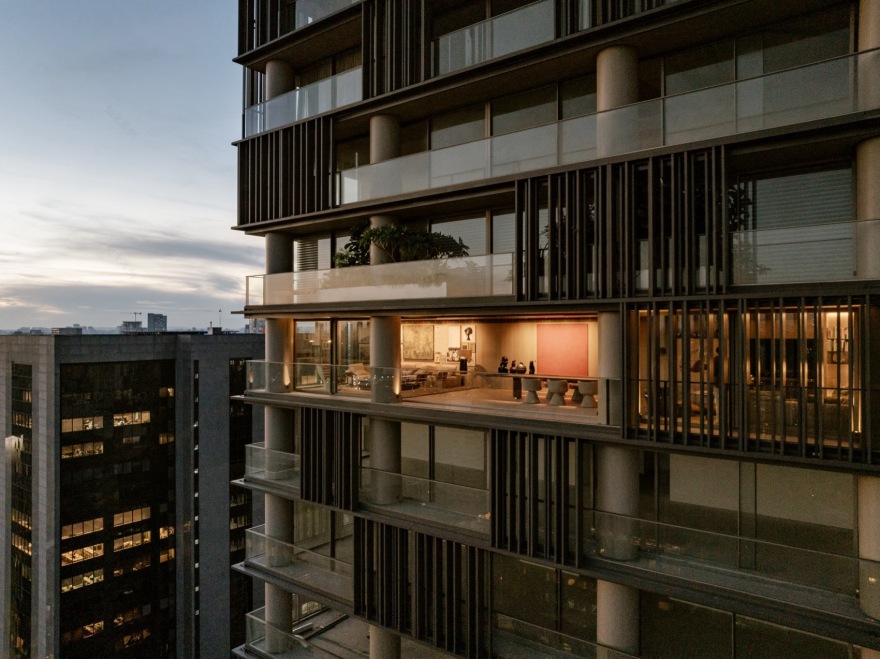
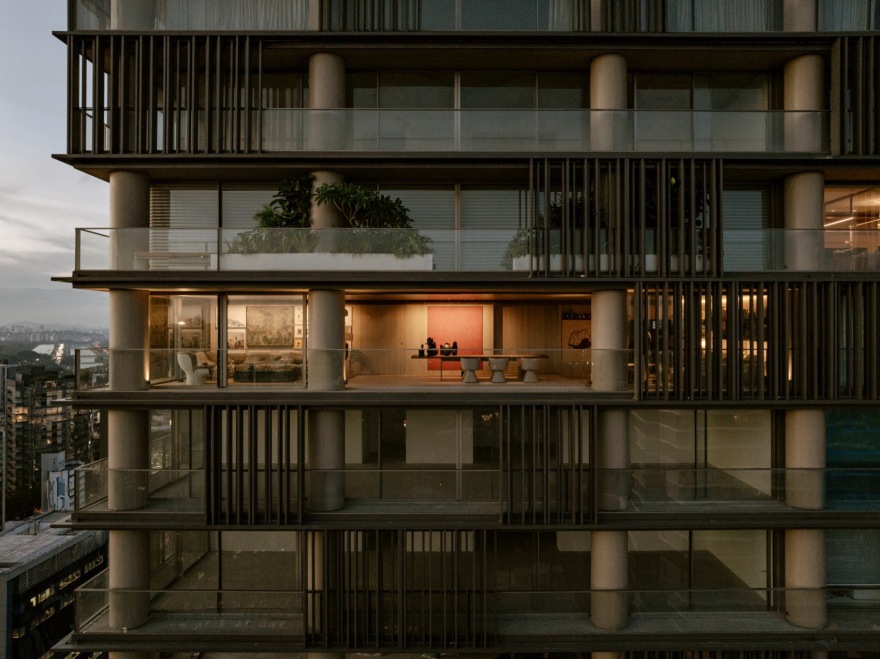
这套面积约300平方米的公寓,以消除冗余空间为前提,强调直接而高效的动线组织与多功能场景的切换。全屋自动化系统、定制化解决方案以及大量天然材质的运用,共同营造出一种精准而温润的氛围——在舒适与控制之间取得平衡,同时以视觉上的中性克制,承载他丰富的收藏:艺术品、雕塑、书籍、摄影作品、设计物件与个人珍藏。“为自己设计其实很简单。我是自己最好的客户,因为我清楚自己喜欢什么、如何生活。”Arthur Casas说道。
With around 300 sqm, the apartment’s layout was designed to eliminate unused spaces, prioritizing direct circulation and versatile environments. Full automation, custom solutions, and extensive use of natural materials create a precise, welcoming atmosphere that blends comfort and control, with visual neutrality to display his collection of items, including artwork, sculptures, books, photographs, cherished objects, and design pieces. “Designing for myself is very easy. I’m the best client for myself because I know what I like and how I live,” says Arthur Casas.
▼由入户空间看客厅,viewing the living room from the entrance© Fran Parente

入户之后,空间的整合性即刻显现。门扇开启,连续展开的公共区域一气呵成:客厅、餐厅、家庭影院与厨房在同一建筑语汇下自然衔接。流线通畅而无阻,固定构件在不打断视线的前提下组织空间秩序。
Upon entering the apartment, the integration of the spaces is immediately apparent. The door opens to a continuous social area, where the living room, dining room, home theater, and kitchen connect in a single architectural gesture. Circulation is fluid and unobstructed, with fixed elements that naturally organize the spatial flow.
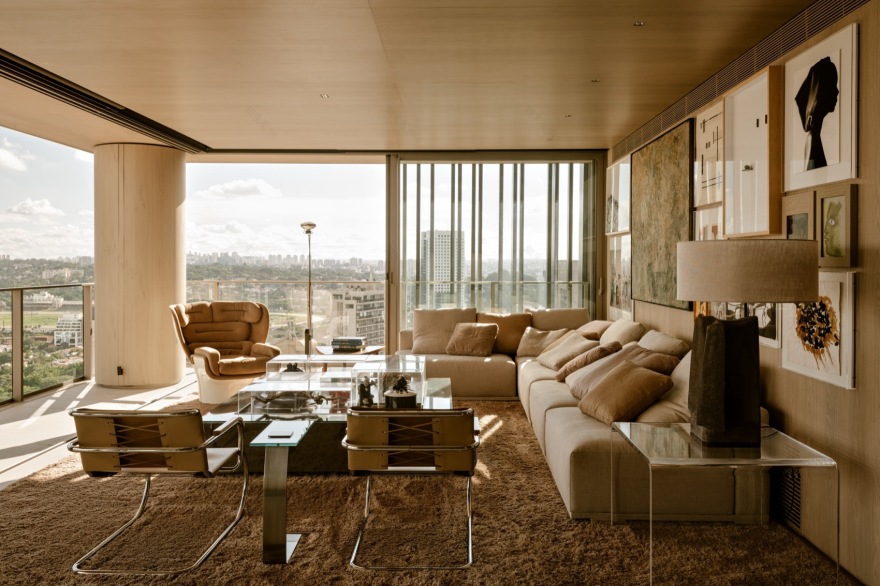
▼客厅,living room© Fran Parente


▼细部,details© Fran Parente


客厅以Fusca沙发(Arthur Casas × Micasa)为核心,搭配Franco Albini设计的Bauhaus椅、Joe Colombo的Elda扶手椅,以及Arthur Casas设计的Desenho茶几。茶几上陈列着Bordallo Pinheiro陶瓷作品,包括与艾未未、Tunga、Rosângela Rennó的合作系列。艺术作品构成空间的精神底色:Mira Schendel、Carlito Carvalhosa、Anna Maria Maiolino与Waltércio Caldas的作品点缀其间。
In the living room, the Fusca sofa (Arthur Casas, Micasa) takes center stage, accompanied by Bauhaus chairs (Franco Albini), the Elda armchair (Joe Colombo), and a Desenho coffee table (Arthur Casas), atop which rests a selection of Bordallo Pinheiro ceramics, featuring collaborations with Ai Weiwei, Tunga, and Rosângela Rennó. The space is marked by the presence of art, with works by Mira Schendel, Carlito Carvalhosa, Anna Maria Maiolino, and Waltércio Caldas.
▼客厅以Fusca沙发(Arthur Casas × Micasa)为核心,
in the living room, the Fusca sofa (Arthur Casas, Micasa) takes center stage© Fran Parente

▼客厅光影,light and shadow in the living room© Fran Parente
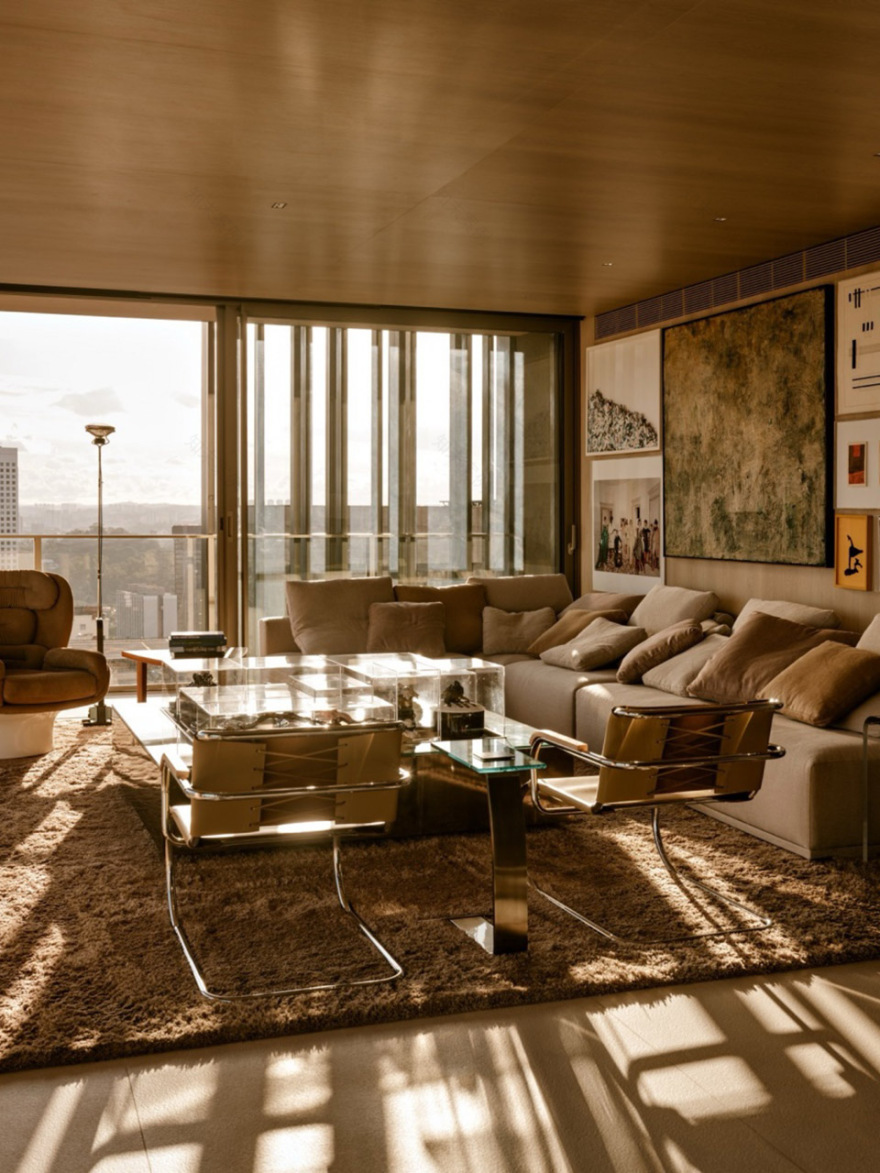
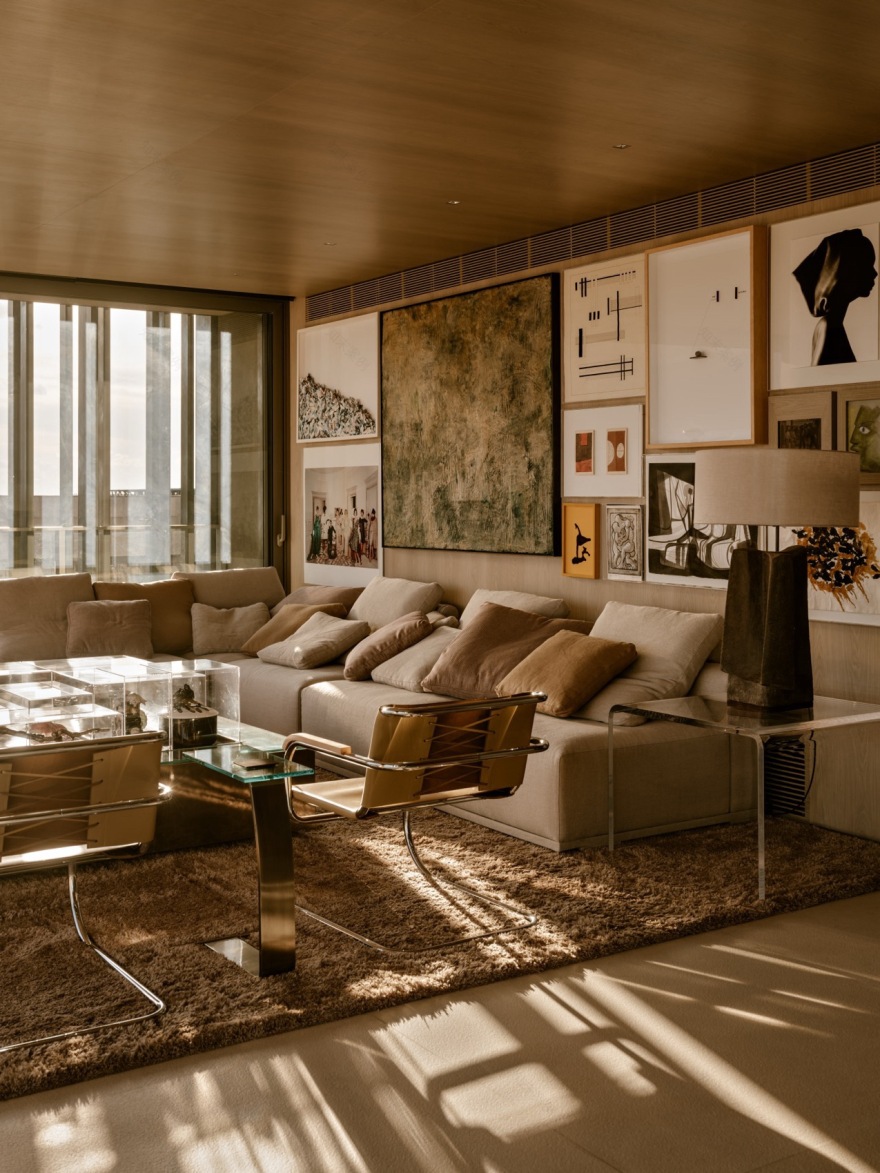
▼茶几,the coffee table© Fran Parente


餐厅的过渡自然流畅。Rino餐桌(Arthur Casas × Etel)以canela木条拼接而成,两侧为B&B Italia的Flairo扶手椅,搭配Rafael Oboé、Liuba Wolf、Ilha do Ferro与Rhodes的雕塑作品。墙面悬挂Paulo Pasta的绘画,嵌入式灯具沿连续木质天花布置,为空间提供精准而克制的照明。
The transition to the dining room happens naturally. The Rino table (Arthur Casas, Etel) in canela wood slats is flanked by Flairo armchairs (B&B Italia), complemented by sculptures from Rafael Oboé, Liuba Wolf, Ilha do Ferro, and Rhodes. Above it, a painting by Paulo Pasta marks the wall. Lighting is punctuated by embedded fixtures in the continuous wooden ceiling, which runs throughout the apartment.
▼餐厅,the dining room© Fran Parente

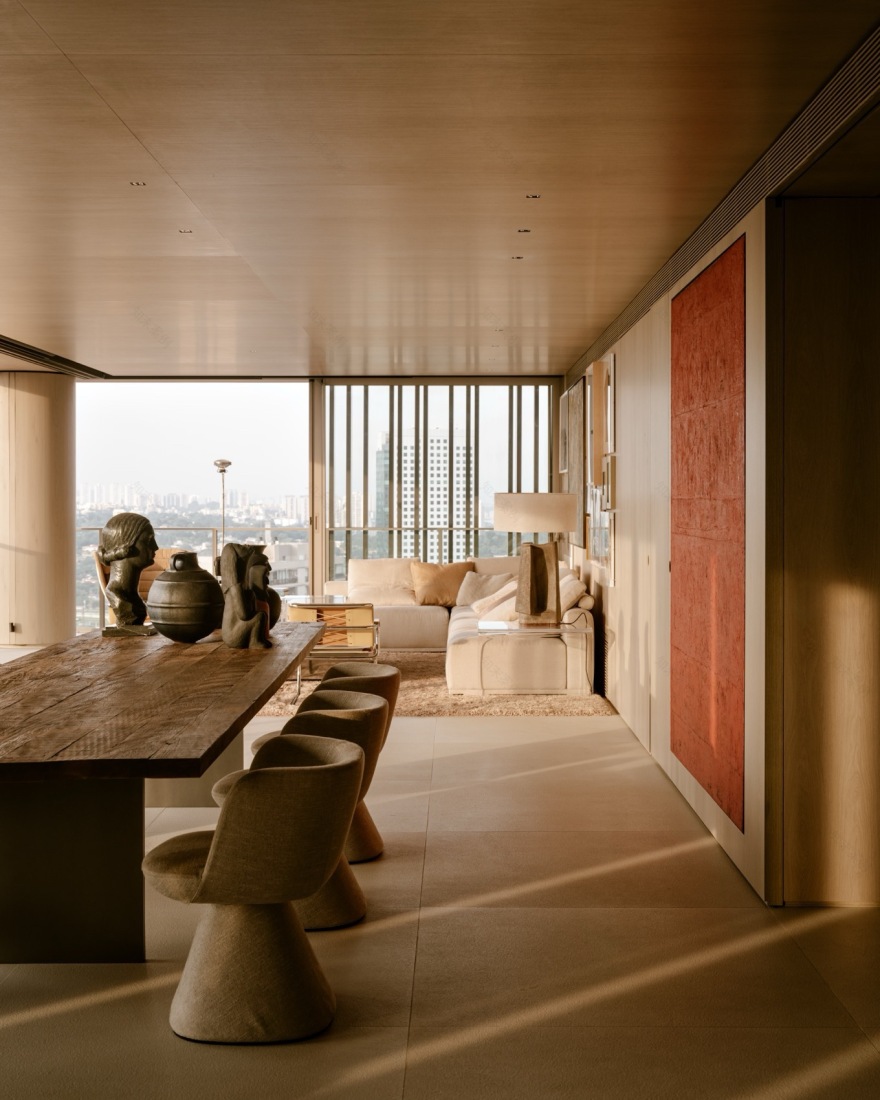

▼Rino餐桌(Arthur Casas × Etel)以canela木条拼接而成,
the Rino table (Arthur Casas, Etel) in canela wood slats© Fran Parente


▼墙面悬挂Paulo Pasta的绘画,the painting by Paulo Pasta marks the wall © Fran Parente

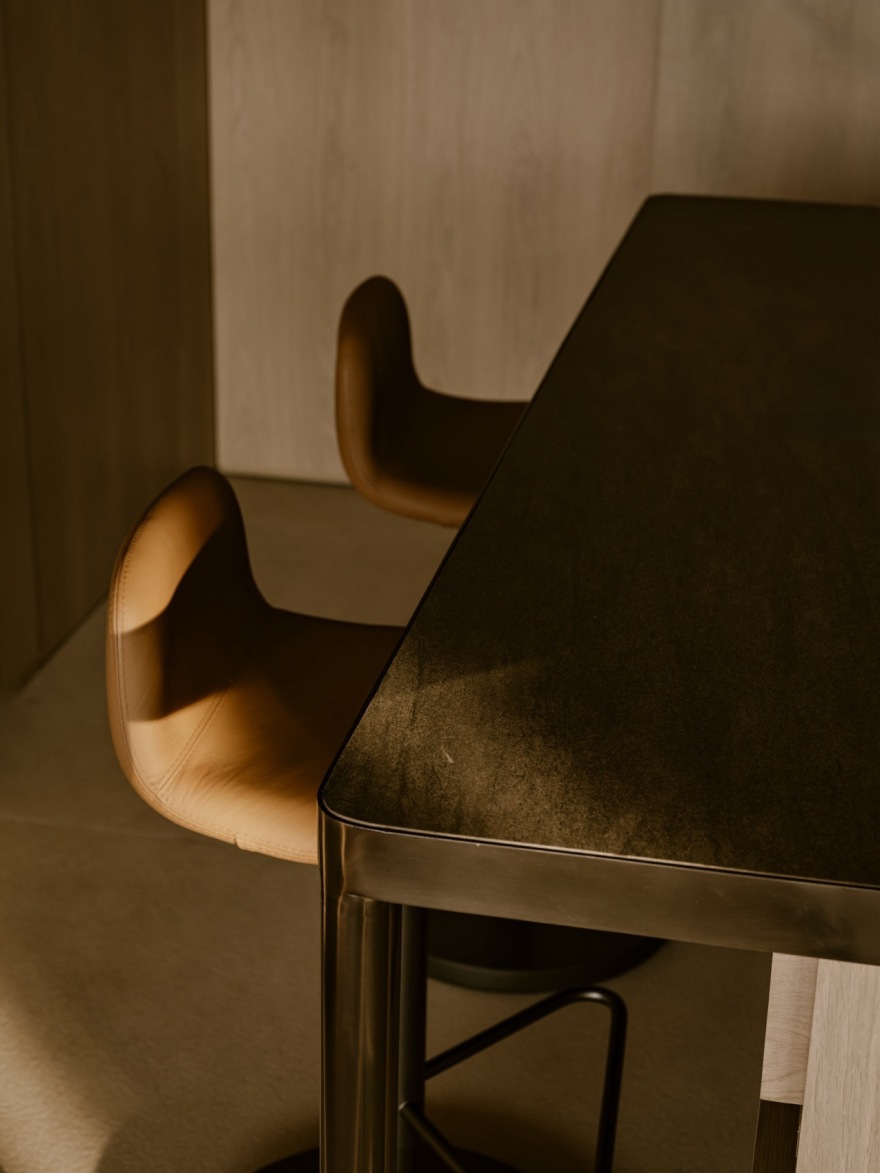
厨房中,Disco吧椅(Arthur Casas × Studio Objeto)与Neolith Basalt Grey岩板台面形成视觉焦点。橱柜由Arthur定制设计,将家电巧妙隐藏,使厨房既可与公共区域完全融合,也可通过滑动门独立封闭。
The kitchen features the standout Disco stool (Arthur Casas, Studio Objeto) and Neolith Basalt Grey countertops, designed within a custom carpentry structure by Arthur. The cabinetry was designed to conceal appliances and optimize the space, allowing the environment to either integrate seamlessly with the social area or be closed off by a sliding door as needed.
▼由餐厅看厨房,viewing the kitchen from the dining area© Fran Parente
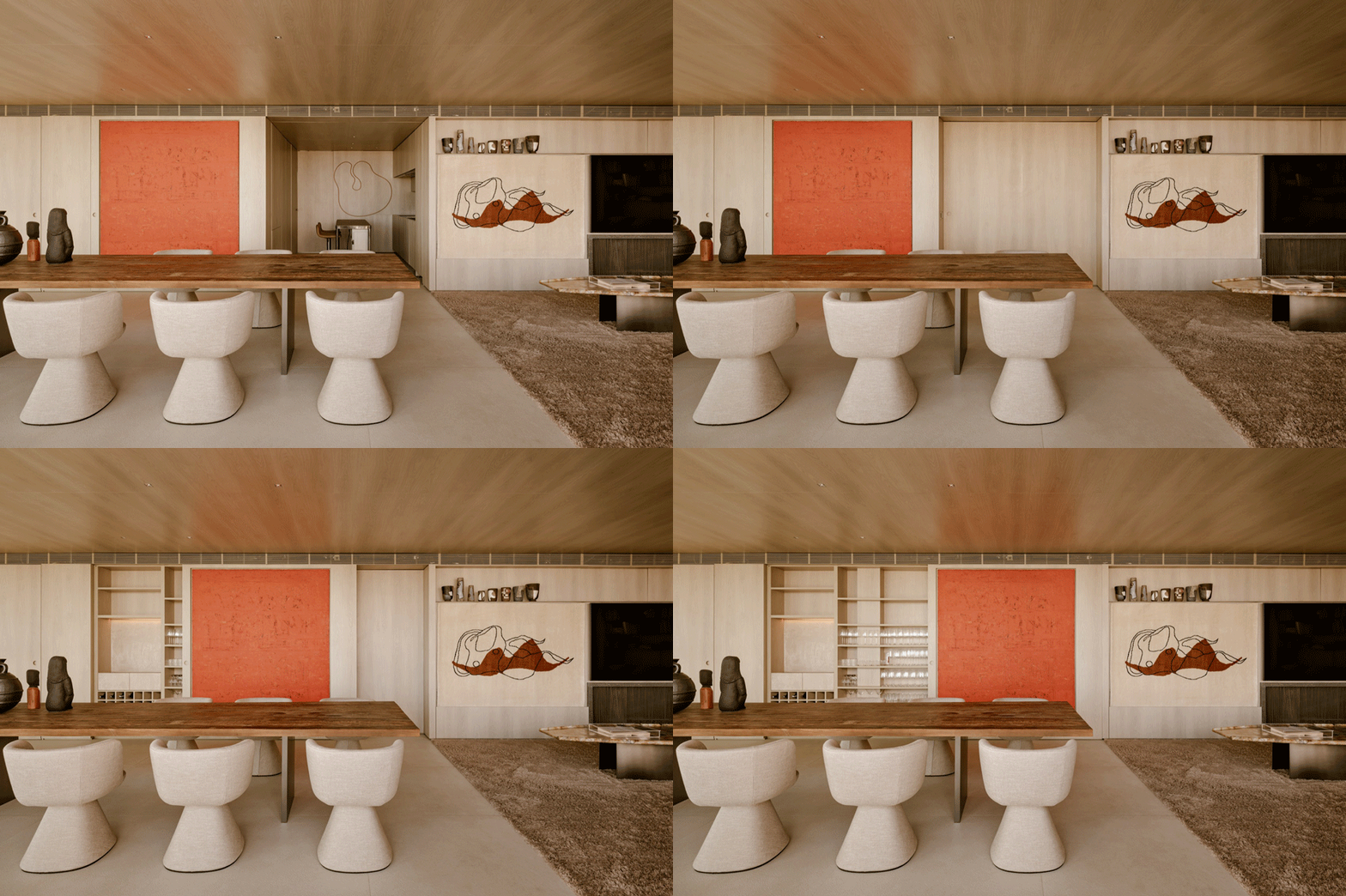
▼厨房中的橱柜由Arthur定制设计,
kitchen designed within a custom carpentry structure by Arthur© Fran Parente
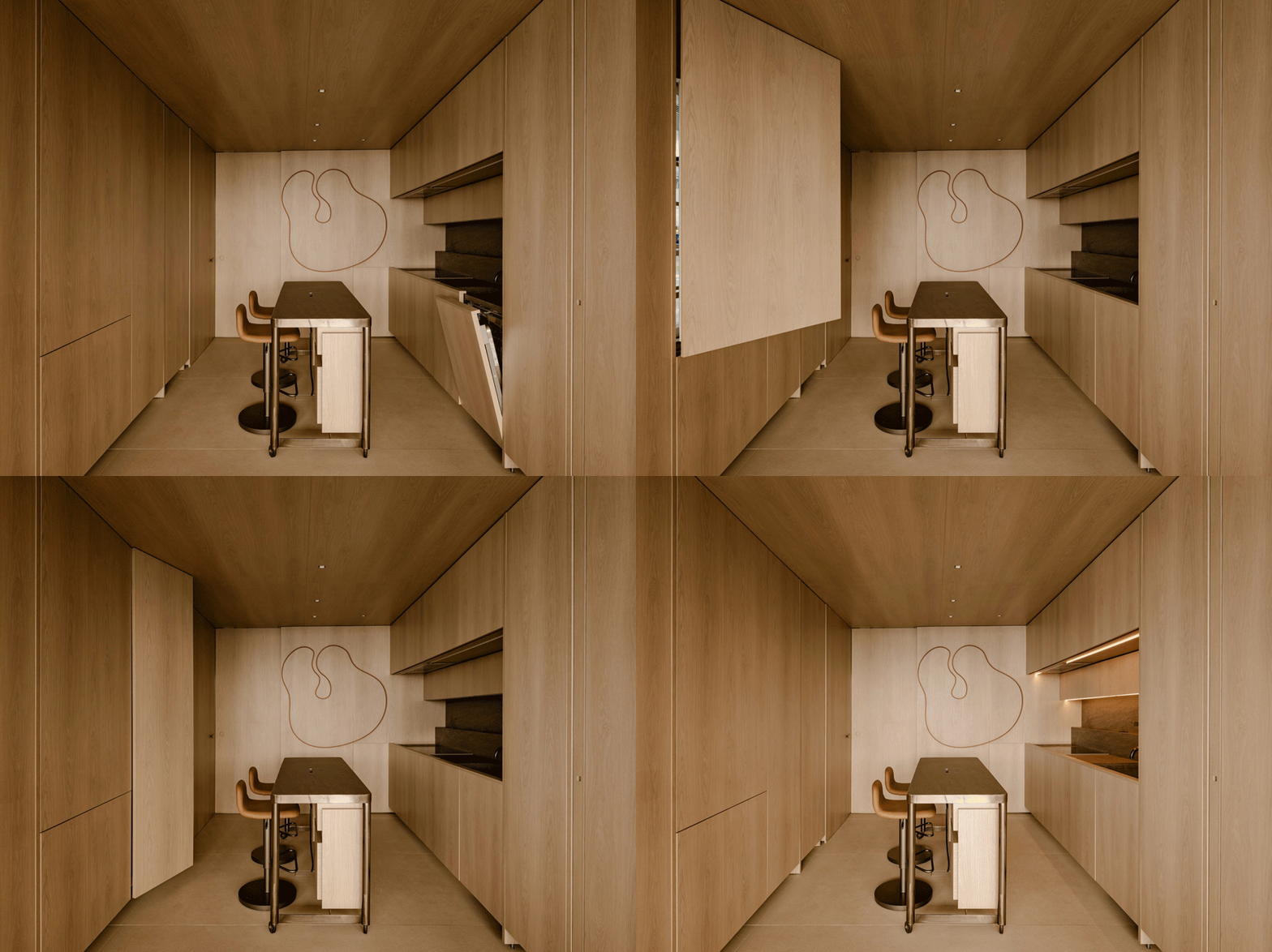
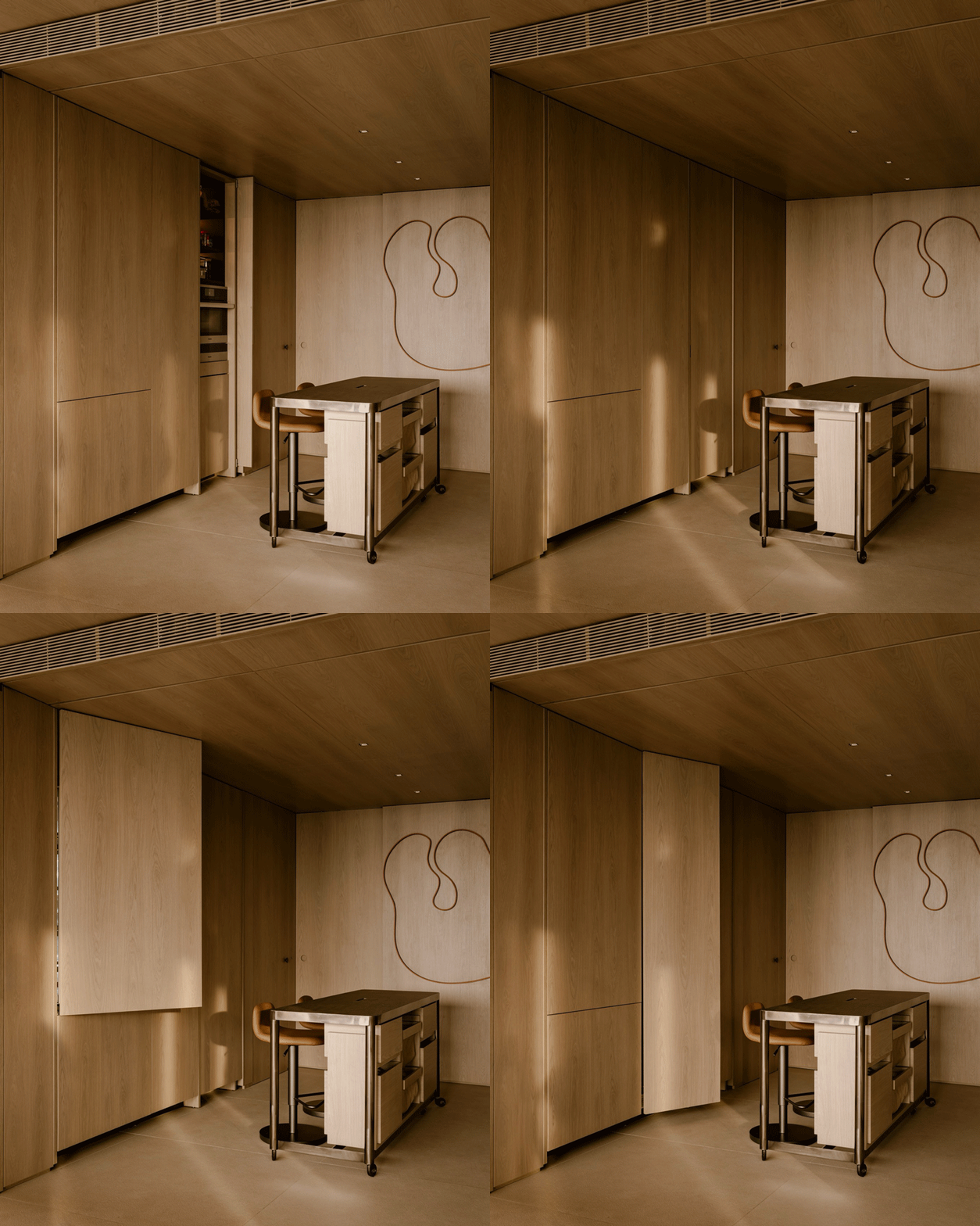

▼厨房细部,details of the kitchen© Fran Parente

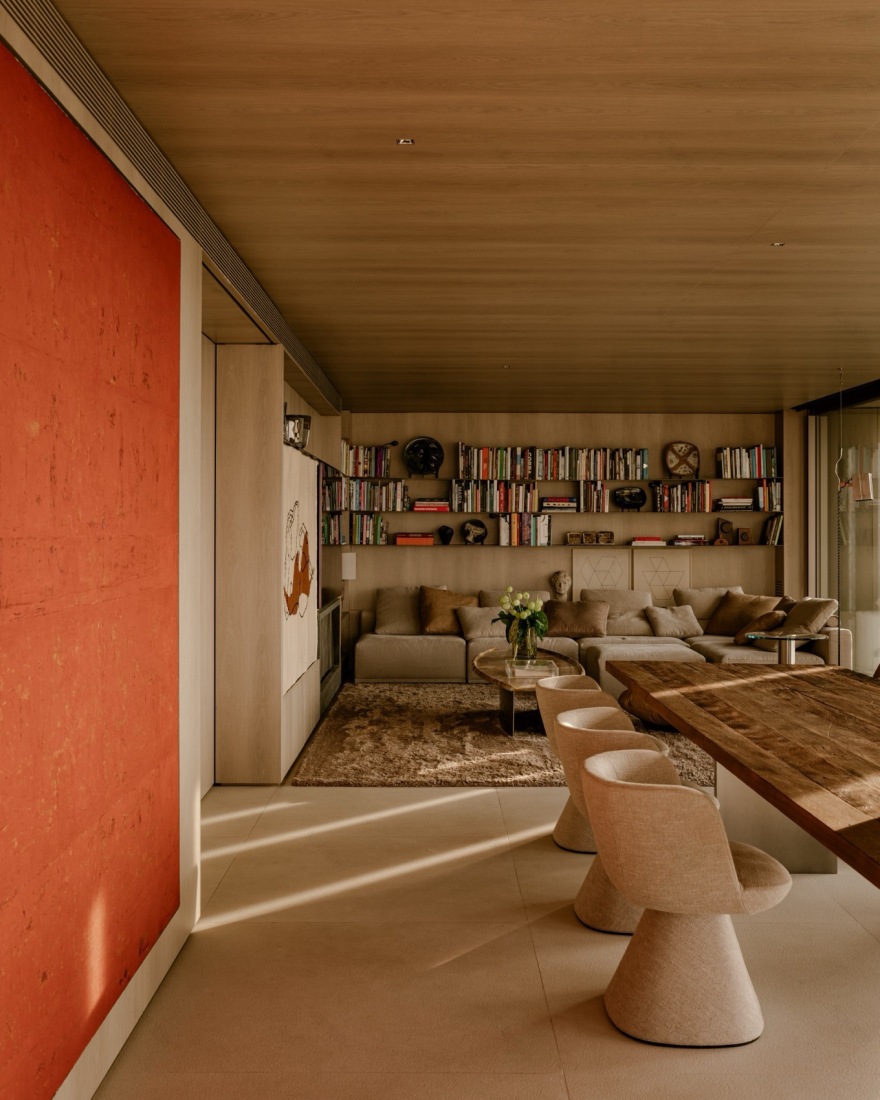
与厨房相邻的家庭影院延续Fusca沙发的使用,并搭配Gio Ponti设计的Tavolino 1932边几、Michael Ducaroy为Ligne Rosset设计的Marsala扶手椅,以及Henri Laurens挂毯。书架上陈列着Livia Gorka、Pablo Picasso与Jean Lurçat的陶艺作品,与书籍与个人收藏交织共存。上方则悬挂Mona Gorovitz的绘画与Ernesto de Fiori的雕塑。
Adjacent to the kitchen, the home theater revisits the Fusca sofa, now paired with a Tavolino 1932 side table (Gio Ponti), the Marsala armchair (Michael Ducaroy for Ligne Rosset), and a Henri Laurens tapestry. On the shelves, sculptures and plates by Livia Gorka, Pablo Picasso, and Jean Lurçat coexist with books and cherished objects. Above the composition, paintings by Mona Gorovitz and a sculpture by Ernesto de Fiori complement the scene.
▼家庭影院,the home theater© Fran Parente


▼家具细部,details of the furniture© Fran Parente


位于公共与私密区域之间的书房兼具多重功能:既是工作空间,也在孩子来访时作为临时卧室使用。空间内设有Vitra的Pivot High高脚凳,以及展示Arthur Casas迷你汽车收藏的定制壁龛。
The office, situated between the social and intimate areas, functions as a multifunctional space: in addition to being a workspace, it accommodates a bed for when one of the children visits. It features the Pivot High stool (Vitra) and Arthur Casas’ miniature car collection, displayed in custom niches.
▼定制的迷你汽车收藏壁龛,
miniature car collection, displayed in custom niches © Fran Parente

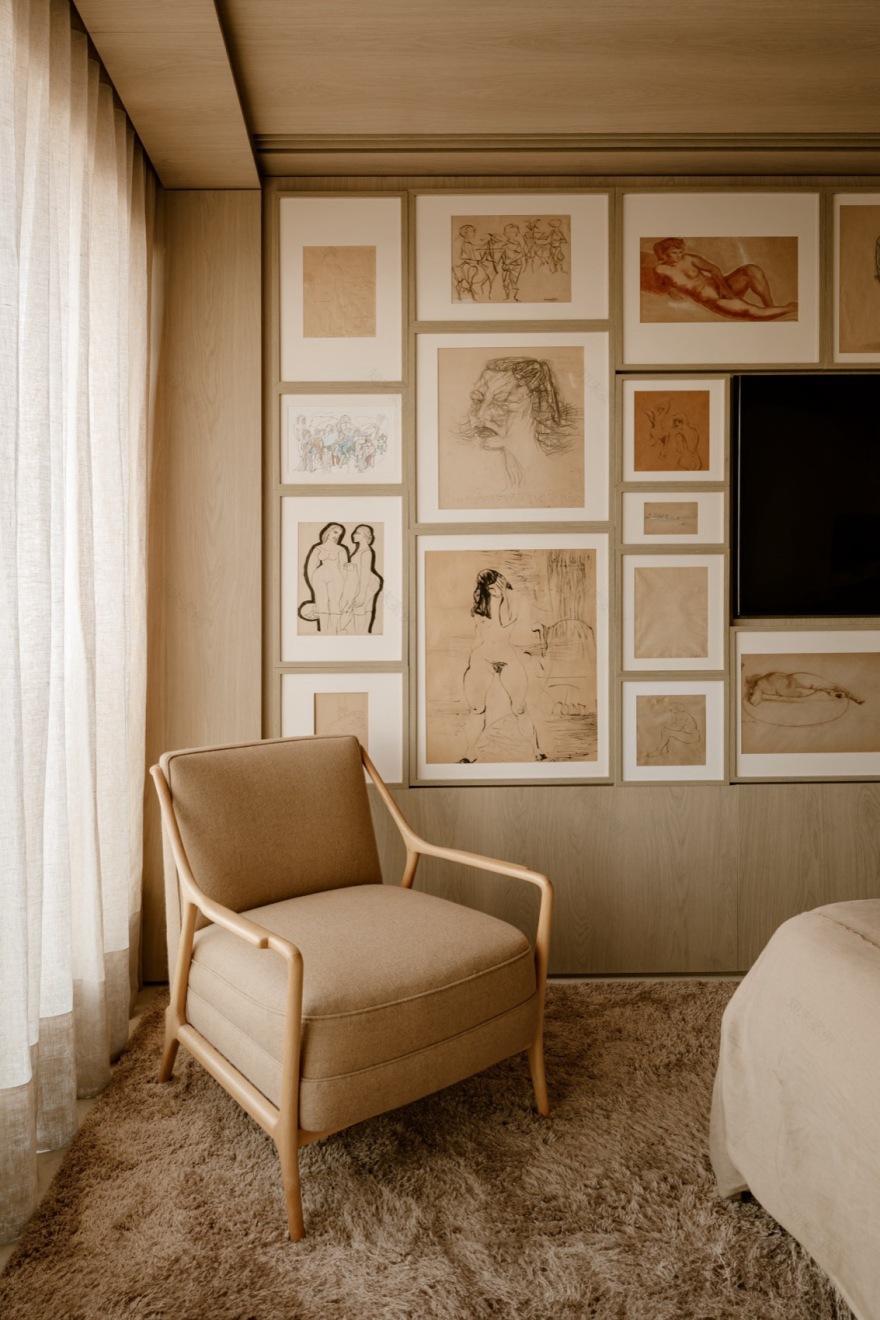
通往卧室的走廊以木饰面包覆,营造平缓而安静的过渡。墙面陈列摄影收藏,包括Pierre Verger、Mario Cravo Neto、Bob Wolfenson与Cristiano Mascaro的作品。主卧套房以柔和光线为主调:复古台灯、Marset的Ledtube壁灯、1960年代California Studio陶瓷灯,与连续木质天花及定制家具共同构成温润氛围。Giuseppe Scapinelli扶手椅与Via Appia大理石床头柜点缀其间,墙面则陈列Tarsila do Amaral、Emiliano Di Cavalcanti、Athos Bulcão与Flávio de Carvalho等艺术家的画作。
The corridor leading to the bedrooms is lined with wood, creating a serene transition to the private spaces. The walls are adorned with a collection of photographs, including works by Pierre Verger, Mario Cravo Neto, Bob Wolfenson, and Cristiano Mascaro. In the master suite, lighting is subtle, with vintage table lamps and technical lighting such as the Ledtube (Marset) and a ceramic lamp by California Studio (1960), combined with the continuous wooden ceiling and custom-designed furniture. The Giuseppe Scapinelli armchair and Via Appia marble nightstand integrate the space, punctuated by a series of paintings by artists such as Tarsila do Amaral, Emiliano Di Cavalcanti, Athos Bulcão, and Flávio de Carvalho.
▼卧室,the bedroom© Fran Parente

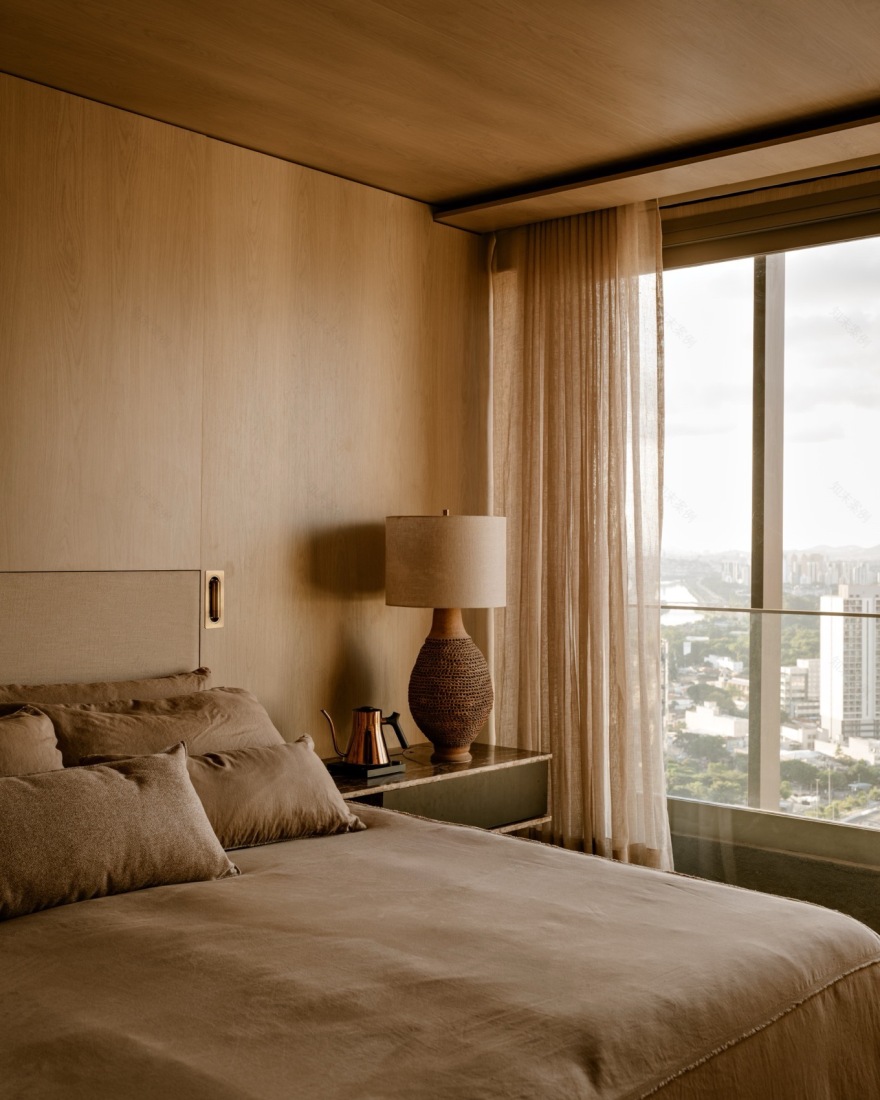

▼书房与卧室细部,the study and details of the bedroom© Fran Parente

所有技术系统均被精细整合:中央吸尘系统、嵌入式音响、隐蔽空调、防潮系统、智能传感器与全屋自动化一应俱全。来自XAL的照明系统以精准的光束控制与对称配光突出艺术品与材质质感,同时避免对建筑本体造成干扰。
Every technical detail was meticulously integrated: central vacuum, embedded sound system, invisible air conditioning, anti-moisture system, intelligent sensors, and full automation. The lighting, featuring fixtures from XAL – known for their precise radiation and symmetrical light distribution – highlights the artwork and materials without interfering with the architecture.
▼浴室,the bathroom© Fran Parente

居住在一套从建筑整体到室内布局、材料与家具皆由自己设计的公寓中,使Arthur Casas得以在1:1尺度上体验自己的建筑。对他而言,Praça Henrique Monteiro不仅是一个集合酒店、餐饮与住宅功能的综合体,更是一个持续演化的“有机体”——一种从内部到外部、再由外部回到内部的整体性建筑体验。
Living in an apartment he himself designed – from the building’s architecture to the layout, finishes, and furniture – gives Arthur Casas the rare opportunity to experience his architecture at scale 1:1. The Praça Henrique Monteiro project, which combines a hotel, restaurant, boulangerie, jazz club, and residences within a single complex, is for him a living organism in constant adaptation – an architecture inhabited from the inside out and from the outside in.
▼室内生活空间夜景,night view of the interior© Fran Parente

“我一直希望住进一套比旧宅更紧凑的公寓。当Praça项目出现时,它正是我对多功能综合体生活方式的想象。你几乎可以在这里构想完整的一生。”Arthur Casas表示,“我无法只设计自己的公寓,而不去设计整栋塔楼、餐厅、酒吧等其他部分。对我来说,保持统一的语言至关重要。”
“I had long envisioned living in a more compact apartment than my old house. When the Praça project came along, it was what I was hoping for in this new model of multifunctional buildings. You can imagine an entire life within this place,” explains Arthur Casas. “I couldn’t design my apartment without also designing the other components of the building, including the tower, restaurant, bar, and so on. For me, it’s essential to maintain this unified language,” the architect concludes.
▼室外视角,exterior view© Fran Parente


▼室外夜景视角,exterior view of the apartment at night© Fran Parente

FACTSHEET
Project AC Apartment
Author Arthur Casas
Project Manager Interiors Tatiana Ordine
Interiors Team Fernanda Mori
Project Manager Decoration Fabiola Andrade
Decoration Team Gabriel Contreira, Manoela Vilaça, Marcella França
Collaborators Constructor – Osborne
Consultants Automation – Taag; Lighting – Maneco Quindere; Air Conditioning – Logiproject; Electrical and Plumbing – Zamaro; Acoustics – RTM Arquitetos
Suppliers Marbles and Granites – Defriulli; Sanitary Ware and Metals – Punto, Valve, and Deca; Custom Cabinets for Kitchen, Service Area, and Closet – Ornare; Flooring – Porcelain Refin Nature by Casas; Marble Flooring | Living Room, Kitchen, Office – Donata; Woodwork – Arali; Complementary Carpentry – Marvelar; Glass – Primo Vidros; Blinds and Blackouts – Uniflex Jardins; Lighting – Elight; Appliances – Miele
Dates 2023 – 2025
Built area 300 sqm
Location Pinheiros – São Paulo, SP, Brazil
3D Natalia Lorenzoni and João Lisboa
Photos Fran Parente
Hall
Maleiro bench – Arthur Casas – Studio Objeto
Sculpture – Artur Lescher
Living
Fusca sofa – Arthur Casas – Micasa
Pair of Bauhaus chairs – Franco Albini
Metal base side table with glass top – Design Institute of America
Elda swivel armchair – Joe Colombo
Desenho coffee table – Arthur Casas, for Bordallo Pinheiro ceramics collection with works by Tunga, Mina Klabin, Ai Weiwei, Rosângela Rennó, Regina Silveira, Efrain Almeida, Luiz Zerbini, Angelo Venosa
Nylon rug – Phenícia
Wood side table – George Nakashima
Toio floor lamp – Achille Castiglioni – Flos
Desenho table lamp – Arthur Casas, base sculpture NY
Paintings: José Damasceno, Otto Stupakoff, Carlito Carvalhosa, Lothar Charoux, Mira Schendel, Anna Maria Maiolino, Jacques Lipchitz, Waltércio Caldas, Burle Marx, Gustavo Nazareno, Fulvio Pennacchi, Jean Cocteau, Frans Krajcberg.
Dining
Wood slat dining table in canela wood – Arthur Casas design
Flair’o swivel chairs – B&B Italia
Table sculptures: Rafael Oboé, Rhodes, Liuba Wolf, Ilha do Ferro
Floor sculpture (mirror) – Ana Maria Tavares
Painting – Paulo Pasta
Home Theater
Fusca sofa – Arthur Casas – Micasa
Tavolino 1932 side table – Gio Ponti
Marsala armchair with ottoman – Michael Ducaroy for Ligne Rosset (1970)
Nylon rug – Phenícia
Sculptures on shelf: Plates: Livia Gorka, Jean Lurçat, Claire Lambert, Pablo Picasso
Sculpture: Ernesto de Fiori
Paintings: Mona Gorovitz
Tapestry – Henri Laurens


南京喵熊网络科技有限公司 苏ICP备18050492号-4知末 © 2018—2020 . All photos and trademark graphics are copyrighted by their owners.增值电信业务经营许可证(ICP)苏B2-20201444 苏公网安备 32011302321234号
苏公网安备 32011302321234号客服
消息
收藏
下载
最近