

创作上传
VIP
收藏下载
登录 | 注册有礼
查看完整案例

收藏

下载

分享

翻译
Architects:bood design bureau
Area:1800m²
Year:2020
Lead Architects:Behzad Maneshgar
Category:Houses
City:Gilan
Country:Iran

Text description provided by the architects. Double Side House is a climate-responsive contemporary residence that redefines the relationship between openness, privacy, and landscape within the humid forest context of northern Iran.

Located near the city of Fuman in Gilan Province, close to the Caspian Sea, the project is shaped by a mild, rainy climate and a local culture that traditionally favors outward-oriented living. The 1,800-square-meter site sits on elevated terrain with uninterrupted panoramic views of dense forest landscapes. A seasonal river runs through the plot, dividing it into two distinct parts and becoming a key factor in the spatial and architectural organization of the house. These natural conditions, topography, climate, and water formed the primary contextual challenges and opportunities for the design.

The central question of the project was how traditional spatial principles, rather than historical forms, could inform a contemporary residential architecture suitable for its context. The design sought to redefine the balance between public and private life, openness and enclosure, while responding to the client's need for privacy, controlled views, and environmental comfort. Instead of replicating familiar residential typologies, the project proposes a new architectural experience rooted in the cultural and climatic logic of Gilan, articulated through a contemporary and internationally legible architectural language.


Inspired by vernacular architecture in the region where daily life unfolds around semi-public spaces such as verandas, the project reinterprets the intermediary zone between interior and exterior. In local culture, this zone functions as a soft threshold, neither fully public nor entirely private. In Double Side House, this concept is transformed into an architectural depth referred to as the "Deep Level": a thick spatial layer that mediates between the solid core of the house and its surrounding landscape, creating distinction without separation.
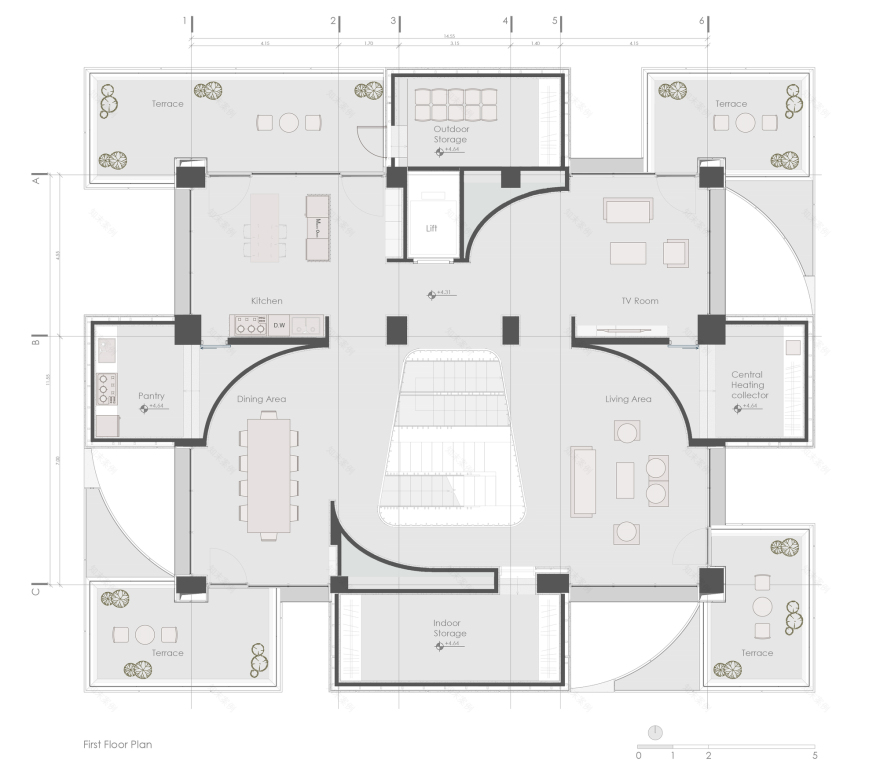

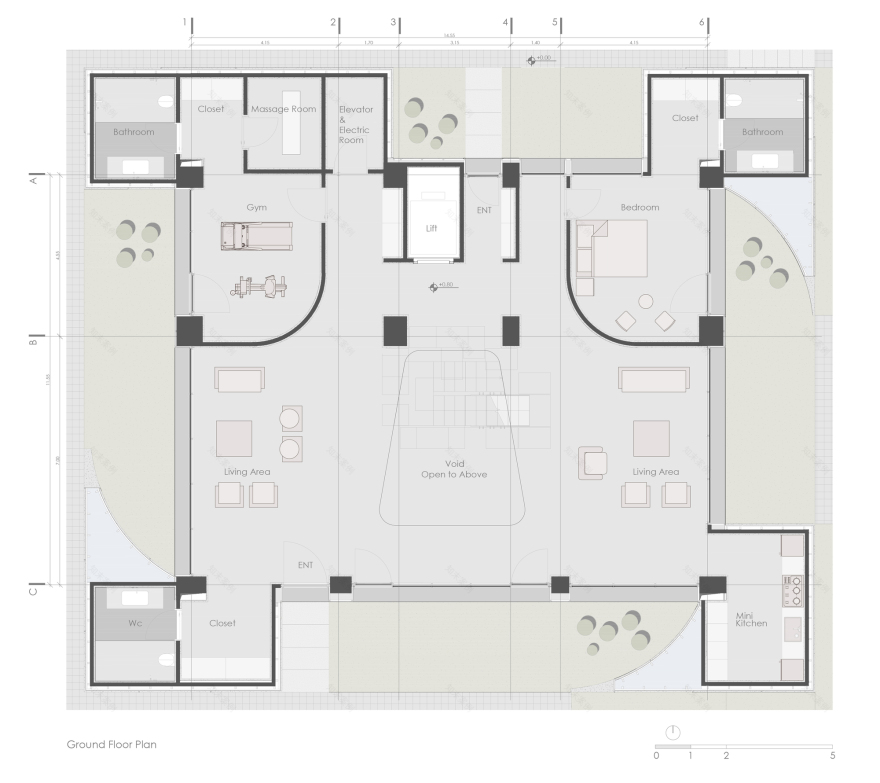
The spatial organization is based on the maximum allowable built area, resulting in a compact solid core that accommodates the main living functions. Surrounding this core is a thick envelope that integrates service spaces such as kitchens, bathrooms, storage, and auxiliary functions. Through the strategic hollowing of this layer, a sequence of suspended volumes, verandas, terraces, and semi-open spaces emerges. These spaces frame controlled views of the forest while enhancing privacy, climatic performance, and spatial depth.

Curved surfaces carved into the building envelope establish indirect visual connections to the landscape. Rather than direct exposure, nature is experienced through layered views and spatial depth. Natural light primarily engages with the outer envelope, leaving interior spaces in soft semi-shadow, reinforcing a sense of calm and temporal suspension. Circulation unfolds around a central void, where a stair connects levels through a continuous spatial sequence that repeatedly reconnects residents with the surrounding environment.

Materially, the house is clad in 5-centimeter-thick concrete panels installed using a dry connection system over a concealed metal substructure. A ventilated cavity between the panels and the main envelope improves moisture control, a critical response to the humid climate. The panels are produced with a modified concrete mix that reduces CO₂ emissions by approximately 35 percent compared to conventional concrete, reinforcing the project's commitment to durability, environmental responsibility, and climate-responsive architecture.

Project gallery



南京喵熊网络科技有限公司 苏ICP备18050492号-4知末 © 2018—2020 . All photos and trademark graphics are copyrighted by their owners.增值电信业务经营许可证(ICP)苏B2-20201444 苏公网安备 32011302321234号
苏公网安备 32011302321234号客服
消息
收藏
下载
最近