

创作上传
VIP
收藏下载
登录 | 注册有礼
查看完整案例

收藏

下载

分享

翻译
Architects:Rosenbaum
Area:358m²
Year:2025
Photographs:Leonardo Finotti
Category:Worship,Cultural Architecture,Educational Architecture
Creation And General Direction:Marcelo Rosenbaum
Project Team:Adriana Benguela, Damany Santos, Paschoal Ribeiro, Pedro Retz
Interns:Marcela Harrop, Guilherme Pace
Communication:Fabiana Zanin, Mirella Santana
Wooden Structure:Ita Engenharia em Madeira
Engineering:ITA Engenharia - Thales Noor, Thalles Carneiro
Foundation Design:Maurício Farias
Local Engineer:Irlan Moura
Foundations:Stec do brasileng
Coordination:Cacique Nixiwaka Biraci Brasil Yawanawa
Support:Hydronorth
Construction:Construtora Yawanawa- Shinu Yawanawa (Universidade dos Saberes Ancestrais); José Leandro de Souza (Universidade dos Saberes Ancestrais); Abraão Silva Moreira (Casa Modelo)
City:Tarauacá
Country:Brazil

Text description provided by the architects. The project of the Sacred Village Yawanawá is not just a built ensemble; it is the materialization of a deep dialogue lasting 14 years between Marcelo Rosenbaum and Chief Nixiwaka Biraci Brasil.

Established in the heart of the Amazon rainforest, along the banks of the Gregório River, the architectural complex articulates architecture, construction techniques, and ancestral knowledge in a project that redefines the possibilities of building in the forest and establishes itself as an anti-colonial architectural act.

The complex consists of three buildings: Model House, University of Ancestral Knowledge, and the Ceremonial Center (Shuhu), conceived as permanent infrastructure for rituals, education, coexistence, and cultural transmission. Inaugurated in 2025, the complex hosted the 5th Indigenous Ayahuasca Conference and consolidates a long-term project aimed at the cultural, educational, and territorial autonomy of the Yawanawá people.

The project arises from the political and spiritual decision to decolonize traditional spaces, creating a set of buildings that reaffirm the cultural and territorial autonomy of the Yawanawá people. Through the dialogue between technical design, engineering, and the empirical wisdom of indigenous and riverside builders, the design solutions were adapted in the field, where knowledge about the behavior of woods, water cycles, and complex logistics dictated the rhythm of the work. The structural approach is radically situated. Native wood managed and processed in the territory itself (Copaíba, Angelim-pedra, Maçaranduba, among others) was used, generating circular economy and productive autonomy.


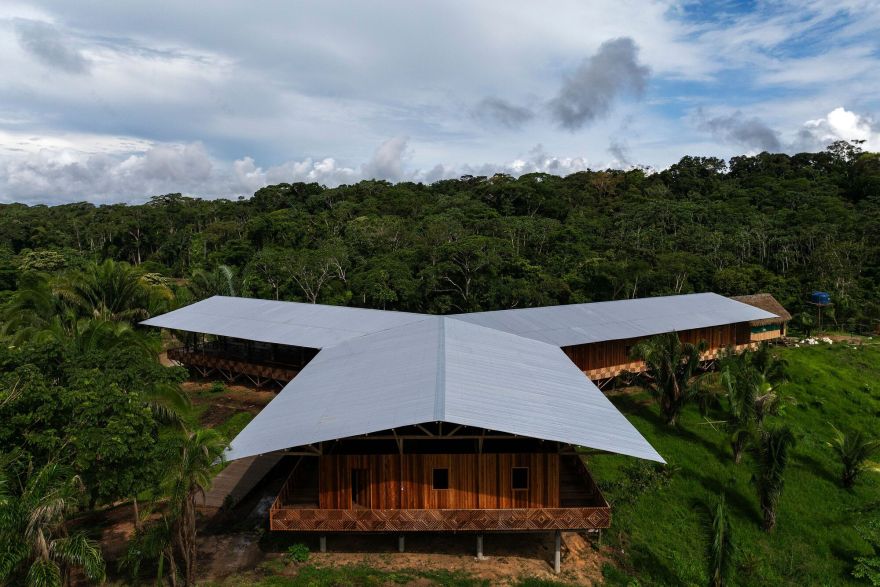
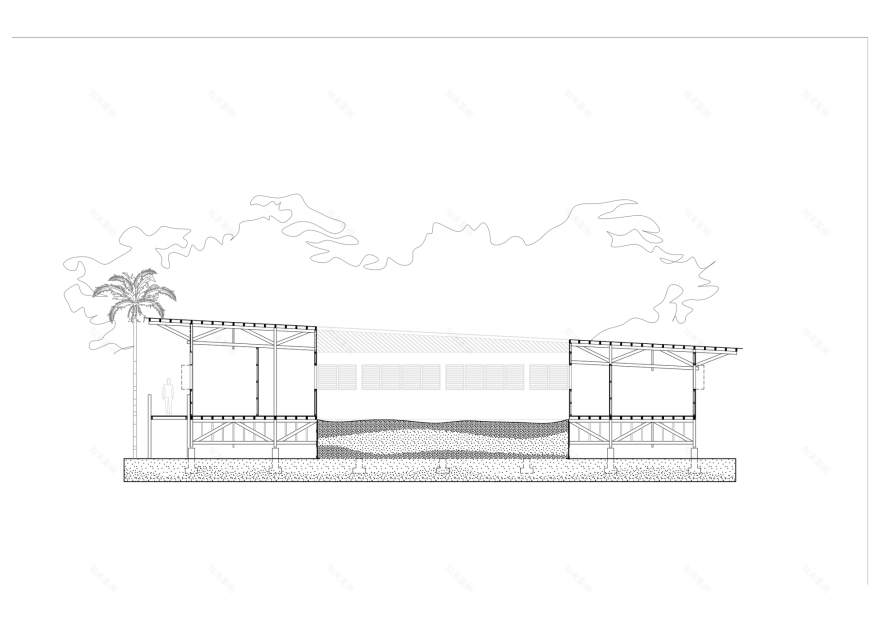
The construction system is based on a rational 4-meter module, present in both the housing and institutional buildings. Point foundations in concrete and elevated metal roofs protect the wood from soil moisture and ensure ventilation, which is essential in the humid tropical climate. This logic gives lightness to the complex: the architecture touches the ground delicately, allowing the forest to breathe through it.

The Sacred Village Yawanawá affirms the forest not as an untouched scenario but as a biocultural heritage managed by human hands for centuries. The architecture implemented here, born from mutual trust and respect, proves that it is possible to combine high technical performance with ancestry, building a future where standing forests are synonymous with technology, healing, and power.
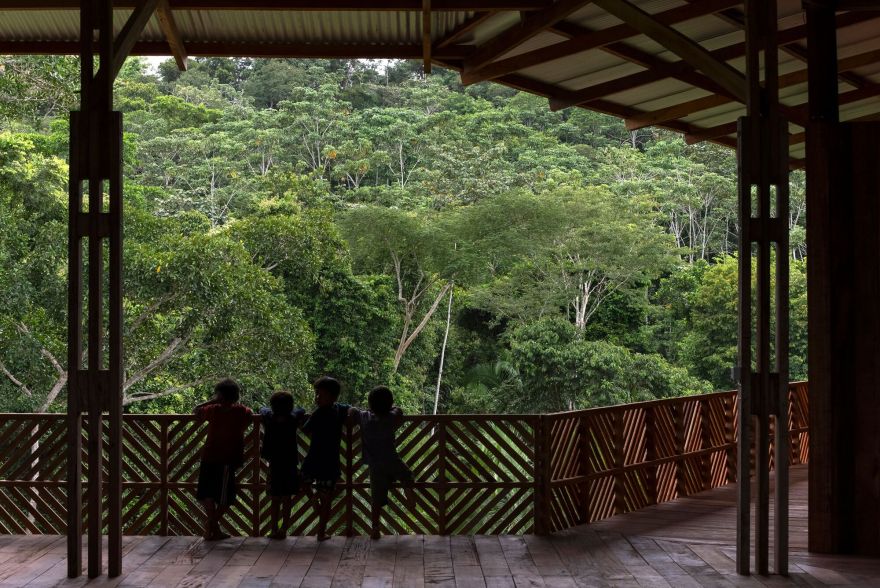
Prototype House — Designed to overcome the precariousness of single-family homes introduced through acculturation, the Model House restores the dignity of dwelling in the forest. With an integrated layout, central courtyard, and cross-ventilation, it reconciles domestic life with the climate and community, serving as a replicable prototype for the families of the village.


The 4-meter construction module, defined by wooden pillars, beams, and trusses, creates a system that values structural balance and spatial lightness, reinforced by the relationship between the volumes of integrated environments that are elevated from the ground and roofs. The project also features an integrated organization with a living room and kitchen, four bedrooms, two bathrooms, and a central courtyard, designed to provide thermal comfort and cross-ventilation between the spaces.
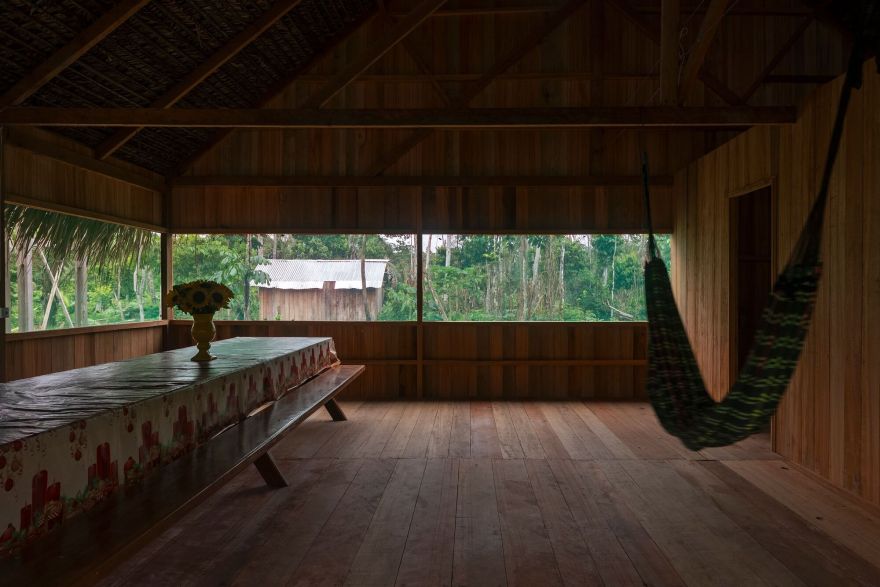
University of Ancestral Knowledge — The University of Ancestral Knowledge constitutes the main programmatic building of the complex. With approximately 1,265 m² of built area, the building houses an industrial kitchen, a dining hall for about 250 people, space for up to 150 hammocks, and 12 classrooms, in addition to ample areas for socializing and collective work. The three blocks that make it up are articulated in the shape of a "Y" — a suggestion from Chief Nixiwaka Yawanawá — symbolizing the convergence of different paths of knowledge.

More than a conventional educational building, the University of Ancestral Knowledge materializes a pedagogy based on orality, collective experience, and intergenerational transmission, affirming architecture as a physical support for the continuity and reinvention of indigenous knowledge.

Architecturally, the building prioritizes open, transparent, and flexible spaces, organized around the 4-meter structural module. Large tables function simultaneously as dining areas, laboratories, classrooms, and conversation spaces, dissolving rigid boundaries between teaching, practice, and coexistence. The elevated roof, supported by lightweight wooden trusses, favors natural ventilation and enhances environmental comfort in the tropical climate.

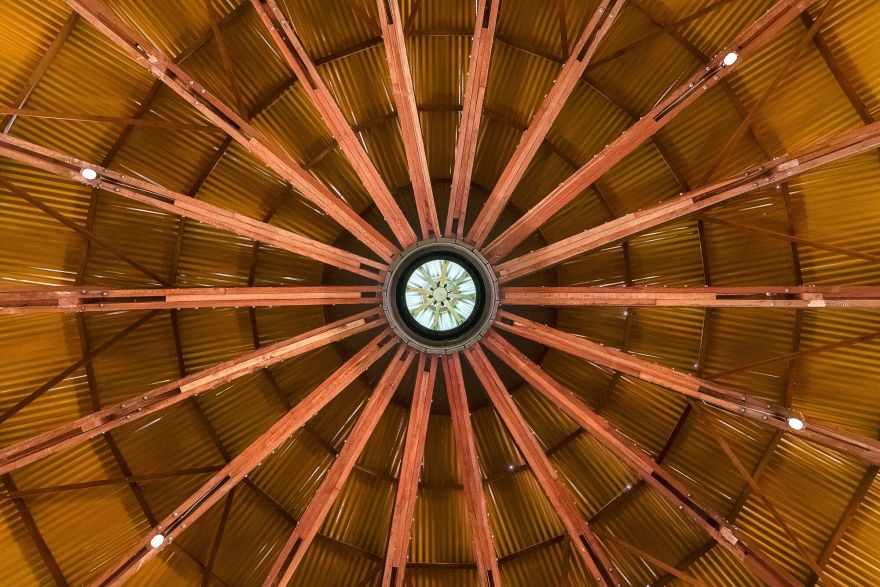
Shuhu Ceremonial Center — In the intersection of ancestral construction techniques, modularity, and contemporary engineering, the Shuhu Ceremonial Center was born. With a free span of 33 meters, the building was conceived to host rituals, gatherings, and large celebrations, having hosted the 5th edition of the Indigenous Ayahuasca Conference. For this, it was essential to have a space completely free of visual and structural interferences, allowing the body, dance, and spirituality to occupy the center of the rite.


In response to this challenge, engineering developed a radial system composed of large wooden trusses, articulated by a compression metal ring that also acts as a skylight, promoting natural lighting and ventilation. The result is a space with a 33-meter free span, without pillars, allowing rituals and body movements to occur fluidly and continuously.

Project gallery




南京喵熊网络科技有限公司 苏ICP备18050492号-4知末 © 2018—2020 . All photos and trademark graphics are copyrighted by their owners.增值电信业务经营许可证(ICP)苏B2-20201444 苏公网安备 32011302321234号
苏公网安备 32011302321234号客服
消息
收藏
下载
最近