

创作上传
VIP
收藏下载
登录 | 注册有礼
查看完整案例

收藏

下载

分享

翻译
Architects:Paloma Bau Studio
Area:170m²
Year:2025
Photographs:David Zarzoso
Category:Offices Interiors
City:València
Country:Spain

Text description provided by the architects. Ausiàs Pérez of T.O.T Studio and Paloma Bau open the doors to Sornells 21, their shared studio in the Valencian neighborhood of Ruzafa, transforming a former commercial unit into a creative workspace inspired by the urban imagination of Tokyo. The intervention combines a strong conceptual narrative with a carefully executed material strategy, shaping a place where design, community and creativity converge.

At number 21 Sornells Street—one of the pedestrian routes linking Valencia's Ruzafa Market with the surrounding residential fabric—T.O.T, the studio led by designer Ausiàs Pérez, and Paloma Bau present a new workspace conceived to host their respective teams as well as a small community of creative professionals.


The project occupies a 170 sqm U-shaped premises with dual street access and emerges from a collaboration that developed organically: Pérez's return to the city and Paloma Bau's search for a new studio. More than a strategic partnership, it represents a shared desire to create an environment where different disciplines, methodologies and languages can coexist, and where architecture and design actively foster encounters and spontaneous synergies.

Context and concept - From the outset, T.O.T led the conceptual development of the project, while Paloma Bau's team took charge of its architectural materialization. This division reflects the essence of both practices: the speculative and strategic nature of T.O.T, and Paloma Bau's ability to translate concepts into tangible form through matter, geometry and detail.

The starting point was a simple but powerful idea: to reinterpret some of the founders' favorite everyday places in Tokyo and translate their atmosphere into a flexible workspace in Valencia. Rather than literal theming, the project offers an architectural interpretation of three recognizable Japanese urban situations: the ceramic-tiled street, the izakaya bar, and the relaxed environment of the onsen.
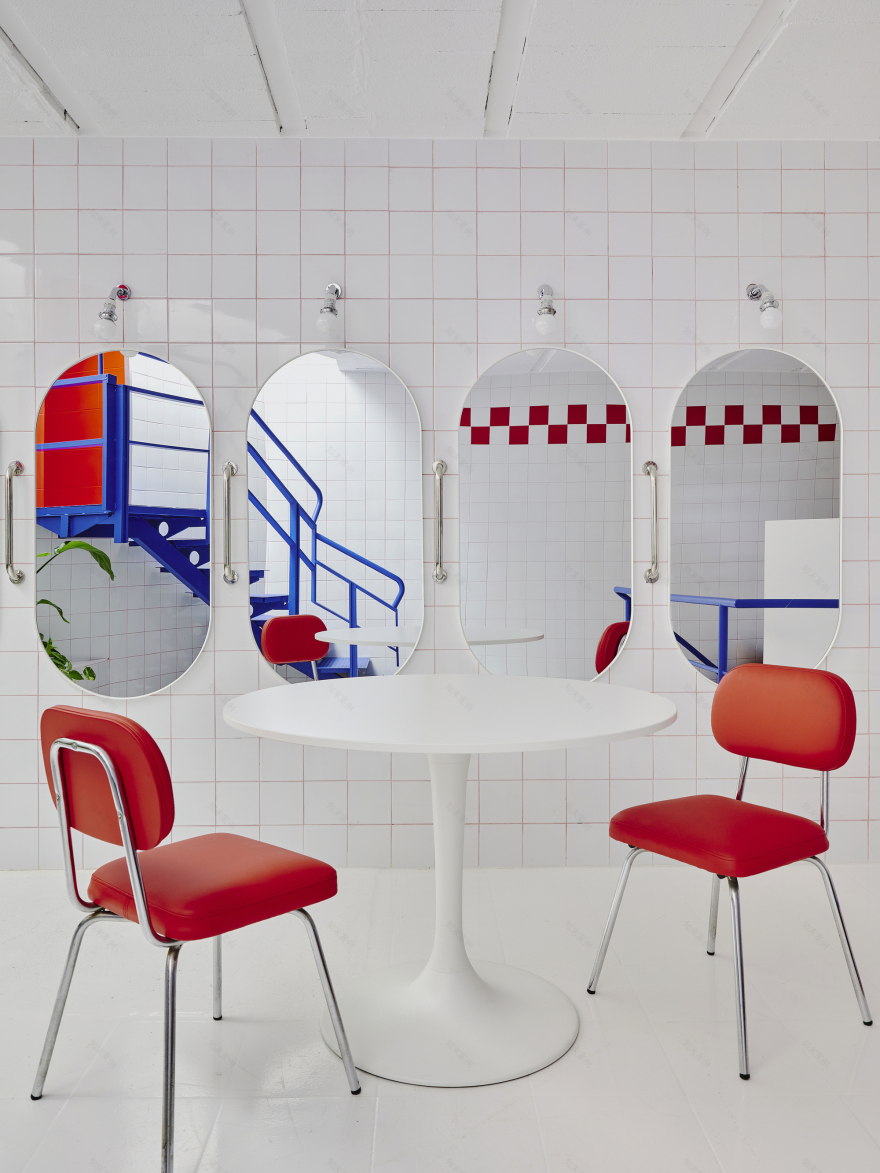

The arrival sequence is conceived as the project's conceptual threshold. The entrance reproduces the material logic of many urban architectures in Tokyo, where white 10×10 ceramic tiles wrap entire façades. Here, the same tile forms a clean, almost exterior-like threshold, reinforced by a large ceiling mirror that doubles the space and alters its proportions. This device creates the sensation that the visitor is still outdoors even after entering, blurring the boundary between street and studio. A solid white concrete bench introduces one of the project's recurring materials, anticipating its structuring role throughout the space.

Project gallery



南京喵熊网络科技有限公司 苏ICP备18050492号-4知末 © 2018—2020 . All photos and trademark graphics are copyrighted by their owners.增值电信业务经营许可证(ICP)苏B2-20201444 苏公网安备 32011302321234号
苏公网安备 32011302321234号客服
消息
收藏
下载
最近