

创作上传
VIP
收藏下载
登录 | 注册有礼
查看完整案例

收藏

下载

分享

翻译
Architects:O.U.V.R.A.G.E.S.
Area:395m²
Year:2025
Photographs:Maxime Delvaux
Manufacturers:Chrono Metallurgie,Tailor Wood,Veranda Service,Weldconception
Category:Residential Architecture,Houses
Design Team:Fiachra McCarthy, Artem Alexandrov, Louis Cassiers, Sébastien Bez, Daphne Meeus (Interiors), Prana Aquitania (Interiors)
Office Lead Architects:Louis del Marmol, Dimitri Stassin
Engineering & Consulting > Structural:Verhelst ingénieurs
Engineering & Consulting > Environmental Sustainability:Brouae
Engineering & Consulting > Mep:Hydrotec
General Contractor:EDK
Interior Design:DM Interios
City:Watermael-Boitsfort
Country:Belgium

Text description provided by the architects. The project transforms a former neighborhood restaurant in Watermael-Boitsfort (Brussels, BE) into a set of adaptable dwellings, rooted in the heritage value of the existing building. In an uncertain ecological and economic context, reprogramming such a building for a single, fixed use appears increasingly inadequate. The project therefore rejects a deterministic approach in favor of a restrained, legible, and forward-looking architectural strategy.
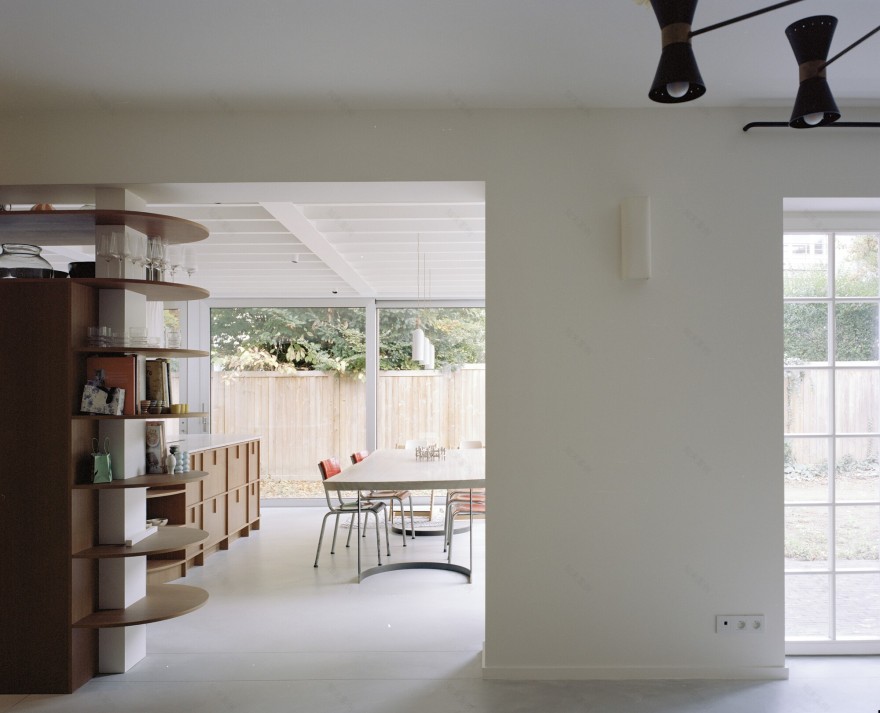

The architectural plan is organized around three vertical circulation cores that rhythm the existing volume and clearly structure the interior layout. Beyond their immediate function, these cores are strategically positioned to enable multiple scenarios of occupation over time.
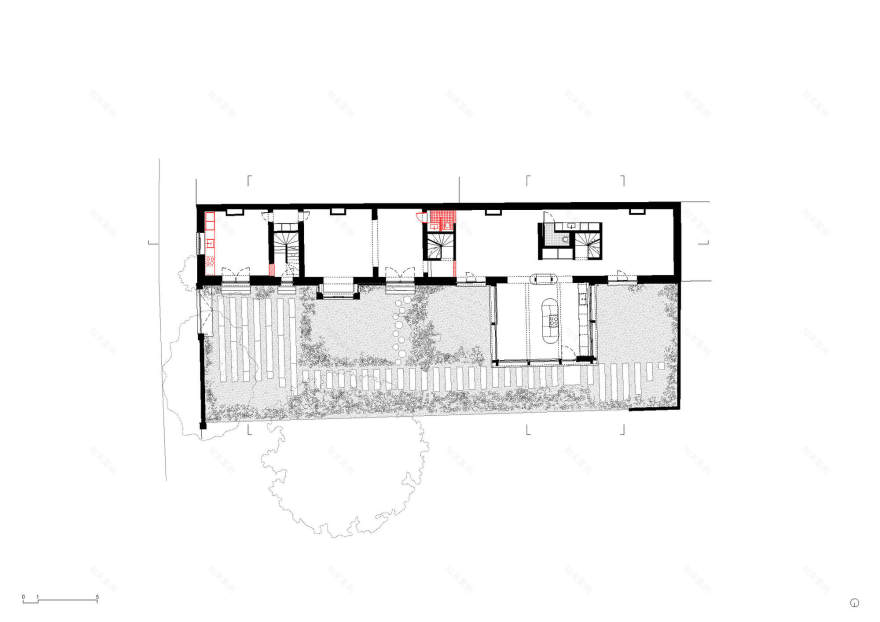

While the building is initially designed to accommodate a single family, it can later be divided into three independent, high-quality dwellings with minimal intervention, each benefiting from its own outdoor space. This capacity for transformation is embedded from the outset, turning the anticipation of change into a true design driver rather than a future constraint.


The architectural intervention also focuses on a measured extension of the existing structure. On the ground floor, an extension increases the usable floor area and reinforces the domestic character of the project. Above, the roof is subtly raised to make the attic space habitable. The newly created volume allows for the introduction of a loggia in the top-floor apartment, bringing depth and daylight through two large sliding roof openings.

This clear and contemporary gesture distinguishes itself from the original building without imitation, allowing the heritage structure to remain legible while being reinterpreted. Both the ground-floor extension and the roof elevation are constructed using load-bearing timber structures and bio-based materials.

By anticipating evolving uses and asserting restraint, the project proposes an alternative to programmed obsolescence. Architecture is no longer defined by a single moment or function, but by its capacity to support change over time, extending the life of existing buildings while carefully negotiating between heritage, density, and contemporary living.

Project gallery




南京喵熊网络科技有限公司 苏ICP备18050492号-4知末 © 2018—2020 . All photos and trademark graphics are copyrighted by their owners.增值电信业务经营许可证(ICP)苏B2-20201444 苏公网安备 32011302321234号
苏公网安备 32011302321234号客服
消息
收藏
下载
最近