

创作上传
VIP
收藏下载
登录 | 注册有礼
查看完整案例

收藏

下载

分享

翻译
Architects:Qing Studio
Area:330m²
Year:2026
Photographs:Yilong Zhao
Main Contractors:Hubei Taiyue Landscape and Historic Architecture Engineering Co., Ltd; Hubei Lianhao Construction Group Co., Ltd.
Structural Consultants:School of Civil Engineering, Huazhong University of Science and Technology
Category:Exhibition Center,Adaptive Reuse,Heritage
Design Team:Hu Xing, Liu Changming, Yan Chunyang, Luo Tingkai, Tang Ziji, Gao Qi, Niu Jiayin, Liu Luoya
Construction Drawing Team:Jia Jing, Huang Haiyan, Gong Xueqin
Supervising Team:Deng Yunqi, Hao Han, Xie Hui
Contractor Team:Yang Fan, Tan Qingjia, Zhan Ping
Structural Team:Nie Sufei
Curtain Wall Team:Zhang Yanxin, Fan Ran
Construction Drawing Design:Wuhan Light Industry Architectural Design Co., Ltd.
Curtain Wall Consultant:Beijing Boya Engineering Consulting Co., Ltd
Client:Jingzhou Museum
City:Jingzhou
Country:China

A Millennium Cross-Section on a Living Street — This project originates from a major breakthrough in the archaeological discovery and conservation practice at Bastion No. 11 of the Jingzhou City Wall. Since 2016, this section of the ancient wall had been listed for emergency conservation due to foundation settlement and structural cracking. During the repair process, a stratified structure of "walls built upon walls," spanning the Five Dynasties, Song, Ming, and Qing periods, was uncovered. This led to the approval by the National Cultural Heritage Administration for systematic archaeological excavation.
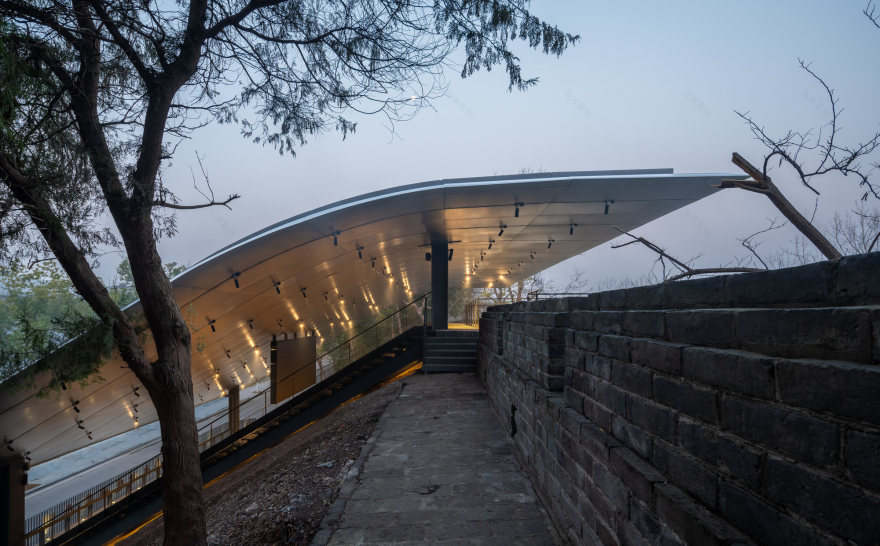


The discoveries at Bastion No. 11 confirmed that Jingzhou's brick city wall can be traced back to the Five Dynasties period, clarified the construction and use of the wall from the Five Dynasties through the Qing dynasty, and vividly revealed the historical and cultural depth of the ancient city. Serving as an important historical witness, the site also raises a new question: how can archaeological remains be displayed in a living manner and integrated into the everyday cultural life of the public?
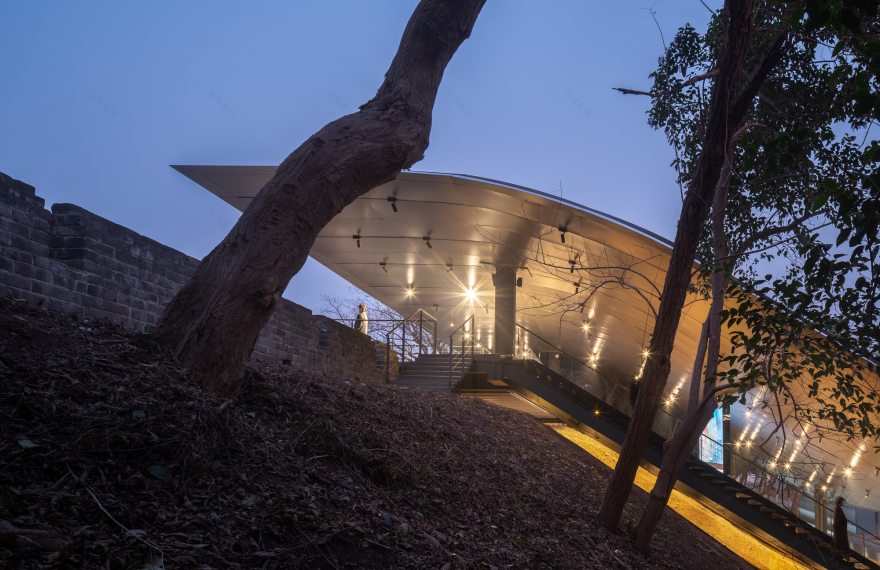

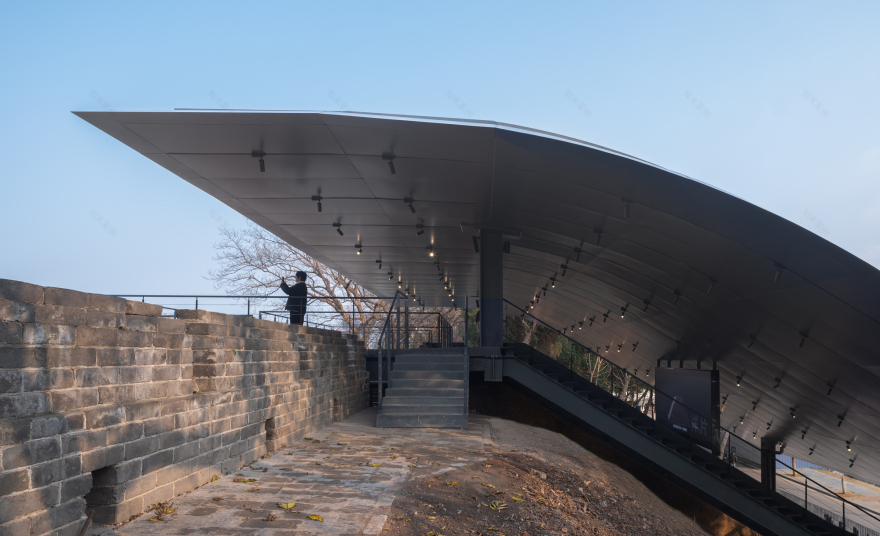
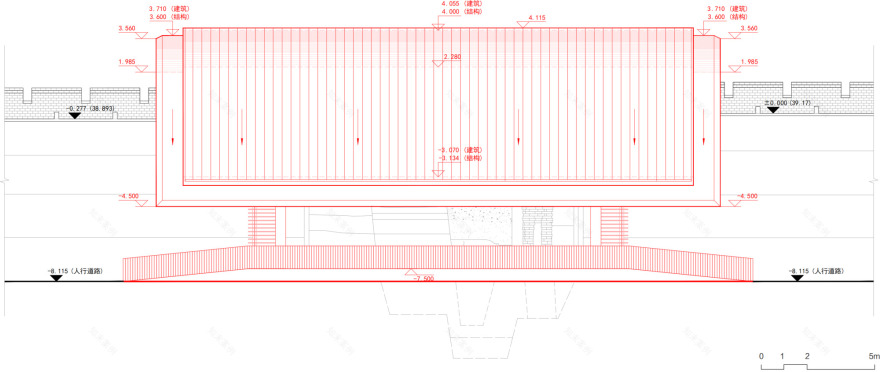
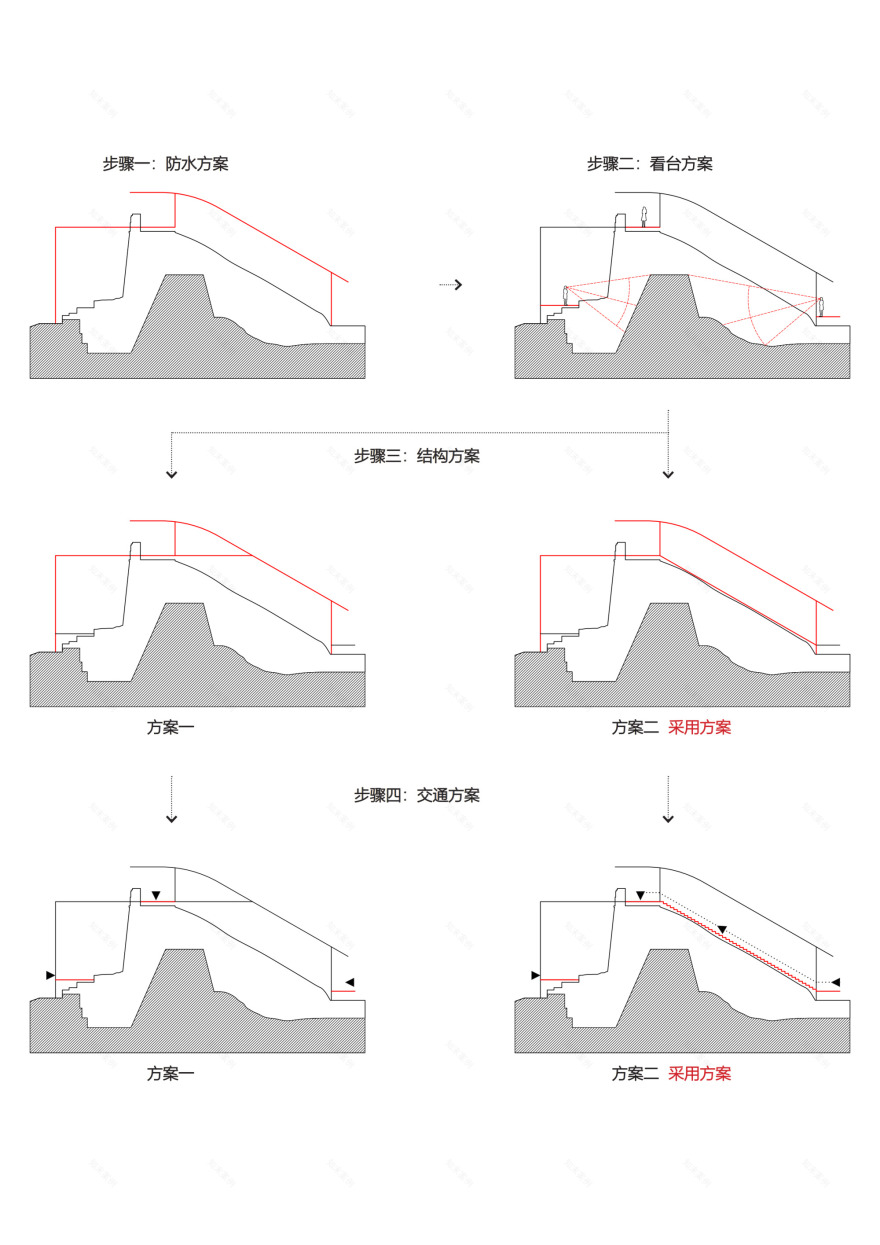
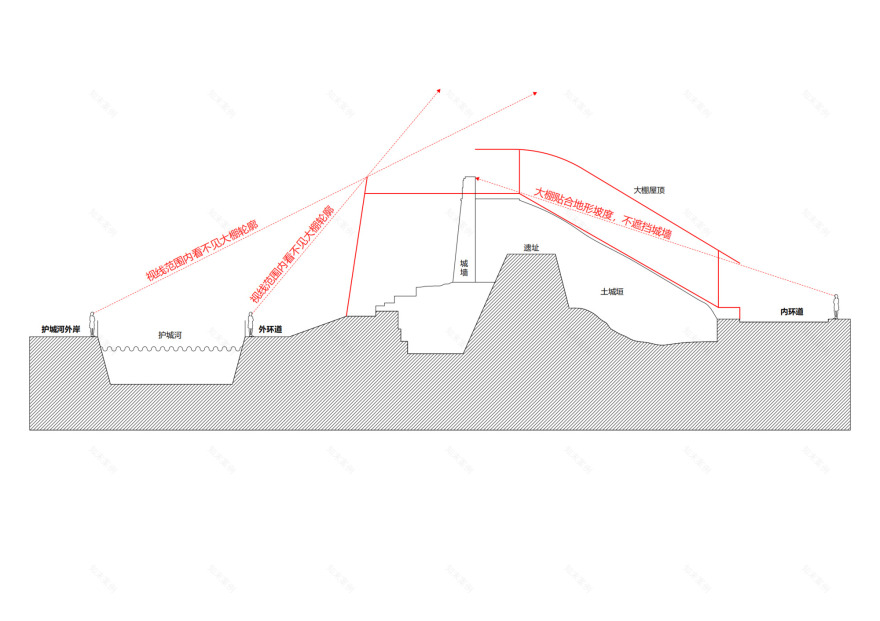
The Canopy: A Light Intervention — The primary task was to shelter the archaeological remains from wind and rain. Yet any bulky or ostentatious covering would have brutally disrupted the silhouette of the ancient city. Our strategy was one of "decomposition" and "visual retreat." The protective canopy is divided into two segments: the southern segment follows the inclined profile of the inner earthen rampart, while the northern segment aligns with the direction and tapering angle of the remaining outer bastion wall. Rather than a massive object descending from above, the canopy appears as a new contour gently "floating up" from the existing terrain.

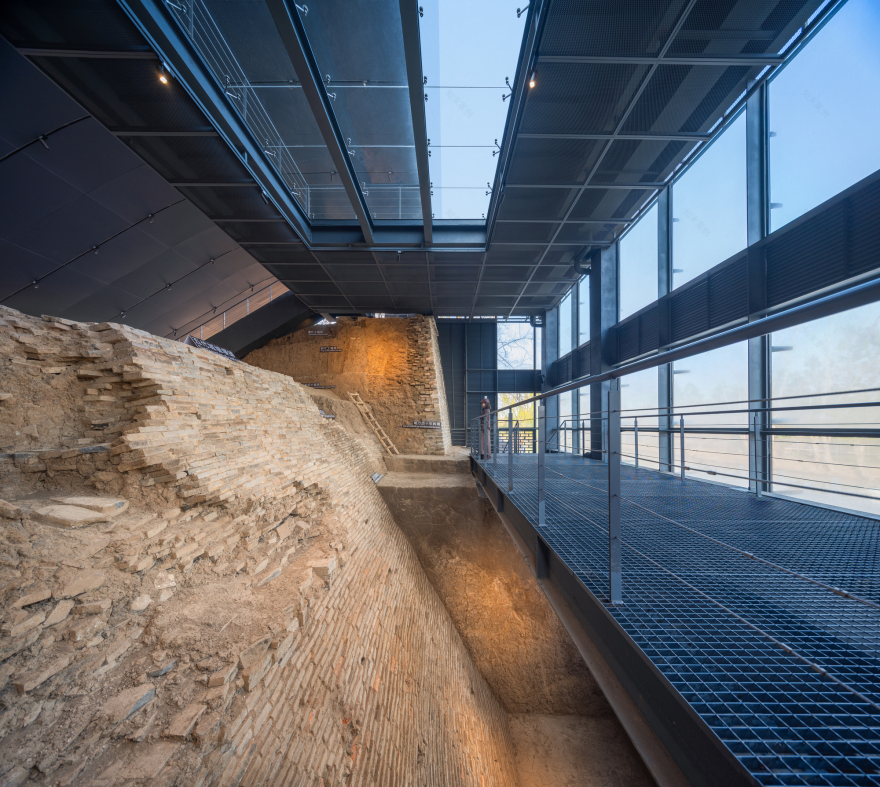
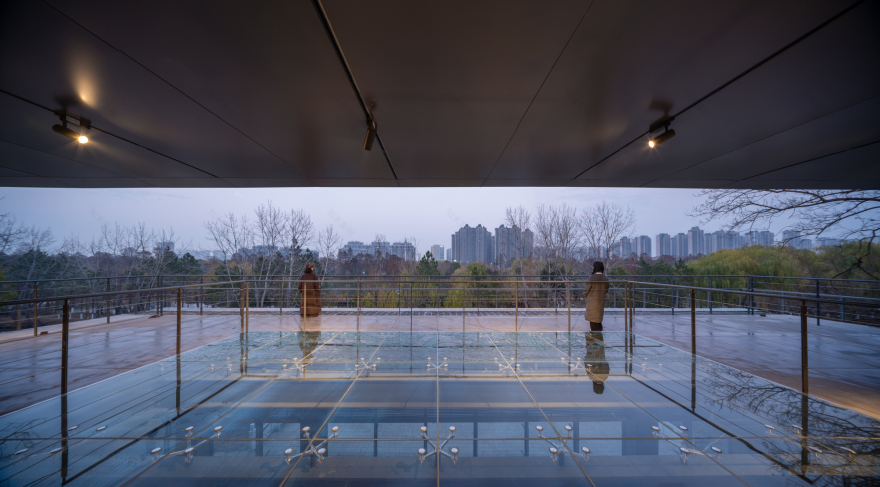
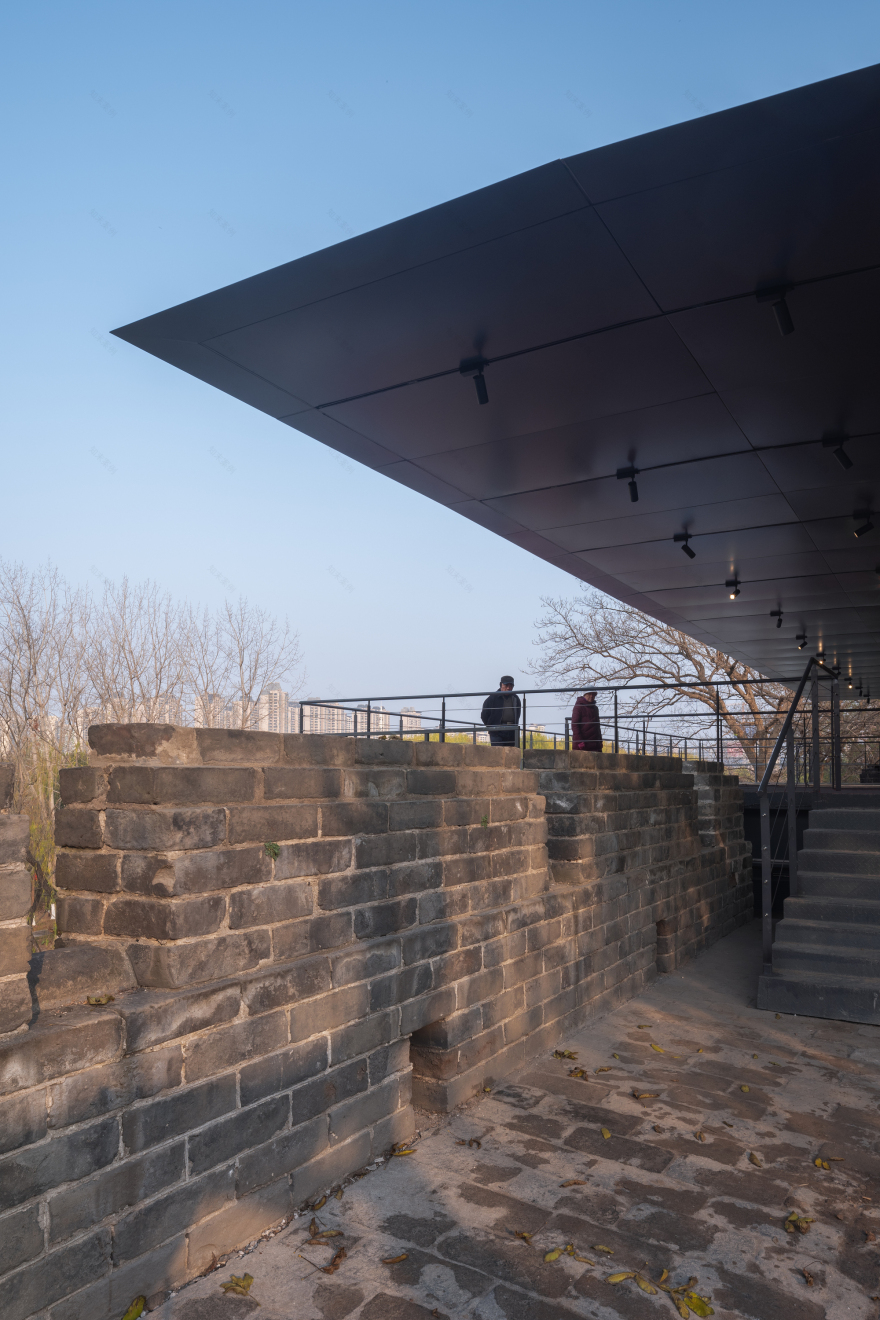
All newly added steel beams and columns maintain a clear physical distance from the historic wall. They lightly span over the site, with foundations largely reusing the points of the former temporary archaeological shelter, minimizing secondary disturbance to the remains and the wall's foundations, and adhering to the principle of minimal intervention. To achieve maximum visual subtlety, the eaves adopt a variable cross-section design: from the street outside, they read as a blade-thin edge, almost merging into the skyline of the ancient city; from within the site, the canopy reveals a complete and cleanly curved soffit, providing calm shelter for both the relics and visitors.
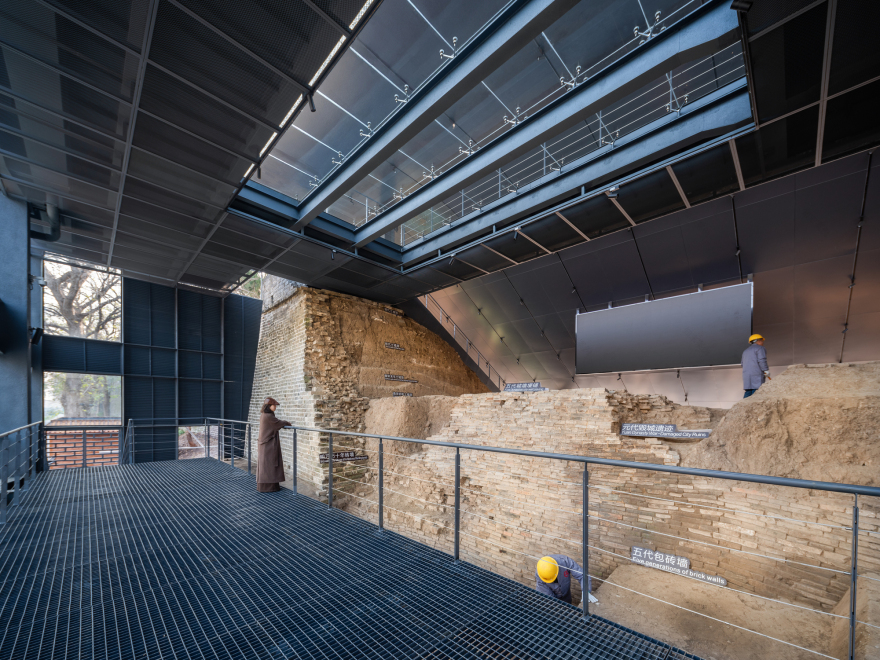
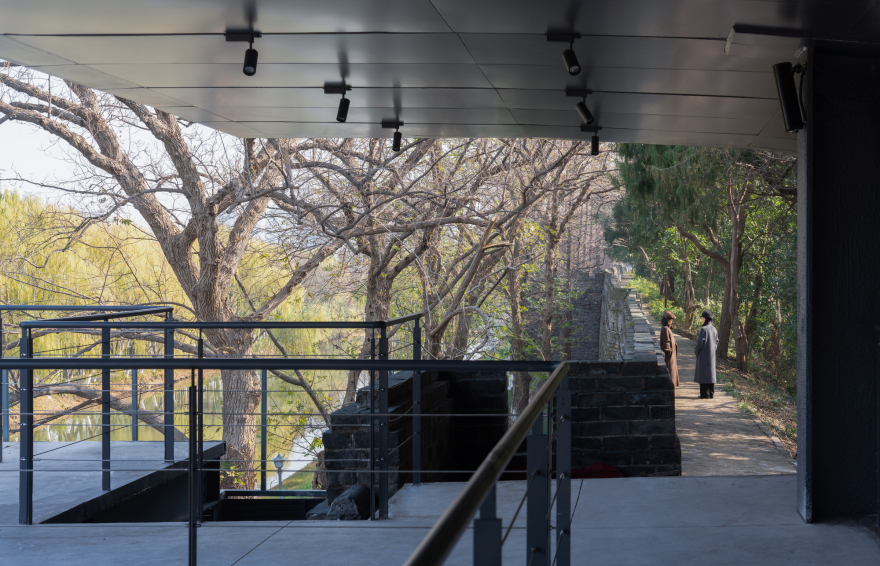
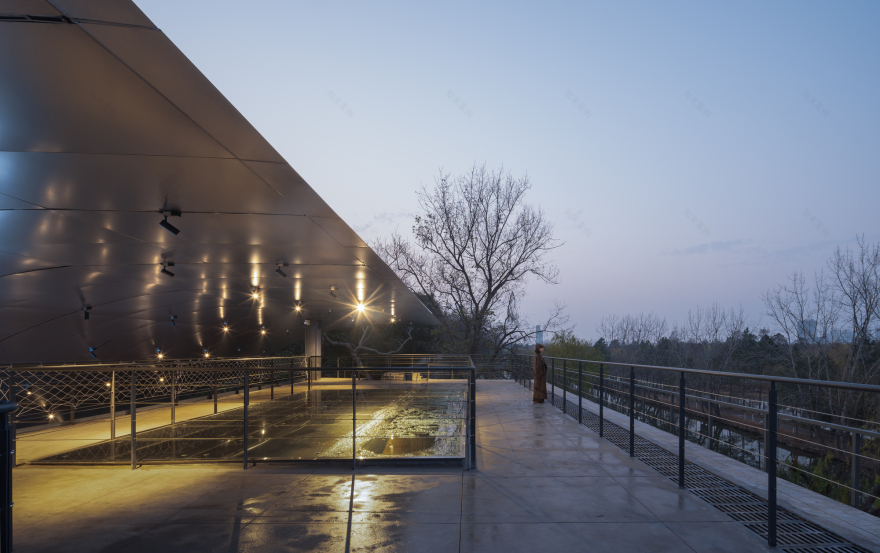
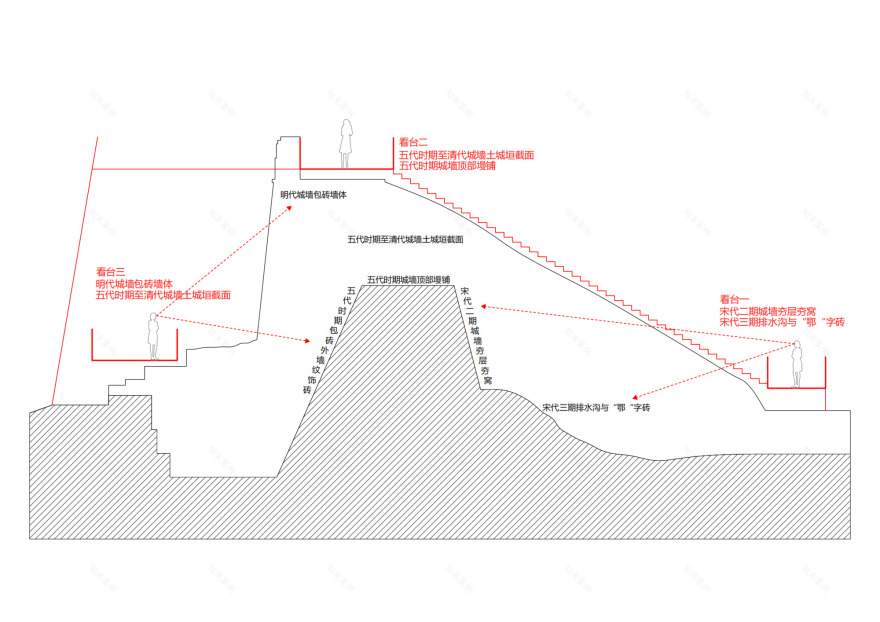
The Path: Suspended Reading — Bastion No. 11 is a critical node for understanding the history of the Jingzhou City Wall, where two intersecting "axes of time" converge. The vertical axis represents the stratified accumulation of remains from the Five Dynasties to the Qing dynasty; the horizontal axis is the intact ancient city wall preserved to this day. As one of the most complete prefectural-level city walls in southern China—and even nationwide—its value lies in its uninterrupted circumference of 11,281 meters, continuous and intact.


At the upper level, the project restores the interrupted wall-top circulation route, re-establishing the continuous spatial sequence of the ancient city and providing viewpoints overlooking the archaeological site and the surrounding city. At the lower level, a lightweight perforated platform cantilevers closely along the excavation wall, guiding visitors to observe the soil layers and masonry details from an almost archaeologist's bird's-eye perspective. All viewing platforms and pathways are reduced to the minimum dimensions permitted by structural requirements and are finished in dark-gray matte metal. As people walk along them, their attention is fully drawn to the historical section beneath their feet, while the paths themselves recede into discreet frameworks that guide vision and then disappear.


The Threshold: A Living Exhibition — This geological cross-section revealing a millennium of construction history is not hidden in wilderness or isolated within a protected enclave. Instead, it is directly exposed alongside a living street on the southern edge of the ancient city, allowing conservation and display to become a natural extension of urban public life. The exhibition pavilion removes all enclosing walls: there is no ticketing, no turnstiles—only gentle ramps and steps seamlessly connected to the street. Turning in from the lively ring road, citizens and visitors strolling or cycling can effortlessly glimpse the profound archaeological section. History is no longer a distant specimen behind glass, but a compelling streetside scene that invites pause and contemplation.
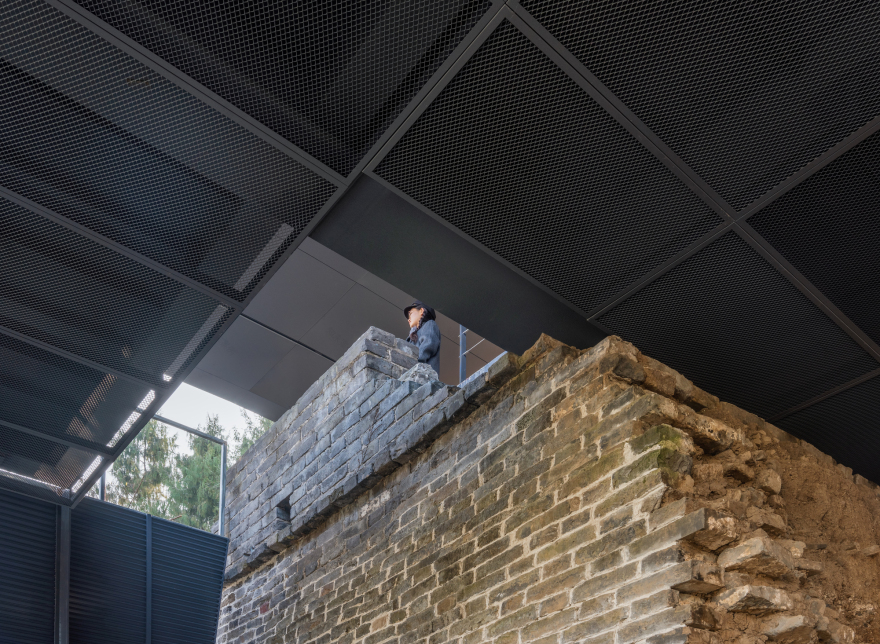

The circulation system is woven into the existing urban fabric. Visitors may walk along the wall-top loop and look back toward the ancient city; enter the site directly from the southern street; or slip in from the north into the interior of the wall to closely observe rammed earth and brickwork. This multiplicity of routes dissolves the formality and one-directionality typical of museums, allowing the exploration of history to be as free and incidental as wandering through a neighborhood. The Jingzhou City Wall Archaeological Site Exhibition Pavilion is not a destination that demands a deliberate visit. It is an everyday node—one that residents might pass by on their way to the market, while picking up children, or during an evening stroll, and then linger at by chance. Here, the space of historical preservation overlaps and merges with the space of contemporary life, allowing engineering remains that span a thousand years to quietly return as part of the city's everyday breathing.

Project gallery






南京喵熊网络科技有限公司 苏ICP备18050492号-4知末 © 2018—2020 . All photos and trademark graphics are copyrighted by their owners.增值电信业务经营许可证(ICP)苏B2-20201444 苏公网安备 32011302321234号
苏公网安备 32011302321234号客服
消息
收藏
下载
最近