

创作上传
VIP
收藏下载
登录 | 注册有礼
查看完整案例

收藏

下载

分享

翻译
Shadow of Tradition anchors a new house on Bistryčios gatvė in Vilnius, Lithuania, where both the landscape and architectural heritage are closely protected. Conceived by Devyni Architektai, the project interprets traditional Lithuanian forms with charred wood facades, a gabled roof silhouette, and a slope-set basement that together weave local memory into contemporary living. Every move ties the compact rectangular plan back to nature, history, and craft.


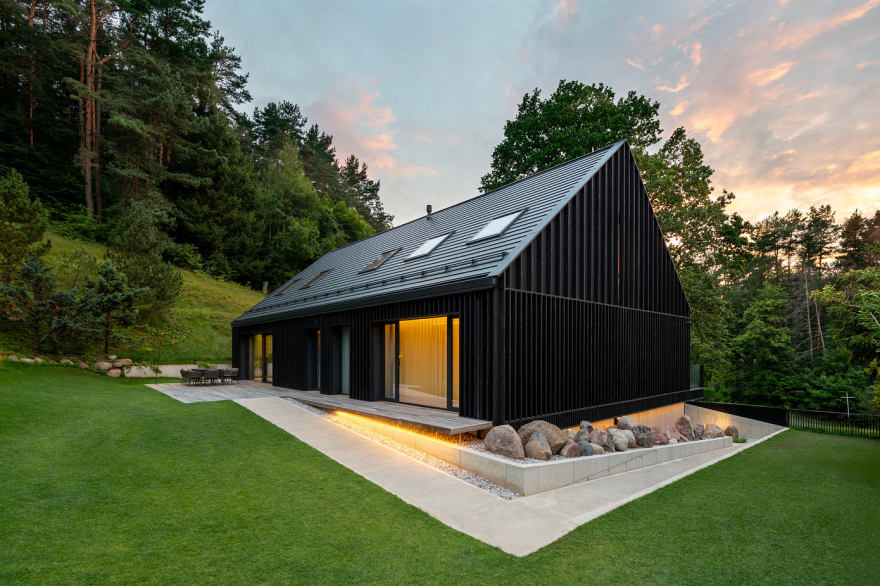


The house rises from the slope in a quiet line. Charred timber catches the light so each change in weather leaves a different pattern of shadow and depth across the walls.
This is a house in a protected Lithuanian landscape, where building rules and regional memory set a clear frame for new work. Devyni Architektai respond with a compact gabled volume that borrows from traditional rural architecture yet stands firmly in the present, using charred wood, a grounded basement, and refined carpentry as the primary tools. Material thinking leads the project, from the base embedded in the hillside to the vertical slats that filter sun, views, and privacy.
A rectangular plan keeps the layout direct, with interior and exterior areas intertwined through large openings and sheltered thresholds. The basement, sunk into the slope, acts as a sturdy pedestal, lifting domestic life while anchoring the structure to the terrain and to the idea of inheritance. Above this base, the timber-clad volume speaks in a familiar gabled silhouette, echoing village roofs that sit comfortably within fields and forests.
Building On The Slope
The project starts with the ground. A basement tucked into the natural incline forms a solid plinth that stabilizes the house physically while also grounding it in local tradition. This lower level reads as a quiet podium, allowing the main timber body to sit slightly elevated, so the house gains presence without excess height or bulk.
Charred Wood Envelope
Here, wood is more than cladding. Centuries of Lithuanian carpentry inform the choice of charred timber, where controlled burning deepens color and improves durability against weather and pests. The rich black surface gives the house a strong outline against greenery and snow, making every joint and corner read with quiet precision.
Vertical slats slip across this dark shell, cutting rhythmic geometric patterns that recall historic ornament once carved into rural facades and eaves. These slats sit in front of glazing to soften direct sun, guard privacy, and break wind without closing rooms to daylight. Light threads between boards during the day, while at night their lattice reads as a subtle graphic on the darker volume.
Tradition In The Roofline
The gabled roof carries the most familiar gesture. Its simple outline matches long-used Lithuanian house forms, so the new construction rests comfortably within a protected architectural context. There is no drama in the silhouette; instead, proportions and pitch quietly reference vernacular barns and homesteads.
Inside this shell, the straightforward rectangular footprint encourages clear, flexible rooms aligned to views and light. Connection between interior and exterior is reinforced at ground level, where doors open directly from living areas toward the slope and surrounding landscape. Seen from a distance, the roof and volume read as a contemporary echo of older neighbors, respectful in both height and rhythm.
Craft, Pattern, And Technology
Historic ornament finds a restrained counterpart in the facade patterns. Rather than carved trim, precise timber slats trace geometric motifs that catch shadows across the charred background throughout the day. This gives the house surface depth without resorting to heavy decoration, aligning old craft values with contemporary construction methods.
Behind the envelope, energy-efficient engineering supports low environmental impact while keeping the building aligned with its protected setting. Mechanical systems, insulation choices, and glazing strategy work in concert with the compact form, reducing heat loss and moderating solar gain. In this way, innovation stays largely invisible, allowing the tactile presence of wood, the weight of the slope-set base, and the remembered outline of the gabled roof to define the experience.
As light shifts over the blackened boards, the house feels firmly tied to its landscape. Wind moves through the timber screens, and the hillside base keeps every level connected to the ground. Material, memory, and technique sit together in calm balance, carrying local tradition forward without freezing it in place.
南京喵熊网络科技有限公司 苏ICP备18050492号-4知末 © 2018—2020 . All photos and trademark graphics are copyrighted by their owners.增值电信业务经营许可证(ICP)苏B2-20201444 苏公网安备 32011302321234号
苏公网安备 32011302321234号客服
消息
收藏
下载
最近