

创作上传
VIP
收藏下载
登录 | 注册有礼
查看完整案例

收藏

下载

分享

翻译
Architects:Estúdio HAA!
Area:107m²
Manufacturers:Macal Madeiras,Multiperfil,Pedra Azul Marmoraria,Quality Glass,Strufaldi
Lead Architect:Homã Alvico
Category:Residential Architecture,Houses
Project Team:Gabriela Batistela, Michele Guillen
Technical Team:Fernando Nabor
Engineering & Consulting > Structural:Tecnobra Steel Framing
General Construction:PELE - Personalização em Larga Escala
City:Sapucaí-Mirim
Country:Brazil

Text description provided by the architects. The Casa Vão was developed within the parametric system of pre-fabricated residential projects created by the construtech PELE (Personalization at Scale), a spin-off company of the HAA! Studio!

The project system allows for infinite customizations within limited criteria, resulting in a factorial number of design possibilities, without altering previously tested construction solutions or affecting production scalability. In other words, the design conception starts from previously defined technical standards to ensure quality and manufacturing speed, without it meaning more of the same or repetition of designs.

PELE was created to be a faster and more practical alternative to the traditional architectural office design process, which naturally takes time to conceive, review, and detail, and due to its uniqueness in architectural solutions, often generates little accurate budgetary and construction schedule predictability.

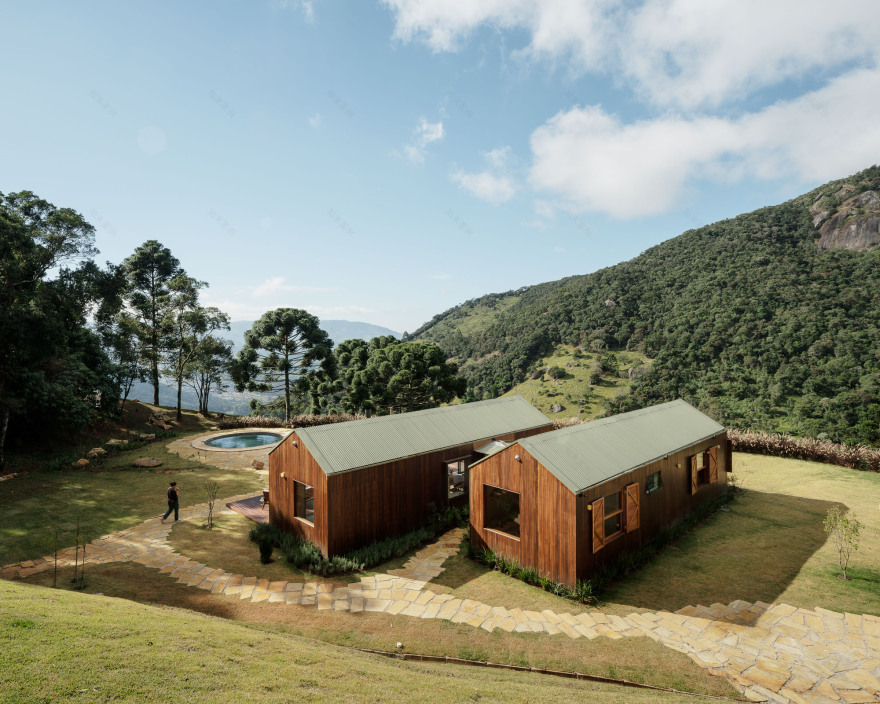
In Casa Vão Sagarana, we had a simple occupancy program with two spacious bedrooms, one of which is a suite, and a large social area integrated with the kitchen. The biggest challenge was the approach to the landscape, as it is a plot of almost seven hectares with no obvious implantation points. We had to create a balance between the expansive feeling offered by a wide view versus the sense of protection and comfort provided by being surrounded by smaller, closer mountains, like a hug that shields from the wind and brings proximity. During our visits to the site with the clients, we applied site apprehension dynamics to test all visible points for the house's implantation, assessing the positives and negatives of each possibility, using criteria such as solar orientation, ease of access, construction complexity, and landscape qualities.

From the definition of the best location, we created a project to adapt the immediate topography without generating significant movement impacts, taking advantage of the potentials the site offered. Since the area was previously used as pasture with vegetation cover only from grasses, we did not need to remove or relocate any trees.


The house was developed entirely in steel frame, resulting in a rapid, clean, and waste-free construction, significantly reducing the environmental footprint compared to the traditional national building system, which is based on cast-in-place reinforced concrete and masonry, resulting in a carbon footprint reduction of 35% to 40%. This is due to the lower consumption of heavy materials, reduced CO₂ emissions in material production, savings in transportation, and less waste generation.

The choice of a pre-fabricated and more sustainable construction system, adopted by HAA! Studio, reflects an ethical commitment to the reality of climate change; we understand this as a basic requirement for acting responsibly in civil construction. In addition to the environmental benefits, the use of advanced technology raises the qualification level of the workforce, providing better working conditions. This system reduces intense physical effort, such as the daily carrying of heavy materials, and allows workers to receive higher hourly wages, promoting improvements in their living and working conditions, especially for those who traditionally face severe situations on construction sites.

It aims to promote the reduction of social inequality within what is possible in our scale of action limitations. We believe that architectural choices go far beyond artistic subjectivities and can be relevant in not maintaining the lamentable status quo when we talk about sustainability and social responsibility.

We selected only natural materials as a way to bring comfort and subjective sensations such as legitimacy and permanence. Each piece of natural wood has a unique and unreplicable design, endowed with singularity, beauty, and imperfections. The natural imperfections of wood are not systematically pursued and discarded. The search for aesthetic perfection in organic materials is symptomatic of our time, where we do not accept the effects of time and seek a plasticized, Instagram-worthy beauty, overlooking real beauty, the possible beauty, the kind that does not fit into standards.

Project gallery


南京喵熊网络科技有限公司 苏ICP备18050492号-4知末 © 2018—2020 . All photos and trademark graphics are copyrighted by their owners.增值电信业务经营许可证(ICP)苏B2-20201444 苏公网安备 32011302321234号
苏公网安备 32011302321234号客服
消息
收藏
下载
最近