

创作上传
VIP
收藏下载
登录 | 注册有礼
查看完整案例

收藏

下载

分享
埴安之家是一座为身为陶艺家的父母,以及作为建筑师伴侣的我们而设计的双家庭住宅。我们拆除了已有58年历史的主屋墙体与天花,使其转化为一个开敞而连贯的大空间,与周围环境彼此渗透、相互连接。随后在主屋的四个角落增建新的体量,其形态仿佛从地面聚拢而起的土块,整体构成令人联想到远古聚落的空间图景。这些新增体量的外墙覆以源自场地的材料——土地中的土壤、素烧陶土,以及生锈铁粉与铜粉等金属粉末——层层浇筑,使建筑的存在感建立在材料本身的重量与质地之上,而非纯粹的建筑形式。
Haniyasu House is a two-family dwelling for our parents, who are potters, and for us as an architect couple. The walls and ceilings of the existing 58-year-old main house were removed, transforming it into a single, expansive space that opens to and connects with the surrounding environment. New rooms were added at its four corners, each shaped as if a mass of earth had been gathered from the ground, forming a composition reminiscent of an ancient settlement. The walls of these additions were layered with materials drawn from the site—soil from the land, bisque-fired clay, and metal powders such as rusted iron and copper—poured on to give the additions a presence grounded in materiality rather than architectural form.
▼项目外观概览,overall of exterior© Shinya Sato
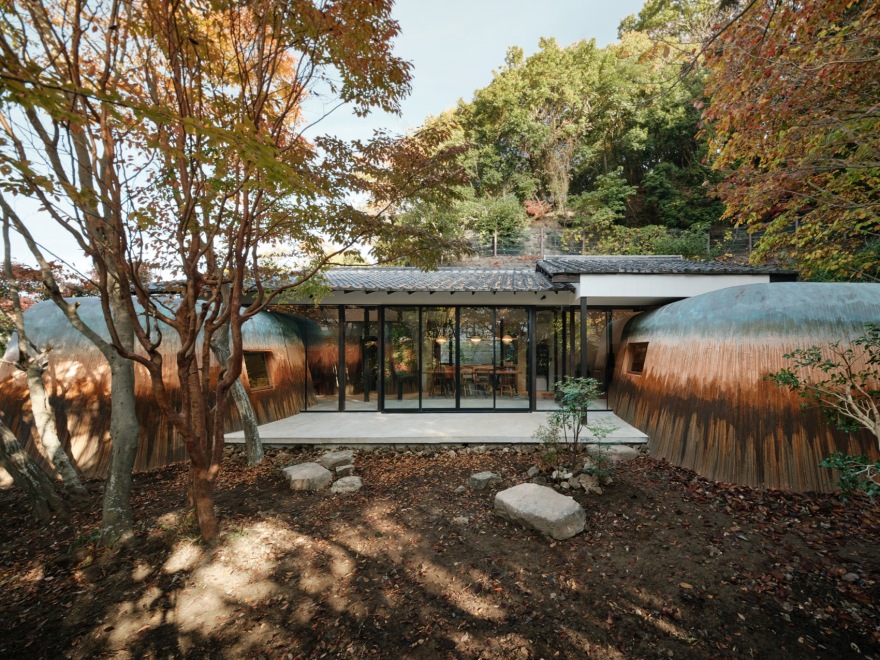
大约十五年前,我们的父母为了寻找一个能够专注于与泥土对话的环境,迁居至镰仓。住宅坐落在被称为“谷户(yato)”的谷地边缘,四周环绕陡峭山崖,崖壁中凿有被称为“やぐら(yagura)”的横穴式洞窟墓。这里强烈地显露出大地的存在。面对这样一片土地,我们以人类最古老的材料——“土”为核心主题,让建筑从土地中生成,以回应这片场地本身的存在方式。
▼改造前,before renovation© AATISMO

Haniyasu House is a two-family residence designed for our parents, who are ceramic artists, and for ourselves as architects. About fifteen years ago, our parents moved to Kamakura in search of an environment where they could fully devote themselves to working with clay. The house is located at the edge of a valley called “yato”, surrounded by steep cliffs into which horizontal cave tombs known as “yagura” are carved—an environment where the presence of the earth is strongly felt. In order to confront and respond to the way this land exists, we took “earth,” humanity’s most ancient material, as our central theme and brought the architecture into being.
▼住宅外观,exterior view© Shinya Sato


作为一个围绕“制作”而生活的家庭,我们设想一种原初的居所状态——在那样的时代里,生活与创造尚未分离。我们将旧屋的墙体与天花剥离,使其成为一个与环境相连的整体空间;同时在四角添加新的房间,其形态如同从地表隆起的土丘。
As a place suited to all of us, whose lives revolve around making, we envisioned a primordial dwelling—one from a time when living and creating were not yet separated. We stripped away the walls and ceiling of the existing house to form a single large space connected to its surroundings, and added new rooms at its four corners, their forms evoking masses of earth emerging from the ground.
▼室内概览,overall of interior© Shinya Sato


在这些新增体量内部,每个人在类似洞穴般的包覆空间中工作与休憩;而在中央如广场般的空间中相聚、交谈与共餐。我们想象的是一种如小型聚落般的生活方式。“埴安”之名源自日本神话中掌管土地、泥土与陶器的神祇。“埴(hani)”是古日语中“黏土”的意思。仿佛向这位神明献上供奉一般,这座住宅试图以“土”为媒介,与大地相连,同时超越土地、建筑与陶艺之间的界限,成为一个让生活与创造不可分割的“容器”。
Within the added volumes, each person works and sleeps in a cave-like, enclosed space, while gathering in a central, plaza-like area to converse and share meals. We imagined a way of life akin to that of a small settlement. The name “Haniyasu House” derives from a deity in Japanese mythology who governs earth, soil, and pottery; “hani” is an archaic Japanese word meaning clay. As if offered to this deity, the house seeks to unite with the land through earth as a medium, while transcending the frameworks of land, architecture, and pottery—becoming a vessel in which living and creating can remain inseparable.
▼住宅与泥土的对话,conservation between soil and the house© Shinya Sato


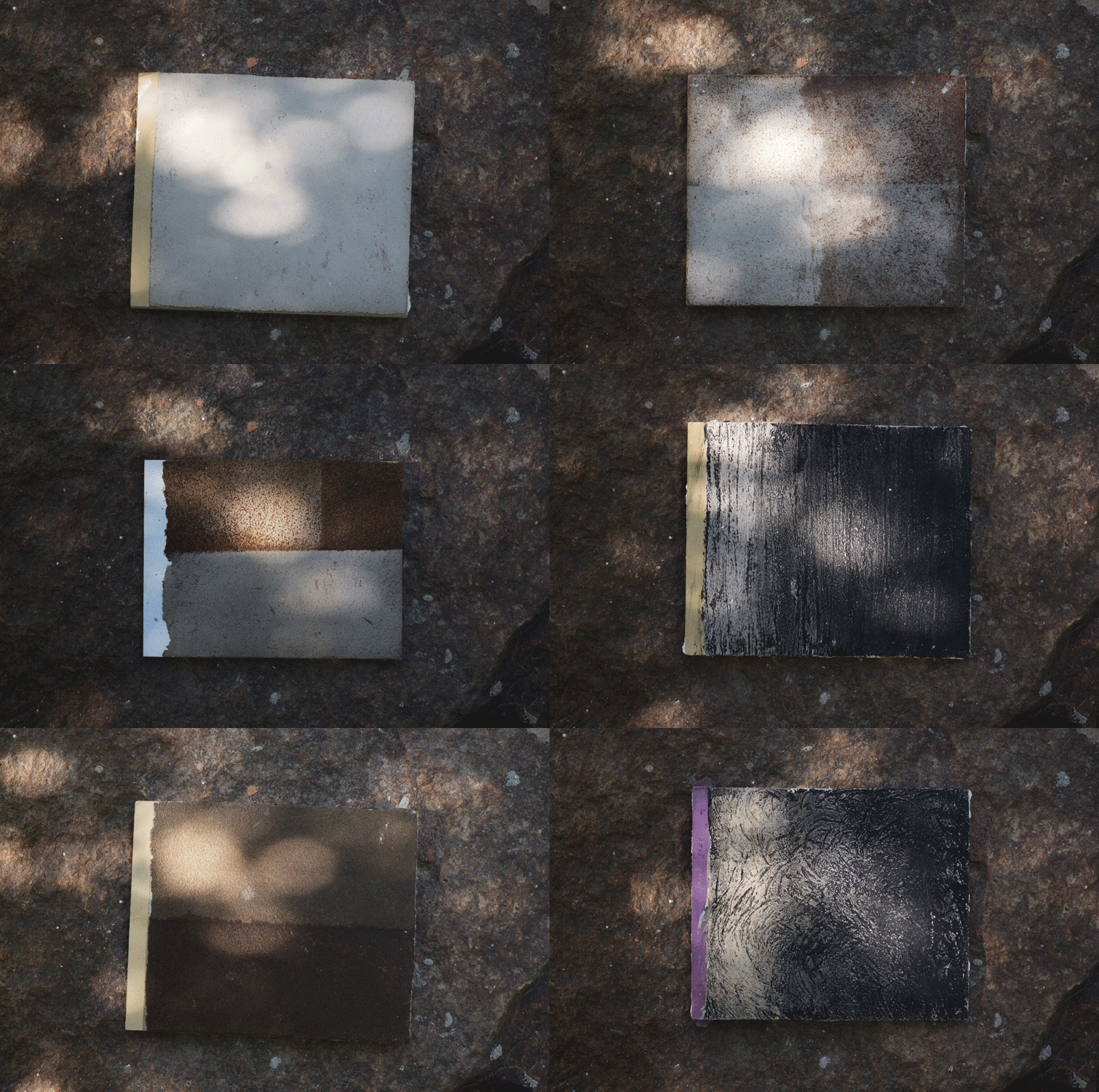
我们的实践并不局限于建筑,还延伸至灯具与家具等多领域设计,这些作品也被置入这座住宅之中。在创作过程中,材料实验往往成为出发点。在本项目中,我们同样思考建筑如何通过直接触及场地的土壤,以及父亲陶艺创作中常用的材料而生成。我们将场地富含黏土的土壤碾碎,在父亲的窑炉中烧制,上釉、以火焰灼烧,反复进行多次实验,尝试将“土地本身的颜色”作为建筑材料来使用。
Our practice extends beyond architecture, spanning multiple disciplines, including lighting and furniture, all of which are used in this house. In the process of making them, material experimentation often becomes the starting point. In this project as well, we considered how the architecture might emerge by directly engaging with the soil of the site and materials close at hand in my father’s ceramic practice. We crushed clay-rich soil from the land, fired it in my father’s kiln, applied glazes, and scorched it with burners—repeating numerous experiments in an attempt to use the colors of the earth itself as a material.
▼“土地本身的颜色”作为建筑材料,use the colors of the earth itself as a material© Shinya Sato

▼建筑细部近景,closer view of exterior© Shinya Sato


▼材料细部,details of material© Shinya Sato

在最终工序中,我们将父亲创作过程中产生的废弃黏土进行素烧,与场地土壤层层叠加,再将混入铁粉与铜粉(来自金属工坊的副产物)的灰泥如釉料般多层浇覆于扩建体量的外墙之上,让氧化与锈蚀自然生成色彩。这种建筑保留了偶然与时间的痕迹,兼具陶艺与手工制作的复杂性与原始质感。它既陌生又自然,在保持独特存在感的同时,仿佛从土地向天空缓缓消融,并将在风雨与时间的洗礼中持续变化。
In the final process, we bisque-fired discarded clay generated through my father’s making process, layered it over the soil from the site, and then poured a plaster mixed with iron and copper powder—byproducts from a metal workshop—over the exterior walls of the extensions in multiple layers, like glaze, allowing oxidation to produce color through rust. Bearing traces of chance and time, and possessing both the complexity and rawness of ceramics and craft, this architecture, while maintaining a presence that is at once strange and natural, simultaneously dissolves from the earth into the sky, and will continue to evolve as it accepts wind, rain, and the passage of time.
▼外观夜景,night view of exterior© Shinya Sato

▼室内夜景,night view of interior© Shinya Sato


在跨越文化与历史的往返思考中,我们试图重新审视潜藏其下的生活与创造方式;通过回到材料与身体的经验,去触碰土地中蕴含的物质性与时间。正是在这样的往复之中,建筑得以超越单纯的功能与形式,成为重新建构人与土地关系的有力“容器”。埴安之家,是一次让建筑重新获得“材料的力量”,并恢复“创造与生活合一”状态的尝试。▼材料实验,experiment of material© AATISMO

▼材料实验,experiment of material© AATISMO
To consider underlying ways of living and making that come into view through traversing cultures and histories, and to return to material and bodily experience in order to engage with the materiality and time embedded in the land. Through this back-and-forth, architecture moves beyond mere function and form, gaining strength as a vessel that reworks the relationship between humans and the ground. Haniyasu House is an attempt for architecture to regain both its “material force” and a harmony between making and living.
▼室外细部,details of exterior© Shinya Sato


▼外立面细部,details of the facade© Shinya Sato

房间
Rooms
四个新增体量分别作为父亲、母亲、成年的子女及其配偶,以及来访客人的房间。每个房间的饰面都通过现场反复实验确定——我们将不同材料进行多种组合,并不断调整比例,制作出大量样本,以回应各自空间的使用方式与氛围需求。
The four additions are used respectively as rooms for the father, the mother, the adult child and spouse, and guests. The finishes of each room were determined through on-site experimentation, producing numerous samples by combining materials in different ways and adjusting their proportions to suit the specific use and atmosphere of each space.
▼室内细部,details of interior© Shinya Sato

▼光影,light and shadow© Shinya Sato

▼地板细部,details of the floor© Shinya Sato

父亲的房间位于西北侧,主要用于陶艺创作。室内以场地土壤调制的深棕色饰面为主,营造出强烈的洞穴般空间感。工作台前的窗户朝向悬崖下方的景观,视野开阔;房间后方直接连接窑炉区域与室外施釉空间,使整个制作流程都能在这一带完成。部分墙体将结构框架转化为书架使用,门外则设置了储藏室与卫生间。
The father’s room is located to the northwest and is primarily used for pottery-making. The interior is finished mainly in a deep brown tone using soil from the site, giving the space a pronounced cave-like character. From the window in front of the work desk, the view opens out toward the landscape below the cliff, and the room is directly connected to the kiln area at the rear and an outdoor glazing space, allowing the entire making process to be completed within this zone. Part of the wall incorporates the structural frame as bookshelves, and a storage room and toilet are located just outside the door.
▼储藏室,storage room© Shinya Sato

▼细部,details© Shinya Sato

▼父亲房间入口,entrance of the father‘s room© Shinya Sato

▼父亲房间室内,interior of the father’s room© Shinya Sato

母亲的房间位于西南侧,是她进行创作的场所。墙面以石灰混合素烧陶土为主要饰面材料,搭配木地板、地板下储物空间与内嵌式柜体,是四个房间中最为朴素与克制的一个。
The mother’s room is located to the southwest and serves as her place of making. Its finishes are based on lime mixed with bisque-fired pottery clay. With a wooden floor, underfloor storage, and built-in cabinetry, it is the most plain and restrained of the four rooms.
▼母亲房间,the mother’s room© Shinya Sato

成年的子女及其配偶的房间位于东南侧,是四个新增体量中面积最大的一间。两侧墙面设置悬挑书桌,陈列着我们多年创作的家具与灯具作品。墙面采用场地土壤与素烧陶土混合的灰泥分三层批覆完成。该体量内部将地坪局部下沉,并以夯土地面收尾,为空间体验带来层次变化。
The adult child and spouse’s room is located to the southeast and is the largest of the four additions. Cantilevered desks line both sides of the room, displaying many pieces of furniture and lighting that we have produced over the years. The walls are finished with three layered coats of plaster made from site soil and bisque-fired pottery clay. In this addition, the floor level is lowered and finished as an earthen floor, introducing variation to the spatial experience.
▼成年子女与其配偶房间,the adult child and spouse’s room© Shinya Sato

客房被设计为一间茶室,铺设四叠半榻榻米,设有床之间(tokonoma)、躙口(nijiriguchi)以及位于推拉门外的水屋(mizuya)准备空间。墙面以场地富含黏土的土壤混合竹炭完成,并通过分级处理使色调向上逐渐加深,顶部由天窗引入自然光。靠门一侧的墙面则使用同样以竹炭染色的和纸饰面。
The guest room is designed as a tea room, furnished with four-and-a-half tatami mats and equipped with a alcove (tokonoma), a entrance (nijiriguchi), and a preparation space located outside the sliding door (mizuya). The walls are finished with clay-rich soil from the site mixed with bamboo charcoal, graded to become darker toward the ceiling, and illuminated from above by a skylight. The wall on the door side is finished with washi paper similarly dyed with bamboo charcoal.
▼茶室,the tea room© Shinya Sato

▼茶室细部,details of the tea room© Shinya Sato


厨房、浴室与卫生间被整合为沿住宅北侧布置的一个服务体量。其上方设置夹层,胶合板地面在结构上起到水平加固作用,而吊顶上方空间则用于安置设备系统。厨房以混入场地土壤的灰泥建造,并设有一个直接通向室外的大开口。浴室同样采用相似的材料构成,并配备大窗,被构想为一个整合沐浴、洗漱与更衣功能的完整空间,而非单纯的功能性房间。
The kitchen, bathroom, and toilets are consolidated into a single service volume along the north side of the house. A loft is placed above this volume, with its plywood floor stiffening the structure horizontally, while the space above the ceiling is used for building services. The kitchen is constructed with plaster mixed with soil from the site and features a large opening that connects directly to the outdoors. The bathroom is finished with a similar material composition and includes a large window; it is conceived as a single room that integrates bathing, washing, and dressing, rather than as a purely functional space.
▼灯具细部,details of the lighting feature© Shinya Sato


▼开关与插座,switch and socket© Shinya Sato


建造过程
Construction
原有住宅为一栋建于1967年的单层木结构建筑,坐落于被陡峭山坡环绕的区域。数年前的一次台风引发山体滑坡,阻断了通往住宅的道路,导致交通与基础设施一度中断。由于房屋的一部分位于高风险地带,该部分被拆除,以拉开与山崖的安全距离;同时,通过在四个角部增建体量,对整体结构进行加固。
The original house is a single-story wooden structure built in 1967, located within an area surrounded by steep slopes. During a typhoon several years ago, a landslide blocked the access road, cutting off transportation and infrastructure. As part of the house was also within a high-risk zone, that portion was removed to create distance from the cliff, while structural reinforcement was achieved through the four corner extensions.
▼外观建造过程,construction process of the house© AATISMO


室内原有墙体与天花全部拆除,腐朽的地梁(sill plates)被更换,原有立柱则在最大程度上予以保留,用以承载瓦屋面的竖向荷载。然而,鉴于原始基础仅为未加钢筋的浅基础,抗震剪力墙被集中并均匀布置于四个新增的角部体量之中,从而提升整体结构的抗震性能。
All interior walls and ceilings were removed, deteriorated sill plates were replaced, and the existing columns were largely retained to carry the vertical load of the tiled roof. However, since the original foundation consisted of unreinforced shallow footings, all seismic shear walls were concentrated and evenly distributed within the four new corner additions.
▼室内施工过程,construction process of interior© AATISMO


▼模型,model© AATISMO


▼平面图,plan© AATISMO

▼剖面图,section© AATISMO

▼细部分析图,detailed analysis diagram© AATISMO

Program: Residence
Location: Kamakura, Kanagawa, Japan
Structural system: Wood
Site area: 544.80m²
Building area: 132.07m²
Total floor area: 132.07m² (Existing 86.06m², Extension 46.01m²)
Structural Design: TECTONICA INC., Mitsuhiro Kanada
Lighting Adviser: DAISUKI LIGHT
Real Estate Consulting: Souzoukei Fudousan
Construction: Yukari Construction
Plastering Supervisor: Imajo Sakan
Plastering Cooperation: Naoya Ago, Kanta Kajita, Kuya Yamamoto, Kirito Yaguchi, Koutaro Horibe, Taichi Kitamura, Yuzuki Kuribayashi, Yuzuka Kobayashi, Miyoshi Sugiyama, Katsura Tatsumoto, Hana Otani, Yasushi Degami
Furniture Production: Sasaki
Research Institute Metalwork
Production: Studio Bead
Electrical Materials Provided: Panasonic BRIDGEHEAD
Credit: Shinya Sato


南京喵熊网络科技有限公司 苏ICP备18050492号-4知末 © 2018—2020 . All photos and trademark graphics are copyrighted by their owners.增值电信业务经营许可证(ICP)苏B2-20201444 苏公网安备 32011302321234号
苏公网安备 32011302321234号客服
消息
收藏
下载
最近