

创作上传
VIP
收藏下载
登录 | 注册有礼
查看完整案例

收藏

下载

分享
项目位于一座占地32英亩的大学校园内,建筑功能包括主行政办公、礼堂、研讨厅、图书馆及餐厅。与其打造一座气势恢宏的纪念性体量,建筑沿来访方向逐步抬升,弱化其28米的高度感,并转化为一座多功能的公共舞台。建筑自北侧起呈对角线式层层退台,五层建筑的整片屋顶平台均向师生开放,使其在景观之中转化为一座开放式露天剧场。层层叠落的平台形成多个可同时开展不同活动的空间,并构成一座可容纳9,000名学生的大型露天礼堂。
▼概念图,Concept drawings © Sanjay Puri Architects

Situated within a 32-acre university campus, the main administration offices, along with an auditorium, seminar halls, library, and cafeteria, form the functions of this building. As opposed to creating an imposing edifice, the building gradually steps up from the approach direction, belying its 28 metre height becoming a multifunctional stage. Stepped up diagonally from the northern point, the entire terrace of the five-level building is accessible to the students and faculty of the university, transforming it into an open auditorium amidst landscape. The stepped platforms become multiple spaces for different simultaneous activities and form an open air auditorium for large scale events, seating 9,000 students at a time.
▼项目鸟瞰,Aerial view © Vinay Panjwani

▼鸟瞰近景,Aerial close view © Vinay Panjwani

▼外观概览,Exterior overview © Vinay Panjwani


建筑形态唤起印度已有1100年历史的阶梯井意象——这种空间不仅用于蓄水,同时也是促进社区交流的大型公共场所。普瑞斯蒂吉大学延续这一原则,成为促进社交互动与活动开展的舞台。总计463级阶梯平台构成一座9,000平方米的屋顶花园,其中部分平台实现了无障碍通行。建筑东、西及南立面采用通风式GFRC遮阳构件包覆,以应对当地气候条件并降低热量吸收。普瑞斯蒂吉大学在气候语境下形成回应性的建筑表达,成为一座节能高效的公共建筑,不仅容纳多种功能活动,同时通过开放首层与景观屋顶,构建一处大型公共开放空间。建筑由不同尺度的互动空间构成,在多重层级上促进使用者之间的交流,同时将功能空间与开放景观空间内在整合。
The built form evokes images of stepped wells which have existed in India for 1100 years, and which were spaces built not just to store water, but also as large social interaction spaces to bring the community together. The Prestige University imbibes this principle, becoming a stage for fostering social interaction and events. A total of 463 stepped platforms form a 9,000 sq.m. rooftop garden. Some of these platforms are made wheelchair accessible. The east, west, and southern sides of the building are enveloped with ventilated GFRC screens to mitigate heat gain in response to the climate. The Prestige University is contextual to the climate of its location, resulting in an energy efficient building that, in addition to housing numerous activities, also becomes a large open public space with an accessible ground floor and landscaped roof. The building is a series of interactive spaces of different scales, fostering engagement at various levels amongst the users, as well as integrating functional and open landscaped areas intrinsically.
▼主入口,Main Entrance © Vinay Panjwani

▼外观近景,Exterior close view © Vinay Panjwani

▼立面细部,Facade Detail © Vinay Panjwani

▼阶梯式屋顶平台,Stepped roof terrace © Vinay Panjwani


▼阶梯式屋顶平台近景,Stepped roof terrace close view © Vinay Panjwani


▼屋顶平台鸟瞰近景,Roof terrace aerial close view © Vinay Panjwani

建筑内部多种功能空间之间穿插布置自然采光的景观庭院,使间接光线渗透至各层内部体量之中。北向采光与庭院空间的策略源自印度传统建筑智慧,营造出一座节能可持续的建筑,最大限度减少对人工照明与空调系统的依赖。这一策略回应了当地全年有8个月气温介于30°C至40°C之间的气候条件。由景观点缀的多样化剖面空间体量,为建筑不同区域营造出各异的空间体验。一条连续的对角线室内街道与多个开放庭院共同促进内部空间的自然通风。公共功能空间,包括餐饮区、礼堂与行政办公,设置于首层以便捷到达。图书馆各组成部分位于二层,通过一座横跨对角线室内街道的桥梁相互连接。公共教室布置于三层,通过不同剖面体量与开放庭院获得采光与通风,这些开放庭院亦作为休闲活动的外溢空间。四层设置阶梯式教室。五层为全部行政及教职人员相关办公设施。
The multiple functional spaces within are interspersed with naturally lit landscaped courtyards, allowing indirect light to infuse the internal volumes at each level. The north lighting and courtyards are imbibed from traditional Indian architecture, creating an energy efficient, sustainable building with minimal dependence on artificial lighting and air conditioning. This is in response to the climate of the city, which varies from 30°C to 40°C for 8 months of the year. Varied sectional volumes punctuated by landscape create different experiences in each part of the building. A continuous diagonal indoor street and numerous open courts facilitate natural ventilation within the internal spaces. The common facilities, including a food court, an auditorium, and the administrative offices, are located on the ground floor for easy access. The various library components are located on the first floor, connected by a bridge over the diagonal indoor street that cuts across the building. The common classrooms occupy the second floor, deriving light and ventilation from the various sectional volumes and open courts. These open courts act as the spillover area for recreational activities. The third floor houses tiered classrooms, and the fourth floor houses all of the administrative and faculty related facilities.
▼建筑内部公共空间,Interior public spaces © Vinay Panjwani

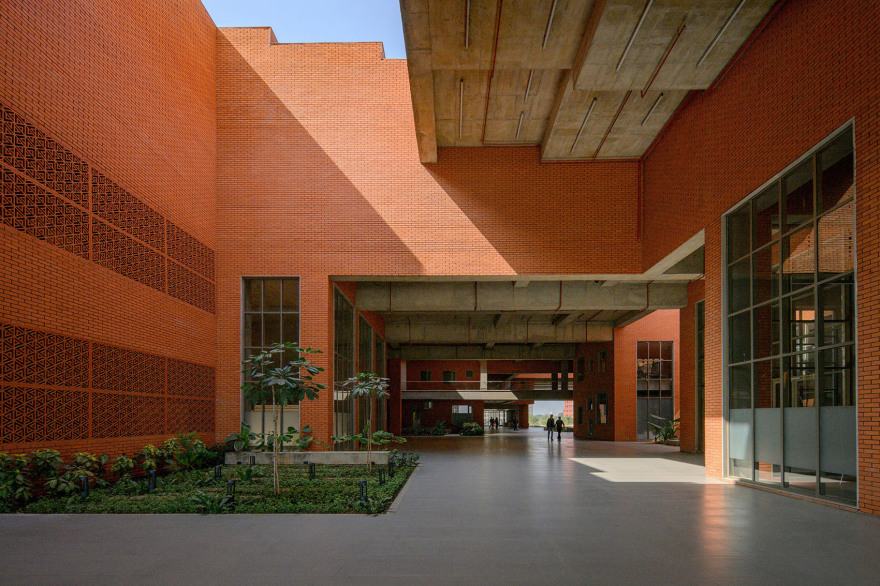


▼景观庭院空间,Landscaped courtyard © Vinay Panjwani


▼餐厅,Canteen © Vinay Panjwani

▼开放庭院,Open courts © Vinay Panjwani


▼庭院天光取景,Framed Skylight View © Vinay Panjwani

▼一层平面图,Ground floor plan © Sanjay Puri Architects

▼二层平面图,First floor plan © Sanjay Puri Architects

▼三层平面图,Second floor plan © Sanjay Puri Architects

▼四层平面图,Third floor plan © Sanjay Puri Architects

▼五层平面图,Fourth floor plan © Sanjay Puri Architects

▼屋顶层平面图,Roof floor plan © Sanjay Puri Architects

▼剖面图,Sections © Sanjay Puri Architects

Project Name: Prestige University
Project Type: Built – Educational, Institutional
No. of Floors: G+4
Location: Indore, Madhya Pradesh, India
Commencement Date: August 2018
Completion Date: January 2026
Client Name: Prestige Education Society
Construction Company: BL Constructions
Gross Floor Area: 3,32,000 SQ.FT. (30,843 SQ.M)
Costs: 99.60 CR INR (1,09,45,055 USD)
Architecture & interior Design Company: Sanjay Puri Architects
Lead Designers: Sanjay Puri, Ruchika Gupta, Madhavi Belsare
Design Team: Manveer Chopra, Devendra Dugad, Arjun Gupta, Bijal Bhayani
南京喵熊网络科技有限公司 苏ICP备18050492号-4知末 © 2018—2020 . All photos and trademark graphics are copyrighted by their owners.增值电信业务经营许可证(ICP)苏B2-20201444 苏公网安备 32011302321234号
苏公网安备 32011302321234号客服
消息
收藏
下载
最近