

创作上传
VIP
收藏下载
登录 | 注册有礼
查看完整案例

收藏

下载

分享
在层叠的山城内部,瑞器RICHAUS以当代性的几何体量与自然的对话逻辑,嵌于复杂而广袤的西南地域。在整个的设计过程中,几里一直在思考如何在城市更新中创造建筑与自然,人际互动的交织状态,也就是一种界面与一种关系。
Nested within the layered folds of this mountain city, RICHAUS inserts itself as a contemporary geometric volume engaged in a dialogue with nature, embedded into the vast, complex terrain of Southwest China. Throughout the design process, Vari Architects persistently explored how to create an interlaced condition between architecture and nature, and among people—essentially,a relationship and an interface—within the context of urban regeneration.
▼外立面,The Façade of RICHAUS ©朱文乔

▼项目概览,Overall of RICHAUS ©吴清波

我们试图通过新的建序,使一栋曾被忽略的办公楼宇在城市结构中重新获得意义,使其转化为连接文化、社区、产业与商业的公共文化枢纽,进而指向一个更为开放、丰满且具备持续生长性的社区中心。
Through a new architectural order, we aimed to reinvest significance into an overlooked office building within the urban fabric, transforming it into a public cultural hub that connects culture, community, industry, and commerce—thereby pointing toward a more open, abundant, and continuously evolving community center.
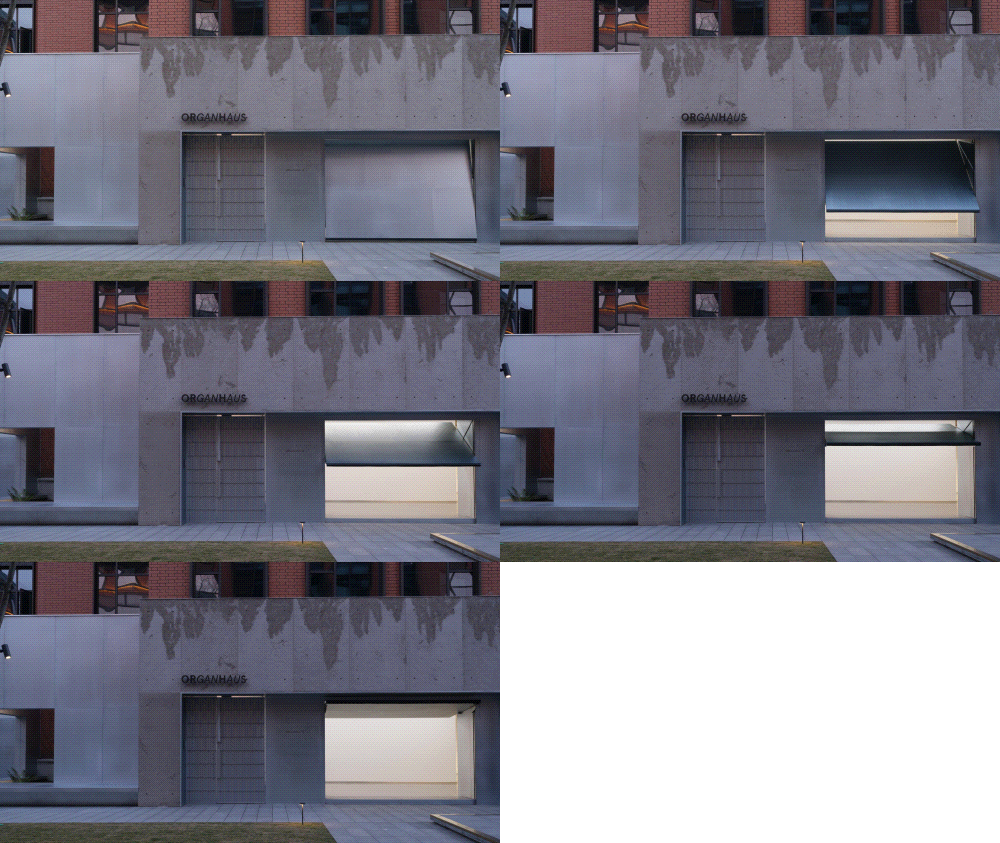
▼界面的不同状态,Different States of Interface ©朱文乔
part 01.
一种界面
An Interface
我们以一种先锋性的金属幕帘为建筑开启一层有界的面纱,入口的金属滑门虚实相间,让自然渗透。另一侧,我们为「器空间Organhaus」定制的金属大门,序列的网格规则构成一种机械构造,可折叠开合的入口形式,它延续了Organhaus的艺术实验精神,像嵌在山城的机库大门向艺术家和创作者们开放。
We cloaked the building in a pioneering metal curtain—a bounded veil that opens a dialogue with its surroundings. At the entrance, a sliding metal door alternates between transparency and solidity, allowing nature to permeate the threshold. On the opposite side, the custom‑made metal gate for Organhaus follows a gridded, mechanical logic—a foldable entrance that continues Organhaus’s spirit of artistic experimentation, resembling a hangar door embedded in the mountain city, open to artists and creators.
▼界面的不同状态,Different States of Interface ©朱文乔

厚实静默的砾石、流动的水景与葱郁的植物,编织出一层山地界面,温热的西南气候自然地渗透进建筑的肌理,在旧有的园区群落中,形成一种“感知性的界限(limite perceptive)”。▼外立面,Exterior facade © vari architects

Dense silent gravel, flowing water features, and lush landscaping are woven into amountain interface. The warm, humid climate of the Southwest naturally seeps into the building’s fabric, creating a“limite perceptive”—a perceptual boundary that asserts a contemporary presence within the existing industrial campus.
▼金属的界面,Metal Interface ©朱文乔


在瑞器 RICHAUS 中,我们希望促成公众、商业与办公之间的高效交互(interaction),为先锋品牌、建筑与设计事务所、新锐内容创业者及创意机构,提供一个能够承载多种语言与工作方式的环境。
At RICHAUS, we aimed to foster efficient interaction among the public, commerce, and work—providing an environment capable of holding multiple languages and ways of working for avant‑garde brands, architecture and design studios, emerging content creators, and creative agencies.
▼瑞器RICHAUS 2F,2F of RICHAUS ©朱文乔


随着展览、论坛与 live 等公共事件的持续发生,瑞器 RICHAUS 逐渐成为山城文化与社交生活的生成场所,内部空间不再是理性功能的简单叠加,而更接近一种彼此贯通的交互结构:人在其中流动、交流与协作,逐步形成一个有机生态系统。由此,瑞器 RICHAUS 完成了从单一建筑实体向城市“社交界面”的转变。
As exhibitions, forums, live events, and other public programs continue to unfold, RICHAUS has gradually become a generative site for cultural and social life in the mountain city. The interior space is no longer a mere rational stacking of functions, but approaches an interconnected interactive structure: people flow, communicate, and collaborate within it, gradually forming an organic ecosystem. Thus, RICHAUS completes its transformation from a singular architectural entity into an urban “social interface.”
▼夜间的状态,Nocturnal Interface Condition ©吴清波


part 02. 一种关系 A Relationship
在内部,我们刻意保留了建筑的“未完成感”,坦然展露梁柱的原始肌理、管线的穿梭路径,用一种轻盈自然的建构方式,去编排空间的生长痕迹与建构逻辑,一切都处于温和的流动与可再定义之中。真诚的袒露,回归的是被接纳的亲近与自由。
Inside, we deliberately preserved a sense of“unfinishedness,”openly exposing the raw textures of beams and columns, the exposed routing of pipes and conduits. Using a light, natural mode of construction, we orchestrated the traces of growth and the logic of making—keeping everything in a gentle state of flux and redefinition. Through honest revelation, what returns is the closeness and freedom of being welcomed.
▼瑞器RICHAUS的内部,Interior Space ©吴清波


对于“在地性”的阐释,我们从地理人文,公共生活的角度出发,寻找一种合适的方式回应在地记忆与温度。
Our interpretation of“local character”begins from the perspectives of geography, culture, and public life, seeking an appropriate way to respond to local memory and warmth.
▼“party 爬梯”楼梯,”Party staircase” © vari architects

梯坎是连接重庆上下城的筋骨,我们移除了部分楼板,形成中庭挑空,以贯穿三层楼的公共楼梯作为最重要的公共节点,来回应重庆人“爬坡上坎”的人地关系,用更具趣味性的拓宽和转折,形成多个跨层互动平台,原本承担单一通行职能的楼梯通道,从“功能性(Functionality)”转向兼具体验与公共属性的“公共维度(Public Dimension)”。
Stairs are the connective tissue linking Chongqing’s upper and lower urban layers. We removed sections of floor slabs to create a central atrium, and introduced a three‑story public staircase as the primary communal node—a direct response to the city’s unique “climbing slopes and navigating steps” relationship between people and terrain. Through playful expansions, turns, and landings, multiple cross‑level interactive platforms emerged. Thus, the stairway, originally serving a singular circulatory function, transforms from mere functionality toward an experiential and communal public dimension.
▼贯穿空间内部的楼梯,Vertical Connector Traversing the Interior ©朱文乔


▼细节、节点,Details and Joints ©朱文乔

三层的楼梯装置“爬梯 Party”,贯联起多层的社交空间体系:包括2F的Organhaus新空间,3F、4F的办公、展陈多功能空间,5F的西南市集aa market。长长的楼梯,如一条熟悉、信任的感情纽带,在鲜活的串门时刻中,我们不再是彼层的他者,从而拾回过往的邻里情义。
▼爆炸图,Axonometric drawing © vari architects

▼“party 爬梯”轴测,Axonometric drawing © vari architects

The three‑level stair installation, “Climbing Stair Party,” threads together a multi‑layer social ecosystem: including the new Organhaus space on the 2nd floor, offices and flexible exhibition areas on the 3rd and 4th floors, and the Southwest‑style aa market on the 5th floor. The long staircase acts as a familiar, trusted emotional ligament. In those lively moments of “dropping by,” we cease to be strangers on another level, rediscovering the neighborly kinship of the past.
▼贯穿空间内部的楼梯,Vertical Connector Traversing the Interior ©朱文乔

▼细节、节点,Details and Joints ©朱文乔


▼细节、节点,Details and Joints ©朱文乔

当设计介入叙事,我们也进行了一些超脱日常的尝试。锯齿状的橱窗界面,让办公变成一种可交互的公共场景,也成为这个关系中最重要的内容。赫拉利说我们“因效率而遗忘生活”,因此我们编排了一些值得玩味的转折、迂回,从提升视觉吸引力与商业展示效能出发,进一步引向人与空间、人与人之间更深层的互动可能。
When design intervenes in storytelling, we also ventured beyond the routine. The sawtooth‑shaped shopfront interface transforms office space into an interactive public scenario, becoming the most vital content within this relationship. As Harari reminds us, “we forget to live in the name of efficiency.” Hence, we orchestrated playful turns and detours—starting from enhancing visual appeal and commercial display effectiveness, then moving toward deeper possibilities of interaction between people and space, and among people themselves.
▼橱窗界面,Showcase Interface ©吴清波

▼橱窗界面,Showcase Interface ©朱文乔

同时我们也让被忽视的细节——灯具,消防栓,栏杆,楼梯扶手这些消极元素以一种更积极的状态和装置的方式,成为空间的一部分。瑞器生发于这座城市的多元关系与需求,它为人际关系的缔结、更新提供了一份契机,让我们可以在这,重新谈论合作,创作,共享。
At the same time, we transformed overlooked details—light fixtures, fire hydrants, railings, stair handrails—from passive elements into active components, integrating them into the space as deliberate installations. RICHAUS grows from the city’s plural relationships and needs. It offers an opportunity to forge and renew human connections, allowing us to speak again—here—of collaboration, creation, and sharing.
▼中庭,Atrium ©朱文乔


part 03.
材料的语汇
Material Vocabulary
除了空间的叙事,材料的构建也在塑造着瑞器独特的纯粹性,混凝土因其坦诚而实用的品质,始终与建造同在,因此,我们由这种“确凿”(Concrete)的物质性去展现出“器”的刚硬姿态。不同质感的材料发生碰撞:原生,粗粝,光滑,生涩,从而区别于高度扁平、统一的办公大楼。
Beyond spatial narrative, the construction of materials also shapes RICHAUS’s distinct purity. Concrete—honest and utilitarian—has always accompanied the act of building. Thus, we allowed this unequivocallyconcretemateriality to express the vessel’s resolute stance. Different textures collide: raw, rough, smooth, unrefined—setting the space apart from the highly flattened, uniform office tower.
▼不同的材质对撞,Collision of Different Materials ©吴清波


▼不同的材质对撞,Collision of Different Materials©朱文乔

木头中有西南在地风物的温度,我们使用了老榆木板去包裹局部结构,在这次构建里,表达“痕迹”,也是一种东方式的抒情。
Wood carries the warmth of the Southwest’s local fabric. We wrapped parts of the structure in reclaimed elm boards—here, the expression of “traces” itself becomes an Eastern lyricism.
▼木材的使用,The Use of Wood ©朱文乔

我们尝试把灯具和道具系统作为公共空间的重要呈现部分,银色金属扩张网垂悬在顶部,冷峻,精密。镀锌银色金属灯具序列排布,镀锌钢管与裸露管线组合成更具当代性的装置系统构造。
We aimed to integrate the lighting and display systems as essential components of the public realm. Silver expanded metal mesh hangs from above—cool, precise. Galvanized silver light fixtures are arranged in sequence; galvanized steel tubes and exposed conduits combine to form a distinctly contemporary apparatus.
▼装置系统构造,The Construction of Installation Systems ©朱文乔


建造中有城市代际之精神,不论是十九世纪工业线上滚动的钢铁,还是自大地而来的树木,它们筑就了人居的底线,又因人的热忱与智识,不断参与着城市的演进。或许因为扎根于西南,瑞器RICHAUS也承袭了这片土地内里的包容与丰厚,自然粗粝与秩序精细同在,塑造着城市中独有的生活容器。
There is the spirit of urban generations in the act of building. Whether it is steel rolling off 19th‑century industrial lines or timber drawn from the earth, they form the baseline of human dwelling and, through human passion and intelligence, continually participate in the city’s evolution. Perhaps because it is rooted in the Southwest, RICHAUS inherits the inherenttolerance and abundanceof this land—where natural roughness coexists with refined order, shaping a unique vessel for urban life.
▼瑞器RICHAUS,Overall of RICHAUS ©朱文乔


▼2F平面图,2F Plan © vari architects

▼3F平面图,3F Plan © vari architects

▼4F平面图,4F Plan © vari architects

▼西立面,West elevation © vari architects

▼南立面,South elevation © vari architects

▼楼梯构造,Staircase construction © vari architects

▼墙体构造,Detailed drawing of the wall © vari architects

项目名称|瑞器RICHAUS
项目地址|重庆中瑞两江产业园
作品体量|8000平方
设计时间|2024年5月
呈现时间|2024年7月
建筑设计|vari architects 几里建筑
主持建筑师|齐帆 蒋逸男
项目建筑师|徐飞洪、何曌龙,邱靖桐,顾伟明
项目摄影|吴清波,朱文乔
内容编辑|许小艺,王柳
Project Name|RICHAUS
Location|Liangjiang Sino‑Swiss Industrial Park, Chongqing
Floor Area|8,000㎡
Design Period|May 2024
Completion Date|July 2024
Architectural Design|vari architects
Principal Architects|Qi Fan, Jiang Yinan
Project Architects|Xu Feihong, He Zhaolong, Qiu Jingtong, Gu Weiming
Photography|Wu Qingbo, Zhu Wenqiao
Copywriting|Xu Xiaoyi, Wang Liu


南京喵熊网络科技有限公司 苏ICP备18050492号-4知末 © 2018—2020 . All photos and trademark graphics are copyrighted by their owners.增值电信业务经营许可证(ICP)苏B2-20201444 苏公网安备 32011302321234号
苏公网安备 32011302321234号客服
消息
收藏
下载
最近