

创作上传
VIP
收藏下载
登录 | 注册有礼
查看完整案例

收藏

下载

分享

翻译
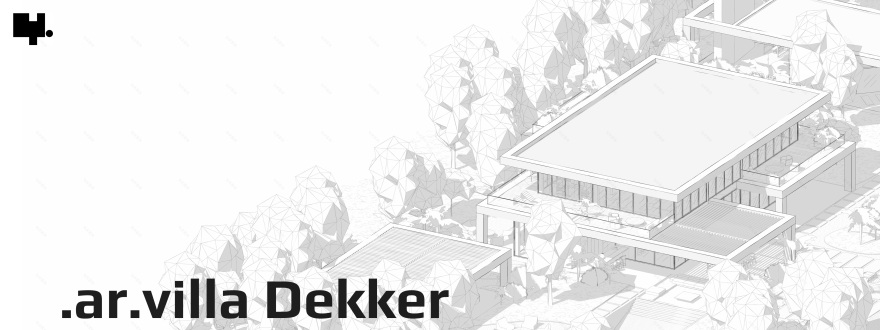
We would like to express our gratitude to everyone involved in our design work in the Indonesian region. For us, this period became an important stage of professional growth and a valuable experience in the field of commercial residential development. This project marked a logical culmination of our work in the Far East and, at the same time, a point after which we gradually shift our focus toward local architectural practice.
Area:
•plot - 3071 sqm;
•build - 1103 sqm;
•house - 447 sqm;
Year: 2023;
Location: Indonesia, Bali;
Architect: Alexander Kovpak;
ArchViz: Alexander Kovpak;
Project manager: Andre Burbela.

General context
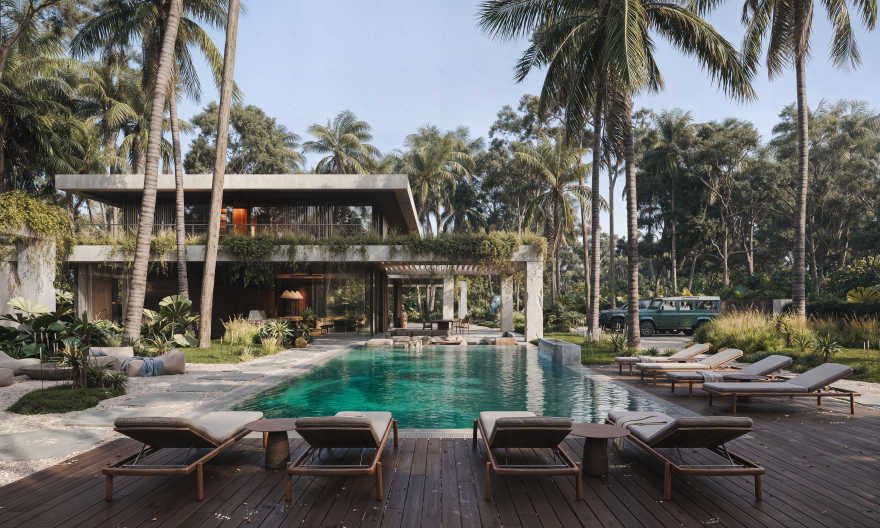
The architectural concept, as in most of our projects, is based on an in-depth analysis of context, research into traditional approaches, and the study of local materials and crafts. At the same time, the contemporary local market is largely shaped by simplified perceptions of what “contemporary architecture” should be — primarily from the perspective of small European investors, operating under limited budgets and simplified construction technologies. The main target audience is concentrated in the regions of Eurasia and Australia, for whom this area is perceived primarily as a destination for leisure, with an expectation of familiar everyday comfort, often without deep engagement with the local cultural context. As a result, this approach produces anonymous volumes of concrete and glass with flat roofs. Our project also operates within this typology, while being fully aware of its limitations.
Through the study of local culture, temple architecture, and the work of local brickmakers, we seek to identify a demand for an alternative future — one in which local architectural traditions can once again flourish and gradually displace standardized European developments placed on rigidly subdivided plots within a mountainous landscape and unique natural scenery.


Layout
The project combines several functional scenarios. It is conceived as a retreat complex intended for long-term seasonal living, integrating areas for active sports and recreation, spaces for spiritual development, as well as work environments for intellectual and creative activities. The site has an almost rectangular geometry and forms part of a residential development located within a forested area of the island of Bali.
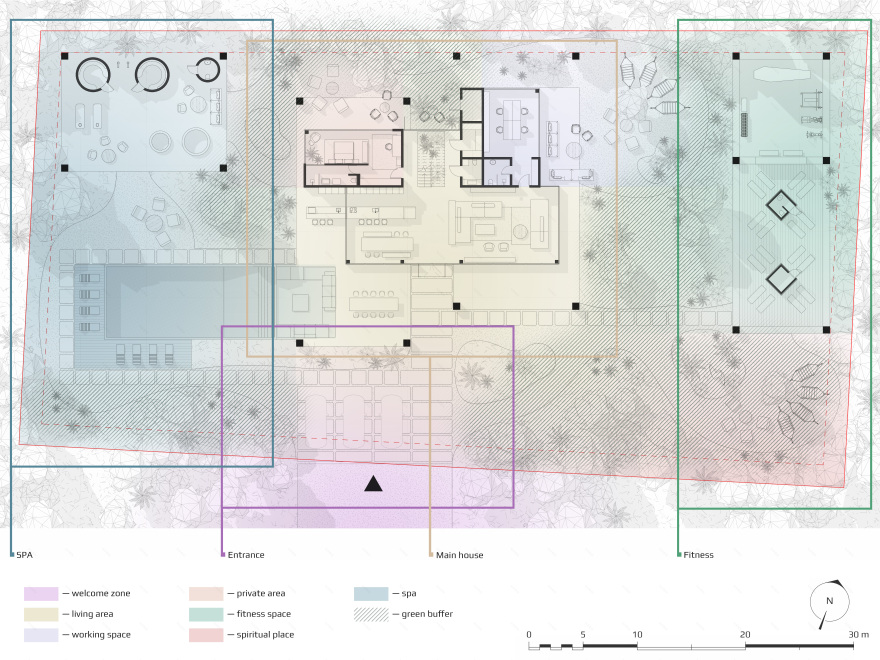
We deliberately avoided rigid functional zoning, opting instead for a system of flowing spaces. While occupying any one zone, residents continuously engage with a broader spatial context and retain the freedom to move between different modes of use. This sense of freedom is one of the key reasons people are drawn to this geography, and we sought to reproduce it within the boundaries of the given site.
Functionally, the site is organized according to the daily cycle. The western part is allocated to more dynamic and socially active relaxation zones, while the eastern side accommodates work and physically active spaces. The tension of body and mind corresponds to the east — the beginning of the day — whereas relaxation and recovery are associated with the west and the day’s end. In this way, natural light and the movement of the sun become tools for shaping the site’s functional structure.
The exterior spaces surrounding the buildings, located along the perimeter of the interior volumes, are conceived as an integral part of the internal spatial experience. They participate in shaping shared areas, bedrooms, and office spaces, blurring the boundary between interior and exterior.
VOLUMES
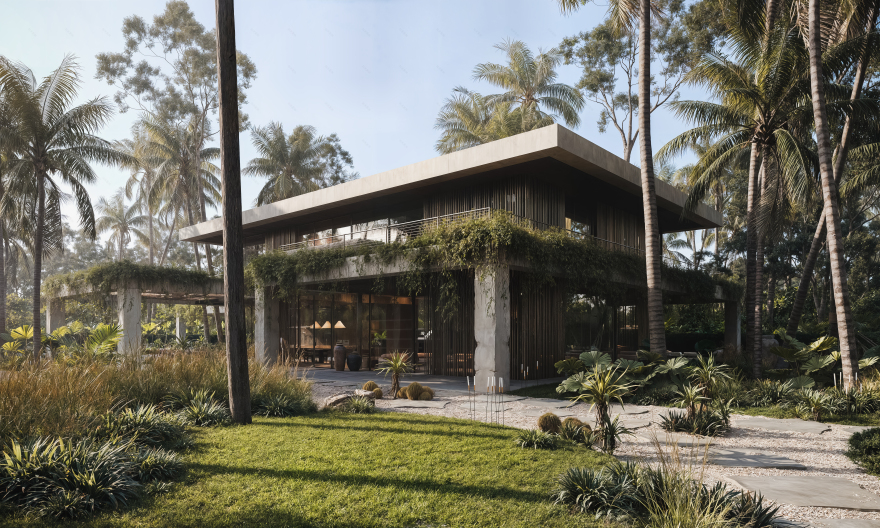
The design of the outdoor spaces is based on the use of living, wild vegetation. This approach minimizes maintenance requirements, preserves the seasonal character of the landscape, and allows the site to remain unattended for extended periods without compromising its condition. In selected areas, open surfaces of smooth lawn or fine-grain gravel are introduced to accommodate informal resting and gathering spaces.
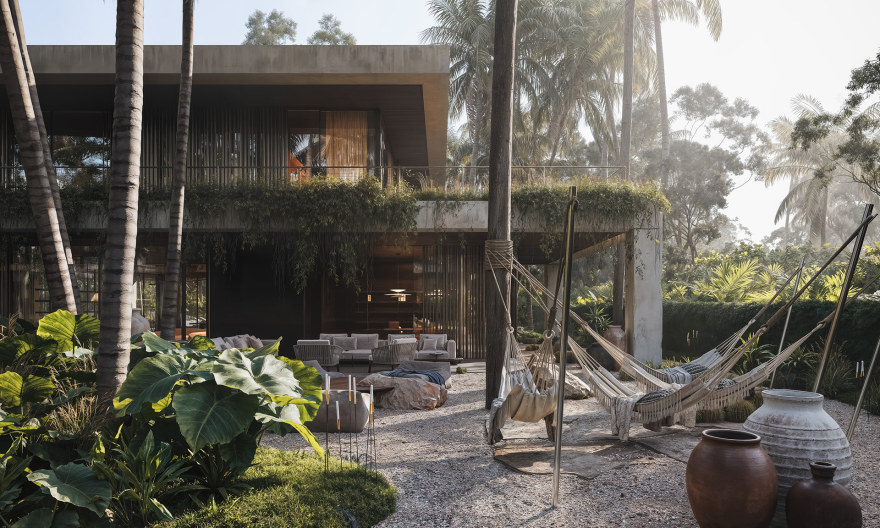


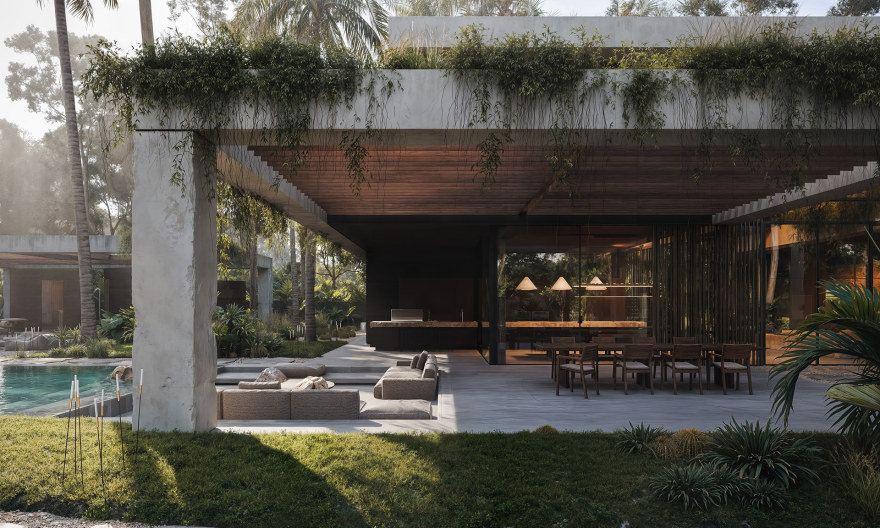
The project is based on a monolithic structural frame, a construction system characteristic of this type of development in the region. This approach allowed us to avoid implementation challenges and had a positive impact on construction timelines. Decorative elements are deliberately eliminated. The architectural expression is reduced to its essentials and subordinated to function: concrete columns, a monolithic reinforced concrete ring beam, exposed materials without additional finishes, and extensive glazing. Glass functions as a transparent boundary between interior and exterior spaces within specific zones, conditionally dividing them into two. In areas where visual separation is unnecessary — particularly within sports and spa spaces — glazing is omitted. At the same time, the same structural system and material logic are maintained. In this way, boundaries between zones and spaces are dissolved, allowing the entire volume to operate as a single, cohesive ecosystem for its inhabitants.
Spa
The spa zone is located in the western part of the site. A concrete frame structure defines the space, accommodating a sauna, hot and cold baths, massage, a relaxation area, as well as an outdoor restroom with a shower. The frame structure also serves as a support for dynamic louvers that provide shading when required, as well as for automated mosquito screens. This solution ensures comfortable use of the spa space throughout most of the year, taking into account local seasonal conditions.

The zone has a direct connection to a 15m x 6,5m swimming pool, with a fireplace positioned between them as both a spatial and experiential focal point. The pool, in turn, is linked to the main building through the lounge area of the outdoor dining space.The deliberate elimination of transitional spaces is a key aspect of our design approach, both in the planning of interior spaces and in the overall organization of the site.


Fitness
The sports zone is located in the eastern part of the site, providing optimal conditions for solar exposure throughout the day — consistent with the logic applied to the other functional zones of the project. The structural solution directly shapes the spatial character: a concrete frame with a canopy, complemented by automated mosquito screens. Within the yoga area, two mirrored volumes are introduced, housing storage spaces for sports equipment as well as a changing room with a restroom. The mirrored surfaces dissolve the volumes into the surrounding landscape while reinforcing a sense of spatial openness.


The active sports area with a climbing wall directly adjoins the yoga space, reinforcing the idea of balance between dynamics and stillness. This zone can also be accessed directly from the work and recreational areas of the main building, which will be described in the following section.


A distinct element of this area is a space dedicated to spiritual balance. At its center stands the sculpture Shift by Ukrainian artist Egor Zigura, beyond which a lounge area for rest and social interaction is formed, furnished with outdoor cushions and hammocks.


SPACES

The main house is conceived as a two-storey volume with generous terraces, individually assigned to each functional zone. This approach eliminates any sense of spatial compression and opens up a wide range of possible scenarios for their use.
Ceiling height and a double-height second light create a feeling of openness and spatial freedom. At the same time, this solution has a positive effect on the internal microclimate. The thermal inertia of the interior environment is critically important in the context of the local humid climate and contributes significantly to overall living comfort.
Planning


The planning structure is designed to allow radical changes in the functional use of each zone when needed: transforming a bedroom into a studio, an office into a children’s room and vice versa, duplicating or relocating functions between the ground and upper floors, and assigning new usage scenarios to the spaces. Simple rectangular rooms with similar floor areas and proportional dimensions form a universal framework for transformation. This approach allows not only freestanding but also built-in furniture to be freely relocated between rooms, enabling flexible and highly individualized adaptation of the space to the resident’s needs — depending on tasks, mood, or season. The space surrounding the internal volumes also participates in the formation of functional zones. For common areas, bedrooms, and workspaces, external terraces and open platforms act as an integral extension of the interior, blurring the boundary between indoor and outdoor environments.
Living
Functionality, openness, and material tactility are the fundamental principles shaping the interior spaces, on equal terms with the exterior. Every material introduced into the interior is carefully considered, while the space is deliberately stripped of superfluous elements.

A modular furniture system was developed specifically for the common area and is repeated throughout the house. It is capable of adapting to various usage scenarios, including a flexible and thoughtfully designed lighting system.
Comfortable upholstered furniture is made from durable materials suitable for operation in a humid climate — a critical consideration given how easily the main interior space transforms into an open terrace through movable glass partitions. Partitions between rooms are made of rammed earth — a material deeply rooted in local architectural tradition. The involvement of local craftsmen ensures a high level of execution, while the physical properties of the material positively influence the indoor microclimate and humidity levels. The unique natural stratification of each surface creates a distinctive atmosphere and emphasizes the singular character of the space.
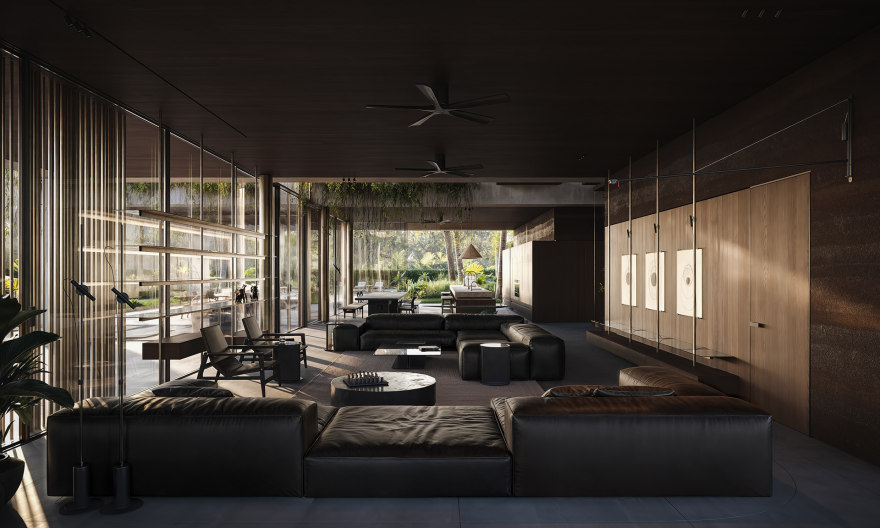


Solar Shading Analysis determined the locations where louvers made of copper tubes are used to provide necessary shading at specific times of the day. This solution expands the functional possibilities of the interiors and enhances overall comfort.

Kitchen
The kitchen is organized around a large functional island and ample storage capacity. It serves not only the main house but the entire site, including the pool, sports, and work areas.
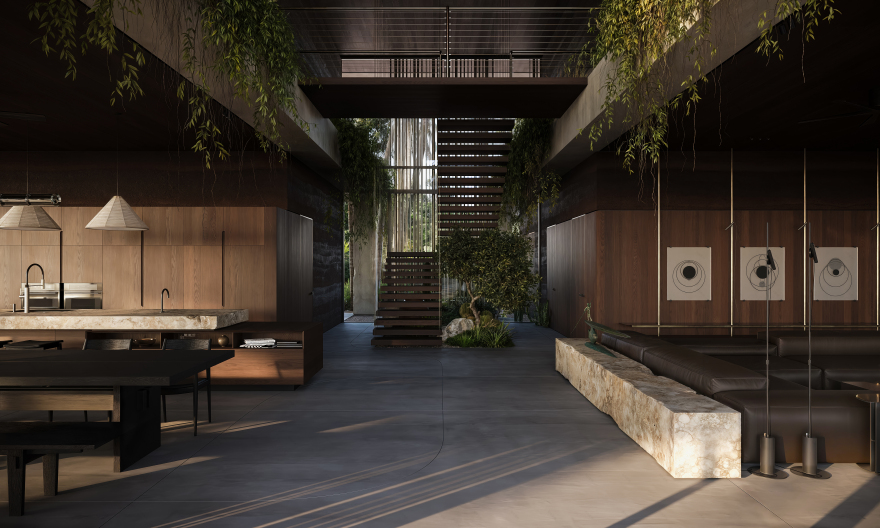


The kitchen space extends beyond the interior and is literally split in half by a glass partition, together with the kitchen island, which becomes a physical and functional link between indoor and outdoor spaces.Natural finishing materials — exposed, durable, and wear-resistant — align with the overall concept of the project and are designed for intensive daily use, including use as outdoor furniture.


Guest bedroom
The guest bedrooms are furnished with simple, functional furniture. A low-profile bed and maximum openness to the surrounding environment create a sense of rest closely connected to being in nature. At the same time, all aspects of comfort and ergonomics are carefully addressed. The layout includes storage areas, a large double bed, a workspace, and a fully equipped bathroom.


In contrast to the public and semi-open areas of the house, all private rooms are isolated from primary circulation routes and shared-use scenarios, ensuring the necessary level of quietness and privacy.In essence, each guest bedroom functions as a self-contained hotel suite with a large terrace and a private outdoor relaxation area.


Office
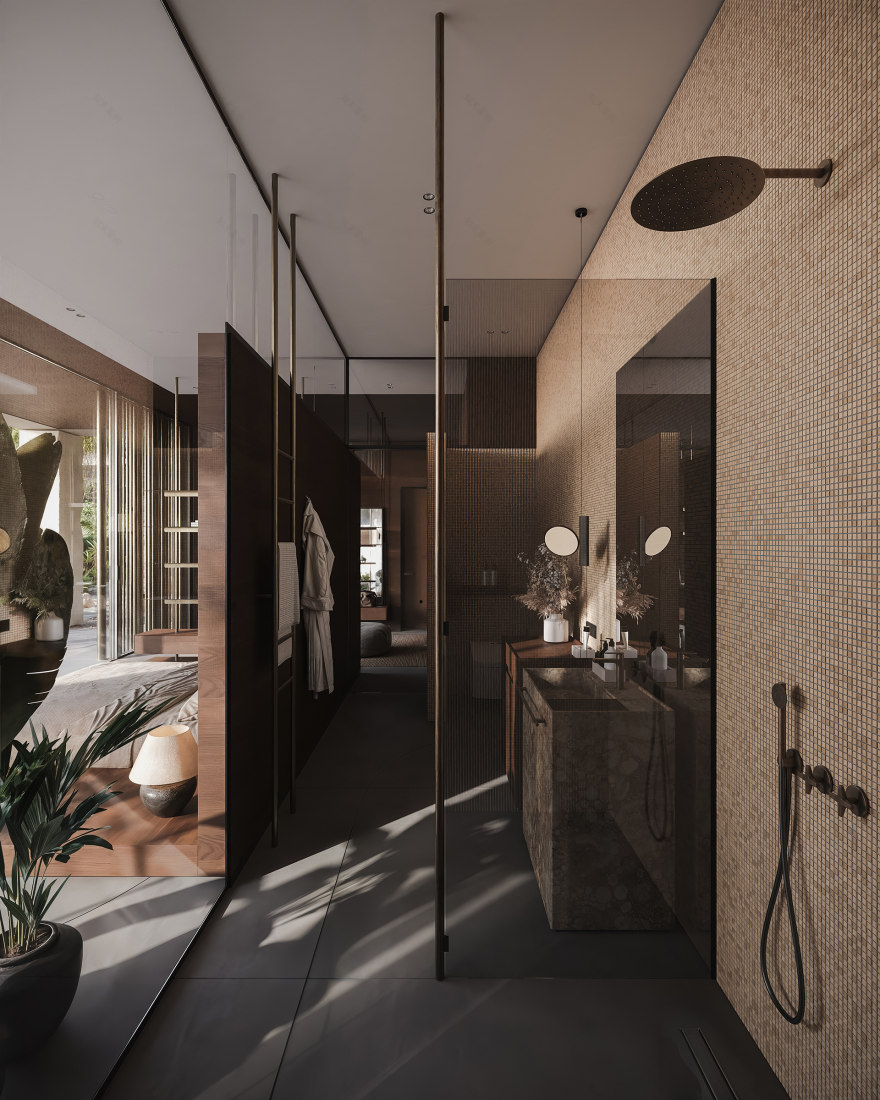
The office spaces serve a single purpose: focused work, thinking, and a comfortable interaction with the environment to achieve maximum productivity. The space is deliberately cleared of unnecessary stimuli and functions as a tool for concentration. Every element of the furniture system is carefully considered down to the smallest detail: a wide work desk, flexible lighting, microclimate control, and acoustic insulation create stable conditions for long working sessions.


The bathroom is finished in a single material and designed without sharp corners for reasons of practicality. The shower is retained as a provision for future transformation of the space, should its functional purpose change.


The office has its own terrace with multiple use scenarios — for teamwork, working discussions, and informal meetings —extending the workspace beyond the interior.
Master bedroom
In the master bedroom, the freestanding bed is positioned at the center of the space, allowing it to be oriented in any direction depending on the use scenario and the resident’s preferences. When needed, the sleeping area can be isolated with a two-layer curtain canopy — one semi-transparent and one full blackout.


Above the bed, a fractal wood carving crafted by local artisans introduces visual tactility and a distinct sense of uniqueness. The walk-in wardrobe is conceived as a flowing space with direct access to the bathroom.


The master bedroom design follows the overall concept of the project — functionality, practicality, and the use of natural materials. All elements are precisely placed, while maintaining a margin of adaptability for different life scenarios.


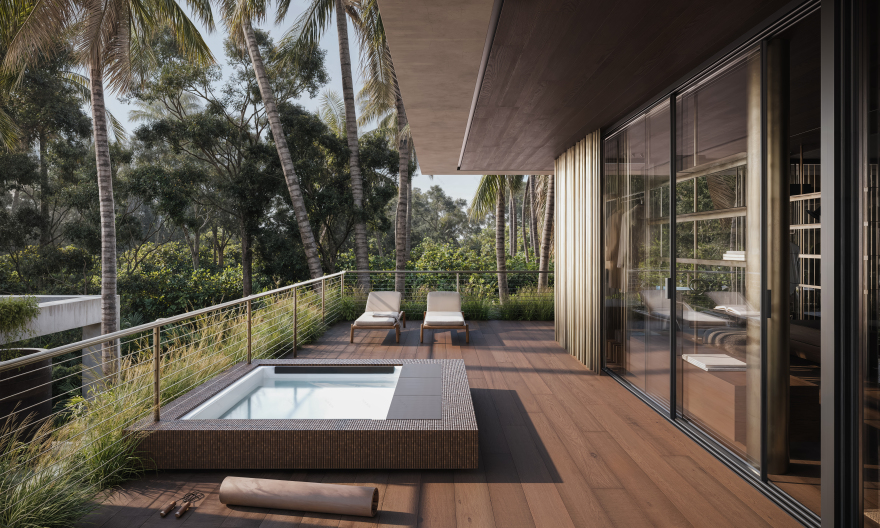
A private terrace with an integrated jacuzzi extends the living space outward. The balconies of the second floor are equipped with planters, creating the sensation of being at ground level while allowing the space to be visually and acoustically isolated from the more active and noisy zones below at any moment.


So, as a result, a multifunctional environment has been formed that almost fully meets the needs of the target audience, while maintaining a substantial margin of flexibility in both interior and exterior use scenarios. The spatial structure is largely free of parasitic transition and is composed of clearly defined functional zones. In essence, the building operates as a framework for life scenarios defined by the user. This sense of structural “framework” is also expressed in the architectural image itself. The design is focused on reliability, structural clarity, openness, and the natural qualities of construction systems, materials, and finishes. Within this environment, the resident engages organically with nature while remaining in comfortable and practical conditions — whether for active or contemplative leisure, physical recovery, or everyday work processes.
Note: The project was developed intermittently over several years and underwent a significant number of compromises during the implementation phase. Prior to publication, it was revisited, reconsidered, and adapted to our current vision — in the form in which we consider it appropriate to present it today. The project was developed without the use of Artificial intelligence. Tools used: Revit, 3ds Max, Corona Renderer, Photoshop.
used brands: Tribù, LEMA, Calligaris, Carl Hansen & Søn, CEA, VIBIA, Flos, Catellani & Smith, PENT, etc.

KOD. 2025
instagram|facebook
南京喵熊网络科技有限公司 苏ICP备18050492号-4知末 © 2018—2020 . All photos and trademark graphics are copyrighted by their owners.增值电信业务经营许可证(ICP)苏B2-20201444 苏公网安备 32011302321234号
苏公网安备 32011302321234号客服
消息
收藏
下载
最近