

创作上传
VIP
收藏下载
登录 | 注册有礼
查看完整案例

收藏

下载

分享

翻译

Rough walls streaked with clay, soil and metal powders evoke ceramic glazes at Haniyasu House, a home in Japan renovated by local architecture studio Aatismo.
Named Haniyasu House after the Japanese gods of earth, clay and pottery, the dwelling in the coastal town of Kamakura was designed for two founders of Aatismo, Keita Ebidzuka and Eriko Masunaga, and Ebidzuka's parents, both of whom are ceramic artists.

Aatismo has completed a streaked house extension in Japan
The project saw the single-storey home, originally built in 1967, stripped back to its timber frame after a typhoon had left it structurally unsound.
Aatismo extended and reinforced this existing structure by introducing four contrasting volumes at its corners, finished with a textured coating made from waste materials to create the impression that they have emerged from the earth.
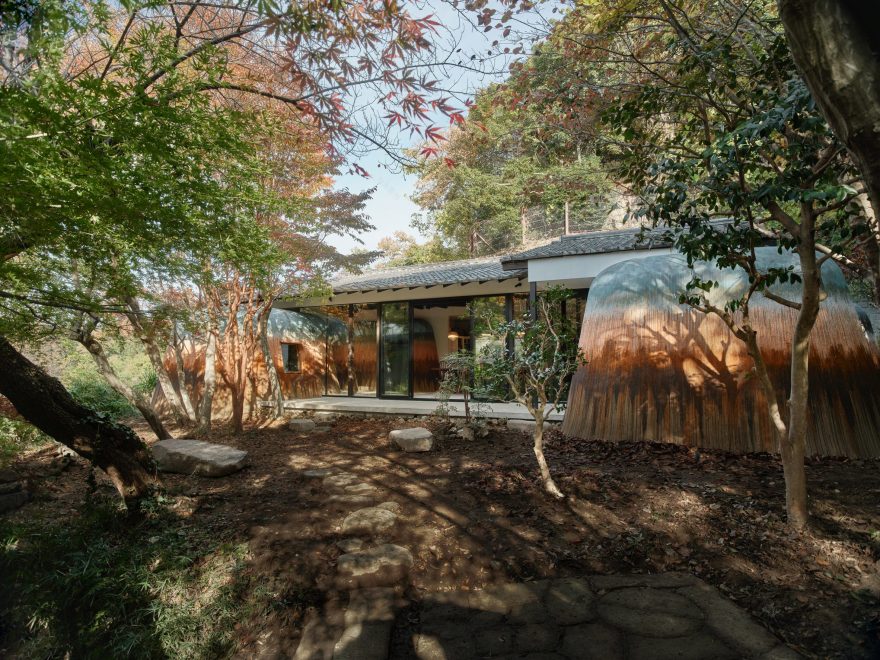
The project references the look of ceramic glazes
"The project functions as a residence for two generations: my parents, who are ceramicists, and my wife and I, who are architects," principal designer Ebidzuka told Dezeen.
"It references the composition of a primitive settlement where life and creation are inseparable," he added.
"By supporting the frame of the existing house with earthen masses that appear to have surged from the ground, we intended to create a temporal intersection where it is unclear which existed first."
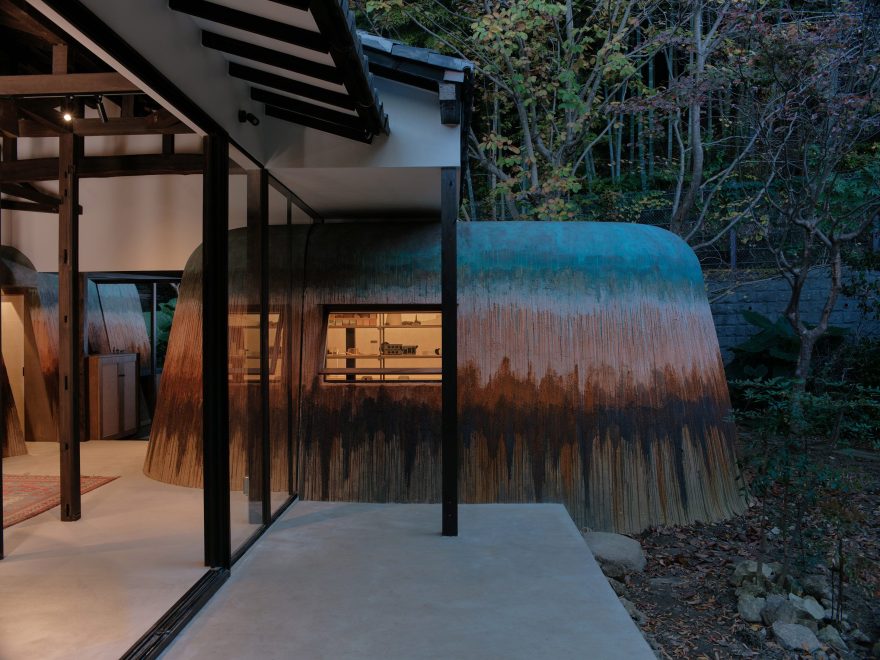
Four curved volumes have been added to the corners
The central footprint of the existing home has been entirely given over to an atelier, living room and kitchen space, framed by the curved, textured corners of the new volumes. This opens out onto a terrace to the south through sliding glass doors.
Three of the corner volumes contain a space for each family member to both sleep and work, with the parents' rooms doubling as pottery-making spaces and the studio members' room lined with desks.

The home was stripped back to its timber frame
To the northeast, the fourth volume houses a tea room that doubles as a guest bedroom, with floors lined with tatami mats and a small square skylight in the centre of its ceiling.
Shaped like trapezoidal prisms with rounded edges, the extension volumes were constructed using simple timber frames insulated and clad in timber panels.
To finish these volumes, waste clay from the parents' ceramic practice was bisque-fired and layered over soil from the site, with a plaster mixed with waste iron and copper powder from a metal workshop poured over the top.
The resulting streaked layers, which evoke the process of glazing ceramics, were left exposed to create a distinctive finish that transitions from blue-green at the top through orangey browns and green-greys. Internally, each was given a rough, cave-like plaster finish.
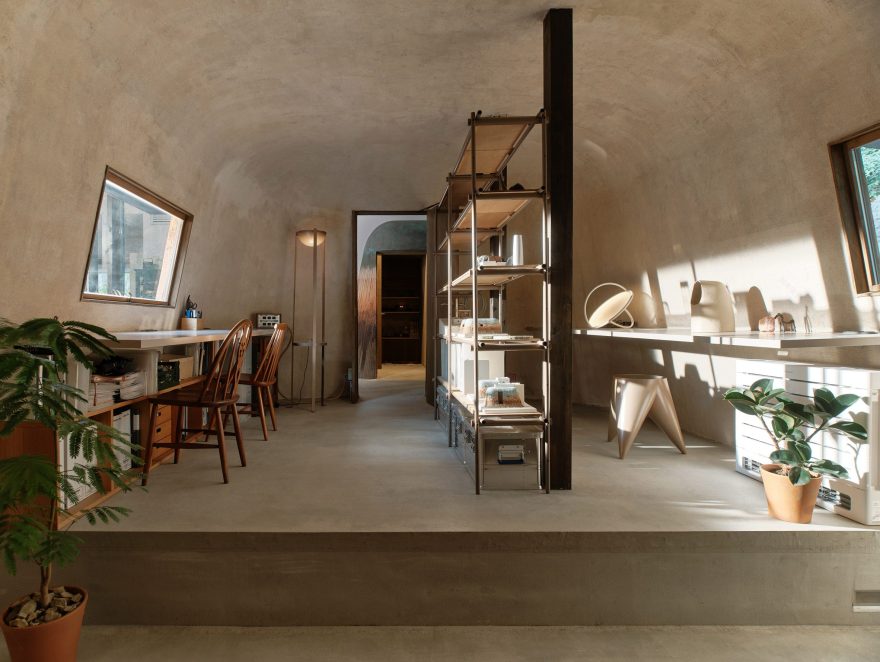
The curved volumes contain work spaces
"In mythology, Haniyasu, the Japanese deity of earth, was born from excrement," said Ebidzuka.
"We translated this mythological cycle, where new life and earth emerge from waste, into a modern architectural process by utilising industrial and domestic waste," he added.
"We actively applied ceramic techniques, such as nagashigake (glaze pouring) and the intentional oxidation of metallic powders, to introduce layers of serendipity and temporal change into the architecture."
Other recent residential projects in Japan include a home in Osaka by Akio Isshiki Architects, which is clad in planks of charred cedar and wrapped by shoji screens, and House in Nakano by HOAA, which is fronted by an elevated, looping metal terrace for potted plants.
The photography is by Shinya Sato.
南京喵熊网络科技有限公司 苏ICP备18050492号-4知末 © 2018—2020 . All photos and trademark graphics are copyrighted by their owners.增值电信业务经营许可证(ICP)苏B2-20201444 苏公网安备 32011302321234号
苏公网安备 32011302321234号客服
消息
收藏
下载
最近