

创作上传
VIP
收藏下载
登录 | 注册有礼
查看完整案例

收藏

下载

分享
出品人:向玲 / Producer: Xiang Ling
编辑:石安,司源,张笑然,亓慧、庞仁飞 / Editor: Shi An, Si Yuan, Zhang Xiaoran, Qi Hui, Pang Renfei
_________________
事务所的三个发展阶段
Three Phases of Link-Arc
Q:可否介绍一下事务所名字Link-Arc的由来?
Q: Could you tell us about the origin of the name Link-Arc?
没怎么多琢磨,记得是在2012年纽约,和斯蒂文霍尔事务所的前同事们在切尔西的酒吧的聊天。大家问我新事务所准备起什么名字,我说叫Link Architecture,大家就开始帮我出主意,看怎么读得顺,一个GSAPP的同事说就叫Link-Arc吧,读起来像Sci-arc(南加州建筑学院),很顺。当时觉得挺好,就用了。
Honestly, we didn’t overthink it. I remember it was in New York in 2012, chatting with former colleagues from Steven Holl Architects at a bar in Chelsea. They asked what I was planning to name the new practice. I said Link Architecture, and everyone immediately started tossing around suggestions—mainly about how it would sound when spoken. One colleague from GSAPP suggested Link-Arc, saying it reads a bit like SCI-Arc (Southern California Institute of Architecture) and rolls off the tongue nicely. It felt right at the time, so we went with it.

Link-Arc其实是一个愿景,就是在纽约做全世界各地的项目,形成一种地域的链接;同时这也是一个实验,如何整合好美国东岸的智力资源与中国大规模建造的一种机遇。当然在13年后,很多事情也都是时过境迁了。但从Link-Arc这个名字,其实能够看到我们那一代建筑师对于全球化和市场化的追求与信仰。
Link-Arc was, in fact, a kind of vision: doing projects around the world from New York, creating connections across regions. It was also an experiment—exploring how to integrate the intellectual resources of the U.S. East Coast with the opportunities of large-scale construction in China. Of course, thirteen years on, many things have changed with time. But the name Link-Arc still reflects the aspirations and beliefs of our generation of architects—our pursuit of globalization and faith in the market.
▼Link-Arc名称由来,The origin of the name Link-Arc ©Link-Arc建筑事务所

Q:在多年的实践经历中,事务所经历了哪些重要的发展阶段?
Q: Over the years of practice, what have been the key stages in the development of the firm?
Link-Arc建筑事务所的成长历程可以大致总结为三个阶段:
第一个阶段:2012年我从斯蒂文霍尔事务所离开,事务所在纽约正式成立,同时开始在清华任教。2015年,我代表清华大学中标了并完成了米兰世博会中国国家馆的建筑设计。这个项目对事务所的意义在于其成立的第三年就建成了一个重要的国家项目。
The growth of Link-Arc can be broadly divided into three phases.
Phase One: In 2012, I left Steven Holl Architects and officially established the firm in New York, while also beginning to teach at Tsinghua University. In 2015, representing Tsinghua University, I won the commission for and completed the architectural design of the China Pavilion at the Milan Expo. For the practice, the significance of this project lay in the fact that by its third year, the firm had already realized a major national project.
▼ Link-Arc建筑事务所纽约初创阶段的合影,Group photo from the early New York start-up phase of Studio Link-Arc ©Link-Arc建筑事务所

第二个阶段:在2015年之后,我们开始有意识地沉淀下来,把自己“关”在纽约,用心打磨了几个重要项目,比如华润集团档案馆、深圳南山外国语学校科华学校等——这也是事务所真正意义上,开始参与中国大规模的城市建设。
Phase Two: After 2015, we consciously chose to slow down and consolidate our work, essentially “closing ourselves off” in New York to carefully refine a number of important projects. These included the China Resources Group Archives and the Kehua School of Shenzhen Nanshan Foreign Language School. This period marked the point at which the practice, in a real sense, began to engage with China’s large-scale urban development.
▼Link-Arc建筑事务所纽约同事们,Colleagues at the New York office ©Link-Arc建筑事务所

第三个阶段:在2020年,我们决定在上海与深圳开设分部。随着项目的增加,我们现在上海办公室的规模也已略大于纽约总部。纽约、上海和深圳的员工总数在40人上下,虽然人不多,但项目规模并不小,现在主要的项目类型是5万到10万平方米以上的文化、办公及教育类项目。
Phase Three: In 2020, we decided to establish branch offices in Shanghai and Shenzhen. As the number of projects increased, the Shanghai office has since grown slightly larger than our New York headquarters. Today, the total staff across New York, Shanghai, and Shenzhen is around 40. While the team is not large, the scale of our projects certainly is: our current focus is primarily on cultural, office, and educational buildings ranging from 50,000 to over 100,000 square meters.
▼Link-Arc建筑事务所上海同事们,Colleagues at the Shanghai office of Studio Link-Arc ©Link-Arc建筑事务所

Q:在Steven Holl Architects和Gehry Partner等事务所担任项目建筑师的实践经历,对您在中国的实践产生了哪些影响?您认为Link-Arc建筑事务所的实践理念在中国目前的行业发展趋势下存在怎样的优势和竞争力?
Q: How did your experience as a project architect at firms such as Steven Holl Architects and Gehry Partners influence your practice in China? In your view, what advantages and competitive strengths does Link-Arc’s design philosophy offer within the current development trends of the Chinese architectural profession?
Frank Gehry和Steven Holl 两位建筑大师在精神层面以及建筑观念层面都对我有着深刻的影响。尤其是Gehry,他也是我在研究生院的导师。每当经历挫折与困难的时候,我都会想想老爷子会去怎么看待、处理这些事儿。
Both Frank Gehry and Steven Holl have had a profound influence on me, not only in terms of architectural thinking but also on a deeper, spiritual level. Gehry in particular—he was my graduate school advisor. Whenever I encounter setbacks or difficult moments, I often ask myself how the old master would view the situation and how he might deal with it.
▼陆轶辰在盖里事务所时期,Photo of Lu Yichen at Gehry Partners ©陆轶辰

我们相信设计方法决定设计成果,事务所的工作流是结合了我在美国东、西岸的实践体验的结合。在工作方法层面,美国西岸的建筑师对于建造的把握是登峰造极的,Gehry事务所严谨的工作方式、对细节的精细处理,以及对构造和材料的掌控力是我们学习的榜样。与之相对应的,斯蒂文霍尔是东岸那批实验建筑师的代表,他坚持每个项目都应该有自己的概念和灵魂——这对我也影响很深。
在我们事务所的每一个项目,都一定会有一个核心观念作为设计切入点,然后根据这个核心的观念去琢磨不同的原创形式和构造。对我们来说,形式只是结果,更重要的是如何观察并找到变革的原点,通过建筑手段去影响现实,最终“发明”有意义的建筑作品。简而言之,Frank Gehry教会我怎么盖房子,Steven Holl教会我怎么去看待盖房子这件事儿。
We firmly believe that design methodology determines design outcomes. The workflow of our practice is shaped by my professional experience on both the East and West Coasts of the United States. In terms of working methods, architects on the West Coast demonstrate an exceptional mastery of construction. The rigor of Gehry Partners—the precision of its processes, its meticulous attention to detail, and its command of structure and materials—has been a crucial reference for us. By contrast, Steven Holl represents the experimental architects of the East Coast, insisting that every project must have its own concept and inner spirit. This approach has also deeply influenced me.
In every project we undertake, there is always a core idea that serves as the point of departure. From this central concept, we explore original forms and constructions. For us, form is merely the result; what matters more is how to observe reality and identify the point from which transformation can begin, and how architecture can be used as a tool to engage with and influence the real world—ultimately “inventing” buildings with genuine meaning. Simply put, Frank Gehry taught me how to build, while Steven Holl taught me how to think about building.
▼纽约办公室堆积如山的过程模型,Process models piled high in the New York office ©Link-Arc建筑事务所

Q:2015年的米兰世博会中国馆是中国第一次在海外建造的当代中国建筑,并且获得了具有里程碑意义的建筑奖项。回顾来看,您对它产生了哪些新的思考与感想?
The China Pavilion at the Expo Milano 2015 was the first contemporary Chinese building constructed overseas and went on to receive several landmark architectural awards. Looking back today, what new reflections or insights has the project given you?
一转眼米兰中国馆已经快过去10年了,如今回想整个儿的设计过程还是相当激进的,我们其实尝试的是尽力排除其它的装饰、象征的手法,通过纯粹建构构造的方式来展现建筑的“中国性”。
世博会中国馆在设计上进行了许多创新,它是中国当代建筑第一次使用胶合木构造系统;它的半透明的开放式竹瓦表皮构造,即使现在来看也是非常实验性的;米兰馆没有封闭的围墙,也是几乎所有各国展馆中最开放的一个,极大地提升主场馆的社会性和公众的参与度。
Almost ten years have passed since the China Pavilion, and in retrospect the entire design process now feels remarkably radical. What we attempted was to strip away conventional decorative or symbolic devices and instead express a sense of “Chineseness” through pure tectonics and construction.
The pavilion introduced a number of important innovations. It was the first time contemporary Chinese architecture employed a glued-laminated timber structural system. Its semi-transparent, open bamboo-tile envelope remains highly experimental even by today’s standards. Moreover, the pavilion had no enclosing perimeter wall, making it one of the most open national pavilions at the Expo. This openness greatly enhanced its social character and encouraged a high level of public engagement.
▼米兰世博会中国馆实景,China Pavilion at the Expo Milano 2015© Sergio Grazia 点击这里查看更多,Click HERE for details
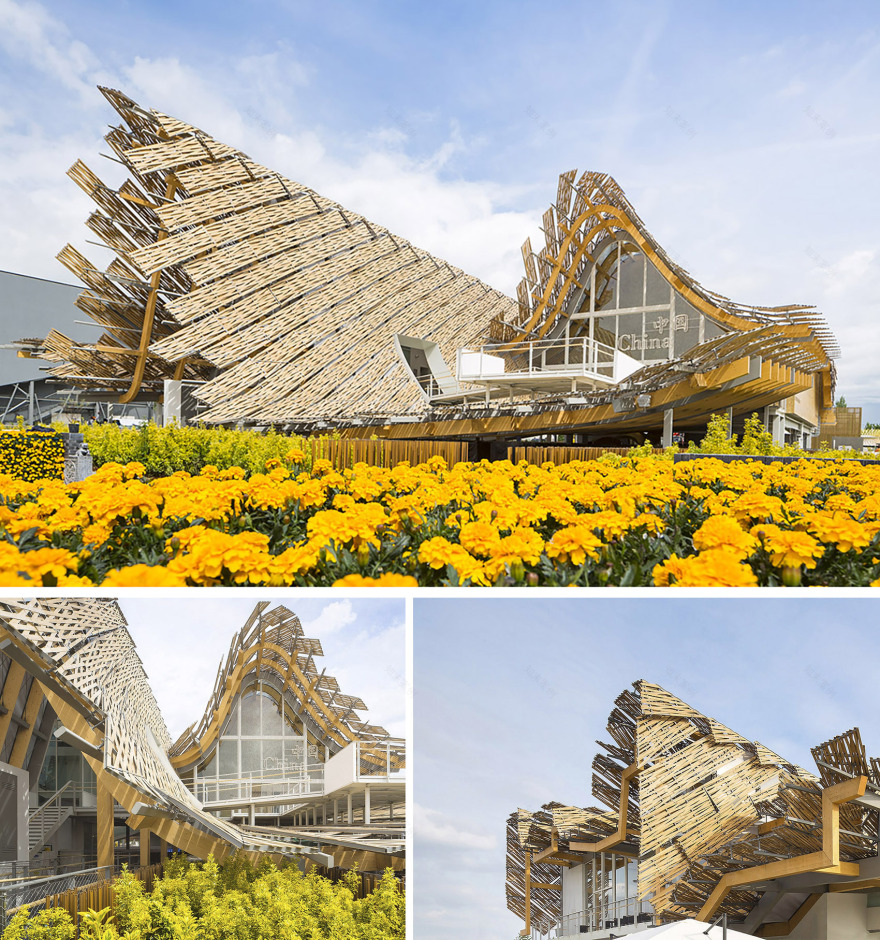
这种鼓励公众参与建筑的观念也贯穿在我们之后的很多项目,通过打破室内外的边界,鼓励市民参与其中。这些年来,我们一直在深入探讨建筑的社会性和公众参与度问题,这些因素的重要性对我们来说超过了建筑形式本身。市民如何创造性地使用建筑,这才是我们最关注的核心。
This idea of inviting public participation in architecture has continued throughout many of our subsequent projects. By dissolving the boundary between inside and outside, we aim to encourage people to actively inhabit and appropriate the space. Over the years, we have consistently explored the social dimension of architecture and the question of public participation—issues that, for us, are more important than architectural form itself. How citizens creatively use architecture is, ultimately, what we care about most.
▼中国馆设计过程模型,Model of the Design Process for the China Pavilion©Link-Arc建筑事务所

▼米兰世博会中国馆实景,China Pavilion at the Expo Milano 2015 © Sergio Grazia

实践的三条线索
Three Lines of Practice
事务所的项目分成几种类型:最主要的是一些规模比较大的文化类、教育类公建项目;其次是一些改造类、室内的项目也逐渐增多;最后是一些展览和装置类作品。针对不同类型的项目,我们大致有一些处理的策略和倾向性:
整合建筑:在我们最核心的公建项目中,我们通过对场地、社区、交通、文化等等信息,整合建筑,体现建筑的核心问题。
消解建筑:在室内和改造项目上,我们是以消解建筑来强化沉浸式的体验,弱化建筑的压迫感。
转换建筑:在展览设计上,我们的策略是以建筑为工具来转换现实。
The projects undertaken by the practice can be broadly divided into several categories. The core of our work consists of large - scale public buildings, primarily cultural and educational projects. In addition, renovation and interior projects have gradually become more prominent. Finally, there is a third category comprising exhibitions and installations. In response to these different project types, we have developed distinct strategies and design tendencies:
Integrating Architecture: In our key public projects, architecture functions as an integrative framework. By synthesizing information related to the site, community, circulation, and cultural context, we use architecture to articulate and respond to the project’s fundamental questions.
Dissolving Architecture: In interior and renovation projects, our approach is to “dissolve” architecture in order to strengthen immersive experience and reduce any sense of spatial oppression or monumentality.
Transforming Architecture: In exhibition design, architecture becomes a tool for transformation—an active medium through which reality can be reinterpreted and reconfigured.
▼Link-Arc部分代表作品,Selected representative works of Link-Arc

Q:请谈一谈什么是“景观建筑”,您通常会从哪些角度去思考和处理建筑形体与外部环境的关系?
Q: How do you define “landscape architecture,” and from what perspectives do you usually approach the relationship between architectural form and the surrounding environment?
所有建筑师在实践之初都会有一个醉心于创造新形式的阶段。但随着实践逐渐深入,尤其是事务所在华南的项目基本都要涉及大量的山体建筑,我逐渐意识到因地制宜的重要性。这也形成了一套我们自己的工作流:设计过程从场所的关系和周边环境的调研开始,设计过程始终会陪伴着一个大型的模型沙盘,在没有深刻理解场地关系之前,我们绝不会轻易画下一根线条——在充分与场地“沟通”再应对,设计其实更像是在顺势推动的行为。
Most architects go through an early phase in which they are fascinated by the creation of new forms. As my own practice deepened, however—especially as many of our projects in South China involved building within mountainous terrain—I gradually came to recognize the fundamental importance of responding to the site. This awareness has shaped a working methodology of our own. We begin every project with an intensive investigation of site relationships and the surrounding environment. Throughout the design process, a large physical site model remains present in the studio. Without a deep understanding of the site, we would never casually draw a line. Only after thoroughly “communicating” with the site do we begin to respond; in this sense, design is less an act of imposition than one of moving with existing forces.
▼深圳鹭湖艺术中心,Shenzhen Luhu Art Center © 田方方 点击这里查看更多,Click HERE for details

比如在鹭湖艺术中心的设计中,我们一直在有意强化建筑与山体的衔接关系,我们称之为“让山与水重新相遇”。为了使建筑屋面真正成为山体的延伸,我们投入了大量时间,将红线外的东侧道路修改协调成下穿式的箱函式隧道;同时,我们又有意识地控制整个建筑的高度,使其略低于山体,以保持一种对于自然的谦逊姿态——让建筑真正成为山体的一部分。从山体方向看去,建筑仿佛消失了,只能看到一片连绵的山体延伸至建筑的边界;而从城市一侧,看到的是立体、挺刮的文化三馆。
The Luhu Art Center is a clear example of this approach. In this project, we deliberately strengthened the connection between the architecture and the surrounding hills, a strategy we described as “bringing the mountain and water back together.” To allow the roof to truly become an extension of the terrain, we invested significant effort in reconfiguring the eastern road outside the site boundary, transforming it into a sunken, box-type underpass. At the same time, we carefully controlled the overall height of the building, keeping it slightly lower than the surrounding hills to maintain a posture of humility toward nature—allowing the architecture to become part of the landscape itself. Viewed from the hillside, the building seems to disappear, leaving only a continuous mountain ridge extending to the edge of the site. From the city side, however, the project presents a crisp, articulated ensemble of three cultural buildings.
▼深圳鹭湖艺术中心室内,Interior of Shenzhen Luhu Art Center© 夏至 / 田方方

Q:请您谈一谈“物”与“场”的关系;您是如何处理建筑与场地以及外部环境之间的关系的?
Q: How do you understand the relationship between “object” and“site”? How do you negotiate the relationship between architecture, its site, and the surrounding environment?
以我们去年刚完成的顺德湿地博物馆举例。场地位于顺德云鹭湿地公园内,旁边就是一个栖息着2.5万只鹭鸟的生态鹭岛。我把建筑选址隐藏在一排落羽杉林后面,不去做那个第一眼就能被看见的建筑。建筑的形态像是四个水平旋转的“镜头”,静静地捕捉着鹭鸟们的生活瞬间。在材料的选择上,我们选择了现浇松木模混凝土。这种材料有一种天然的质朴感,我们希望这个建筑在自然面前谦逊、内敛,而不张扬。
Take Shunde Yunlu Wetland Museum as an example. The project is located within Yunlu Wetland Park in Shunde, adjacent to an ecological egret island inhabited by approximately 25,000 birds. Rather than placing the building in a visually dominant position, we deliberately concealed it behind a row of bald cypress trees, resisting the impulse to create an architecture that asserts itself at first sight. The building is composed of four horizontally rotating “lenses,” quietly framing and observing the daily life of the egrets. Instead of becoming an object to be viewed, it operates as a viewing instrument—an interface between humans and the wetland ecosystem. For the material strategy, we used cast-in-place concrete formed with pinewood planks, which leaves behind a subtle grain and tactile warmth. The intention was for the building to remain restrained and understated in the presence of nature—calm, introverted, and free of unnecessary expression.
▼顺德云鹭湿地博物馆,Shunde Yunlu Wetland Museum©田方方 /存在建筑
点击这里查看更多,Click HERE for details

▼旋转的四个镜头示意&从半空中望向四个取景框,Four rotating tubes & View of the four viewfinders©Link-Arc建筑事务所 /田方方


两座建筑分别位于山地上与湿地间,场地其实并不“显赫”,甚至是有些局促的。在这种情况下,仅仅讨论建筑如何融入自然是不够的,建筑更像是周边不稳定场地的一个“锚点”,需要在整体性思考之后变成一个激发新的场地联系的触媒。
The two volumes are positioned between the hillside and the wetland. The site itself is neither grand nor expansive; in fact, it is somewhat constrained. Under such conditions, simply discussing how architecture can “blend into” nature is insufficient. Instead, the building acts more like an anchor within a fluid and unstable field. Through a holistic reading of the site, architecture becomes a catalyst—one that generates new relationships and connections within the broader landscape.
▼远眺云鹭湿地博物馆的第五立面,Aerial view of the Wetland Museum©田方方
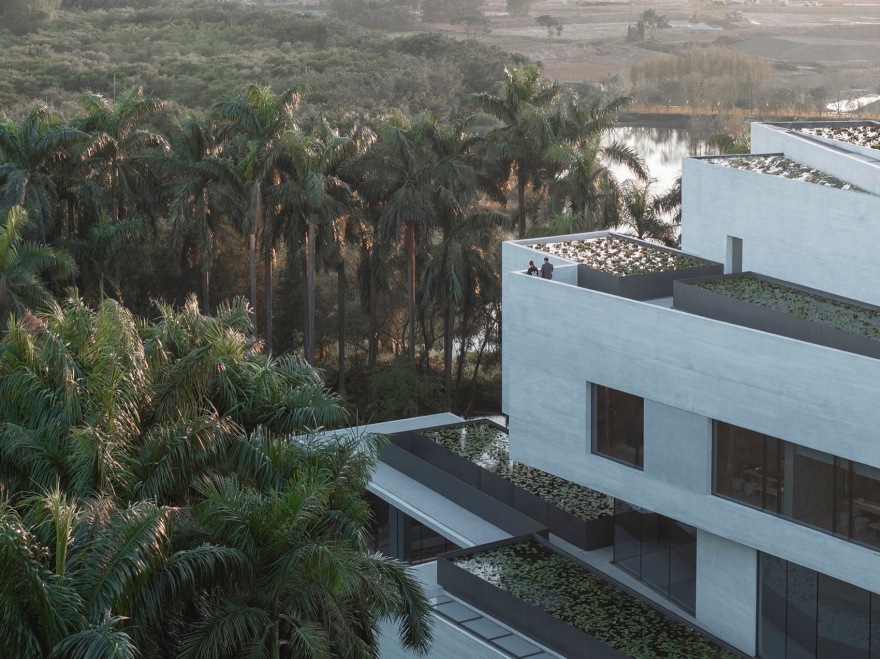
▼云鹭湿地博物馆室内空间,Interior view of the Museum from the Wetland Park©田方方 / 存在建筑

Q:可否谈一下在你们的改造和室内设计如何“消解建筑”,为什么要消解它,意义在哪里?
Q: In your renovation and interior projects, how do you “dissolve” architecture? Why is this dissolution necessary?
我们事务所的建筑、室内与景观是不分家的。针对偏重室内的建筑项目,我们很多时候采取的是一种“消解”的策略,而不是去做“加法”。首先梳理好内部空间与建筑的关系,然后再考虑比例、材料等问题。理想的设计程序像是层层剥离问题,逐渐接触到问题实质的过程。
In our practice, architecture, interiors, and landscape are never treated as separate disciplines—they are conceived as a continuous whole. In projects where the emphasis leans toward interiors, we often adopt a strategy of “dissolution” rather than addition. Instead of layering more elements onto the building, we begin by clarifying the relationship between interior space and the architectural structure itself, and only then move on to questions of proportion, materiality, and detail. Ideally, the design process unfolds like a gradual peeling away—layer by layer—until we reach the core of the problem.
▼广东华润集团档案馆照片与砖幕墙研究模型,China Resources Archives Library&material study for brick©苏圣亮 /Link-Arc建筑事务所 点击这里查看更多,Click HERE for details


▼转角砖、钢、玻璃, the curved brick wall, steel and glass©苏圣亮

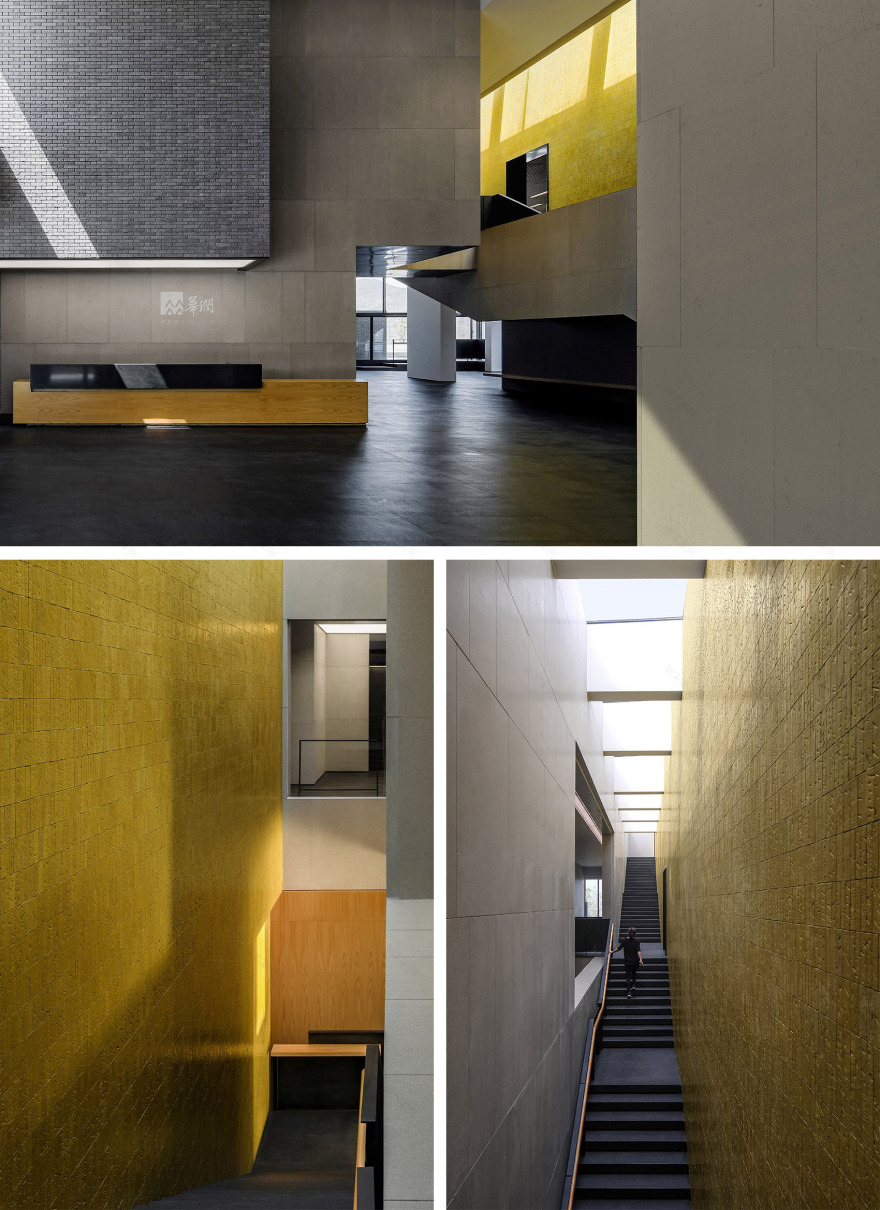
华润集团档案馆是一个永久性建筑,在设计之初,业主的要求就是打造一座能够记录时间的建筑。它的功能分成两部分,藏在山里的6000平米是档案库房和办公,山体之上的展览面积只有2000多平米。建筑、室内和景观都是我们一气呵成地完成的项目,室内着重于不同的空间相互渗透,我们称之为“山内之山”。在材料与颜色的选择上,我们保持了极度的低调,使用了青砖、黑钢、与玻璃等能够彰显时间痕迹的自然材料。室内则采用了在景德镇特殊烧制的釉面砖,全部手工制成。我们希望这座建筑不仅只是被观看,更是可以被触摸、被身体感知的。
The China Resources Archives Library is a permanent building. From the outset, the client asked for a structure capable of recording time. Programmatically, the building is divided into two parts: 6,000 square meters of archive storage and offices embedded within the mountain, and just over 2,000 square meters of exhibition space above it. Architecture, interior, and landscape were conceived and executed as a single, integrated gesture. The interior strategy focuses on the mutual infiltration of spaces—what we call “mountains within the mountain.” In terms of material and color, we maintained an extremely restrained palette, using blue brick, black steel, and glass—materials that naturally bear the traces of time. For the interiors, we employed specially fired glazed tiles produced in Jingdezhen, each crafted by hand. Our intention was for the building not only to be seen, but to be touched—to be experienced physically and sensorially by the body.
▼内部空间构成草图,internal space design sketch ©Link-Arc建筑事务所

▼室内空间实景照片,interior views of the archives library ©苏圣亮
Q:武汉万华麓洲艺展中心这个项目发起的契机和目的是什么?“连续”与“流动”在空间体验上体现在哪里?
Q: What was the impetus and intention behind the Wuhan Wanhua Lakeside Gallery project? How are “continuity” and “flow” embodied in the spatial experience?
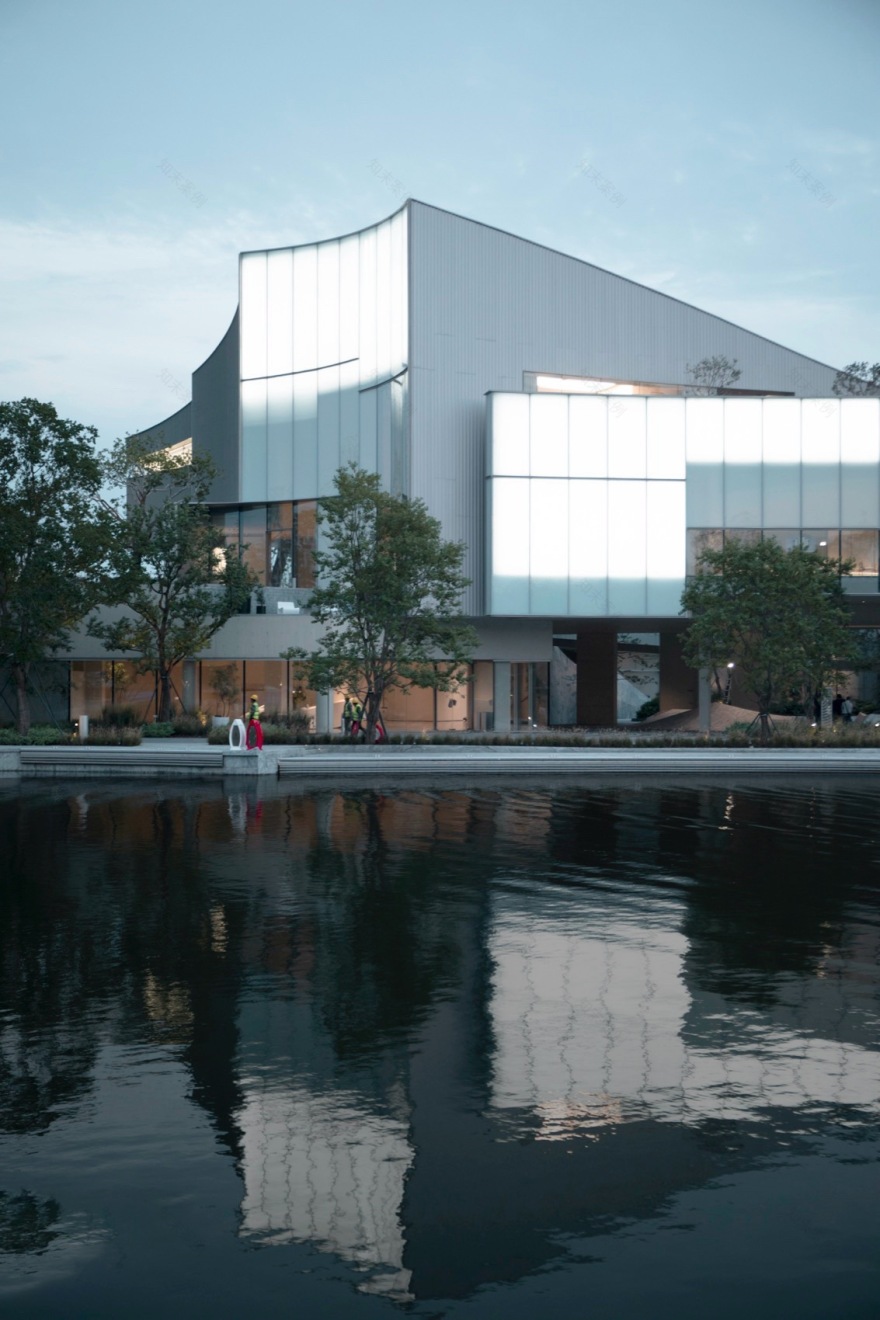
武汉艺展中心的项目是和成都万华在武汉的一次新的城市实践。这座艺展中心是整个武汉麓洲项目首个落地的建筑,在这栋建筑的设计中“流线”是设计切入的关键。项目的场地有大约六米左右的高差,我们顺势组织了三条主要的人流路径, 这三条流线分别对应不同的标高,最后在建筑中交汇、扭转,形成一种螺旋式的体验关系。人们可以从水路上岸,经弧形楼梯到达首层,也可以从地面层“爬山”至屋顶。路径之间不断交织,既能从建筑首层进入花园,也能从滨水层穿过翼展空间,再逐步走向更高的公共区域。
我们希望这座建筑不是“看一眼就结束”的,而是“越走越有发现”。它更像一座微型城市,内部有自己的道路系统与节奏。建筑的流线以顺时针展开,环绕着中心水院逐层攀升,人在其中不断转换视角和高度,体验空间的连续与转折。这种复杂的流线结构,也让建筑在没有强烈文脉的土地上,自身生成了一种新的秩序与生命力。
The Wuhan Wanhua Lakeside Gallery emerged from Wanhua Chengdu’s new urban initiative in Wuhan. As the first completed building within the larger Luhu development, it was conceived as a catalyst for the entire district. In this project, circulation became the primary design entry point. The site presents a level difference of approximately six meters. Rather than flattening this condition, we embraced it and organized three primary circulation routes, each corresponding to a different elevation. These paths converge and twist within the building, forming a spiral experiential sequence. Visitors may arrive by water and ascend to the main level via a curved stair, or approach from the ground plane and “climb” upward to the roof. The routes interweave continuously—one can enter the garden from the ground level, pass through the wing-like exhibition space at the waterfront level, and gradually move toward higher public zones.
We envisioned the building not as something to be understood at a glance, but as a place that reveals itself gradually through movement. It operates more like a miniature city, complete with its own internal network of streets and rhythms. The circulation unfolds clockwise, spiraling upward around a central water courtyard. As people move through it, their viewpoints and elevations constantly shift, producing a spatial experience defined by continuity and transition. In the absence of a strong historical or urban context, this intricate system of movement allows the building to generate its own internal order and vitality—an architecture animated by flow rather than imposed form.
▼武汉万华麓洲艺展中心研究模型与实景照片,model and photos of Wuhan Wanhua Lakeside Gallery ©Link-Arc建筑事务所 / 存在建筑

Q:在2022深港双年展中,Studio Link-Arc推出了生态装置“反方向的构筑”。以蘑菇砖为材料的设计灵感是怎么来的?它如何体现事务所转换建筑的概念?
Q: At 2024 UABB, Studio Link-Arc presented the ecological installation INVERTED ARCHITECTURE. What inspired the design using mushroom bricks, and how does it reflect the concept of “transforming architecture”?
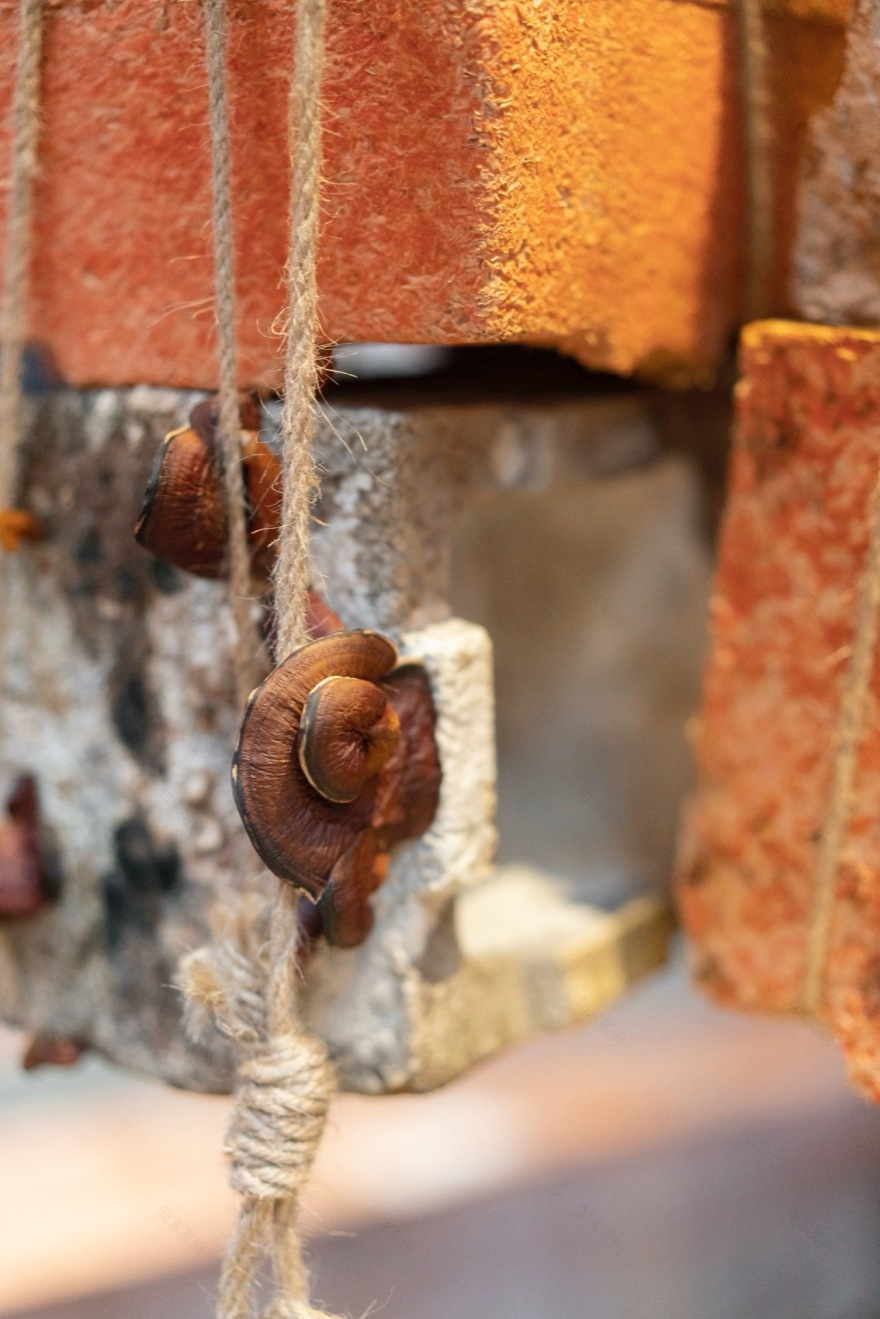
2022年深港双年展的策展人子耕找到我们,聊到这个展览的主题关键词之一是“发现隐藏的生态系统”,这个很吸引人。在构思过程中,我们便开始寻找与生态系统紧密相关的材料,最终找到了蘑菇砖——一种将蘑菇菌丝与农作物废料相结合的创新材料。通过烘焙、烧制和培养的过程,这种材料可以固化成了一种轻质的砖材,而且其表面还能生长出各式各样的蘑菇,这一特性让我们觉得非常魔幻。
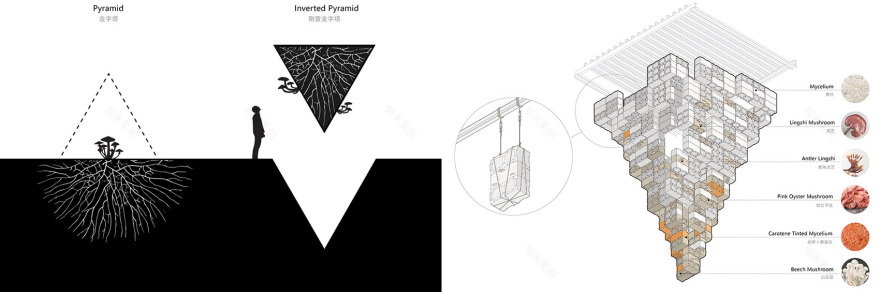
在这个装置项目中,我们并没有刻意地做什么,只是揭露现实中一些令我们惊奇的事物。在蘑菇砖的基础上,我们想着做一个完全颠覆常规的“反建筑”装置。设计的参照物选择了金字塔——这一象征人类建筑精度、砌筑和重力关系的经典形式,成为了我们的“打击对象”。我们希望打造一个非砌筑、不精确、甚至带有反重力特性的反向金字塔——这也是“反方向的构筑物”命名的缘由。建成之后,这个装置在UABB展览期间受到了市民们的欢迎。它呈现出一种轻松自然的状态,由于材料轻盈,装置会随风轻轻摇曳,表面逐渐生长的蘑菇种类繁多,散发出独特的菌类气味。
这个看似非传统建筑的装置,恰好体现了我们在面对建筑问题时所采取的策略和我们对待建筑的态度——我们希望抛掉那些无意义的包袱,去突破、发现建筑学的新类型。
In 2022, UABB curator Wang Zigeng approached us, mentioning that one of the key themes of the exhibition was “discovering hidden ecosystems,” which immediately intrigued us. During the conceptual phase, we began exploring materials closely tied to ecosystems and eventually discovered mushroom bricks—an innovative material made by combining mycelium with agricultural waste. Through a process of baking, firing, and cultivation, this material solidifies into a lightweight brick, and its surface can even grow various types of mushrooms. We found this characteristic truly magical.
For this installation, we didn’t set out to make something overly conceptual; instead, we aimed to expose some surprising aspects of reality. Using mushroom bricks as the base, we envisioned an entirely unconventional Inverted Architecture installation. The design was inspired by the pyramid—an iconic form representing human architectural precision, masonry, and gravity. The pyramid became our “target” for disruption. We aimed to create a non-masonry, imprecise, and even anti-gravitational inverted pyramid—hence the name Inverted Architecture.
Upon completion, the installation was well-received by visitors during the UABB exhibition. It presented a relaxed and natural state. Due to the lightweight material, the structure swayed gently in the wind, and the surface grew a variety of mushrooms, emitting a unique fungal scent. This installation, seemingly non-traditional in its architectural form, perfectly embodies our approach and attitude towards architecture. We aim to shed unnecessary burdens, break boundaries, and discover new types of architecture.
▼反方向的构筑,INVERTED ARCHITECTURE © 白羽
点击这里查看更多,Click HERE for details

▼蘑菇砖金字塔概念示意图,analysis diagramof the suspended mushroom bricks © Link-Arc建筑事务所
▼装置由悬挂着的蘑菇砖组成,the installation consists of suspended mushroom bricks© 白羽


与展览并行地,我们也参与了大量的学术编撰工作,包括了2015年出版的《AC建筑创作:从时代图景到建构表达》、2018年发行的书籍《XPOSITIONS: 关于世博会建筑的对谈》以及近期出版的《建筑实践》学校专辑特刊等。
In parallel with the exhibition, we have also been deeply involved in various academic editorial projects. These include the 2015 publication on ArchiCreation, the 2018 book XXPOSITIONS: Pavilion Dialogues, and more recently, the special school edition of Architectural Practice.
▼学术出版物封面合集,Collection of Academic Publication Covers © Link-Arc建筑事务所整理

教育的观念变革
Transformation of Educational Architecture
Q:您曾提到“教育变革 建筑先行”,请解释一下教育理念的变革是如何影响建筑空间的?事务所目前在深圳开展了一系列学校项目,您对于教育项目是否探索出了一套行之有效的建筑语言?此外,在您看来为未来的教育建筑将会往什么方向发展?
Q: You’ve mentioned that “educational reform begins with architecture.” How does the shift in educational philosophy influence architectural space? Studio Link-Arc has undertaken a series of school projects in Shenzhen—have you developed a unique architectural language for educational projects? Additionally, where do you see the future of educational architecture heading?
我们从2016年开始做设计校园,至今已完成了六七个项目。在这些校园设计中,我们始终坚持一个核心理念:学校的核心在校园,校园的核心在“学生怎么玩”。国内的学校设计规范对日照间距、开窗率、消防和退线等限制可能是世界上最严格的,然而遵循这些规则必然会导致校园设计变得刻板无趣,我们团队寻找的是在规则之上的观念转变,以之应对当下教育观念从应试教育向素质教育的转变的契机。
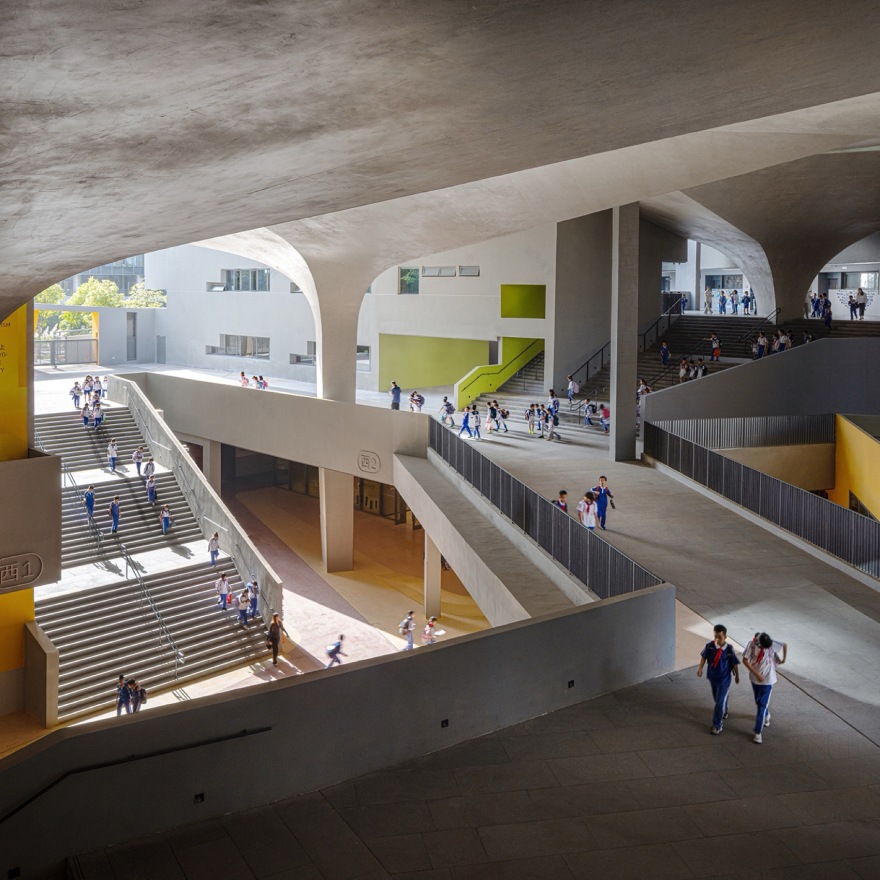
在南山外国语学校科华分校的项目中,我们通过校园设计对高密度的新城区域进行梳理,校园建筑统一为3 - 4层的低层,与竖向生长的城市形成戏剧性的对比,线性的教学楼所围合出的校园的“空”成为高密度城市中“会呼吸”的花园,高密度的社区生活成为日常教学的背景。
Since 2016, we’ve designed six or seven campus projects. In each of these, we’ve adhered to a core principle: the heart of the school lies within the campus, and the heart of the campus lies in how students interact with the space. While domestic school design regulations in China—regarding sunlight exposure, window ratios, fire safety, and setbacks—are among the strictest in the world, following these rules too rigidly can make campus designs rigid and uninspiring. Our team seeks a conceptual shift beyond these constraints, responding to the current transition in education from exam-focused systems to quality-based education.
For NSFL School, we approached the design by organizing the high-density new urban area around the campus. The school buildings, unified in low-rise 3-4 stories, dramatically contrast with the vertical city structures. The linear classrooms frame an “empty” space within the campus, which becomes a “breathing” garden in the high-density urban environment. The surrounding community life seamlessly integrates with the everyday educational experience.
▼深圳南山外国语学校实景照片,NSFL School at Shenzhen, SCHOOL AS URBAN GARDEN ©苏圣亮

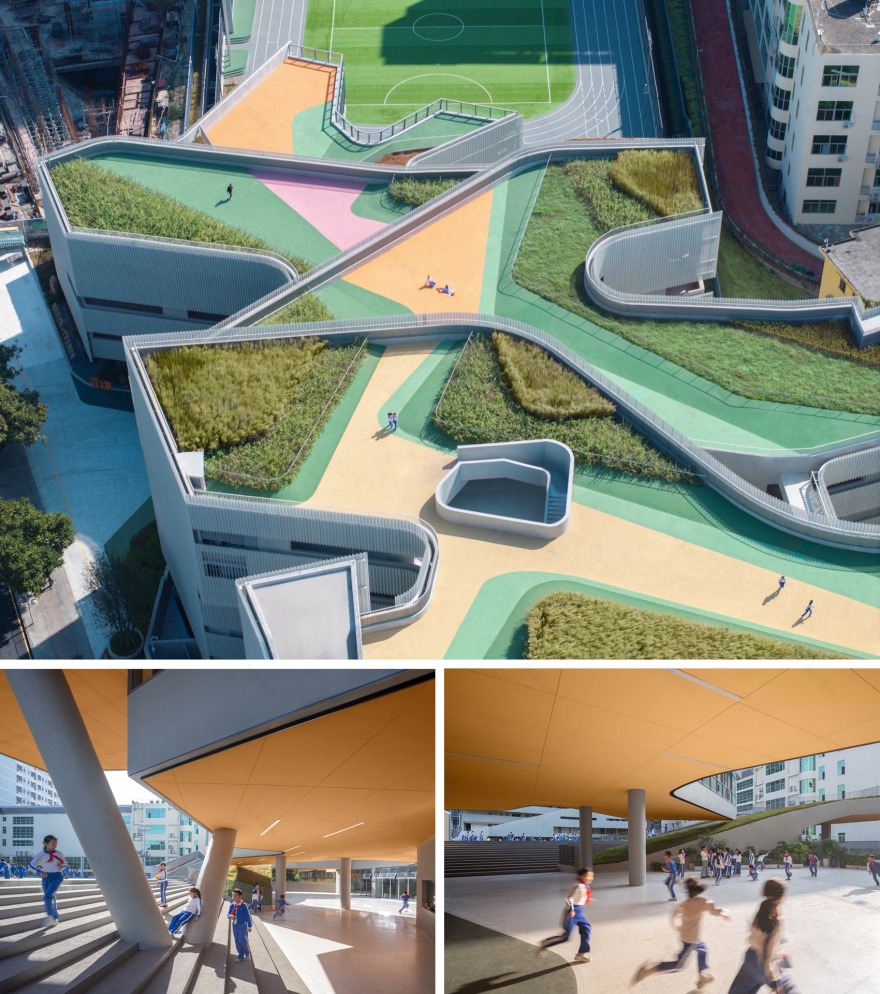
在我们最近完成的罗湖翠竹学校,校园被隐藏在了一片新旧混杂、极具烟火气的城市众生相中,我们设计的校园像是一块“调色板”,拼上了周边大规模城市开发的最后一块历史拼图。为了处理好场地南北五米的高差,我们将建筑设计成了一个层层叠落的形态,就像梯田一样,自北向南逐渐降低。这样一来,不仅可以缓解教学楼体量对操场的压迫感,还可以将自然从地面层一直延伸到屋顶。每个年级的学生,都能拥有属于自己的屋顶花园。
我们理解的“城市中的校园”,不仅仅是地理位置上的概念,更是一种开放、包容、多元的校园文化的体现。我在建筑内部“挖”出了六个空间特色迥异的庭院,这些庭院就像是一个个“城市客厅”,将阳光、空气和绿色引入到建筑内部,从每个院子望出去是各有特色的城市对景。不同于传统的线性板式教学楼,我们在课室之外设计了很多大平台和灰空间,我们希望学生和老师可以在公共空间里更自由地互动交流,把课堂带到教室之外,整个校园都是一个流动的教学场所。
In our recently completed Cuizhu Foreign Language School, the campus is nestled within a vibrant urban context, blending old and new with a distinct local atmosphere. The design of the campus acts like a “palette,” completing the last piece of the historical puzzle amidst the surrounding large-scale urban development. To address the site’s five-meter elevation difference from north to south, we shaped the building into a terraced form, gradually descending like a series of steps. This design not only alleviates the pressure of the building’s volume on the playground but also allows nature to extend from the ground level all the way to the rooftop. Each grade has its own rooftop garden, providing students with their own green space.
Our concept of a “campus within the city” goes beyond mere geography—it represents an open, inclusive, and diverse campus culture. Inside the building, I “excavated” six courtyards, each with a unique character. These courtyards serve as “urban living rooms,” bringing sunlight, air, and greenery into the building. From each courtyard, there are distinct urban views. Unlike traditional linear classroom buildings, we designed large platforms and flexible spaces outside the classrooms. We aim to encourage students and teachers to interact freely in these public spaces, extending the classroom beyond the walls. The entire campus becomes a fluid, dynamic learning environment.
▼翠竹外国语学校,深圳,Cuizhu Foreign Language School, Shenzhen ©田方方 点击这里查看更多,Click HERE for details

▼翠竹外国语学校概念模型图,Conceptual Model©白羽 /Link-Arc建筑事务所


▼翠竹外国语学校第五立面与公共空间,The fifth facade and public space of Cuizhu Foreign Language School © 田方方
Q:同期完成的前海桂湾学校,你们有着怎样的设计思考?
Q: What was your design thinking behind the Qianhai Guiwan School?
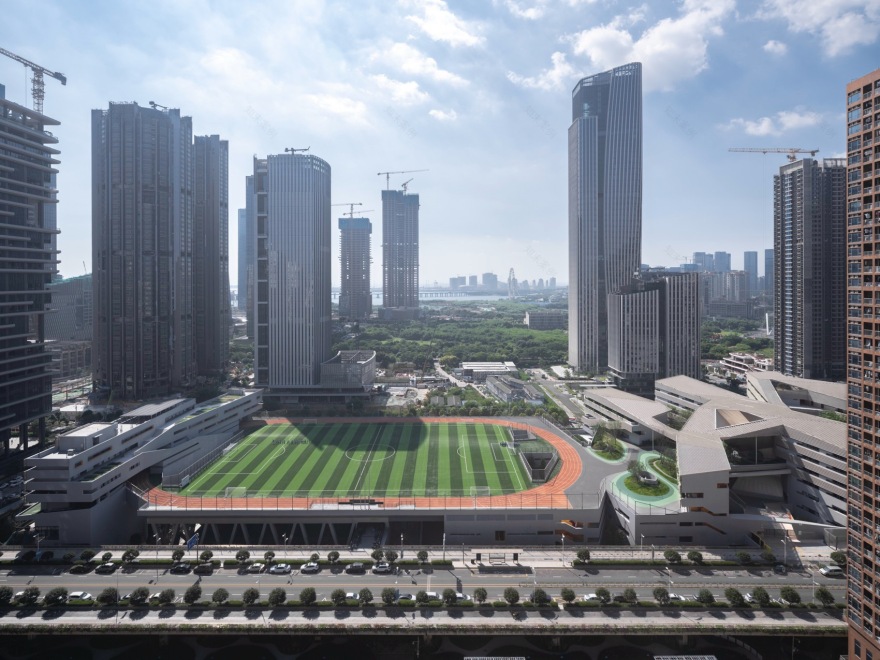
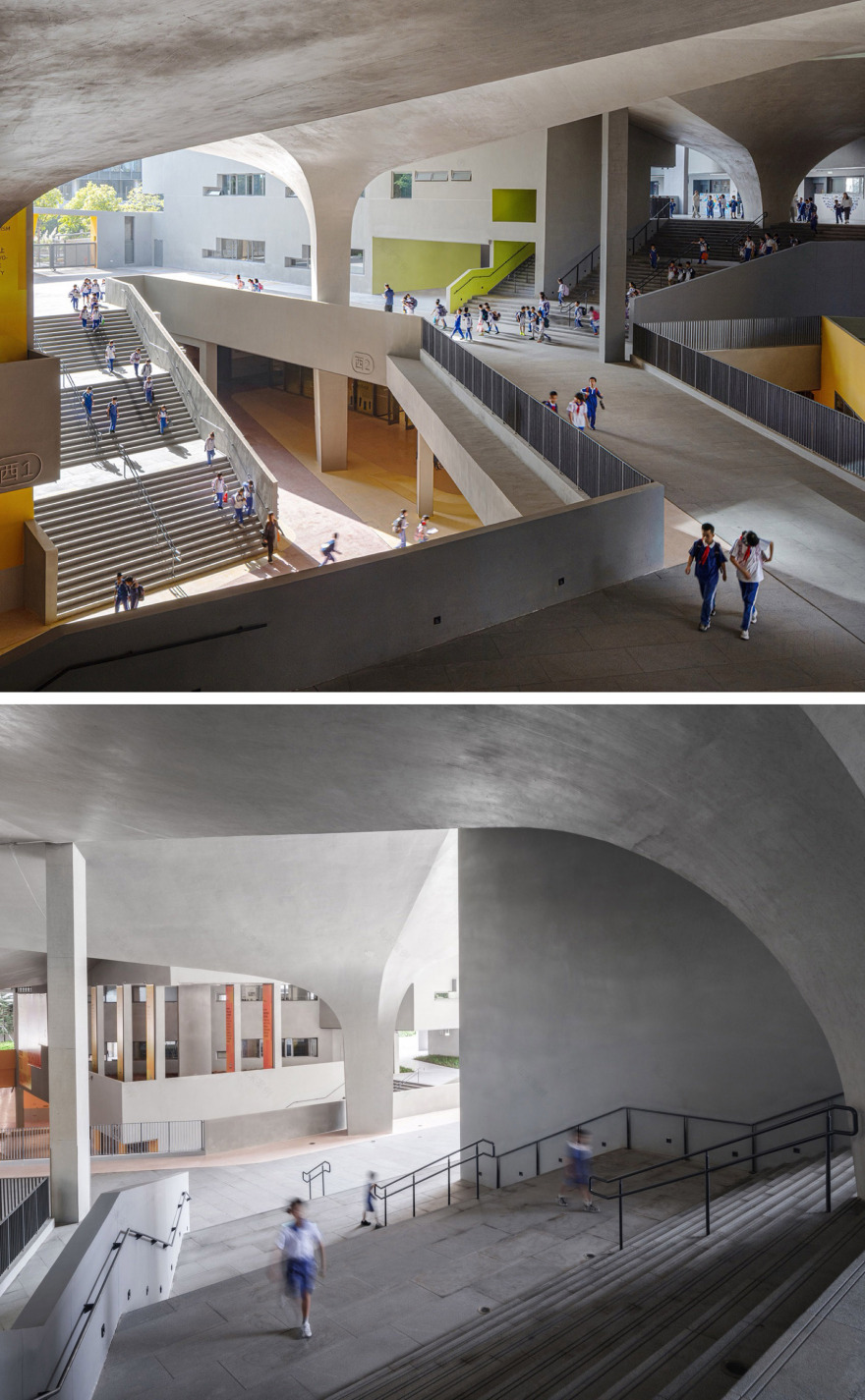
在前海桂湾学校,我们面对的是一块“没有态度”的场地,我们采用的是在学校里造城市的做法,通过一系列剖面植入,让建筑本身成为周边复杂城市关系和“节点”,“知识花园”和巨型结构柱的设置,使得整个学校成为充满想象力和活动的教学“hub”。
在生态层面上,我们希望将绿色前海的概念融入到校园设计中,让教育与自然和谐共生。学校场地南北长、东西窄,400米跑道的设置使得校园的教学楼只能被安置在北侧,西北侧设置小学部,东北侧设置中学部。一道逐级抬升的“知识花园”让学生可以从操场直接去到北侧教学楼的每一层。这条位于校园中部的绿轴,是一个半室外的空间,这里阳光充足,空气流通,不同年级的学生都可以在这里享受绿色校园的静谧与欢愉。
For the Qianhai Guiwan School, we were working with a site that had little inherent character. We adopted an approach of “building a city within a school,” using a series of inserted sections to allow the architecture itself to become a node in the surrounding complex urban fabric. The creation of a “knowledge garden” and the inclusion of large structural columns transformed the school into a vibrant educational hub, filled with imagination and activity.
Ecologically, we aimed to integrate the concept of green Qianhai into the campus design, fostering a harmonious coexistence between education and nature. The site is long from north to south and narrow from east to west, so we positioned the school building on the north side to accommodate a 400 - meter running track. The elementary school was placed on the northwest corner, while the secondary school was located on the northeast side. A gradually elevated “knowledge garden” allows students to access every floor of the teaching building directly from the playground. This green axis, located in the center of the campus, is a semi - outdoor space bathed in sunlight and fresh air, where students from different grades can enjoy the tranquility and joy of the green campus.
▼前海桂湾学校鸟瞰,Aerial view of Shenzhen Qianhai Guiwan School©田方方
在教育层面上,我们希望能创造一种全新的教育模式,让学生们可以从教室“回归”到城市中,在开放、自然的环境中学习和成长。为了实现这个目标,我们在“知识花园”的下部设置了“创意平台”,这是一个更加开放、灵活的多功能空间,不仅可以用于教学,还可以用于举办各种活动,例如校史展览、艺术节、戏剧节等等。希望通过这种方式,激发孩子们的创造力和想象力,让他们在学习中感受到快乐和自由。
我们的每个学校都是针对具体的问题发出的“质疑”。学校建成之后,无论是学生还是老师都会很喜欢,觉得校园充满趣味,甚至激发了学生对建筑学的兴趣。在回访时,一位小学生曾在走廊里拦住我,说要跟建筑师“谈一谈”,这一经历让我们很开心。
Educationally, we wanted to create a new model that would allow students to “return” to the city, learning and growing in an open, natural environment. To achieve this, we placed a “creative platform” beneath the “knowledge garden”—an open, flexible multifunctional space that can be used not only for teaching but also for hosting various activities such as school history exhibitions, arts festivals, and drama festivals. We hope this environment will stimulate students’ creativity and imagination, allowing them to experience joy and freedom in their learning process.
Every school we design starts with a specific “question” to be addressed. After the school was completed, both students and teachers loved it, finding the campus engaging and even sparking students’ interest in architecture. During a revisit, a young student stopped me in the hallway and asked to “talk to the architect,” which was a delightful experience for us.
▼前海桂湾学校剖面草图,Sketch of the Shenzhen Qianhai Guiwan School ©Link-Arc建筑事务所

▼前海桂湾学校空间实景,Photo of Shenzhen Qianhai Guiwan School ©苏圣亮 /ACF
跨文化的实践
Cross-Cultural Practice
Q:如何定义建筑师?
Q: How do you define an architect?
我们这批建筑师所受的建筑教育,都是源于西方的那套建筑学理论,其实是很“硬”的东西,里面缺了很多内容,比如:社会学、经济学、还有人文的那些东西。经过这套“硬理论”熏陶的建筑师,总是会有一种近乎执念的追求,想着做一些惊天动地、能载入史册的伟大建筑。但其实如果建筑学根本的意义没有厘清,建筑师的能力越大,对社会和人文的破坏力就越大。
很多时候,我们把太多的精力放在了建筑的符号意义上,反而忽略了它最基本的意义。让木头成为木头,让石头成为石头,混凝土做好混凝土,乡建交给自然,把学校还给孩子,让办公变得高效,让住宅住得舒服……建筑应该是通往真实世界的桥梁,而不是粉饰虚无的工具,所以我认为,建筑师本质上是一个综合解决问题的人,不该被某种类型或标签所限制。
2015年米兰世博会中国馆之后,我主动地从公众视野里淡出了一段时间。那是一个沉淀和积累的过程,我也开始有意识地接触不同类型的项目,不限定地域、类型以及规模。这种选择,也反过来要求建筑师必须具备更全面的能力——面对业主的期待、施工的挑战、紧张的项目周期,还有如今AI技术带来的持续影响。
新技术和新经济,正在打破传统建筑学中那些被视为经典的框架。这个过程虽然充满不确定性,但也蕴含着新的可能。如今,建筑设计越来越接近产品设计的逻辑,学科本身也在经历一场扁平化的重构。在这样的环境下,建筑师更需要成为那个连接不同领域、整合多方专业的角色,不断拓展学科的边界,实实在在地去解决问题。
Our generation was largely trained within a Western architectural framework—a rigorous, highly formal system that often overlooks sociology, economics, and the humanities. Such training can easily lead architects to pursue iconic, history-making buildings. But if the fundamental purpose of architecture is unclear, greater ability can also mean greater impact—sometimes not in a positive way. Too much attention is often placed on symbolism, while the essential role of architecture is forgotten. Let wood be wood. Let stone be stone. Make concrete well. Return schools to children, make offices efficient, and ensure housing is truly comfortable. Architecture should connect us to reality, not decorate emptiness. To me, an architect is fundamentally a comprehensive problem-solver—someone who should not be confined by style, scale, or type.
After completing the China Pavilion at the 2015 Milan Expo, I deliberately stepped out of the spotlight for a period of reflection. I began working across different regions, building types, and scales. This choice requires broader capacities: responding to clients, construction, tight timelines, and now the ongoing influence of AI. Today, new technologies and economic models are reshaping the discipline. Architecture increasingly operates with the logic of product design, and the field itself is becoming more fluid and interconnected. In this context, architects must act as integrators—bridging disciplines, coordinating expertise, and, above all, solving real-world problems.
▼工作中的陆轶辰,Lu Yichen at work ©Link-Arc建筑事务所

Q:事务所还有哪些项目正在进行中?未来还有哪些您想要挑战的项目类型或其他领域?
Q: What projects is the firm currently working on? Are there any types of projects or other fields you’d like to challenge in the future?
目前事务所有5-6个在建项目,其中包括四个规模较大的文化中心:深圳文学艺术中心、南山大沙河文体中心、上海青浦市民中心,同时还有接近10个项目正在设计阶段。
在纽约开设事务所,一个非常重要的责任就是希望能够在海外证明中国建筑师一样可以做出高品质的作品。这几年美国市场逐渐复苏,我们采取双线并进的策略,一方面持续深化国内公建项目的实践,另一方面通过海外项目的经历,提升Link-Arc在国际舞台上的影响力。
Currently, the firm has 5-6 ongoing projects, including four large cultural centers: the Shenzhen Literature and Art Center, the Nanshan Dasha River Cultural and Sports Center, and the Shanghai Qingpu Civic Center. Additionally, nearly 10 projects are in the design phase.
Opening an office in New York carries an important responsibility: proving that Chinese architects can also produce high-quality work on the international stage. As the U.S. market gradually recovers, we’ve adopted a dual-track strategy. On one hand, we continue to deepen our practice of domestic public projects, while on the other hand, our international projects help enhance Link-Arc’s influence globally.
▼纽约第五大道草图与模型,Sketch and Model of Fifth Avenue project, New York ©Link-Arc建筑事务所

▼纽约第五大道效果图,Rendering of Fifth Avenue project, New York ©Link-Arc建筑事务所

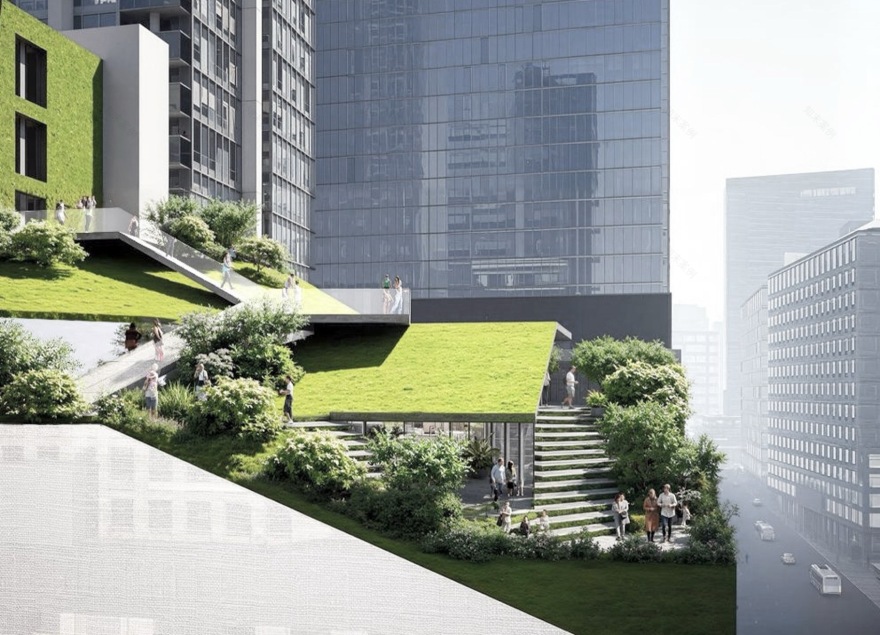
▼纽约时代广场43街改造效果图,Rendering of Times Square 43rd Street Renovation, New York ©Link-Arc建筑事务所

在跨文化的差异中穿梭,让我们在中、美之间的实践都得以保留一个相对冷静的距离去客观观察我们的实践对象。我们纽约、上海、深圳的同事也可以有更多相互学习的机会,更能在两个体系中寻找最有效、最令人振奋的路径,推动Link-Arc建筑事务所的设计工作不断进步,不辜负当初留学海外、创办事务所的理想与追求。
Navigating between cross-cultural differences allows us to maintain a relatively objective distance when observing our practice across both China and the U.S. This approach also provides our colleagues in New York, Shanghai, and Shenzhen more opportunities for mutual learning, enabling us to identify the most effective and inspiring paths within both systems. This, in turn, drives continuous progress in Link-Arc’s design work, staying true to the ideals and ambitions that inspired us to study abroad and establish the firm.
▼陆轶辰,Portrait of Lu Yichen ©陆轶辰










南京喵熊网络科技有限公司 苏ICP备18050492号-4知末 © 2018—2020 . All photos and trademark graphics are copyrighted by their owners.增值电信业务经营许可证(ICP)苏B2-20201444 苏公网安备 32011302321234号
苏公网安备 32011302321234号客服
消息
收藏
下载
最近