

创作上传
VIP
收藏下载
登录 | 注册有礼
查看完整案例

收藏

下载

分享

翻译
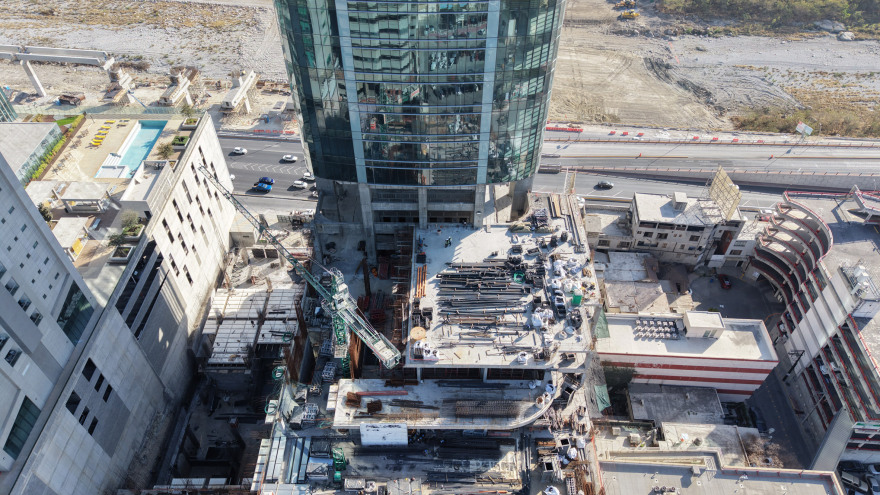
Images have revealed progress on the Torre Rise supertall skyscraper in Monterrey designed by Ancore Group, which will be the tallest building in Mexico and the second tallest in the Western Hemisphere when completed.
Torre Rise is currently around 300 metres high as it ascends towards its 484-metre (1,588-foot) final height, which would make it the tallest skyscraper in Latin America.
It will be the 13th-tallest building in the world upon completion, with only the 541-metre-high One World Trade Center in New York standing taller in the Western Hemisphere.
The rectilinear skyscraper is being developed by Nest and Ancore Group, with design by the later's in-house architecture department led by Mexican architect Esteban Ramos.
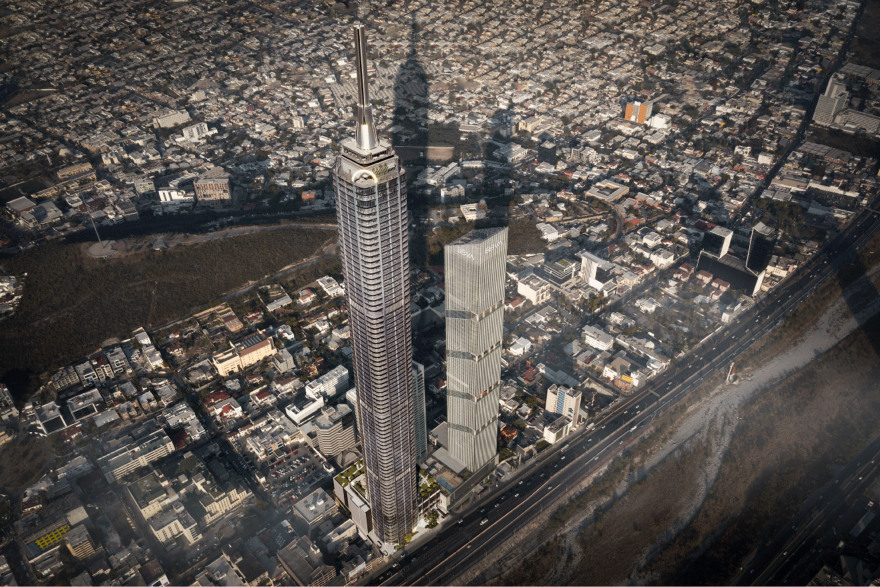
It is situated next to the tiered Torres Obispado skyscraper. Developed by the same consortium, Torre Obispado currently holds the title of tallest skyscraper in Latin America at 305.3 metres (1,002 ft).
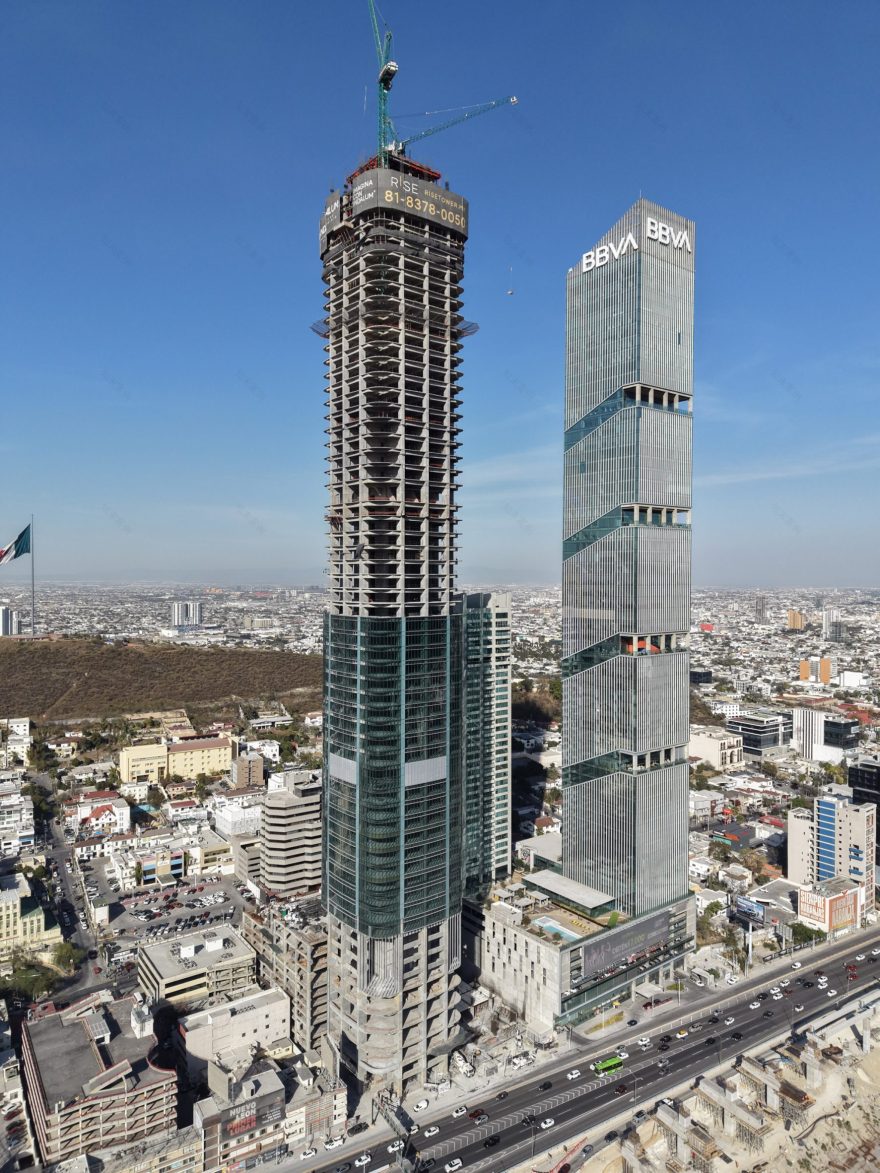
Torre Rise in Monterrey will be the tallest skyscraper in Mexico
Monterrey, in the northern Mexican state of Nuevo Leon, is known for its industry, and Nest told Dezeen its skyscraper construction signals a move towards high-density living in a country that is known for its sprawling metropolises.
"Torre Rise is a catalyst for urban regeneration," said the developer.
"It signals a shift toward high-density, sustainable growth in Monterrey, driving economic opportunity and city-center repopulation," it continued. "As the new tallest building in Latin America, it serves as a landmark of regional possibilities, proving that Mexican engineering and urban planning can compete on the global stage."
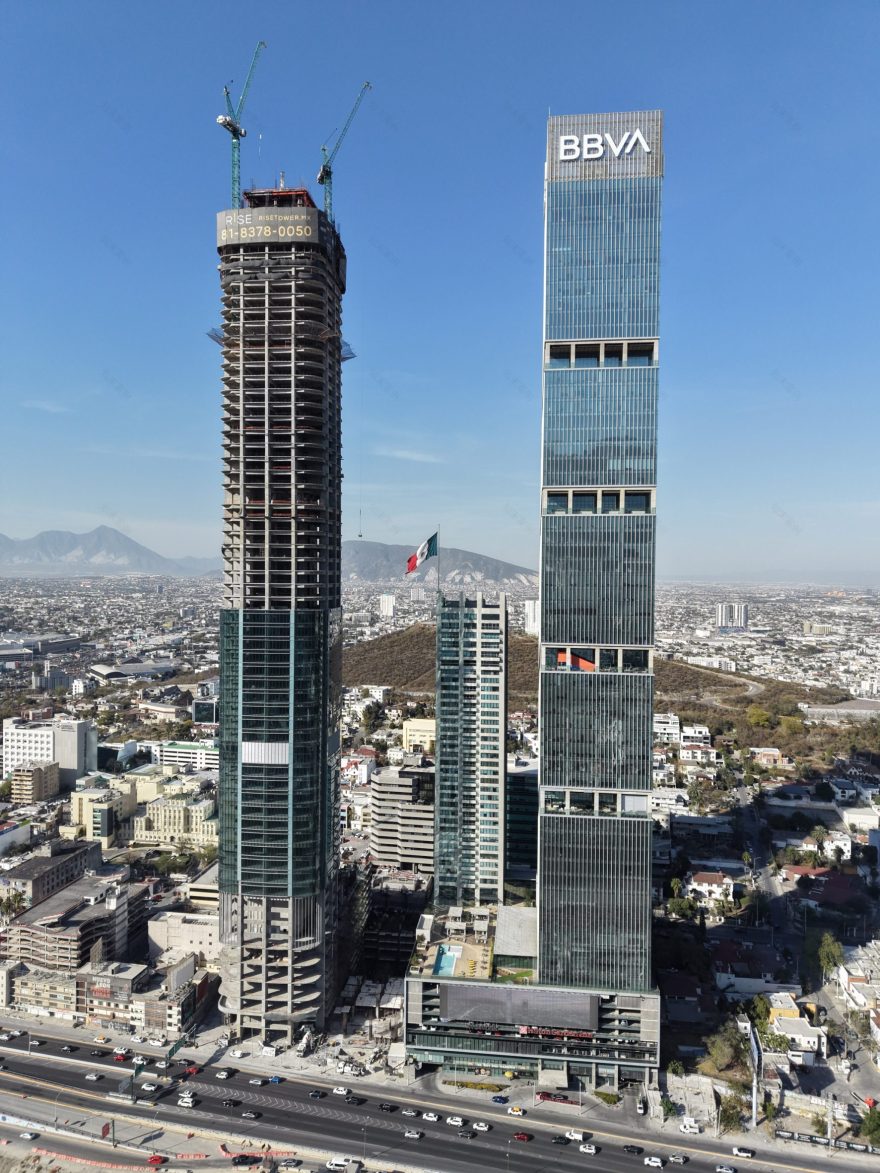
It is adjacent to Torres Obispado, the current tallest building in the country
The group said that creating the tallest building in Latin America was always the ambition, "though the scale of that ambition evolved".
Its original design was supposed to only rise 350 meters tall.
"Through seven years of architectural development, it evolved to its current 484-meter height, representing a 38 per cent increase from its initial concept," said the team.

Torre Rise features an aluminium-and-glass facade system
From a formal perspective, renderings of the skyscraper largely eschewed the smooth geometries utilised in recent Mexican skyscrapers, such as the Pelli Clarke & Partners-designed Mitikah skyscraper, the tallest in Mexico City.
Instead, the designers chose a more articulated, mid-century approach, with a unitized-aluminum curtain wall system that bears a striking resemblance to Torre Latinoamerica in Mexico City – the country's tallest skyscraper from 1956 until the 1980s.
Its sculptural bulkhead is more art deco than ultra-modern, with a thick spire that gives it additional height.
However, the current progress on the construction shows a far more glass-forward reality than the renderings.
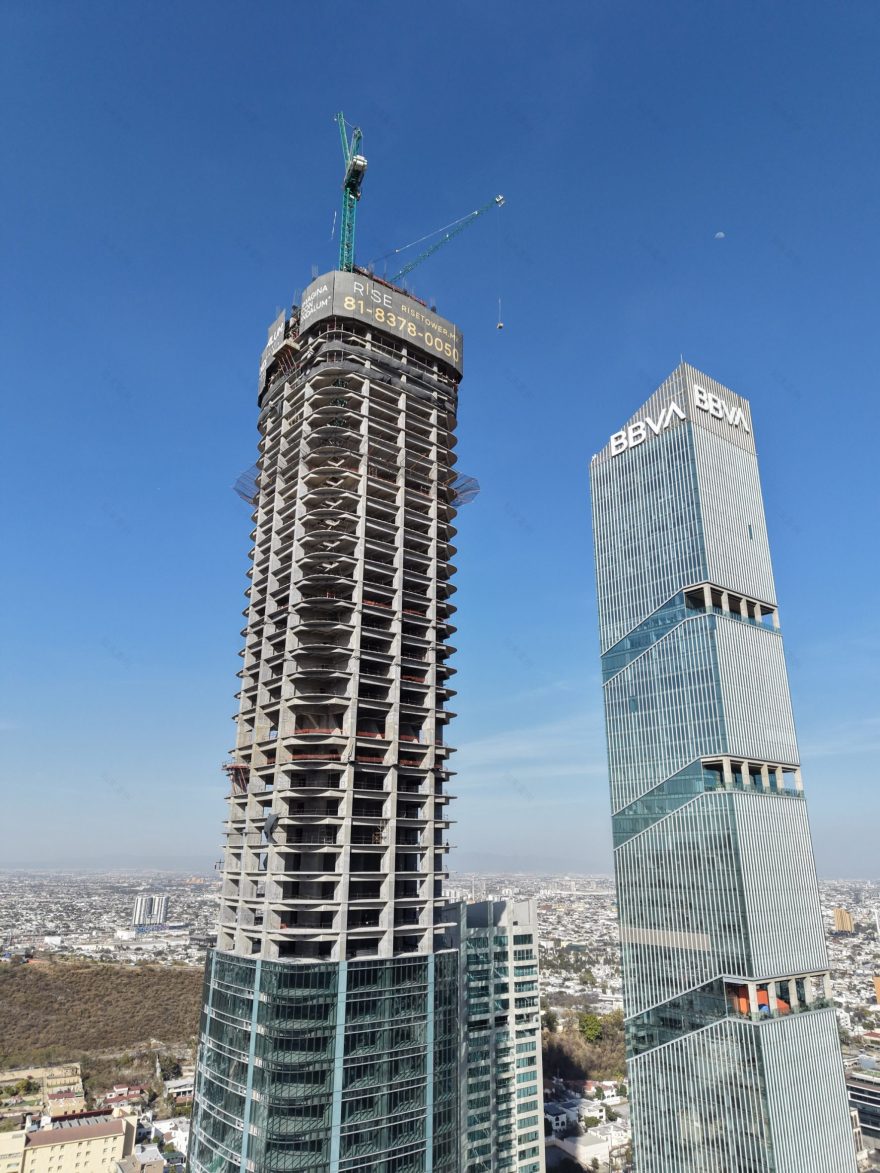
Torre Rise signals a move toward density in the region, according to its developers
For stability Forty piles were driven 15 metres into the ground. The structure features a massive base of a three-metre-thick reinforced slab.
Remarkably, the building does not feature any of the tuned-mass dampers typically utilised in a structure this height to act as a counterbalance for wind or seismic activity, a common occurrence in that part of the world.
Ancore Group highlighted the fact that 95 per cent of the glazing on the structure was sized to one specific dimension, calling it a "a remarkable feat of its engineering".
"By utilizing almost the full sheet of glass for each panel, the design maximizes manufacturing efficiency and significantly reduces material waste and costs," said the team.
Functionally, the building was designed to act as a "true mixed-use vertical city".
It will have residential, office, retail and hospitality elements strewn across its 99 floors. A mid-rise building the same level as the podiums will connect the skyscraper to the adjacent buildings and be topped with a rooftop park.
On top of Torre Rise will be an observation deck, which the developers expect will be a tourist draw, an almost-ubituquitous aspect of skyscraper building in the Americas.
Renderings show a sculptural metallic bulkhead
Foundations were poured for the building in September 2023, despite a delay due to flooding in the excavation site. As of early 2026, the building is just "days away" from surpassing Torre Obispado.
Though many of the tallest buildings in the Hemisphere are in the United States and Canada, with Canada's tallest topping out last week at 106 storeys, many Latin American countries are also building tall.
In Brazil, developers are working on a project to construct a 500-metre-tall tower, which would be the tallest in Latin America if completed.
Last year, Dezeen put together a list of some other recent skyscraper completions in the region.
南京喵熊网络科技有限公司 苏ICP备18050492号-4知末 © 2018—2020 . All photos and trademark graphics are copyrighted by their owners.增值电信业务经营许可证(ICP)苏B2-20201444 苏公网安备 32011302321234号
苏公网安备 32011302321234号客服
消息
收藏
下载
最近