

创作上传
VIP
收藏下载
登录 | 注册有礼
查看完整案例

收藏

下载

分享
果园与砖墙毗邻一座带教堂的墓地,一座历史小镇拥有一座美丽的市政厅。高大的树木环绕其间。随后,人们不禁思考“老年”这一现象——宁静、沉默,以及砖作为“家”的原型意象。医院与墓地的邻近或许会让人产生某些苦涩的联想;然而在这里,我们看到的却是一种品质,一种关于静谧与沉思的图景,一幅城市边缘安宁生活的画面。类似城堡般、对称且近乎古典主义的布局,将中庭、花园、景观视野以及充足的自然光引入这座养老之家。
An orchard and brick walls near a cemetery with a church, a historic town with a beautiful town hall. Tall trees. And then old age as a phenomenon—calm, silence, brick as the archetype of home. The proximity of the hospital and cemetery may invite bitter associations; here, however, we see quality, an image of quiet and contemplation, an image of the peaceful edge of town. A chateau-like, symmetrical, almost classicist layout brings atriums, gardens, views, and abundant daylight into the Home.
▼项目鸟瞰,Aerial view of the project ©Filip Šlapal


▼建筑与自然,Architecture and nature ©Filip Šlapal


老年 Old Age
老年是当今欧洲社会的重要议题之一。我们应当如何面对衰老?我们为老年人做些什么,我们如何看待他们,我们为他们提供什么——又对他们提出怎样的期待?在2026年的捷克共和国,成为一名老年人意味着什么?在设计过程之初,我们问自己:我们希望怎样度过自己的老年?我们又该如何将“家”的概念具象化?老年并不一定意味着负担或痛苦,它也可以是积极而充实的,在某种意义上依然充满生命力。它或许象征着(终于到来的)平静,也可能是一种解放。老年人可以反思生命的意义,有时间思考,并回顾人生。对于信仰者而言,死亡的临近甚至可能是一种解脱。
Old age is one of today’s European themes. How do we approach ageing? What do we do for older people, how do we perceive them, what do we offer them—and what do we ask of them? What is it like to be an elderly person in the Czech Republic in 2026? At the beginning of the design process, we asked ourselves: what kind of old age would we wish to live? How can we materialize the phenomenon of home? Old age does not have to be a burden or suffering; it can be active, full, and in a certain sense still vital. It may represent (finally) a calming down, or a liberation. An elderly person can reflect on the meaning of life, has time to think, and can take stock. For a believer, the nearness of death may even be a form of release.
▼建筑街景,Architecture street view©Filip Šlapal

一个有智慧的社会,不会把老年人视为需要怜悯、被安置起来并仅仅接受照料的无助躯体。在这样的社会中,老年能够带来智慧、宁静以及摆脱不必要事物的自由;它能够传递经验,并提供超越日常忙碌生活的视角。老年同样带来温情(例如孙辈),并以一种积极的方式让生活慢下来——我们这个匆忙的社会需要学会放慢节奏。老年人应当感到自己依然有价值,因为他们仍然拥有许多可以分享的东西。我们可以将老年视为自身的一面镜子,或是一次回到人生起点的旅程。儿童与老年人之间,其实有许多共同之处。
A wise society does not regard older people as helpless bodies to be pitied, stored away, and merely cared for. In such a society, old age can bring wisdom, peace, and freedom from unnecessary things; it can pass on experience and offer perspective beyond the bustle of everyday life. Old age also brings tenderness (grandchildren) and, in a positive sense, slows things down—our rushing society needs to calm itself. An elderly person should feel useful, for they still have much to offer. We may perceive old age as our mirror, or as a return to the beginning of our earthly journey. There is much in common between children and the elderly.
▼建筑立面,Building facade ©Filip Šlapal
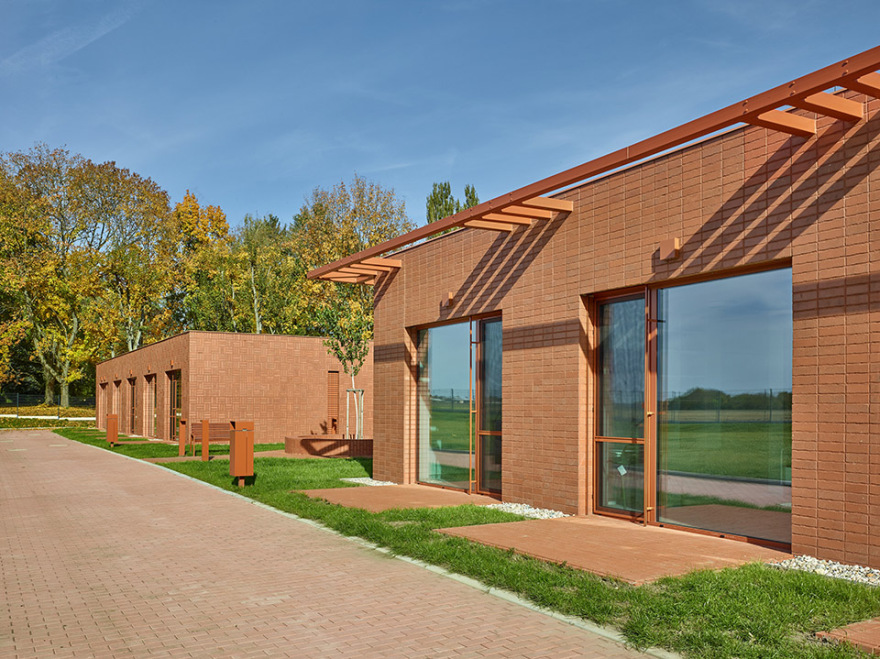


▼立面细节,Facadedetail©Filip Šlapal


无尽绿野中的红色线条
Red Line in Infinite Green
诺维比兹霍夫市(Nový Bydžov)提出的任务,是在医院旁一片旧果园的场地上设计一座老年之家。街道对面是一处带教堂的墓地,那里有优美的砖砌建筑,也是人们进入小镇时首先看到的景象。场地的静谧与象征意味,仅被一条道路稍稍打破;然而这条道路也带来了生活的活力——不仅有汽车,还有推着婴儿车的母亲、遛狗的人,以及匆匆赶路的行人。墓地与教堂格外醒目,充满象征意味,高大的树木与略带神秘的氛围营造出独特的场所感。砖墙绵延而低矮,而教堂塔楼则向上耸立。场地规模允许建造一座单层、大面积的建筑,同时也便于无障碍通行与步行活动。稍加想象,人们或许会说——是的,我会期待在这里看到一座老年之家。周边景观地势平坦,分布着森林与田野,长长的道路穿行其间。从视觉上看,这片景观十分优美,具有典型的“中波希米亚”风貌:远处的地平线上可以看到村庄的剪影。在这样的环境中,我们放置了一座单层建筑——仿佛一株五叶草,由四个生活单元围绕中央核心组织而成。它象征着四种元素,也象征四个基本方位,而建筑则沿着这些方向以正交方式布置。
The assignment of the Town of Nový Bydžov was to design a Home for Senior Citizens on the site of a former orchard adjacent to the hospital. Across the street lies a cemetery with a church, beautiful brick buildings, the first objects that one sees when arriving in the town. The silence and symbolic predestination of the place is slightly disturbed only by the road, which, however, brings the excitement of life—not only cars, but also mothers with strollers, people walking dogs, pedestrians hurrying to do their duties. The cemetery with the church is distinctive, symbolic, with huge trees and a magical atmosphere. The brick walls are long and low, while the church tower, on the other hand, points upwards. The size of the plot allowed for a single-storey, large-area building, which is also accessible and walkable. With a little imagination, one would say—yes, I would expect a home for senior citizens here. The surrounding landscape is flat, with forests and fields, with long roads running through them. It is visually beautiful, typical of “Central Bohemia” with horizons on which there are silhouettes of villages. In this environment, we place a one-story house, a kind of five-leaf clover formed by four households connected by a central core. A symbol of the four elements and also the four cardinal points, or the object is placed orthogonally in their directions.
▼草坪,Garden©Filip Šlapal


围绕内部中庭的居住单元概念
Concept of Households with Internal Atriums
空间方案的核心,是将整栋建筑划分为四个自给自足的群组——生活单元,总共可容纳约六十位住户。每个单元可容纳十五位住户及其所需的工作人员,并能够实现完全独立的运行。生活单元的设计避免形成漫长而线性的走廊。相反,通过围绕共享中庭布置房间,形成紧凑的空间组合,而公共走廊则环绕中庭展开。每个单元都设有技术用房和储藏空间、员工设施,以及一个可直接通往内部花园的公共活动区域。内部中庭的概念不仅为走廊提供了充足的自然采光,也创造了舒适宜人的室内空间。每个房间都设有一个带直接出入口的小型露台。各个生活单元拥有自己的带顶内部庭院,同时也可通向更大的公共花园,每两个单元共享一个花园空间。四个生活单元通过中央核心相互连接。房间按照同样的原则组合——围绕中央中庭的外围布置。内部中庭在空间概念中起着重要作用:空间与花园形成视觉联系,室内环境通透、明亮,并与自然保持接触。通过建筑南侧的中央入口进入后,访客来到一个宽敞的大厅,在这里可以看到主要的椭圆形中庭。接待台位于此处,访客从这里前往四个不同的生活单元。接待区周围还设有等候空间,并与中央中庭直接相连。整座建筑为单层结构,可以绕行其间——步行本身正是设计意图的一部分,人们在充满自然光的室内空间中行走。
▼概念生成,Concept generation ©Architektura

▼方形中庭,Square atrium ©Filip Šlapal


▼椭圆中庭,Elliptical atrium ©Filip Šlapal

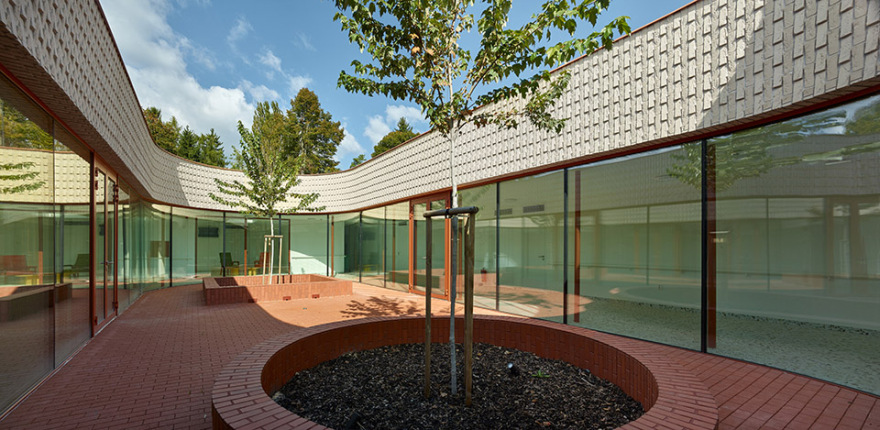
▼中庭细节,Atrium detail©Filip Šlapal


▼环绕中庭的公共空间,The public space surrounding the atrium ©Filip Šlapal


砖、花与光
Bricks, Flowers and Light
砖砌立面可视为对墓地围墙的一种回应;其几何秩序通过简洁的法式落地窗节奏得到强调,这些窗户为住户提供了直接通往露台的通道。窗洞在这面墙体中如同象征性的开口。不同形式的窗户遮阳构件强化了各个生活单元的个性。例如,西南侧单元在檐口高度设置了矩形钢结构遮阳,而东北侧则采用倾斜结构,象征屋顶的形态。西北侧则不受直射阳光影响,因此外立面没有设置遮挑或遮阳。砖立面还拥有四种不同的砌筑图案,这些图案同样延续到室内——体现在次级接待空间以及浴室中的拼接细部。通过这一原则,每一个“家”(即生活单元)都拥有独特的身份。室内主要以砖材构成,并配以大量白色元素,使空间更加明亮。地面设计也十分独特——设计团队将当地花卉与草本植物的照片扫描并转化为地面图案。这也成为引导这座规模较大的建筑空间的方式。因此四个生活单元分别被命名为:Travinová(草之家)、Černýšová(巴氏草之家)、Heřmánková(洋甘菊之家)以及 Pampelišková(蒲公英之家)。地面图案在房间入口处延伸上墙,自然花卉的纹样宛如绘画般呈现。
Brick facades are an analogy to cemetery walls; their geometry is emphasized by the simple rhythm of French windows that provide clients with direct access to the terrace. The windows are symbolic openings in this wall. Different window shading supports the individual character of each household. For example, the southwestern household has rectangular steel structures at the level of the cornice, while the northeastern one has sloping ones, symbolizing roofs. The northwest part is not exposed to direct sunlight, here the exterior is designed without overlap and shading. The brick facade also has four different patterns that are also reflected in the interior—in secondary receptions and in the joint cutting in the bathrooms. This principle also creates the uniqueness of each “home” alias household. The interior is made of bricks, contains a lot of white, which further illuminates it. The floors are characteristic—custom-made photos of local flowers and grasses were scanned and transferred to the flooring. This is also the guiding principle of the relatively large building. So there are households: Travinová (Grass House), Černýšová (Bartsia House), Heřmánková (Chamomile House), and Pampelišková (Dandelion House). The flooring is pulled up at the entrances to the rooms, and natural floral patterns form paintings.
▼面向室外的厨房,A kitchen facing the outside ©Filip Šlapal


▼面向中庭的厨房,A kitchen facing the atrium ©Filip Šlapal


▼居住单元,Unit ©Filip Šlapal

▼室内细节,Interior detail ©Filip Šlapal


▼祷告空间,Prayer Space ©Filip Šlapal

这座建筑的诞生,得益于投资方——诺维比兹霍夫市政府——超出常规的开放态度,以及他们对建筑师创造一座卓越养老之家的信任。这是一种相互合作、不断交流观点的过程,双方都愿意倾听并在必要时作出调整(有些内容在实施过程中与最初设计有所不同)。项目工程团队在整个过程中也始终以专业与耐心作为合作伙伴。最终,这座高品质的建筑得以实现,也离不开施工方所展现出的非同寻常的细致、经验与理解。
The house is the result of the above-standard approach of the investor, the Town of Nový Bydžov, its trust in the architects’ efforts to create an exceptional senior home. It was a mutual cooperation and constructive exchange of views, where both parties listened and were willing to change (some things were implemented differently than they were designed). The project engineers were also professional and patient partners throughout the entire process. A house of this quality was ultimately created thanks to the contractor’s unusual care, experience, and understanding.
▼夜景,night view ©Filip Šlapal

▼项目区位图,Site plan ©Architektura

▼平面图,Plan ©Architektura
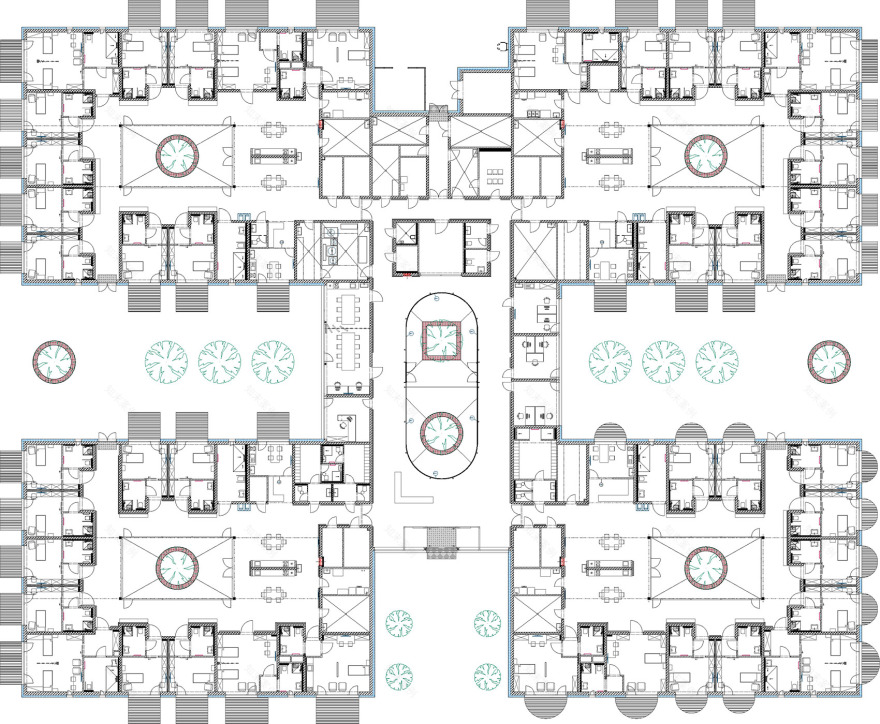
▼立面图,Elevation©Architektura


▼剖面图,Section©Architektura

Studio:Architektura
Author:David Kraus
kraus@archi.cz
Studio address:V korytech 169/11, 106 00 Prague 10 – Záběhlice, Czech Republic
Co-author:Alina Fornaleva [study phase, interior cooperation]
Project location:V aleji, 504 01 Nový Bydžov
Project country:Czech Republic
Project year: 2021
Completion year: 2025
Gross floor area: 3 331m²
Usable floor area: 2 910m²
Plot size:46 000m²
Cost:8,47M €
Client:Town of Nový Bydžov
mesto@novybydzov.cz
Photographer:Filip Šlapal, info@filipslapal.cz
Collaborators and suppliers:Project engineer: Projecticon [Pavel Ježek, Jindřich Pavlík], Wayfinding: Architektura [Zdeněk Dohnálek], RAKOWSKI & CO., Investor’s technical supervision: Jiří Pilský, General supplier: UNISTAV CONSTRUCTION, Furniture supplier: Dřevotvar, Window supplier: Glamet, Kitchen supplier: ADI Interiér
Materials: household reception – brick, main reception – glass bricks, kitchenettes – colored laminate, facade – brick cladding, aluminum windows, triple glazing, ceramics – tiles, sanitary facilities cladding, gypsum interior plasters, paved areas around the building – red concrete blocks, locksmith exterior structures, color unification of the building – outdoor lighting, trash cans, exterior furniture, windows, etc. (RAL 8004 – dark brick red)
Products and Brands: floors — Forbo, bricks — Beleta



南京喵熊网络科技有限公司 苏ICP备18050492号-4知末 © 2018—2020 . All photos and trademark graphics are copyrighted by their owners.增值电信业务经营许可证(ICP)苏B2-20201444 苏公网安备 32011302321234号
苏公网安备 32011302321234号客服
消息
收藏
下载
最近