

创作上传
VIP
收藏下载
登录 | 注册有礼
查看完整案例

收藏

下载

分享
Casa Daia度假住宅于2025年在巴西塞阿拉州西海岸Barra dos Remédios开放,坐落于一处偏远且生态敏感的场地之中。项目旨在推动再生型旅游、文化沉浸以及人与土地和当地社区之间更具意义的联系。同时,它也是工业化木结构在酒店建筑领域应用的重要案例研究。精品酒店位于一片约220公顷的旧农场上,与多样生态系统共存——红树林、沙丘、河岸、卡廷加植被以及沿海森林交织形成复杂的景观层次。
Embedded in a remote and environmentally sensitive site in Barra dos Remédios, on the western coast of Ceará, Casa Daia opened in 2025 with the purpose of promoting regenerative tourism, cultural immersion, and a meaningful relationship with the territory and its local community. The project stands as a relevant case study for the application of industrialized timber construction within the field of hospitality. Set on a former farm of approximately 220 hectares, the boutique hotel coexists with diverse ecosystems – mangroves, dunes, riverbanks, caatinga vegetation and coastal forest – forming a complex overlap of landscapes.
▼场地与项目鸟瞰,aerial view of the project and the site © Victor Collor

在这一背景下,UNA barbara e valentim开发的模块化木结构建筑探索了应对地理偏远、物流复杂、生态脆弱以及施工精度要求的策略,同时提升整体空间、环境与材料品质。
Within this context, the modular timber architecture developed by UNA barbara e valentim investigates strategies capable of responding to geographic remoteness, logistical complexity, territorial fragility and the demand for construction precision, while enhancing the spatial, environmental and material quality of the ensemble.
▼外观概览,overall of the house © Victor Collor

▼客房卧室,bedroom © Victor Collor

建筑设计
The architecture
四栋平房单体面积约90平方米,以低干预的方式嵌入场地。模块单元被谨慎地安置在现有空地中,避免清除原生植被。浅基础与抬升式平台的使用减少了对地面的直接干扰,并保持土地的自然渗透性。建筑体量的布置通过太阳方位与主导风向研究确定,以实现自然的交叉通风和热舒适,而无需依赖机械系统。阳台、宽大的挑檐以及受到保护的大开口使室内与景观之间形成连续关系,让气候与自然光成为塑造空间体验的重要因素。
The four bungalows, each approximately 90 m?, constitute a low-impact intervention within the territory. The modular units were carefully positioned in existing clearings, avoiding the removal of native vegetation. The adoption of shallow foundations and elevated decks minimizes direct interference with the soil and preserves the land’s natural permeability. Studies of solar orientation and prevailing winds guided the placement of the volumes, ensuring cross ventilation and thermal comfort without reliance on mechanical systems. Verandas, generous overhangs, and large protected openings establish a continuous relationship between interior and landscape, allowing climate and natural light to become structuring elements of the spatial experience.
▼住宅远观,exterior view at distance © Victor Collor


▼外观,exterior view © Victor Collor


▼立面局部,facade © Victor Collor


Modular BV:建造体系
Modular BV: the construction system
这些平房采用Modular BV系统建造。该系统由UNA barbara e valentim与巴西工程木材制造商Crosslam合作开发,并由Abaté Construtora e Incorporadora在现场组装。系统基于由再造桉木CLT(交叉层压木材)制成的预制模块,在工厂受控环境中生产,并在现场进行干式装配。像Casa Daia这样的项目再次证明了该系统在偏远或生态敏感地区开发中的价值,在这些地区,成本、时间和环境影响的可预见性尤为关键。与传统高端建筑方式相比,模块化木结构施工能够减少建筑废料、提高过程控制,并显著缩短建造周期。
The bungalows were built using the Modular BV system, developed by UNA barbara e valentim in partnership with the Brazilian engineered timber manufacturer Crosslam and assembled on site by the contractor Abaté Construtora e Incorporadora. The system is based on prefabricated modules in reforested eucalyptus CLT, produced in a controlled factory environment and dry-assembled on site. A project such as Casa Daia reaffirms the relevance of this system for developments located in remote or environmentally sensitive areas, where predictability in costs, timelines and environmental impact becomes decisive. Compared to traditional high-end construction methods, modular timber assembly reduces waste, increases process control and significantly shortens implementation time.
▼户外休闲平台,outdoor terrace © Victor Collor
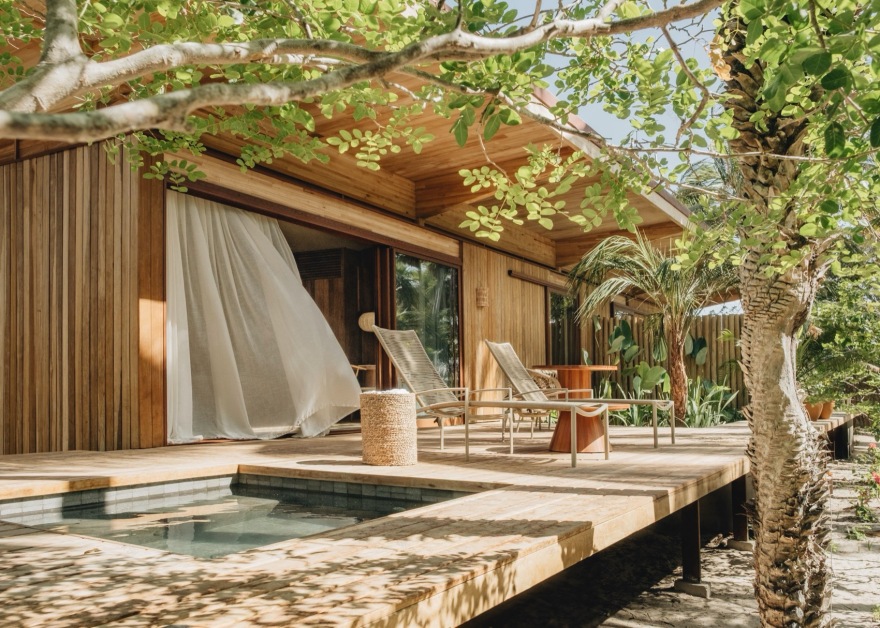
▼泳池平台,pool deck © Victor Collor


▼细部,details © Victor Collor

通过将建筑设计与工业化精度结合,这一系统挑战了“预制化必然限制设计品质”的观念。相反,它提出一种模式:技术为建筑意图服务,而非取而代之。在Casa Daia项目中,模块化木结构成为当代建筑的一种有效工具——对场地环境、物流条件与文化背景的综合回应。Casa Daia是Modular BV系统建成的第二个项目。第一个案例是位于巴伊亚州南海岸的Modular Bahia独栋住宅,该系统在住宅环境中得到应用,通过独立木结构、CLT围护以及强调交叉通风、遮阳和景观融合的生物气候策略,实现了空间与环境的协调。
By associating architectural authorship with industrial precision, the system challenges the notion that prefabrication inherently limits design quality. On the contrary, it proposes a model in which technology supports architectural intention rather than replacing it. At Casa Daia, modular timber construction establishes itself as an effective tool for contemporary architecture – an integrated response to the environmental, logistical and cultural conditions of the site. Casa Daia is the second built example using the Modular BV system. The first was Modular Bahia, a single-family residence on the southern coast of Bahia, where the system was applied in a residential context, combining an independent timber structure, CLT enclosures and bioclimatic strategies focused on cross ventilation, shading and integration with the landscape.
▼卧室,bedroom © Victor Collor

▼由卧室看露台,
viewing the terrace from the bedroom © Victor Collor

▼卧室一角,corner of the bedroom © Victor Collor

景观与社区影响
Impact on landscape and community
Casa Daia度假屋的选址源于对Barra dos Remédios生态独特性的认识。这里多种生态系统与传统生活方式并存,在经历时间变迁的景观中仍保持着罕见的共存状态。因此,在任何建设开始之前,项目就进行了广泛的环境分区研究,并遵循再生型旅游的原则:最小化干预、融入景观、尊重地方文化以及顺应土地自身的时间节奏。建筑成为对这些条件的回应——以精准的方式嵌入场地,避免砍伐植被并减少对土壤的影响。
The siting of the bungalows at Casa Daia stems from the recognition of the environmental singularity of Barra dos Remédios, where a rare coexistence persists betweenmultiple ecosystems and traditional ways of life within a landscape that has withstood the passage of time. For this reason, even before any construction began, an extensive environmental zoning study was carried out, in alignment with the principles of regenerative tourism: minimal impact, integration with the landscape, appreciation of local culture, and respect for the time of the land. Architecture becomes a response to these conditions – conceived as a precise insertion that avoids vegetation removal and reduces soil interference.
▼独特生态环境,the environmental singularity of Barra dos Remédios © Victor Collor


项目还与周边社区如Pescada Nova和Praia Nova保持持续互动,优先使用当地劳动力,支持社会项目,并采用多种低影响实践,包括雨水收集、光伏能源、废弃物管理、农林复合系统以及减少一次性塑料使用。在一个经历深刻环境与社会变化的时代背景下,Casa Daia为当代旅游提供了一种敏感而具体的替代路径——在这里,建筑、景观与社区被组织为一种连续的关系。
The project maintains an ongoing dialogue with neighboring communities such as Pescada Nova and Praia Nova, prioritizing local labor, supporting social initiatives, and adopting low-impact practices including rainwater harvesting, photovoltaic energy, waste management, agroforestry, and the reduction of disposable plastics. In a context marked by profound environmental and social transformations, Casa Daia positions itself as a sensitive and tangible alternative for contemporary tourism – one in which architecture, landscape, and community are articulated in a relationship of continuity.
▼生态环境,ecological environment © Victor Collor

▼总平面图,site plan ©UNA barbara e valentim

▼平面图,plan ©UNA barbara e valentim

▼剖面图,section ©UNA barbara e valentim

Location Barra dos Remédios – Barroquinha, Ceará, Brazil Project completion 2025
Architecture UNA barbara e valentim
Authors Fernanda Barbara, Fabio Valentim
Team Breno Sá Leitão, Rodrigo Carvalho, Camila Ungaro, Luís Cunha, Mariana Nunes
Engineered timber supplier Crosslam
Construction Abaté Construtora e Incorporadora
Interior design MNMA Studio
Built area – bungalows 4 bungalows of 90 m? each – 360 m? total
Site area 220 hectares
Photography Victor Collor







南京喵熊网络科技有限公司 苏ICP备18050492号-4知末 © 2018—2020 . All photos and trademark graphics are copyrighted by their owners.增值电信业务经营许可证(ICP)苏B2-20201444 苏公网安备 32011302321234号
苏公网安备 32011302321234号客服
消息
收藏
下载
最近