

创作上传
VIP
收藏下载
登录 | 注册有礼
查看完整案例

收藏

下载

分享
中国·株洲,清水塘工业区。新中国成立后,凭借独特的交通优势,这里被列为国家重点建设的工业基地。从1956年株洲冶炼厂动工开始,短短十几年间,在15.15平方公里的土地上,聚集了261家冶炼、化工企业。然而,进入21世纪后,由于环境治理的需要,这片曾经沸腾的工业区全部关停,陷入了长久的沉寂。
© 陈逸帆
Qingshuitang industrial site, City of Zhuzhou, China. After the founding of the People’s Republic of China, Qingshuitang was designated a key national industrial base thanks to its unique transportation advantages(located in the center of China). Starting with the construction of the Zhuzhou Smelter in 1956, within just over a decade, 261 smelting and chemical enterprises had gathered on this 15.15 square kilometer land. However, after entering the 21st century, due to the need for environmental protection requirements, this once-bustling industrial zone was completely shut down and fell into long-term silence.
▼项目概览,Overview of the project© 陈逸帆

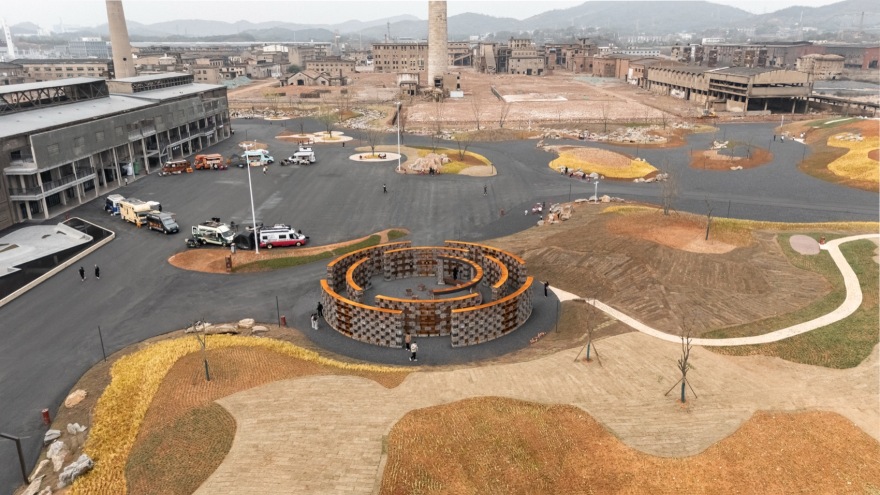
▼顶视,Top view© 陈逸帆

2026年2月,一座名为“废土·回声”的声音博物馆在这片沉寂多年的老工业区落成。它没有传统博物馆的白色方盒与玻璃展柜——它是一座从废墟中直接生长的建筑,一座用老厂房的每一块废弃砖瓦构筑而成的开放式声音博物馆,是一个可供所有人进入、聆听、讲述的城市公共场域。▼厂区内圆形构筑物,Circulaire Structure© 壹外建筑

In February 2026, the “Echo of the ruins” Sound Museum was completed in Qingshuitan—this old industrial area which had lain silent for years. Free from the white cubes and glass display cases of traditional exhibition space. Instead, it is a structure that grows directly from the ruins, an open-air Museum built from every discarded brick and tile of the old factory buildings. It is an urban public space open to all, a place where people can enter, listen, and share their stories.
▼鸟瞰,Aerial view© 陈逸帆

设计缘起:在图像中凝视清水塘
Inspiration: Gazing at Qingshuitang Through Images
方案设计之初,我们将清水塘的现状照片与黑白老照片挂满了工作室的四面墙壁。一边是烟囱林立、机器轰鸣的辉煌岁月,一边是厂房空置、砖石散落的沉寂废墟。在长达数周的时间里,我们反复面对这些图像,凝视、思考、讨论,试图从这片土地的过去与现在之间,找到那个可以连接二者的锚点。
▼在图像中凝视清水塘的变化,Gazing at the changes in the Qingshuiting in the image © 壹外建筑
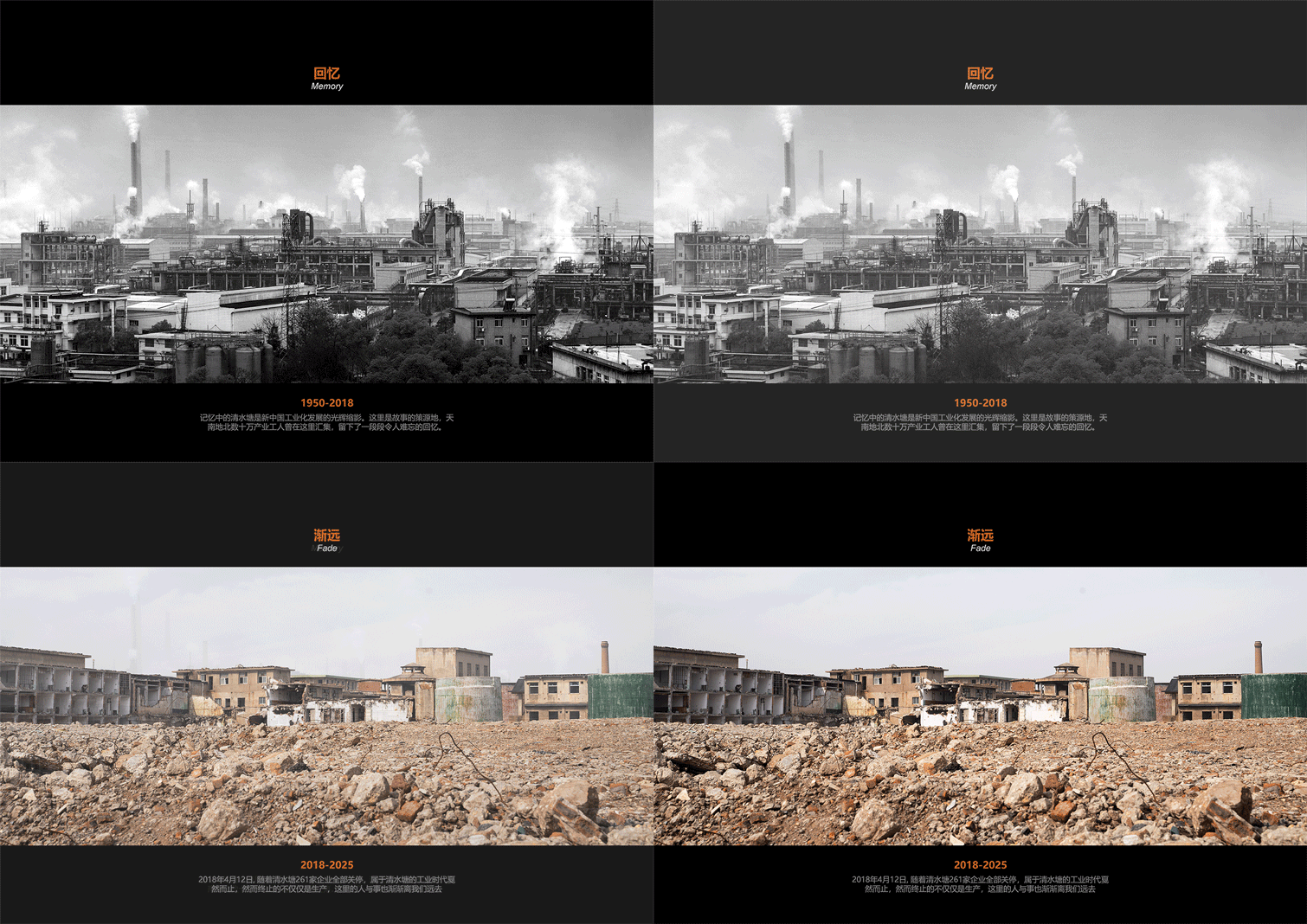
At the initial stage of the design, we covered the four walls of our studio with current photographs of Qingshuitang alongside black-and-white archival images. On one side, we saw its glorious past: towering chimneys, roaring machinery of the industrial era. On the other, we faced its silent present: vacant factories and quiet ruins. For weeks, we returned to these images again and again — gazing, reflecting, debating — looking for an anchor that could connect the land’s past and present.
▼外立面与环境的对话,Dialogue between the exterior facade and the environment © 陈逸帆

▼空间入口,Entrance© 陈逸帆

在这持续的凝视中,两条设计思路逐渐清晰:其一,是以“废土”作为方案的核心设计元素。清水塘最打动我们的,不仅仅是那些已被列为文保单位的标志性建筑,那些散落满地的废弃砖块与瓦砾也同样动人——它们数量庞大,形态各异,每一块都带着数十年工业烟尘熏染的痕迹。我们决定,让这些被遗忘的材料重新成为空间的主角。其二,是对清水塘工业历史的猎奇心理。作为一个外来者团队,我们对这片土地的历史充满好奇——那些高炉旁发生过什么?那些车间里回荡过怎样的声音?那些在此度过青春的人们,如今去了哪里?我们相信,这样的猎奇心理并非我们独有,对大多数进入这片场地的人而言,同样存在一个渴望:想知道这里曾经发生过什么。因此,我们将项目定位为一个历史的讲述者,一个可供人们挖掘历史故事的平台。而让这个平台真正建立起来的,正是那些来自废墟的材料——它们本身就是历史最诚实的见证者。
▼在废土中重拾历史,Rediscovering History in the Wasteland © 壹外建筑

Through this sustained contemplation, two design directions gradually came into focus: The first was to embrace “ruins” as the core design element of the project. What moved us most about Qingshuitang was not only its landmark buildings, which now protected as cultural heritage, but also the countless discarded bricks and fragments scattered across the ground — each bearing traces of industrial memory. We decided to let these forgotten materials once again become the main actor of the space. The second was our curiosity about Qingshuitang’s industrial history. As an outsider team, we were deeply curious about the stories of this land—what happened inside those factories? What sounds once echoed through those workshops? Where are the people who spent their youth here? We believe such curiosity is not ours alone; for most who enter this site, they have the same desire: to know what once took place here. This is why we positioned the project as a storyteller of history, a platform where people can uncover historical narratives. And what truly brings this platform to life are precisely those materials from the ruins—they are the most honest witnesses of history.
▼进入回声广场,Enter Echo Square© 陈逸帆

旧物新生:浸润在材料里的时光
Revival of Ruins: Time Embodied Within
“废土”——这个带着衰败意味的词,恰恰成为我们思考的起点。如果将这些废墟视为需要清运的垃圾,那么清水塘的记忆也将随之消失。但如果换一个视角:厂区内每一块废弃的砖块、每一片破碎的瓦砾,都是经过时间筛选的独特存在——它们承载着数十年的工业烟尘,镌刻着风雨侵蚀的痕迹,记录着这片土地的全部历史。它们反而是最珍贵的地方材料,是这片土地留给历史最诚实的馈赠。我们从清水塘的废墟中,一块一块地拾起那些散落的砖块、瓦片、混凝土碎块。它们有的完整,有的残缺,有的表面带着烟熏火燎的黑色痕迹,有的棱角已被岁月磨圆。每一块都有自己的来历,每一块都无法被复制。如何将这些形状不一、质地各异的材料,重新构筑为稳定的建筑体量?我们选择了格宾石笼网作为基本的单元模具。这一源自水利工程的建造技术,原本用于河道护坡——将石块填入金属网箱,形成既透水又稳固的结构。在“废土·回声”中,我们将清水塘的废弃砖瓦填入格宾石笼,层层垒叠,构筑成空间的主体墙体。
“Ruins”—a word tinged with decay—became precisely the starting point of our thinking. If these ruins were viewed merely as debris to be cleared away, then the memory of Qingshuitang would vanish along with them. But if we shift our perspective: every discarded brick, every fragment of rubble is a unique entity refined by time—they carry decades of industrial memory, and record the complete history of this land. They are, instead, the most precious local materials, the most honest gift this land has left to history. From the ruins of Qingshuitang, we picked up scattered bricks, tiles, and concrete fragments, one by one. Some are intact, Some are incomplete. Each piece has its own origin; each piece is irreplaceable. How could these materials be reconstructed into a stable architectural volume? We chose gabion mesh cages as the basic modular unit. This construction technique, originating from hydraulic engineering, was originally used for riverbank protection—filling stone into metal cages to form structures that are both permeable and stable. In this project, we filled the gabions with discarded bricks and tiles from Qingshuitang, stacking them layer by layer to form the main walls.
▼由遗存材质组成的弧形结构,The arc-shaped structure composed of the remaining materials © 陈逸帆


这一策略带来了多重价值:历史感的直接传递:砖瓦未被破碎,未被覆盖,未被加工成面目全非的新材料。它们以最原始的状态呈现——每一块砖的色泽、纹理、残缺,都清晰可见。参观者可以伸手触摸那些粗粝的表面,历史不再是文字记载或影像资料,而是可感知、可触摸的物质存在。建造的快速与简洁:格宾石笼网可在现场快速组装,填充物料后层层固定,无需复杂的砌筑工艺,无需漫长的养护周期。整个项目的建造在半年内完成,实现了从废墟到空间的快速转化。
This strategy brought multiple values: The presence of history: The bricks and tiles are not crushed, not covered. They are presented in their most original state—the color, texture, and imperfections of each brick are clearly visible. Visitors can reach out and touch those rough surfaces; history is no longer just written records or visual materials, but a perceptible, tangible physical presence. Speed and simplicity of construction: The gabion mesh cages can be quickly assembled on site, filled with materials, and fixed layer by layer—requiring no complex techniques or long period. The entire construction was completed within six months, achieving a rapid transformation from ruins to space.
▼格宾石笼网,gabion mesh cages © 陈逸帆

▼废土立面细节,Details of the wasteland facade © 陈逸帆

用“废土”搭建主体结构,使其在物质性上呈现历史感——这是让建筑成为历史讲述者的第一步,也是让清水塘的“废土气质”得以低调转译的关键。
Using “ruins” to construct the main structure of the museum, allowing history to manifest in its materiality — this is the first step in making architecture a storyteller of history.
▼光线从砖石缝隙洒落,Light spills through the cracks in the bricks and stones. © 陈逸帆

“环环”相扣:空间里的回声与对话
Interlocking Circles: Echoes and Dialogues in Space
展览空间的整体形态采用同心圆放射结构,一组组由格宾石笼墙体构成的环形序列,从中心向四周扩散。这一几何原型的选定,源于两重考量:
The museum adopts a concentric radial structure. A series of circular sequences formed by gabion walls radiate outward from the center. The selection of this geometric prototype is based on two considerations:
▼回声的走廊,The corridor of echoes © 陈逸帆
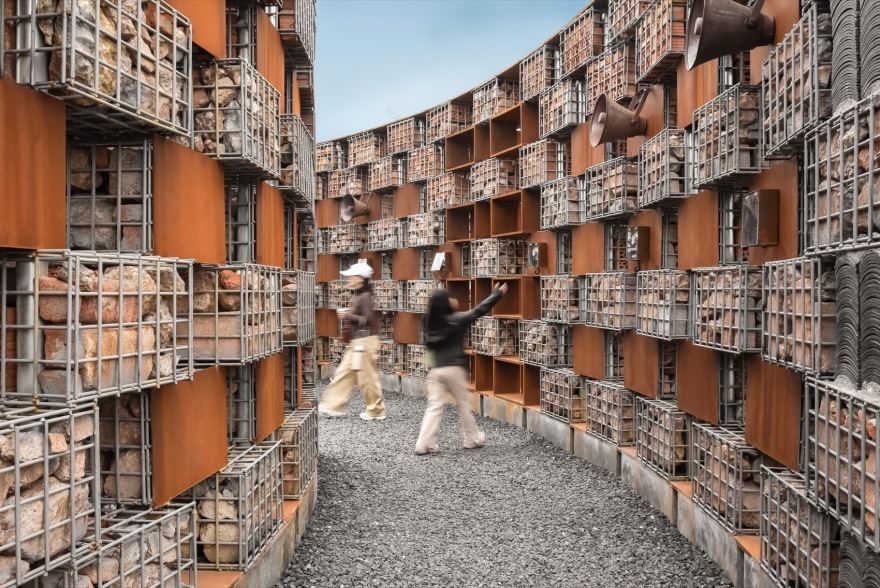
▼回声广场,Echo square© 陈逸帆

其一,是对“回声”主题的形态呼应。同心圆如同声波在水面泛起的涟漪,将声音传播的物理形态转化为可进入的空间体验。当声音在环形墙体间回荡,形态与功能在此达成一致。其二,是对场地肌理的对话与借力。清水塘厂区内遗存着大量圆形肌理——圆形储罐的基座、圆形烟囱、圆形的运输管道。同心圆结构的介入,并非强加一套新的几何秩序,而是对场地既有语言的延续与放大。新空间由此自然地融入工业遗址的空间特质,成为场地的一部分,而非外来的闯入者。这一结构,让后续的体验环节有序铺展,同时在视觉上赋予鲜明的整体性与韵律感。当观众穿行于环形通道之间,墙体时而收窄、时而放开,光线从砖石缝隙洒落,沉浸感随着步伐逐渐加深。
▼记忆的回声波,Echoes of Memory© 壹外建筑

Firstly, it is a formal response to the theme of “Echo”. Concentric circles resemble ripples spreading across water, translating the physical form of sound propagation into an immersive spatial experience. Second, it engages with the existing site context. Qingshuitang site retains abundant circular elements: the base of round storage tanks, circular chimneys, and cylindrical pipelines. The introduction of the cirlular structure does not impose a new geometric order, but continues the site’s inherent language. The intervention thus blends naturally into the industrial heritage, becoming part of the site rather than an external intrusion. This structure organizes the visiting sequence in order. As visitors walk through the circular passages, the walls narrow and expand alternately; light filters through the gaps between bricks and stones, and the sense of immersion experience deepens with each step.
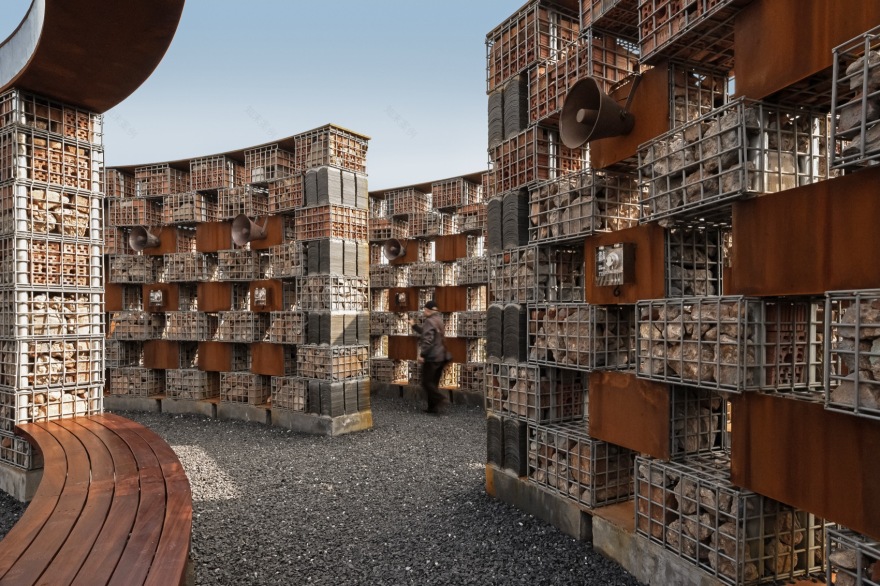
▼环环相扣 层层展开的空间,Interlocking and unfolding layer by layer space © 陈逸帆
以声音为媒介:在互动中让记忆流转
Sound as Medium: Where Memories Flow Through Interaction
用“废土”搭建主体结构,让建筑成为历史的讲述者——这是第一步。第二步,是让历史真正“活起来”。我们引入了声音元素,在同心圆结构中铺展三大核心“回声”体验,让人们从被动的观看者,转变为主动的参与者与记录者。▼用声音留下清水塘的记忆与故事,Leave behind the memories and stories of Qingshuitang through sound © 壹外建筑

Using “ruins” to form the main structure and letting architecture become the storyteller of history is only the first step. The second step is to truly bring history to life. We introduced sound as a medium, unfolding three “echo” experiences within the concentric structure, transforming people from passive viewers into active participants and recorders.
▼聆听故事的成年人,Adults who listen to stories © 陈逸帆
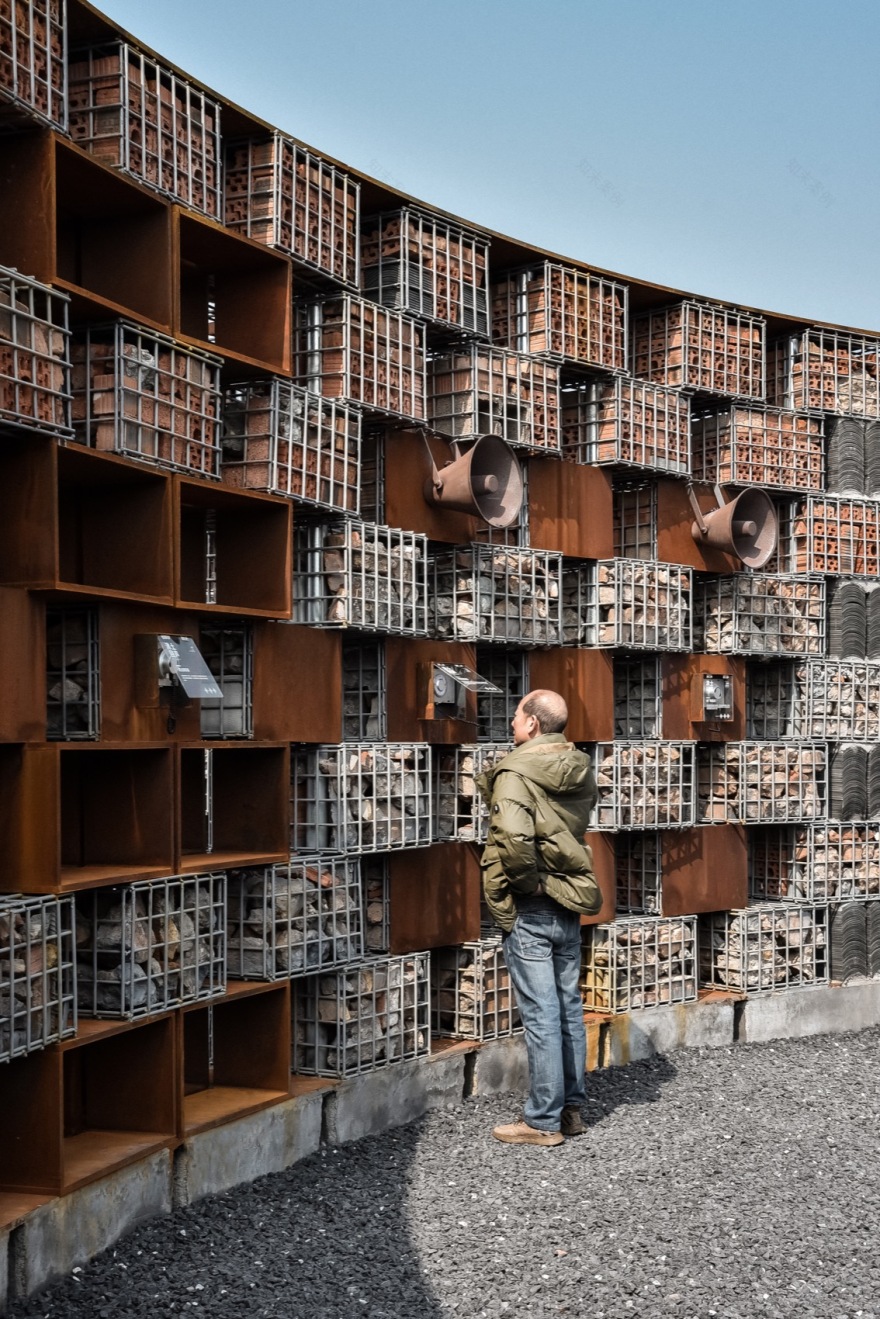
一、听故事:记忆的存储与回放
在环形墙体的内侧,嵌入了20组定向音响。它们循环播放着清水塘老工人、原住民及新一代株洲人的口述史——那些关于炉火温度的记忆、关于搬迁时刻的不舍、关于对未来期待的声音。参观者也可通过放置的40组磁吸式耳机,细致聆听那些带着时代温度的场所记忆。在聆听历史的同时,身后是填满废弃砖瓦的石笼墙,每一块砖都曾是某座厂房的一部分——它们成为这些声音最真实的背景。
I. Listening to Stories: Storage and Playback of Memories
Embedded inside the circular walls are 20 groups of speakers. They play oral recod from former workers, original residents, and young people of Zhuzhou city. Visitors can also listen closely to these memories through 40 sets of magnetic headphones. As they listen to history, what behind them is the gabion walls filled with discarded bricks and tiles—each brick was once part of some factory building, becoming the most authentic backdrop for these voices.
▼聆听故事的儿童,Children who listen to stories © 陈逸帆

二、诉说故事:当下的介入与累积
在每组环形通道的端头节点,设置了录音点。参观者可以在此记录下自己的故事——或许是从父母那里听来的工厂往事,或许是自己在废墟旁长大的童年记忆,或许只是此刻面对这片土地的感受。这些录音经过处理后,将汇入口述史库,成为博物馆持续生长的声音档案。在这里,每个人从记忆的倾听者,转身成为记录者与参与者。
II. Telling Stories: Intervention and Accumulation of the Present
Recording stations are placed at the end nodes of each circular passage. Visitors are invited to record their own stories. After processing, these recordings are added to the oral history archive, becoming part of the museum’s ever growing sound collection.
▼在回声广场分享故事,Sharing stories at Echo Square © 陈逸帆

三、分享故事:现场的汇聚与共鸣
位于同心圆核心的回声广场,是一个直径约16米的圆形剧场。这里没有固定的功能定义,它可以是自发聚集的故事会舞台,可以是一场小型朗读会或音乐演出的场地,也可以是陌生人相遇后坐下交谈的场所。人们围聚于此,面对面交流各自的清水塘故事,让多元记忆在碰撞中交融共生。当声音在场地上空回荡,石笼墙中沉默的砖瓦与当下的人声在此交汇。
III. Sharing Stories: Gathering and Resonance on Site
At the heart of the concentric circles lies the Echo Plaza, an amphitheater with a diameter of approximately 16 meters. It has no fixed program: it can be a spontaneous stage for storytelling, a venue for small readings or musical performances, or a place for strangers to sit and converse. People gather here, sharing their stories face to face, allowing diverse memories to intersect. As sound resonates above the site, the silent bricks in the gabion walls meet the living voices of the present.
▼在回声中忆昔日岁月的老人 ,An old man reminiscing about the past in the echoes© 陈逸帆
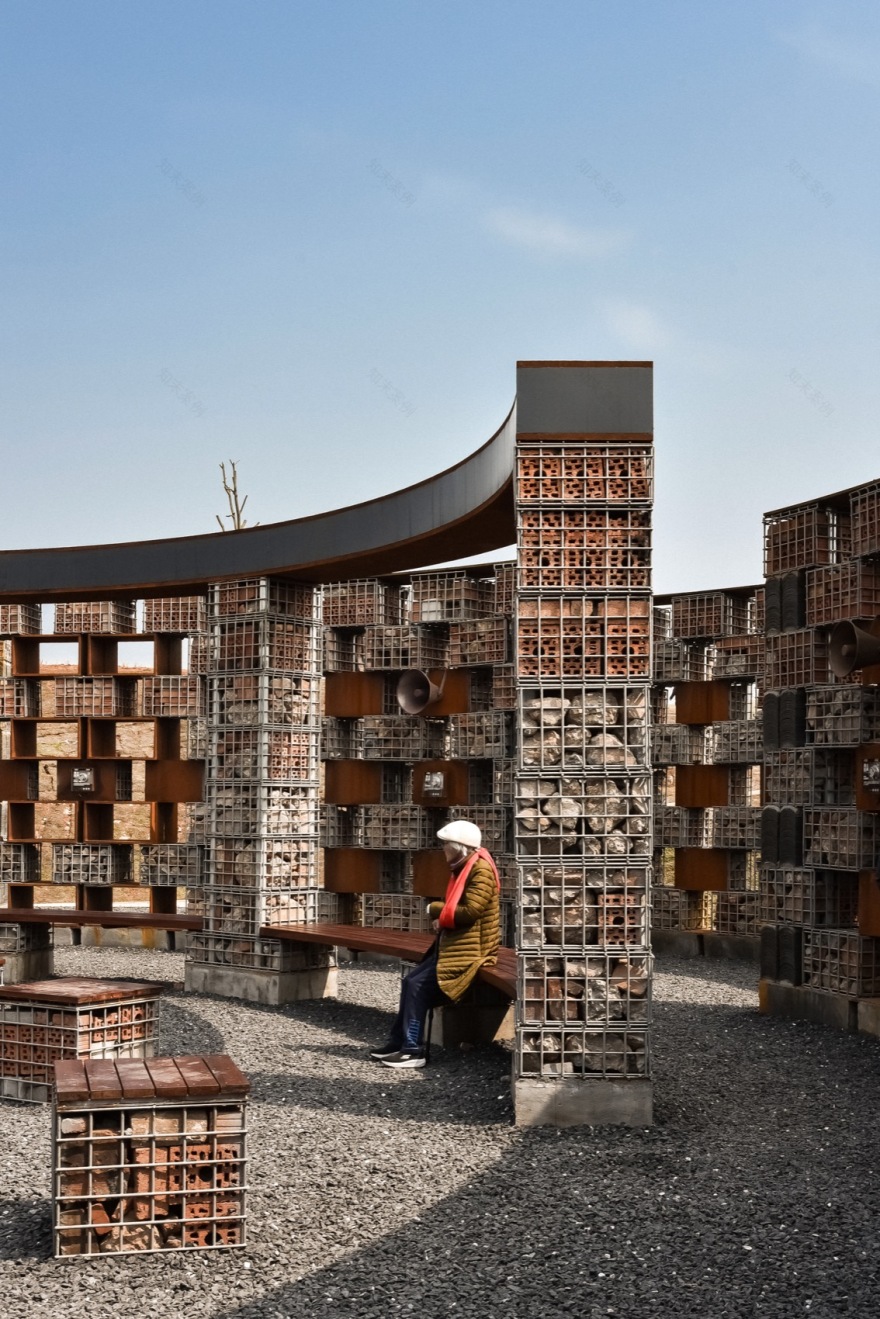
当观众进入到这个声音的场域时,记忆的互动已悄然开始。这不仅是沉浸游览,更是能留下自身故事、让自身成为清水塘历史的一部分的互动体验。层层递进的声音(与记忆)体验,让游览升华为一场可参与、可留存的鲜活对话。
When visitors step into this field of sound, an interactive dialogue of memories quietly begins. This is more than an immersive visit — it is an interactive experience where people leave their own stories and become part of Qingshuitang’s history.
▼声音设备细节 ,Details of audio equipment © 陈逸帆

全龄参与的开放式博物馆
An Open-Air Museum for All Ages
自2026年2月建成开放以来,“废土·回声”已成为株洲新的城市地标。一个全龄参与的城市开放空间:对老一辈清水塘人而言,这里是重温历史的记忆场——那些填满石笼的砖瓦,或许就来自他们曾工作过的车间、曾走过的厂区道路。他们可以在此聆听熟稔的乡音,也可以站上回声场,讲述自己的故事。对年轻一代而言,这里是理解父辈与城市历史的入口。那些粗粝的砖石表面,比任何文字记载都更直接地传递着时间的质感。对儿童而言,这里是一座由环形通道构成的迷宫。他们在墙体间奔跑、穿行、探索,在游戏中完成对这片土地的第一次接触。这就是一座开放式博物馆应有的状态——它不是被围护起来供人参观的“展品”,而是融入日常生活的城市公共空间,全年龄的人群在此各得其所。
▼全龄参与的开放式声音博物馆,An open and accessible sound museum for all ages © 陈逸帆

结语:向旧而新
Conclusion: rebirth from the Past
工业遗址的场地,就像是一个时间孕育下的有机体,它有一套独特的基因。而设计师的工作,如同基因工程师破解密码一般,需要破解出它那组独特的基因序列,然后在此基础上“向旧而新”。对于清水塘,最大的挑战就是在史诗般的岁月积淀与场地复杂的环境条件中,破解出其独特的基因密码。而我们给出的答案,就是“废土·回声”。
A post-industrial site is like an organism nurtured by time, possessing its own unique set of genes. The work of an architect, much like a genetic engineer, is to uncover its distinctive genetic sequence, and on that basis, create something new. For Qingshuitang, the greatest challenge is to decode its unique genetic code based on its epic historical layers and complex site conditions.
▼在空间内与昔日亚洲第一高烟囱对话,In the space, having a conversation with the former tallest chimney in Asia © 陈逸帆

它用最朴素的方式回答了一个关于工业遗产的终极问题:当物质生产停止之后,这片土地还能承载什么?我们的答案是:它可以承载记忆,承载声音,承载人与人的相遇,承载过去与未来的对话。它让每一块废弃的砖瓦,都找到了新的位置;让每一段将被遗忘的故事,都有了回响的空间。这不仅是倾听历史的地方,更是让每个人都能成为清水塘故事一部分的互动场。废土之上,仍有回声。
Our answer to this challenge is “Echo of the Ruins”. It responds in the simplest way to an ultimate question concerning industrial heritage: When the industrial production ceases, what else can this land carry? Our answer is this: It can carry memory, it can carry sound, it can carry meetings between people, and it can carry dialogues between the past and the future. It gives every discarded brick and tile a new place; it gives every nearly-forgotten story a space to resonate. This is not merely a place to listen to history, but an interactive field where everyone can become part of Qingshuitang’s story. Above the ruins, there is still an echo.
▼平面,Plan© 壹外建筑

▼立面,Facade© 壹外建筑

▼剖面,Section© 壹外建筑

▼声音设备安装节点,Details of vocal devices© 壹外建筑

项目名称:“废土·回声”
项目类型:建筑 工业更新 开放式博物馆
设计方:壹外建筑
项目设计:2025年4月-2025年7月
完成年份:2026年2月
设计团队:范昶 刘阳城 刘燕
项目地址:湖南省株洲市清水塘1956文创园
建筑面积:380㎡
摄影版权:陈逸帆
Project name: Echo of the Ruins
Project type: Architecture/Renovaiton for Post-Industrial Site/Open-Air Museum
Design: 1Y Architecture
Design year: 04/2025-07/2025
Completion Year: 02/2026
Leader designer & Team: Fan Chang Liu Yangcheng Liu Yan
Project location: Qingshuitang 1956 Industrial Heritage Site, City of Zhuzhou, Hunan Province, China
Gross built area: 380㎡
Photo credit: Chen Yifan
南京喵熊网络科技有限公司 苏ICP备18050492号-4知末 © 2018—2020 . All photos and trademark graphics are copyrighted by their owners.增值电信业务经营许可证(ICP)苏B2-20201444 苏公网安备 32011302321234号
苏公网安备 32011302321234号客服
消息
收藏
下载
最近