

创作上传
VIP
收藏下载
登录 | 注册有礼
查看完整案例

收藏

下载

分享

翻译
RIFUGIO 2286 | Contemporary Mountain Sanctuary in the Italian DolomitesA modern alpine residence integrated into the limestone cliffs of Passo di Giau at 2,286 meters elevation. This project explores the relationship between brutalist architecture and natural wilderness, creating a dialogue between human shelter and geological permanence.PROJECT OVERVIEW:Located on the legendary SS48 mountain pass in the Italian Dolomites, Rifugio 2286 responds to its dramatic context through materiality and restraint. The design avoids competition with the landscape, instead anchoring itself to the mountain through board-formed concrete, local stone cladding, and strategic glazing.DESIGN PHILOSOPHY:The architecture emerges from the site rather than imposing upon it. Cantilevered terraces float above the valley, floor-to-ceiling glass dissolves interior/exterior boundaries, and raw materials weather in harmony with surrounding peaks. The structure serves as both fortress and observatory.MATERIALITY:
- Board-formed concrete walls echoing geological strata
- Local Dolomite stone cladding
- Natural timber accents for warmth and contrast
- Extensive glazing systems for passive solar gain and panoramic views
- Steel framework for cantilevered structural elements
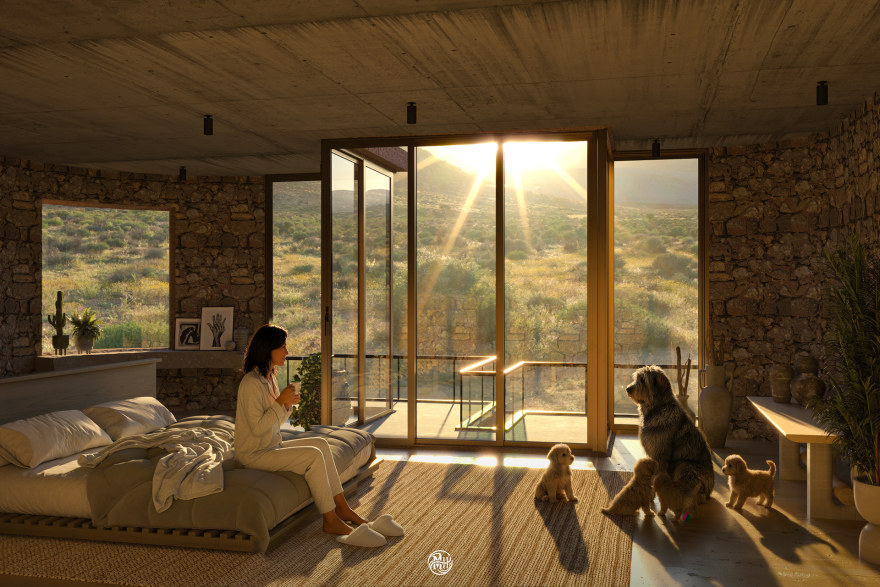
INTERIOR CONCEPT:Minimal intervention, maximum impact. Raw-Concrete ceilings, stacked stone accent walls, natural textiles, and furniture that complements rather than competes with the 360° alpine panorama. The bedroom becomes a light-filled sanctuary where dawn breaks directly through floor-to-ceiling windows.CONTEXT & STORYTELLING:The renders incorporate authentic alpine wildlife (red deer, golden eagles, insects, etc.) and the Ferrari Portofino (Italian registration GH 458 TM) both representing Italian design excellence. The project celebrates the marriage of automotive and architectural craftsmanship, and the journey required to reach such elevated solitude.---TECHNICAL DETAILS:
- Software: 3Ds Max 2024, Quixel Megascans, Maxtree
- Rendering: Chaos Corona 13
- Vegetation: Forest Pack
- Road Modeling: Railclone
- Post-production: Adobe Photoshop (Generative Fill, color grading)
- Elevation: 2,286m (7,500 ft)
- Location: 46.4847° N, 12.0558° E
- Project Type: Conceptual Architectural Visualization
This project examines how luxury evolves from excess towards intentionality, where the greatest status symbol is having the wisdom to step away from everything that confers status.


ARCHITECTURAL DOCUMENTATION:Before moving into 3D visualization, traditional architectural drawings established the design language and structural logic. The section elevations show how the residence anchors to the cliff face through a combination of ground-level masonry volumes and cantilevered upper floors.KEY DESIGN DECISIONS VISIBLE IN DRAWINGS:
- Three-level vertical organization responding to topography
- Strategic cantilever positioning to maximize views without destabilizing the cliff
- Glazing placement optimized for solar orientation and privacy
- Material transitions (concrete base, stone cladding, timber accents, glass volumes)
- Human scale references throughout to maintain architectural proportion
The blueprint documentation provided a reference framework for all subsequent 3D modeling, ensuring dimensional accuracy and structural plausibility. While this is a conceptual visualization rather than a buildable project, maintaining architectural rigor was essential to credibility.These technical drawings also served as conceptual development tools, allowing exploration of spatial relationships before committing rendering resources.


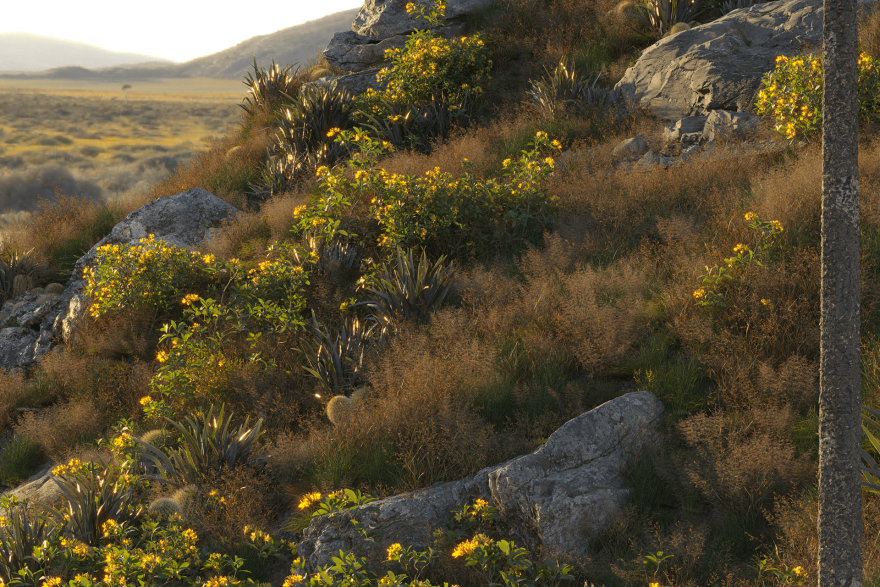
WORKFLOW & PROCESS:The project evolved through several distinct phases, documented in the process images above:PHASE 1 - BLOCKOUT & WHITECARD:Two initial massing studies focused on how the structure could anchor to the cliff face. Early whitecard renders established sightlines, cantilever angles, and volumetric relationships before detailed modeling.PHASE 2 - ROAD DETAILING:Photorealistic ground surfaces required layered decal work. The two road studies document asphalt weathering, tire marks, crack patterns, and surface imperfections consistent with high-altitude mountain pass conditions.PHASE 3 - VEGETATION SYSTEMS:Forest Pack populated the Alpine ecosystem authentically. Two placement studies show iterative vegetation distribution, where you find scattered conifers, low shrubs, alpine grasses gathered from Maxtree Volumes, all typical of 2,286m elevation while maintaining architectural visibility.PHASE 4 - MATERIALITY & INTEGRATION:Final phases involved material detailing (board-formed concrete, stone cladding), lighting studies, wildlife placement, and atmospheric effects. Every element serves the narrative of arrival and elevated sanctuary.
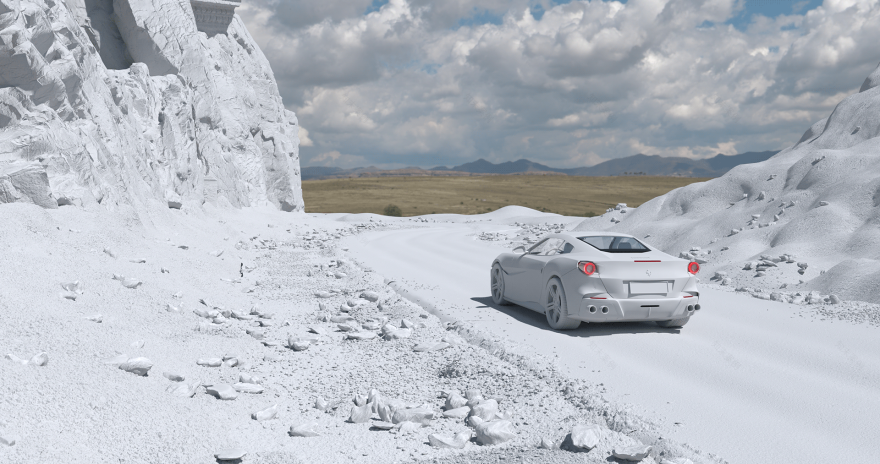




POST-PRODUCTION & AI-ASSISTED WORKFLOW:Transparency is important: while the architecture, landscape, lighting, and primary compositions are 100% 3D rendered, wildlife and human figures were integrated during post-production using Adobe Photoshop's Generative Fill feature.WHY THIS APPROACH:In architectural visualization, we're storytellers first. While I could have modeled, rigged, and animated every deer, eagle, and insect in 3D, the focus needed to remain on the architecture itself. Using AI-assisted tools for secondary narrative elements allowed me to:
- Maintain render efficiency and project timelines
- Focus 3D resources on architectural detail and material accuracy
- Achieve authentic wildlife poses and natural integration
- Iterate quickly on compositional storytelling elements
- Deliver photorealistic results within realistic production schedules
This hybrid workflow represents the evolution of archviz in 2025; using the right tool for each task within an extended workflow, rather than staying within a single software workflow.RAW VS. FINAL BREAKDOWN:The comparison images show raw 3D renders straight from the render engine versus final post-produced images. You'll see how strategic additions of wildlife, people, and atmospheric refinements enhanced the narrative without compromising architectural integrity. - Key post-production elements:
- Wildlife integration (deer, eagles, Insects, birds) via Generative Fill
- Human figures (cyclist, balcony occupants, interior life)
- Color grading and atmospheric enhancement
- Detail refinement and focal adjustments
- Dust particles, lens effects, and photographic realism touches
The goal wasn't to hide this workflow but to celebrate it. Modern archviz is about smart pipelines that deliver maximum impact.
Stag Encounter | Raw 3D → Final Composite with wildlife integration

Complete Vista | Raw 3D → Final with narrative elements
The Arrival | Raw 3D → Final with ground-level detail
Aerial View | Raw 3D → Final with human scale and atmosphere
Architecture Detail | Raw 3D → Final inhabited scene
Interior Sanctuary | Raw 3D → Final with life and warmth

南京喵熊网络科技有限公司 苏ICP备18050492号-4知末 © 2018—2020 . All photos and trademark graphics are copyrighted by their owners.增值电信业务经营许可证(ICP)苏B2-20201444 苏公网安备 32011302321234号
苏公网安备 32011302321234号客服
消息
收藏
下载
最近