

创作上传
VIP
收藏下载
登录 | 注册有礼
查看完整案例

收藏

下载

分享
地震以来的情况
Post-earthquake background
日建设计作为2012年日本国内航线航站楼5期扩建改造工程的设计单位,首次参与熊本机场的设计,进行了车道边(curbside)局部扩建及环境性能提升等工作,并荣获日本主要建筑奖项之一的BELCA奖,该奖项旨在表彰为提高存量建筑品质做出贡献的建筑。此后,该航站楼在2016年经历了两次震度7级的熊本地震和随后的多次余震。虽然部分受损,但受灾程度评定结果显示整体损毁情况较轻。然而,扩建部分的边界区域损坏严重,且基础抗震性能已无余量,因此日本国土交通省提出了重建的方针。
Nikken Sekkei first became involved in designing Kumamoto Airport as the architect for the Phase 5 expansion and renovation of the domestic terminal in 2012. This project included adding a single layer to the curbside area and improving environmental performance. It received the Building and Equipment Long-life Cycle Association (BELCA) Award, one of Japan’s major architecture prizes that recognizes buildings that contribute to improving the quality of the built environment. The terminal building persevered through the 2016 Kumamoto Earthquake, which included two level 7 seismic intensity events, as well as numerous subsequent aftershocks. Although partially damaged, an overall assessment concluded that this was minimal to the building. However, due to severe damage to the boundary sections of the addition and the lack of reserve capacity in the base seismic strength, the Ministry of Land, Infrastructure, Transport and Tourism (MLIT) recommended a rebuild.
▼航站楼外观,木质屋顶框架形成鲜明识别性, Exterior view of the terminal with expressive timber roof structure ©SS Co., Ltd.

基于机场特许经营权的重建
Rebuilding through airport concession
国土交通省的方针是在设立临时航站楼的基础上,基于民营化项目提案对原有航站楼进行重建。对此,团队针对促成此次重建的地震灾害,提议采用高于标准要求的抗震性能,并且不设置天花板。这是因为之前地震后,频繁发生的余震导致天花板上方等部位的损坏不断累积,甚至存在某一时刻突然坍塌的风险,故此为确保旧航站楼的安全耗费了大量精力。
MLIT’s policy involved establishing a temporary terminal while rebuilding the existing terminal was based on a business proposal featuring privatization. We proposed earthquake resistance exceeding the required standards for the quakes that prompted the rebuild, along with eliminating the ceiling structure. This was due to the fact that after the prior quake, repeated aftershocks had caused cumulative damage in areas like the cavity ceiling, raising the possibility of sudden collapse. Ensuring the safety of the old terminal had become extremely challenging.
▼车道边入口空间,开口控制与光线引导结合, Curbside entrance with controlled openings and guided daylight ©SS Co., Ltd.

科学合理的建筑规划
A rational construction plan
虽然日本地方机场的民营化在此前已有先例,但航站楼的重建尚属首次,考虑到项目落地面临的严苛考验,团队提出了以下科学合理的规划方案。
1.将航站楼布置在停机位的中心
2.增加航站楼的纵深,为登机口配套打造集中式的候机厅
3.国内及国际航线旅客均可使用的停留型登机口候机厅(多功能登机口候机厅)
4.通过设置夹层实现合理的剖面结构
5.经济合理的跨距+无地下层+重要设备设于室外
6.外墙开口部分的合理化设计与高隔热性能的屋顶结构
这些提案并没有因为追求合理化而牺牲便利性,我们的设计目标是为旅客提供更便捷、更愉悦的体验。
▼概念生成,Concept generation ©Nikken Sekkei Ltd


While privatization of regional airports in Japan had precedence, this terminal building rebuilds represented a first. Recognizing the challenging viability of the project, we proposed the following highly rational plan:
1.Position the terminal at the center of the aircraft apron
2.Extend the terminal depth to create a consolidated lounge areas for gates
3.Make a multi-gate lounge accessible to both domestic and international passengers
4.Establish a rational cross-section configuration via a mezzanine floor
5.Make economical spans + no basement + outdoor placement of core utilities
6.Optimize exterior wall openings and highly insulate the roof structure
These proposals were designed to achieve rationalization without compromising convenience, aiming instead to provide passengers with a user-friendly, enjoyable experience.
▼木桁架屋顶结构,展现地域材料与空间秩序, Timber truss roof expressing local materiality and spatial rhythm ©SS Co., Ltd.

1.将航站楼布置在停机位的中心
Terminal positioned centrally, relative to the aircraft apron
此前熊本机场90%以上的旅客来自日本国内航线,而70%以上的国内航线为来往于东京的航班。原有航站楼将国内与国际航线分设于不同楼栋,且各自预留了扩建区域,导致其位置相对于停机位大幅偏心。另一方面,从未来发展预期来看,入境旅客将弥补因人口减少而萎缩的国内航线需求,国际航线业务具备增长潜力。因此,以此次重建为契机,将国内国际一体的航站楼布置在停机位中心,并基于截止到2052年的需求预测,规划了其两侧的扩建方案。
Historically, domestic travelers have made up over 90% of Kumamoto Airport’s passengers, with over 70% of domestic flights bound for Tokyo. The existing terminal had separate buildings for domestic and international flights, each with its own expansion areas, causing them to be significantly offset from the parking spots. Looking ahead, inbound travel is expected to compensate for declining domestic demand due to the decreasing population, with international flights seen as having growth potential. Therefore, the rebuild project aimed to place a unified domestic/international terminal at the center of the aircraft stands apron. Expansion plans for both sides were developed based on demand projections through 2052.
▼出发大厅,大开间布局清晰流线, Departure hall with open-plan layout ©SS Co., Ltd.


2.增加航站楼的纵深,为登机口配套打造集中式的候机厅
Extending the terminal depth to create a consolidated lounge for gates
团队没有在每个登机口分别设置候机厅,而是将公共候机厅设计为一个大开间,并在综合考虑跑道数量和航班时刻表的基础上来优化空间布局。同时,为了便于使用商业设施,将候机厅的宽度与停机位脱钩并适当收窄,从而确保了更深的纵深空间。为此,在启用临时航站楼期间,将车道边的道路从原有位置迁移,使该登机口候机厅成为日本国内进深最大的候机区域。
Instead of lounges for each gate, a large, open-plan shared lounge was designed. Space efficiency was achieved by considering the number of runways and flight schedules. To facilitate access to commercial facilities, the lounge frontage was narrowed without linking it to the boarding area, thereby securing greater depth. Consequently, the curbside road was relocated from its existing position during the temporary terminal period, enabling the gate lounge to achieve one of the deepest such layouts in Japan.
▼集中式候机空间, Consolidated lounge©SS Co., Ltd.
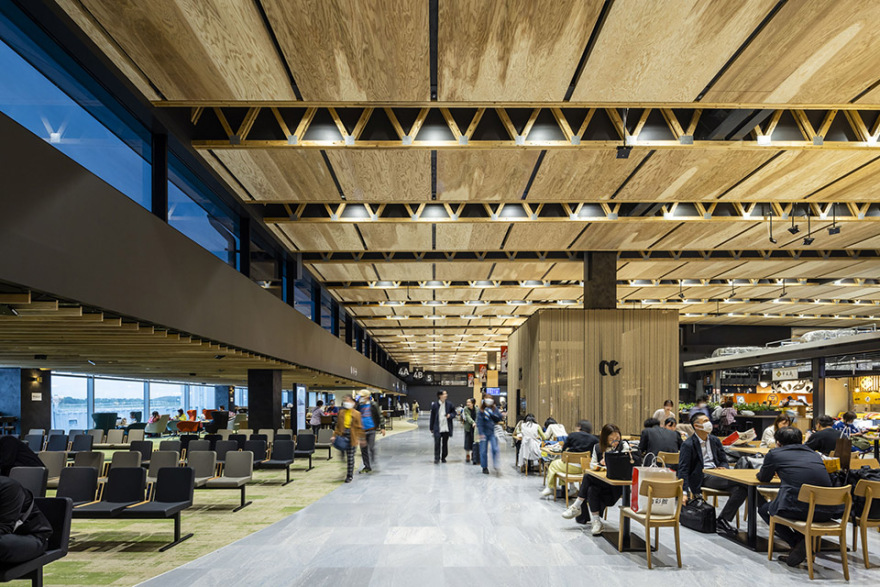

3.国内及国际航线旅客均可使用的停留型登机口候机厅(多功能登机口候机厅)
Stay-type gate lounge accessible to both domestic and international passengers (multi-gate lounge)
如果专门为国际航线设置商业等设施,则会因旅客处理量的平衡问题导致集聚度偏低,缺乏吸引力。为此,团队采用了让国际航线旅客在安检后也可使用国内航线登机口候机厅的设计方案。此外,针对以往商业设施被安检分割为前后两部分、旅客在利用时需顾虑安检排队拥挤程度的情况,将登机口外的商业设施集中设于登机口候机厅一侧,使旅客可在提前通过安检后悠闲享受商业区的服务直至登机前。另一方面,供当地居民和送行人员等使用的区域则设于1层及部分二期工程竣工的独立商业设施(Sora Yoka Dining)中。该区域可以和与Sora Yoka Dining相邻的广场(Sora Yoka Park)一体化使用,实现了“让所有到访者都乐在其中的机场”。
Designating commercial facilities exclusively for international passengers would result in low passenger density relative to volume, reducing its appeal. Therefore, the plan allows international passengers to use the domestic gate lounge after security screening. Furthermore, commercial facilities previously divided before and after security screening — which passengers used while concerned about security congestion – were consolidated on the gate lounge side. This allows passengers to casually enjoy the commercial area from the point of early security clearance until just before boarding. Meanwhile, areas by local residents and for seeing off passengers are located on the first floor and in the separate commercial building (Sora Yoka Dining), which was completed in the second construction phase. These areas can be used in conjunction with the adjacent plaza (Sora Yoka Park), yielding “an airport where everyone who visits can enjoy themselves.”
▼多功能登机口候机厅,国内国际旅客共享空间, Multi-gate lounge shared by domestic and international passengers ©SS Co., Ltd.

4.通过2层结构及其中间夹层实现合理的剖面结构
Rational cross-section composition with two floors and an intermediate mezzanine level
航站楼剖面结构简洁明了。1层为票务大厅与到达大厅,其上层为出发大厅,两层之间作为夹层设置机房,形成合理服务上下楼层的“三明治”结构。1层大厅侧通过错开夹层的布局,确保了符合地面交通接驳需求的双层通高空间。
The cross-section composition is simple. The first floor houses the ticket lobby and arrival lobby, with the departure floor above. Between them, a mezzanine level contains the mechanical equipment rooms, forming a rational “sandwich” structure that services both upper and lower floors. On the first-floor lobby side, the mezzanine level was offset to create a two-story height appropriate for the ground transportation hub.
▼“三明治”空间,“Sandwich” configuration with mezzanine level ©SS Co., Ltd.


5.经济合理的跨距+无地下层+重要设备设于室外
Economic span + no basement + outdoor placement of core facilities
旅客航站楼为确保视认性,多采用大跨度设计,本项目则挑战了如何在确保视认性的前提下实现经济合理的跨距。相较于传统的航站楼设计,通过上述简洁的剖面结构与功能配置,再结合灵活的区域划分,从而实现了更清晰的动线以便于直观引导旅客。此外,取消地下机房,将需要大面积空间的重要设备布置于室外,同时确保设备更新的便捷性,并将狭长的廊桥用作地面管沟。
While large spans are often used in passenger terminals to ensure visibility, this design challenged the balance between an economical span and visibility assurance. Compared to conventional terminal designs, this simple cross-section and functional layout, combined with dynamic zoning, allows for passenger guidance that minimizes confusion. We eliminated underground mechanical rooms, placing large-area core facilities outdoors. This also ensures easy future upgrading and utilizes the extended pier as an above-ground trench.
▼灵活的区域划分,Dynamic zoning©SS Co., Ltd.

▼卫生间,Restroom©SS Co., Ltd.

6.外墙开口的合理化设计与高隔热性能的屋顶结构
Optimizing exterior wall openings and high insulation of the roof structure
通过封闭朝南的车道边,同时向北侧的机场空侧开放,有效抑制了直射阳光的影响,面向旅客行进方向设置开口,利用光环境起到引导作用。车道边的国内航线安检区仅在排队区域前方设置开口,既缓解排队压力,又能从外部感受到3层木桁架的氛围。屋顶采用100㎜厚隔热材料的木质夹芯板构成,力图通过提升外皮的隔热性能来降低能耗。
By closing the south-facing curbside and opening to the north-facing air side, the impact of direct sunlight is minimized. Openings are positioned along the passenger flow direction, providing both light and guidance. The domestic security checkpoint on the curbside features an opening only in front of the waiting line, reducing stress for people waiting, and allowing the ambiance of the third-floor wooden trusses to be felt from outside. The roof is also constructed with 100mm-thick insulated wooden sandwich panels. These aim to reduce energy consumption through the high thermal insulation performance of the building envelope.
▼外立面开口与屋顶系统协同控制热环境, Façade openings and roof system optimizing thermal performance ©SS Co., Ltd.

通过木质框架的混合式设计实现震后复兴的象征
A symbol of post-earthquake recovery through hybrid wooden framing
新机场不仅具备航站楼功能,更作为震后复兴的象征,采用熊本县产木材打造木质屋顶框架,将这一象征性意义直观地传达给旅客和来访者。这一设计不仅呈现出视觉效果,更能让人们感受到木材的香气及其随时间变化的质感。利用住宅用2×4规格的建材,架设10m跨度的桁架结构,用来支撑上述木质夹芯板的屋面板。为防止木质框架发生侧向屈曲,团队在小国町发现了一种木纹优美的结构用胶合板,将其应用其中,并将其空腔用作风管和设备通道,以低成本实现了结构与设备一体化、造型优美的木框架体系。虽然是一座完全没有钢铁、玻璃、大跨度结构或大开口玻璃幕墙等元素的航站楼,但仍致力于为旅客提供富有地域特色的独特体验,力求打造出能让所有到访者留下深刻印象的建筑。
▼木结构细部,Wood structure detail ©Nikken Sekkei Ltd

The new airport goes beyond terminal building functionality. As a symbol of post-quake recovery, it features a wooden roof structure that employs locally sourced Kumamoto timber, and so conveys this message directly and symbolically to passengers and visitors. Designed to offer visual appeal as well as the scent and aging characteristics of wood, residential-use 2×4 lumber was assembled into 10-meter length trusses which support the roof sheathing made from the aforementioned wooden sandwich panels. To prevent lateral buckling, structurally engineered plywood with beautiful wood grain sourced from Oguni Town was used. The resulting cavities were utilized as ducts and equipment routes, integrating structure and systems to achieve an elegant, low-cost timber framework. Although this terminal building contains no steel, glass, large-span glass curtain walls or large openings, it aims to provide a unique passenger experience imbued with regional character — an architecture worthy of memory for all who visit.
▼结构与设备一体化设计,Integrating structure and building services ©SS Co., Ltd.

▼夜景,Night view ©SS Co., Ltd.

项目名称(中文): 熊本机场旅客航站楼
项目名称(英文): Kumamoto Airport Passenger Terminal
用途: 航空旅客服务设施
所在地(都道府县、市): 日本熊本县上益城郡益城町
用地面积(m2): 217,057.91㎡
建筑面积(m2): 39506.88㎡(包括2期工程)
层数: 地上4层
檐口高度/最高高度(m): 檐口高度 14.601(m)/最高高度21.251(m)
主体结构: 钢结构、部分木结构
竣工年月: 2023/01/10(1期)、2024/09/30(2期)
项目相关方信息
业主(中文):熊本国际机场株式会社
业主(英文): Kyushu Kumamoto International Airport Co., Ltd.
主创设计: 株式会社日建设计
主要业务范围: 基本规划、基本设计、实施设计、监理
JV・共同设计・监理・咨询等: 协同监理(株)梓设计 (仅1期工程)
施工单位: 大成建设株式会社
其他设计合作企业:
标识设计:株式会社I Design
行李处理系统(BHS):(株)AGP
施工计划:日建设计项目管理株式会社
景观设计:(株)未来风景舍
照片提供(中英): 株式会社SS/SS Co., Ltd.
项目负责人(截至2026年2月)
姓名 所属部门、职位
金内 信二 建筑设计总部 设计部门 设计总监
高桥 央 建筑设计总部 设计部门 设计总监
三轮 浩明 建筑设计总部 设计部门 设计主管
建材、相关产品信息
材料: 规格/产品名 品牌/生产厂商
屋顶(主航站楼部分): 木质夹心板+防水卷材 三井Home (株)+ 田岛Roofing (株)
外墙(南侧): 双层压型钢板 三晃金属工业(株)
外墙(其他): 耐火型ISOWAND(日铁开发的隔热夹芯板) 日铁钢板株式会社
屋顶(主航站楼部分): 木质夹心板+防水卷材 三井Home (株)+ 田岛Roofing (株)
Building Overview
Project name (English): Kumamoto Airport Passenger Terminal
Purpose: Airport Passenger terminal
Location (city, prefecture): Mashiki-machi, Kumamoto Pref.
Site area (m2): 217,057.91㎡
Total floor area (m2): 39,506.88㎡ (including Phase 2 construction)
Number of floors: Four above-ground floors
Eave height/maximum height (m): Eave height: 14.601 (m) / Maximum height: 21.251 (m)
Main structure: Steel frame construction, partially wood frame
Completion month/year: January 10, 2023 (Phase 1), September 30, 2024 (Phase 2)
Credits
Client name (English): Kyushu Kumamoto International Airport Co., Ltd.
Lead Architect: Nikken Sekkei Ltd
Main Scope: Concept plan, concept design, development design, supervision
Supervision: Collaborative supervision: AZUSA SEKKEI CO., LTD. (Phase 1 only)
Construction Contractor: Taisei Corporation
Other collaborating design companies: Wayfinding: i Design inc.
Interior design: D-Brain Co.,Ltd.
Baggage handling system (BHS): AGP CORPORATION
Construction Plan: Nikken Sekkei Construction Management, Inc.
Landscaping: Miraifukeisha LTD.
Photo credit (Japanese / English): SS Co., Ltd.
Project Managers (as of February 2026)
Full Name: Role, Job Title, Department etc.
Shinji Kaneuchi:Architect Director, Design Group, Architectural Design Department
Hiroshi Takahashi:Architect Director, Design Group, Architectural Design Department
Hiroaki Miwa:Associate Architect, Design Group, Architectural Design Department
Building Materials and Related Products
Material: Specification/Product name Brand/Manufacturer
Roof (main terminal section): Wooden sandwich panel sheet waterproofing Mitsui Home Co., Ltd. +
Tajima Roofing Inc.
Exterior wall (south side) : Double pack corrugated sheet Sanko Metal Industrial Co., Ltd.
Exterior wall (other) : Fire-resistant isoband NIPPON STEEL COATED SHEET CORPORATION
南京喵熊网络科技有限公司 苏ICP备18050492号-4知末 © 2018—2020 . All photos and trademark graphics are copyrighted by their owners.增值电信业务经营许可证(ICP)苏B2-20201444 苏公网安备 32011302321234号
苏公网安备 32011302321234号客服
消息
收藏
下载
最近