

创作上传
VIP
收藏下载
登录 | 注册有礼
查看完整案例

收藏

下载

分享

翻译
MRLJ128 is a 2024 apartment renovation in Madrid, Spain, designed by Plutarco. What began as a modest intervention grew into an almost complete reworking of the home, reshaping the plan and sharpening its chromatic identity. Open social rooms, darker private interiors, and a bold mix of stone, oak, and black herringbone flooring set a contemporary mood against a more traditional residential shell.



About MRLJ128
What began as a small intervention ultimately became an almost complete renovation, driven in part by a strong connection with the client. The central challenge was to understand the context of La Moraleja, an area of single-family homes on the outskirts of Madrid with a classic, traditional character, and to bring that setting into dialogue with something more contemporary in the way Plutarco works.
The first move was a change to the floor plan. The kitchen was connected to the main living and dining areas, since both open onto the garden and pool. A more private living zone was then reserved for the TV lounge and library, while the main bedroom was paired with a dressing room and en-suite bathroom. On the ground floor sit the remaining bedrooms, and in another wing of the house there is a social area for parties, a gym, and a guest apartment.
A major contribution to the project is its mix of materials and colors, complex but fresh, set against the traditional skeleton of the house without tipping into excess. The surprise comes at the threshold, where the shift in atmosphere becomes immediately clear. Dark ceilings, distinctive marbles, oak woodwork, and a black herringbone wood floor all give the interiors their character.
A Chinese quartzite in green, gray, and black tones, marked by strong veining, ties together the first floor. It appears at the entrances leading from the hallway and entrance hall into the various rooms, and it also establishes the green tones that shape the main living areas. In the kitchen, a Mutina floor from the Mews collection by Barber and Osgerby lays out a field of dark gray tones. The room is composed of three main elements: a highly functional area in warm gray with white Silestone, a central island in green tones finished with the Chinese quartzite and a stainless steel core, and tall oak cabinetry. A large midnight-blue window, matched by the ceiling, visually links the kitchen to the dining room and creates a dialogue between the person cooking and the social life unfolding in the living room. This idea, introduced by Charlotte Perriand in 1952 at the Unité d’habitation de Marseille, remains important in Plutarco’s work.
The living room, arranged in a gradient of greens, is the brightest area of the house. Two freestanding bar units connect it to the dining area, and minimalist shelving flanks the fireplace to form the social lounge. Furniture by Note Design for Sancal, &Tradition, rugs by Giancarlo Valle, and chairs by Studio Persona for Pierre Frey make that meeting of tradition and modernity visible. Large-format photographs by Juan Baraja reinforce the role of chromatic intensity and color across the project. Because of the room’s position, the sunset light gives it the effect of a Sorolla painting, recalling the Valencian artist’s depictions of Mediterranean evenings.
The library, finished entirely in terracotta tones, creates an enveloping atmosphere. Dark colors were the goal here, making the room feel close and intimate. As a combined library, office, and TV room, it needed a strong sense of comfort. Oak wood introduces a steady rhythm and becomes a bookshelf in the library area, while two bow windows define the office zone on one side and the TV zone on the other. Here again, the furniture mixes established design icons with newer names: the Standard sofa by Edra, the Bahamante bar cabinet and Indochino armchair by Cassina, an Audo desk, and Sancal armchairs.
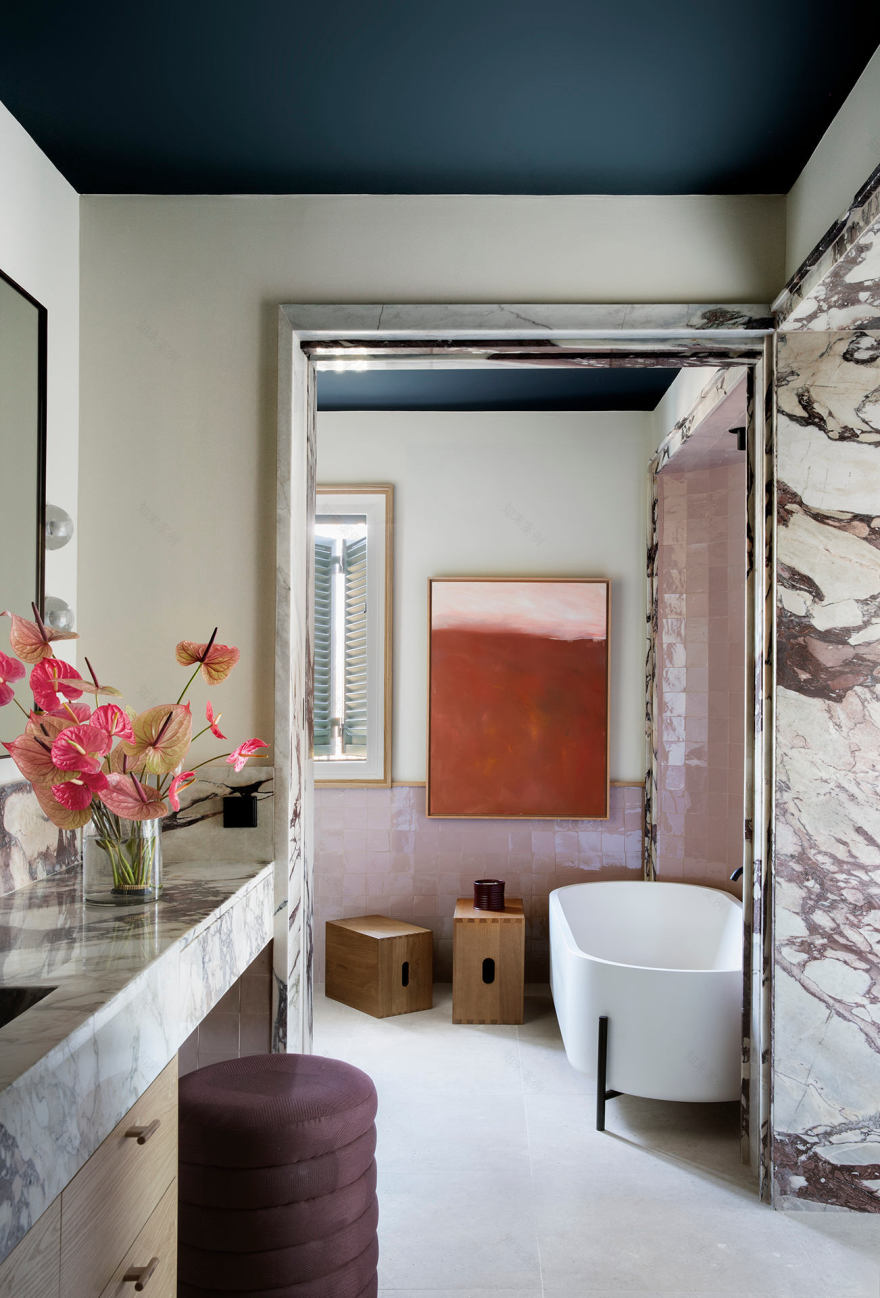
The main bedroom works through a range of earthy colors. The selected Calacatta Viola marble moves beyond a simple two-tone reading and opens onto a broader spectrum of warm hues, which became the basis for the room’s palette. A dark blue ceiling plane meets a Campaspero beige stone floor, with carpet, walls, and tiling in pink and maroon tones. The EX.T bathtub becomes the focal point, framed by marble and zellige tile. The fully paneled bedroom, in eggplant tones with canvassing, creates a visual effect that conceals the closets behind the rhythm running across the room. Nightstands by &Tradition, a Parentesi lamp by Flos, and textiles by Kvadrat complete the composition.
On the first floor are the remaining bedrooms, each one taking on a distinct color in contrast to the neutral hallway. The doors, like those on the upper floor, create geometric play, further emphasized by Uovo door handles by Olivari. One bedroom stands out in particular, where a duality of blues sets up a dialogue between Mutina bathroom tiles from the DIN collection by Konstantin Grcic and their matte and gloss finishes, which extend into the rest of the room. Pierre Frey’s embroidered textiles continue that chromatic range. The bathrooms share Arabescatto marble, lacquered metals shaping the shower enclosures with portholes, and dark color palettes.
In the other wing of the house, the party room was conceived as a versatile and durable area. For that reason, IQ Surface vinyl flooring by Note Design was selected. From there, a chromatic grid in wine and maroon tones was developed. Curtains allow the room to shift from a cinema room to a party room by concealing both the TV and the kitchen. A wine bar in maroon tones and oak wood gives the area a more intimate character.
南京喵熊网络科技有限公司 苏ICP备18050492号-4知末 © 2018—2020 . All photos and trademark graphics are copyrighted by their owners.增值电信业务经营许可证(ICP)苏B2-20201444 苏公网安备 32011302321234号
苏公网安备 32011302321234号客服
消息
收藏
下载
最近