

创作上传
VIP
收藏下载
登录 | 注册有礼
查看完整案例

收藏

下载

分享
当我们谈及“简单而克制的住宅”时,一个熟悉的形象往往会立即浮现:那些在瓦伦西亚地区不断重复出现、变化极少的乡村住宅。它们分布于瓦伦西亚的l’Horta、la Ribera、la Costera或la Safor等地,拥有相似的结构、与街道的共同关系,以及植根于传统的室内组织方式。这些住宅朴素无华,却意味深长——它们是代际相传、不断积累的经验与智慧的结晶。
When we speak of simple and discreet houses, a familiar image immediately comes to mind: those village houses that repeat themselves, with few variations, across the Valencian territory. They appear in the towns of l’Horta de València, la Ribera, la Costera, or la Safor, all sharing a similar structure, a common relationship with the street, and an interior organization rooted in tradition. These are humble houses, yet full of meaning —the result of accumulated knowledge passed down from generation to generation.
▼住宅外观,house facade©David Zarzoso
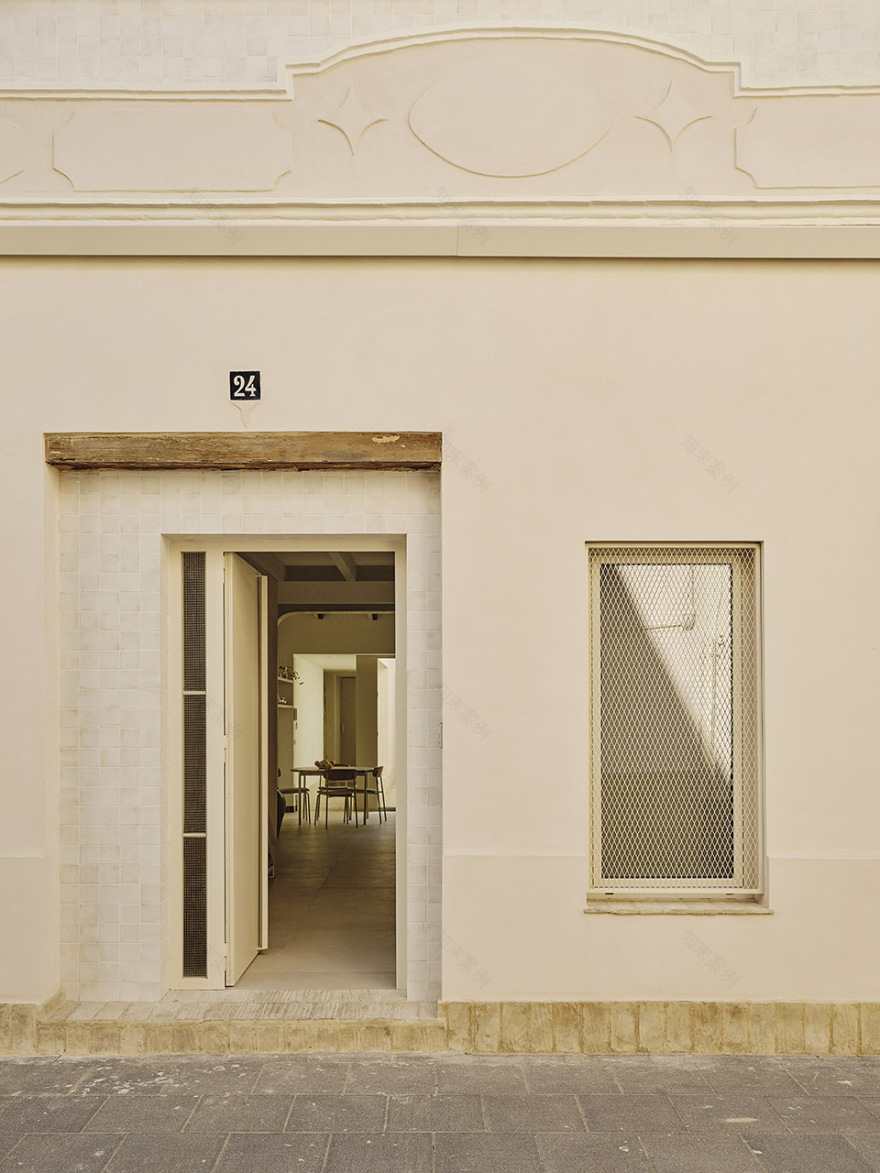

材料的差异也反映出每栋住宅的经济状况。有的以实心砖砌筑,有的采用石材与夯土结构,还有许多则混合使用各种现成材料:夯土、石灰与黏土墙体、芦苇编织、松木等。屋顶通常为双坡形式,由木梁、檩条与砖拱构成;在更为朴素的住宅中,则直接在梁上铺设芦苇与抹灰。立面多为白色粉刷,既起到保护作用,也形成整体统一;有时在底部加设基座,兼具防护与一定的装饰性。宽阔的双开木门入口(供马车出入)也是其典型特征之一。
Material variations also reveal the economic condition of each house. Some were built of solid brick, others of stone and earth masonry, and many combined whatever materials were at hand: rammed earth, lime and clay walls, reed lattices, pine wood… Roofs were usually gabled, with wooden beams, crosspieces, and brick vaults—or, in the humblest houses, reed and plaster laid directly over the beams. The façades, often whitewashed, served to protect and unify. In other cases, a plinth was added to the base of the façade, offering both protection and a touch of distinction. The wide entrance for the cart, with its two wooden doors, is another defining feature.
▼屋顶采用双坡形式,gabled roof©David Zarzoso

还有那些“andana”——位于屋顶下的阁楼空间,用作储藏室、粮仓、晾晒场或临时庇护所。这些可变的空间承载着灰尘与记忆,如今常被视为潜力巨大的场所。在我们初次踏勘待改造住宅时,andana总是一个充满魔力的地方——那里堆满了箱子、工具与往昔的痕迹。在业主许可下,我们有时会带走一件小小的陶器或器具,作为工作室中的纪念与见证。
And then there are the andanas: the upper rooms beneath the roof that served as storerooms, pantries, drying spaces, or shelters. Mutable places that collect dust and memory, and which today are often perceived as spaces full of potential. In our first visits to houses to be restored, the andana is always a magical place—often full of boxes, tools, and memories. With the owners’ permission, we sometimes take a small ceramic piece or utensil from those attics to keep in our studio as a memento and witness.
▼光影变幻下的庭院,the courtyard under the play of light and shadow©David Zarzoso
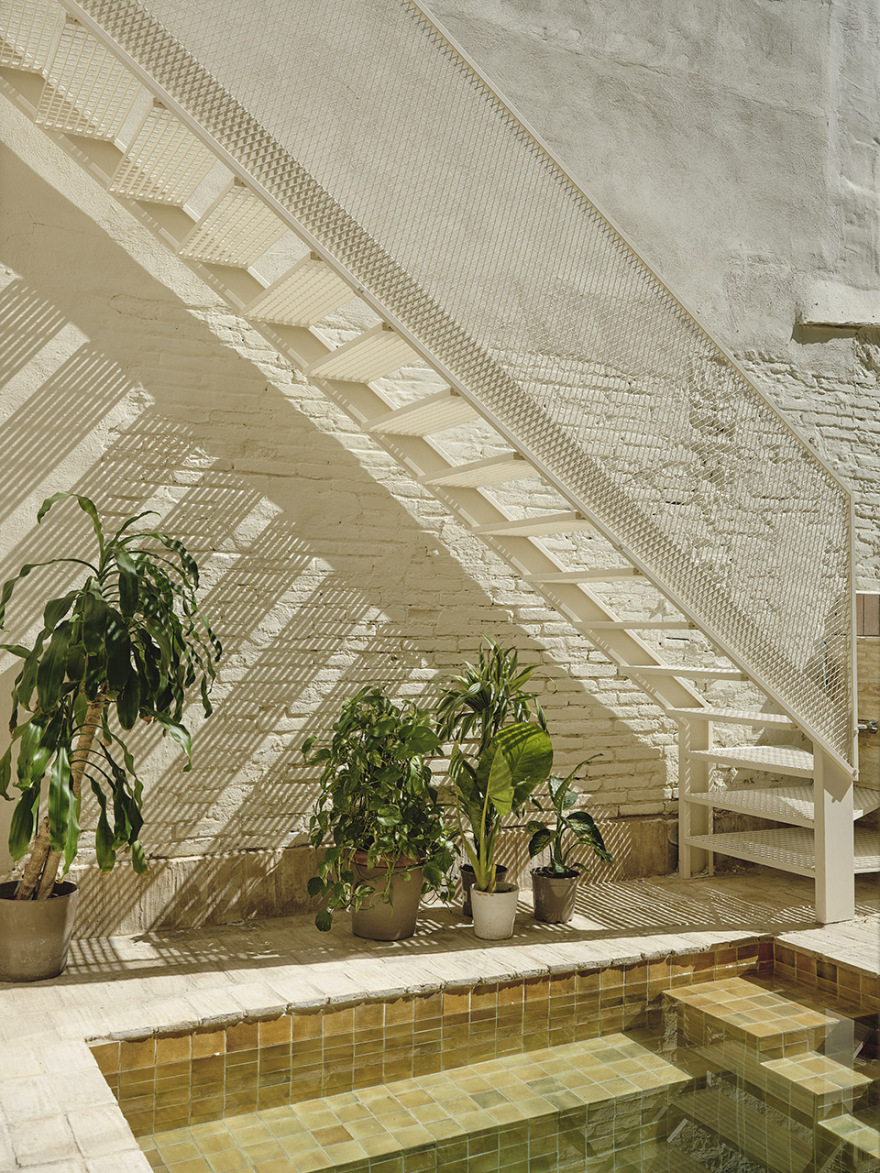
正是在这样的背景下,“Casa dels Estels”诞生——这是一座位于瓦伦西亚南部l’Horta Sud地区Albal村庄中的简单而克制的住宅,典型地呈现了单开间类型。其结构清晰可辨:纵向布局与双进深空间,中央楼梯通向夹层andana,宽敞的马车入口、带有柠檬树的庭院,以及一座两层高的旧谷仓(pallissa)。建筑采用传统材料建造,部分为夯土,部分为实心砖,并覆以双坡屋顶。
It is within this context that Casa dels Estels is situated —a simple and discreet house in Albal, a village in l’Horta Sud of València, perfectly representing the single-bay typology. Its structure is clearly identifiable: a longitudinal layout with a double bay, a central staircase leading to a mezzanine andana, a wide entrance for cart and horse, a courtyard (with a lemon tree), and an old two-story pallissa (barn). Built with traditional materials, part rammed earth and part solid brick, and a gabled roof.
▼带有柠檬树的庭院,a courtyard with a lemon tree©David Zarzoso

新居住者的需求——他们热爱Sargadelos陶瓷、沉浸于阅读,并具有鲜明的地中海气质——要求对住宅进行一种既尊重原貌又果断清晰的改造。目标并非将其变成一件“博物馆展品”,也不是不加批判地保留一切,而是在恢复其本质特征的同时,使之真正适应当代生活方式。住宅依旧需要保持简单与克制,但同时也应明亮、高效且舒适。项目对既有结构进行了优化,修复了最具价值的构件——梁、砖拱、夯土墙,并在必要处开辟新的空间孔洞。流线被压缩,交叉通风得到改善,与外部的联系也被强化。曾被忽视的andana被转化为一个灵活的生活空间,局部抬高屋顶以拓展其可能性。
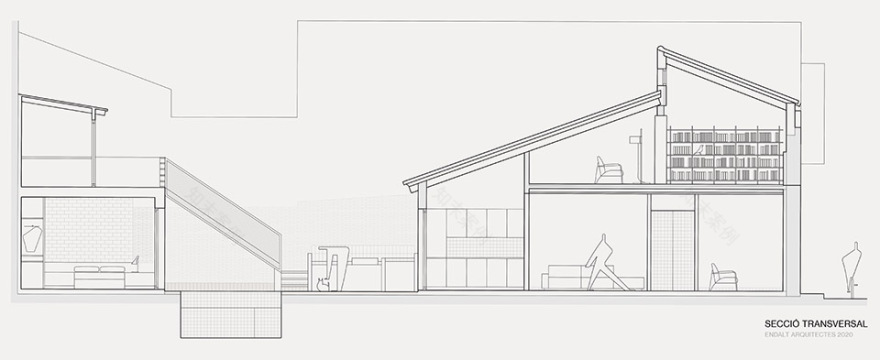
The needs of its new inhabitants —great lovers of Sargadelos ceramics, passionate readers, and of a distinctly Mediterranean character— required a respectful yet determined adaptation. The goal was not to turn the house into a museum piece, nor to preserve it uncritically, but to recover its essential character while making it truly habitable for a contemporary way of life. The house had to remain simple and discreet, yet also bright, efficient, and comfortable. The existing structure was optimized, restoring the most noble elements—beams, brick vaults, rammed earth—and opening new voids where needed. Circulation spaces were reduced, cross ventilation improved, and the connection with the exterior strengthened. The andana, once neglected, became a living, versatile space, slightly extended and with part of the roof raised to expand its potential.
▼简单与克制的室内氛围,The house remains simple and discreet©David Zarzoso

这座房屋,如同许多同类建筑一样,并不需要宏大的姿态,而需要的是尊重——对其过去与未来潜力的尊重。本次修复的目标不是改变,而是显现:让新的生活从旧有结构中自然生长,使过去得以延续。在传统乡村住宅似乎正面临被遗弃或被“民俗化”的当下,这一项目展示了第三种可能:以自然的方式去生活于遗产之中——使用它、让它继续生长。Casa dels Estels并非特例,而是一个范例:一个关于“简单而克制的住宅”如何再次成为充满生命力的家的范例。
This house, like so many others, did not ask for grand gestures but for respect —respect for what it was and what it could continue to be. The rehabilitation sought not to transform, but to reveal: to allow a new life to emerge from within old walls, prolonging the past with naturalness. At a time when the traditional rural dwelling model seems doomed either to abandonment or folklorization, projects like this demonstrate a third way: to live heritage naturally —to use it, to let it grow. Casa dels Estels is not an exception, but an example. An example of how a simple and discreet house can once again become a home full of life.
▼新旧结构的结合,combination of the old and new structure©David Zarzoso

改造要点
Keys to Intervention
改造前的住宅极为朴素,长期无人居住,且缺乏维护。因此,从一开始就需要进行深度干预,包括拆除部分既有体量以及受潮严重、缺乏防水措施的屋顶结构。关键问题在于:拆除应进行到何种程度?在不失去其意义与“灵魂”的前提下,可以去除多少原有部分?
The house we found before rehabilitation was very humble. It had been uninhabited for years, and its maintenance had clearly been poor. This condition required, from the outset, a deep intervention that involved demolishing part of the existing volumes as well as sections of the main roof, which was severely damaged by constant humidity in a structure without any waterproofing. The challenge was determining how far to take the demolition: how much of the original building could be removed without losing its meaning —its soul.
▼改造后的屋顶结构,the roof structure after renovation©David Zarzoso

这一界限从来不是客观的,而取决于对既有建筑的细致解读。在本项目中,拆除并非系统性的,而是“外科手术式”的:去除那些在时间中逐渐偏离整体、或因结构与病害问题而无法保留的部分。在Casa dels Estels中,这意味着拆除状态已无法保障保存的谷仓(pallissa),以及附着于主建筑、条件简陋且打断室内与庭院关系的附属体量(原唯一卫生间)。
This boundary is never objective; it depends on a careful and respectful reading of the existing volumes. In our case, demolition was not systematic but surgical: we removed elements that distorted the ensemble over time or that, for constructive or pathological reasons, made the intervention unfeasible. In Casa dels Estels, this meant removing the pallissa, whose material condition no longer guaranteed its preservation. We also demolished an annex attached to the main building that housed the only bathroom —a volume interrupting the natural relationship between the living area and the courtyard, built with poor materials and temporary solutions.
▼改造后的餐厅及厨房,
the kitchen and dining hall after renovation©David Zarzoso
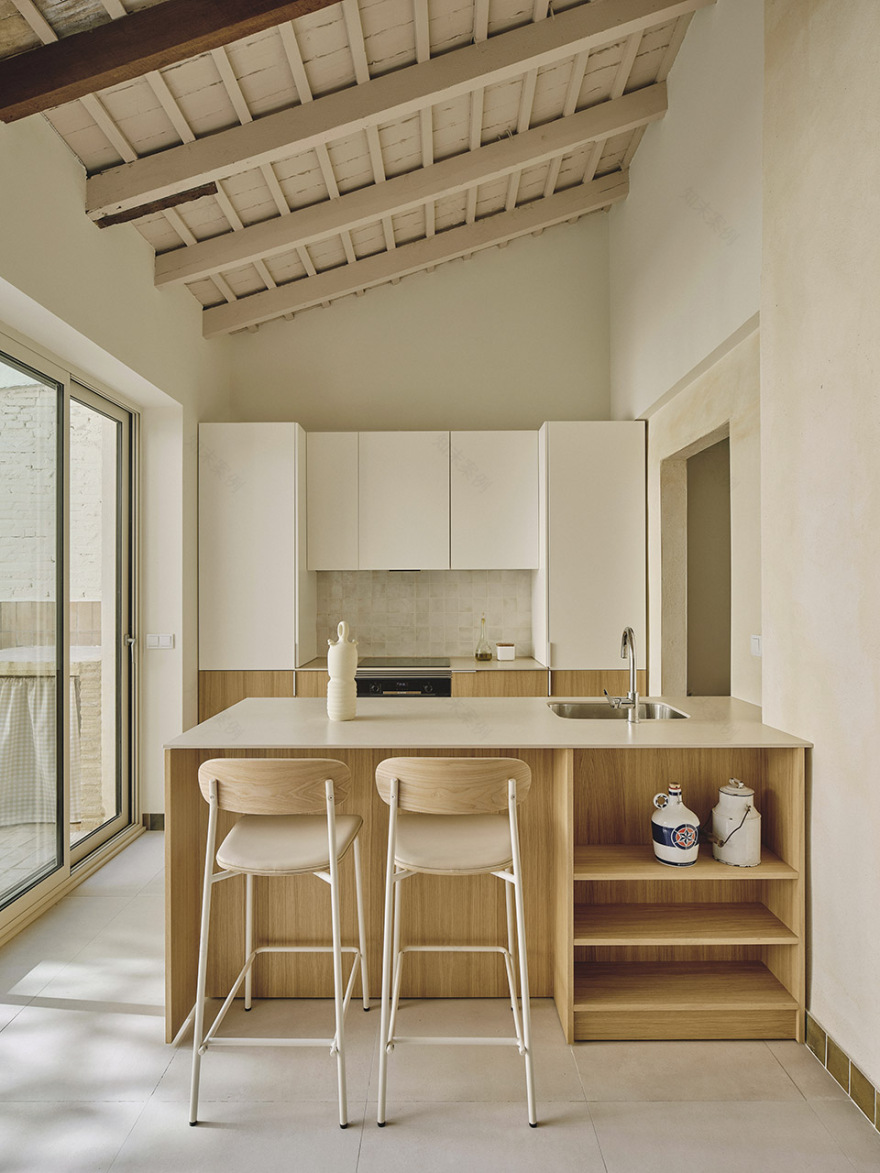
▼改造后的厨房,the kitchen after renovation©David Zarzoso
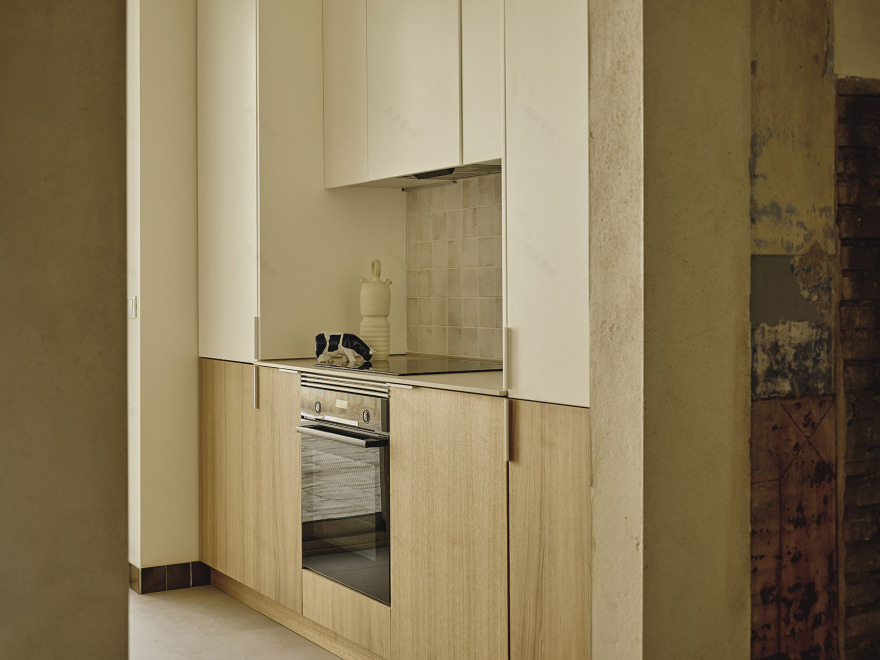
这一“清理”过程使原有体量逻辑得以恢复,重新建立内外之间的对话,并在实体与空隙之间生成新的关系。光线重新进入那些已沉寂数十年的空间。或许,“光”正是最能定义新住宅空间的要素。通过体量的净化,原有功能结构获得新的生命力,既回应规范要求,也契合新一代居住者的感知方式。主空间虽然大体保留,但其意义已被彻底重构。
This process of clearing allowed us to recover the original volumetric logic and reestablish the dialogue between interior and exterior, while new relationships emerged between built and empty spaces. Light, now, reaches places that had remained in shadow for decades. Perhaps this element—light—is the one that most defines the new dwelling’s program. Thanks to this volumetric cleansing, the original functional scheme gains new vitality and adapts to current needs: both regulatory and those derived from the sensibility of a new generation. Thus, although the spaces in the main volume are largely preserved, their meaning is completely transformed.
▼实体与空隙之间生成新的关系,
new relationships emerged between built and empty spaces©David Zarzoso
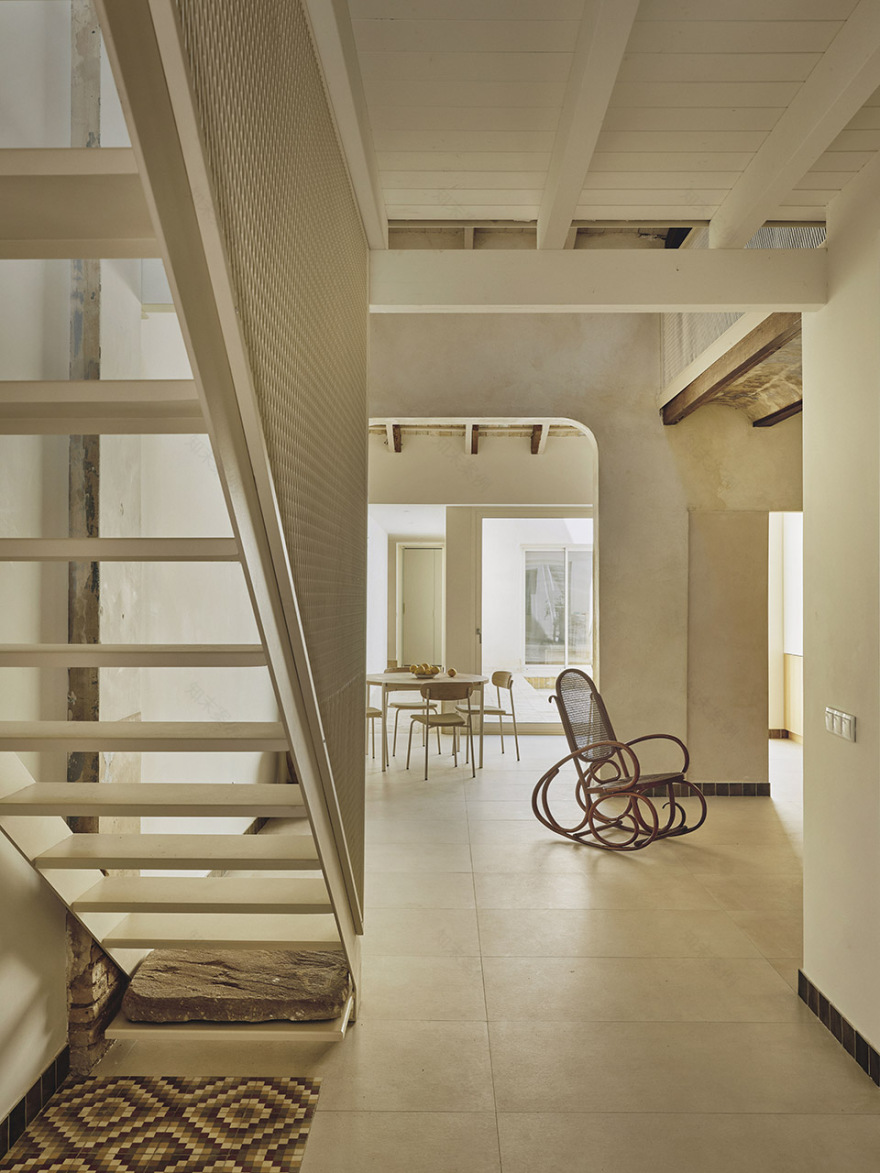
入口仍位于原位,宽度几乎未变,但其中一部分空间被用于设置定制金属楼梯,并嵌入庭院中发现的一块rodeno石材,在不改变空间感知的前提下提升使用效率。起居空间仍处于核心位置,部分被楼板覆盖,保持原有的亲密与庇护感,并保留了一段砖拱。厨房依旧紧邻庭院,但如今延展至整个开间,并通过一条长台面向外延伸。▼起居室,living room©David Zarzoso
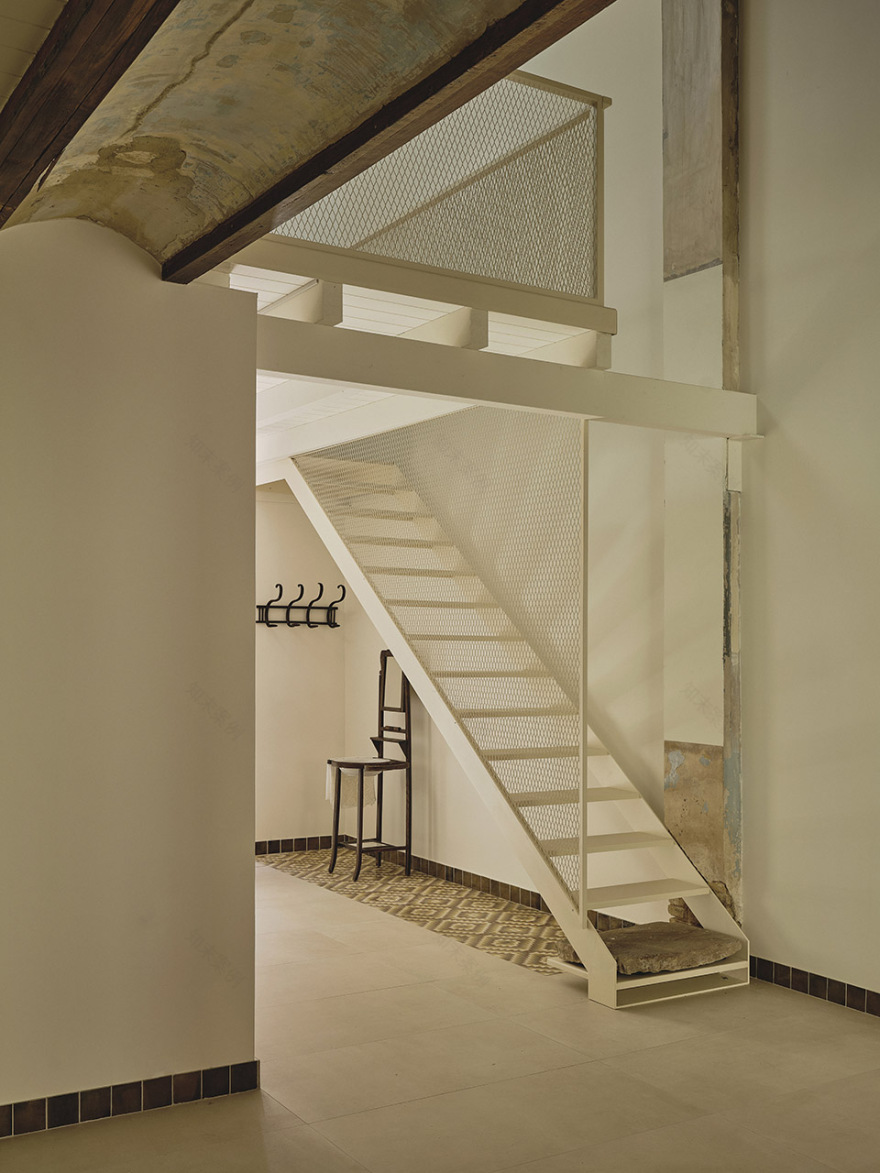
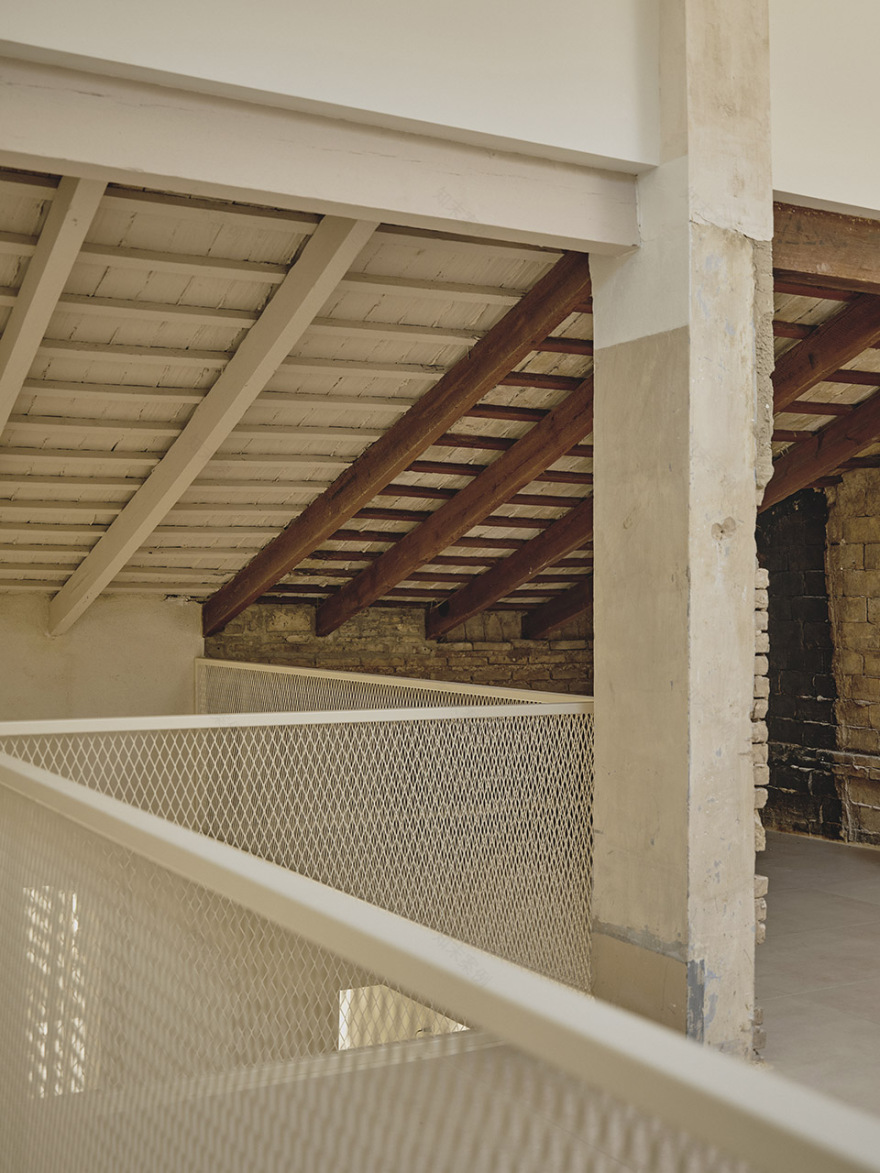
曾用于储存农作物的小型andana,属于一个逐渐消逝的乡村世界。如今,随着职业与生活方式的改变,这一空间以另一种形式延续其功能:昔日存放谷物之处,如今陈列书籍;曾经剥玉米的地方,如今用于批改稿件、书写文字、整理账目。
That small mezzanine—the andana that once stored the harvest—was part of a rural world that is gradually disappearing. Now, professions have changed, and the space that once served agricultural work recovers that function in another form: where grain was stored, books are now kept; where corn was husked, papers are corrected, words are written, and accounts are made.
▼书写文字整理账目的书桌,
A desk for writing and organizing accounts©David Zarzoso
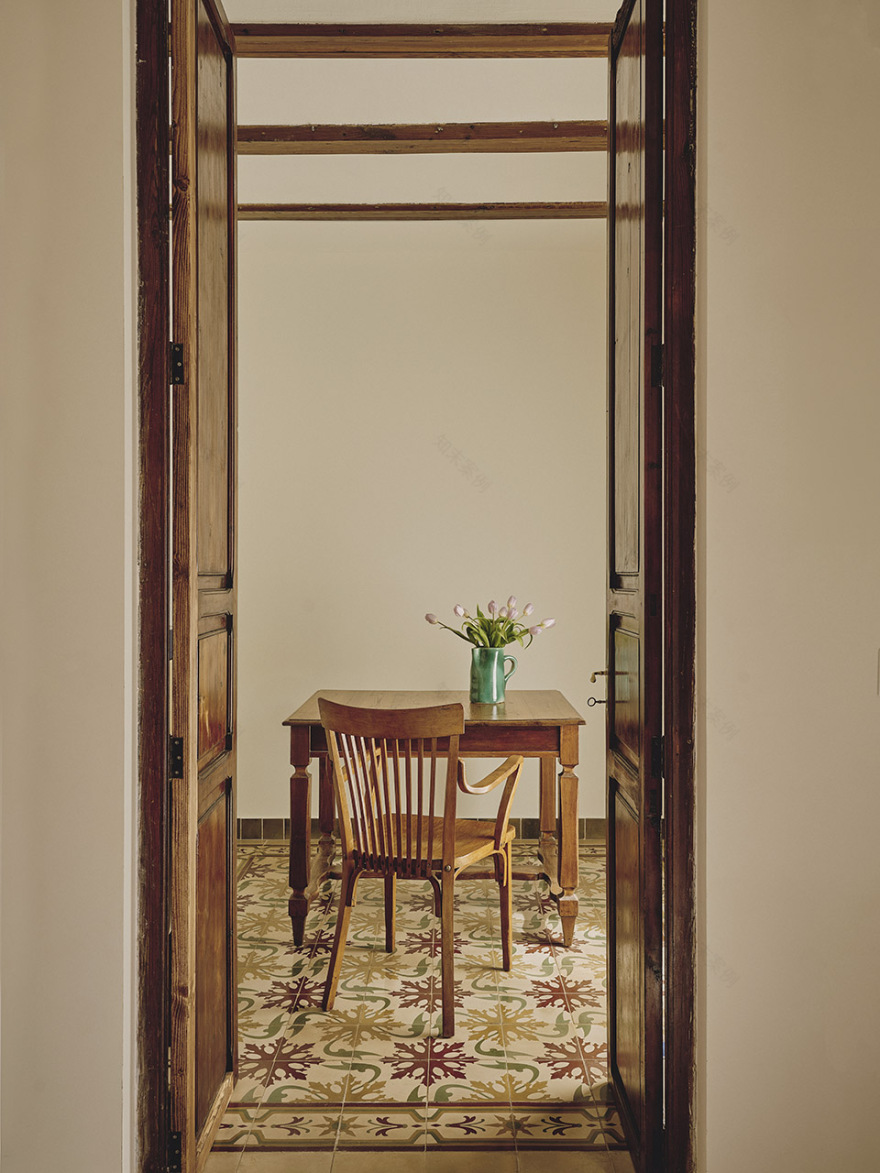
这种使用方式的转变也反映出更深层的生活观变化。曾供动物栖息的低矮凉爽空间,如今成为主卧。除了功能上的调整,这一转变带有诗意:曾承载人与动物共处记忆的场所,如今成为人类休憩之所,仿佛那些生命的气息仍在其中,引导我们更贴近土地、沉静与本源。
This change in the house’s use also speaks of a deeper shift in our way of living and understanding the world. Where animals once rested —in the cooler, lower areas near the courtyard or barn— the main bedroom now sits. Beyond its functionality, this gesture carries a poetic resonance: the space that once held shared life with other species has become a place of human rest, as if the memory of those bodies still breathed there, inviting us to sleep closer to the earth, to silence, to origin.
▼主卧空间,main bedroom©David Zarzoso


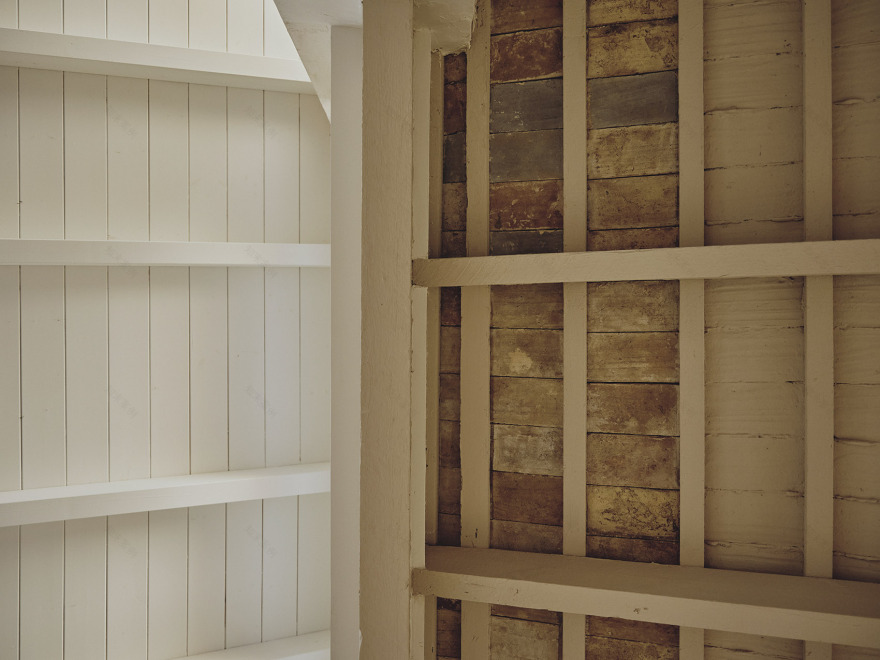
材料在本项目中占据核心地位,遵循一条清晰策略:恢复建筑本质,同时赋予其当代价值。新的结构介入与乡土语言形成对话——木梁与结构板虽区别于原有砖拱,但在形式与材料上保持连续性。这种对话延伸至所有材料与饰面选择,项目力求与环境建立深层一致性,并遵循环境与社会文化责任。因此,项目使用石灰砂浆、陶材与木材,并回收再利用拆除过程中获得的黏土砖。这些砖块如今铺设于庭院与走廊,形成一块“历史地毯”,其表面仍保留着百年前匠人手工塑形时留下的指纹。
Materials play a central role in this intervention, guided by a clear strategy: to restore the essence of the house while adding new contemporary value. The new structural additions dialogue with the vernacular language —wooden beams and structural boards that, though distinct from the original brick vaults, maintain a formal and material continuity. This intent to establish dialogue extends to materials and finishes as well. The project seeks a profound coherence with the environment, employing vernacular construction techniques and criteria of environmental and sociocultural responsibility. Thus, lime mortars, ceramics, wood, and reclaimed clay bricks from the demolition were reused. These clay pieces, extracted from the dismantled roof, now pave the courtyard and corridor, forming an authentic historical carpet where the fingerprints of the craftsmen who shaped them a century ago remain visible in their texture.
▼阁楼阅读空间,loft reading space©David Zarzoso


▼屋顶细部,roof detail©David Zarzoso
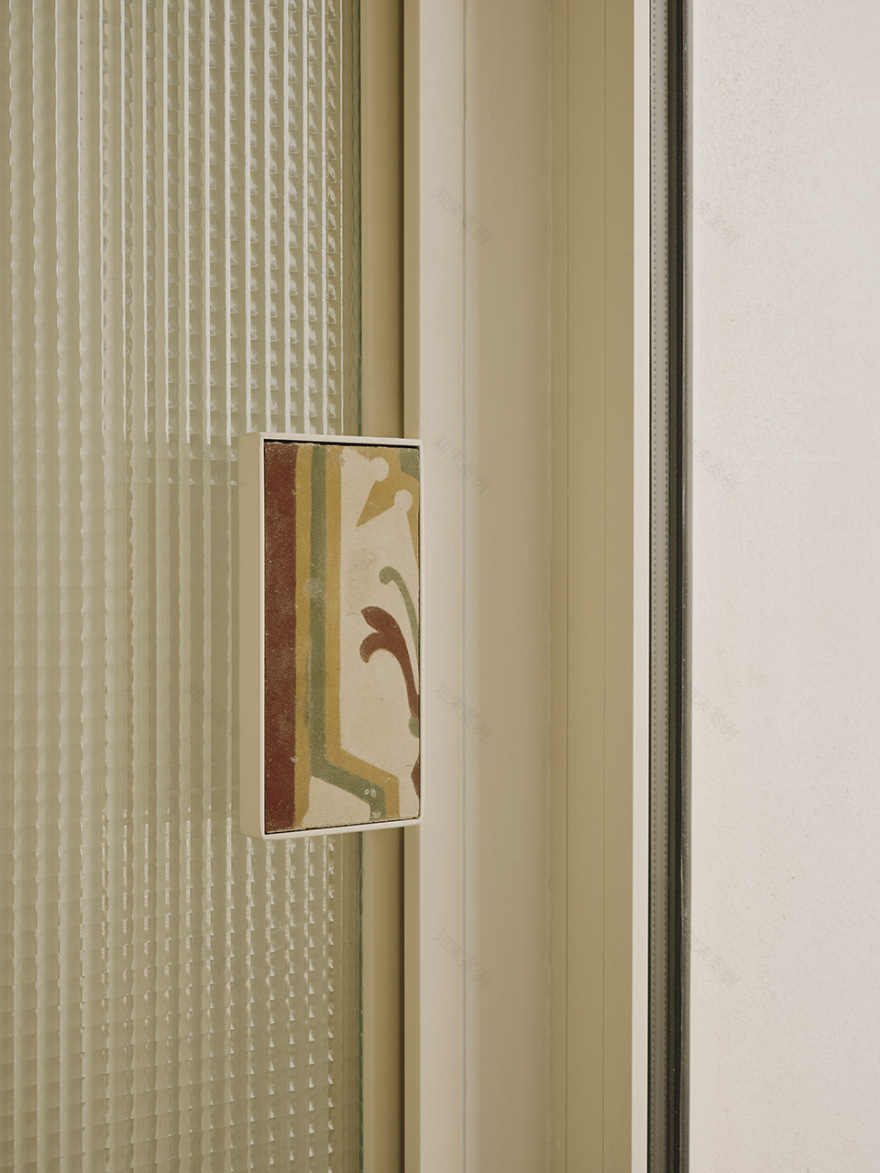
这些烧制陶砖与浴室、厨房、泳池及踢脚线所用的釉面陶砖形成对话,丰富了空间的材料与感知层次。黄色用于湿区,与水交融,呈现出类似瓦伦西亚农田灌溉水塘的绿色调;绿色釉面则用于踢脚线,使这一细部得到强调,并呼应原有同色基座的记忆。
This fired clay converses with the glazed ceramic tiles of the bathrooms, kitchen, pool, and skirting boards. These diverse, heterogeneous pieces bring material and sensory richness to each space. Yellow tones are reserved for the wet areas (bathroom and pool), where they blend with the water to generate a greenish hue reminiscent of irrigation ponds in the Valencian farmland. The green glaze, meanwhile, is used for the skirting boards, dignifying this element and linking it to the memory of the original baseboard of the same color.
▼釉面陶砖,the glazed ceramic tiles©David Zarzoso

正如所见,本项目高度重视材料再利用与耐久建造策略。它源于尊重——尊重根基,同时面向未来。这不仅是对空间的占有,更是与场所、历史以及物质缓慢循环之间建立连续关系。这是一种不张扬而倾听的建筑,不展示而陪伴的建筑。如同黏土与石灰一般,它顺应变化——并得以长久存在。
As we have seen, the project pays special attention to the reuse of existing materials and the selection of long-lasting construction solutions. It is built from respect —from the roots— but with a gaze toward the future. It is not only about inhabiting a space, but about establishing continuity with the place, with history, and with the slow cycles of matter. It is an architecture that does not impose but listens; that does not display but accompanies. An architecture that, like clay and lime, adapts —and endures.
▼平面图,plan©ENDALT Arquitectes

▼立面图,elevation©ENDALT Arquitectes

▼剖面图,section©ENDALT Arquitectes
Project name: Casa dels Estels
Architecture studio/Office: ENDALT Arquitectes
Instagram: @endalt_arquitectes
Facebook: endalt arquitectes
Twitter: @ENDALT_arq
Country: España
Year of completion: 2025
Built area: 152 m2
Location: Albal (València, España)
Photography: David Zarzoso
Products:
Kitchen furniture and glass doors Lebrel Furniture
Furniture Sklum
Lighting Casasuau
Metal carpentry Nakoa Concept
Ceramic tiles Nais
Decorative ceramics Sargadelos, La Mediterránea (Siesta Héctor Serrano), Lladró


南京喵熊网络科技有限公司 苏ICP备18050492号-4知末 © 2018—2020 . All photos and trademark graphics are copyrighted by their owners.增值电信业务经营许可证(ICP)苏B2-20201444 苏公网安备 32011302321234号
苏公网安备 32011302321234号客服
消息
收藏
下载
最近