

创作上传
VIP
收藏下载
登录 | 注册有礼
查看完整案例

收藏

下载

分享
该办公建筑位于印度斋浦尔一条极为繁忙的城市主干道旁,处于一个由老旧商业开发构成的街区之中,是该区域首个新建项目。设计在回应场地语境与气候条件的同时,建立起当代建筑形象,并尊重当地的建筑遗产。
Situated on an extremely busy arterial road in Jaipur, India, within a neighborhood of old commercial developments, this office building marks the first new development in the area. Designed to respond to both context and climate, the project establishes a contemporary identity, while respecting the architectural heritage of the region.
▼建筑概览,overview of the building © Mr. Vinay Panjwani


在总体规划上,项目将设备用房与交通核心筒策略性地布置在南侧边缘,同时将结构柱设置于建筑外围,从而确保每层楼板空间的完全灵活性。底层布置较小尺度的办公单元,上部楼层则设置更大面积的办公空间。
The planning strategically positions the service areas and circulation core along the southern edge, with structural columns placed along the perimeter to ensure complete flexibility across each floor plate. The lower levels accommodate smaller office units, while larger office spaces are located on the upper floors.
▼建筑街景,street view of the building © Mr. Vinay Panjwani
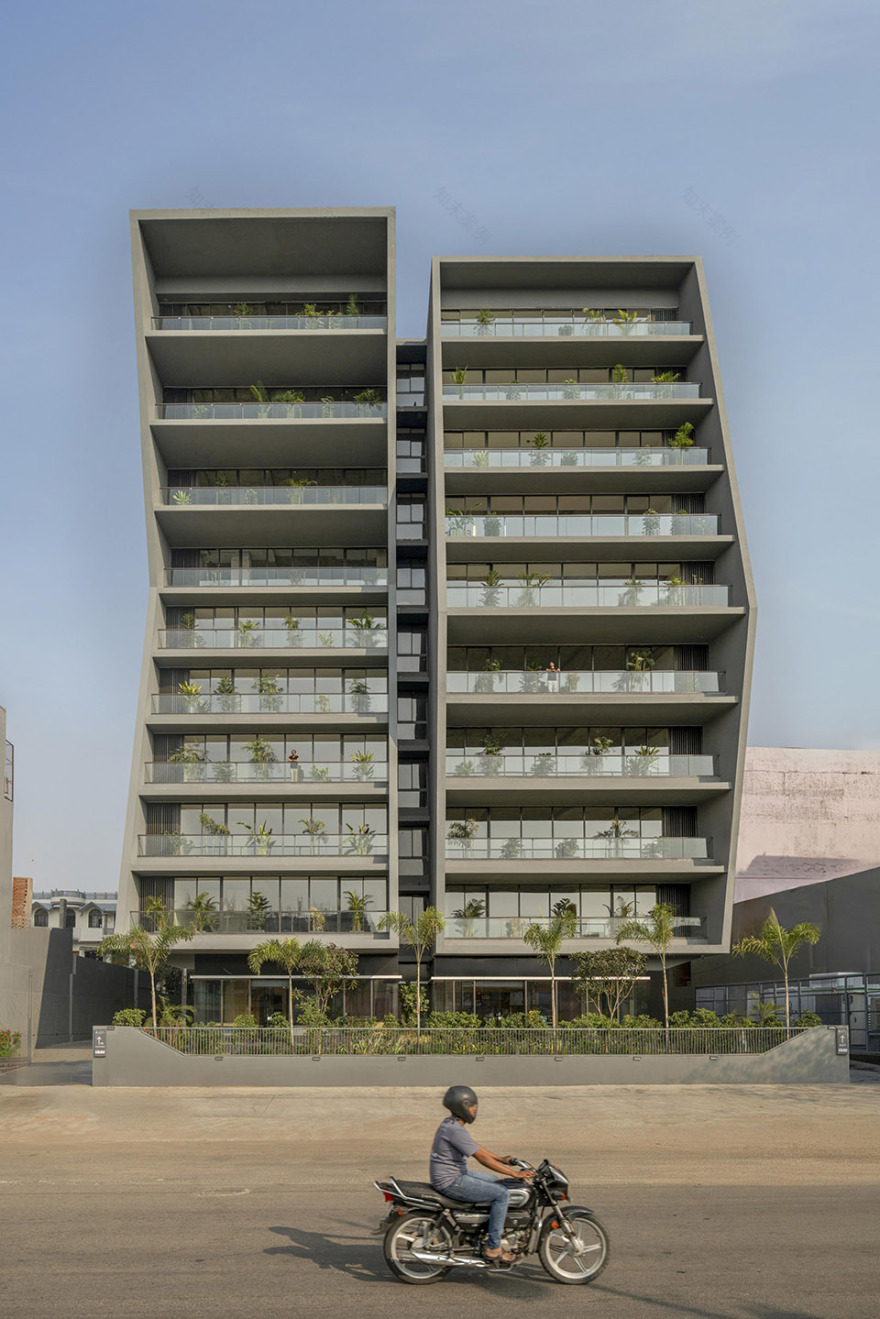

面向道路的西立面呈现前后倾斜的体量形态,形成两个角度相对的垂直体块。这种动态的体量组合在每一层都创造出带有遮蔽的室外平台,同时相反方向的倾斜也有效保障了相邻办公露台之间的私密性。
On the road-facing western facade, the building inclines both forward and backward, forming two vertical volumes with opposing angles. This dynamic massing creates sheltered outdoor decks at every level. The contrasting inclines also ensure privacy between adjacent office terraces.
▼立面呈现前后倾斜的体量形态,
the building inclines both forward and backward © Mr. Vinay Panjwani

▼有遮蔽的室外平台,sheltered outdoor decks © Mr. Vinay Panjwani


针对高密度的城市环境,建筑两侧包覆有穿孔屏风,其灵感来源于拉贾斯坦邦传统建筑中典型的石制“jaali”格栅。这些屏风由以再生材料为主的轻质泡沫混凝土制成,同时具备良好的隔热性能。
In response to the high-density urban setting, the building’s sides are wrapped in perforated screens inspired by the traditional stone jaali screens characteristic of Rajasthan’s heritage architecture. These screens are fabricated from lightweight foam concrete, composed primarily of recycled materials, and offer thermal insulation properties.
▼建筑两侧包覆有穿孔屏风,the building’s sides are wrapped in perforated screens © Mr. Vinay Panjwani


▼屏风细部,screen detail © Mr. Vinay Panjwani


在穿孔屏风与玻璃幕墙之间设置了一条宽约3英尺(约0.9米)的种植带,既作为来自繁忙道路的噪音缓冲层,又在建筑周边引入连续的绿化界面。
A 3′-0″ wide planter zone is introduced between the perforated screen envelope and the glazed facade, serving as a noise buffer from the busy road, while simultaneously introducing continuous greenery along the building’s perimeter.
▼从室内看向穿孔屏风,
look towards the perforated screen from the interior space © Mr. Vinay Panjwani


首层设置餐厅与会议设施,激活街道界面;屋顶层则布置了咖啡厅、健身房及景观花园,为使用者提供休闲与社交空间。
The ground floor accommodates a restaurant and conference facility, activating the street frontage. The terrace level features a cafeteria, gym, and landscaped outdoor garden, creating recreational and social spaces for occupants.
▼室内空间,interior space © Mr. Vinay Panjwani


建筑主要采用粉煤灰砖与钢筋混凝土框架结构建造,并整合了包括水循环利用、雨水收集以及屋顶太阳能板在内的可持续策略。相较于常规办公建筑,这些措施显著降低了其隐含碳排放。穿孔屏风与内退式平台共同构成被动遮阳系统,有效减少热量进入,降低空调能耗,并减少建筑全生命周期的碳排放。
Constructed predominantly using fly ash bricks and an RCC frame structure, the building integrates sustainable strategies such as water recycling, rainwater harvesting, and rooftop solar panels. These measures significantly reduce the embodied carbon footprint compared to conventional office buildings. The perforated screens and recessed decks act as passive shading devices, mitigating heat gain, lowering air-conditioning demand, and reducing lifecycle carbon emissions.
▼被动遮阳系统,passive shading devices © Mr. Vinay Panjwani

该办公建筑在充分回应斋浦尔炎热气候的同时,汲取地域建筑传统的灵感,最终形成了一个兼具能源效率与在地性表达的当代办公空间。
This office building thoughtfully responds to Jaipur’s hot climate while drawing inspiration from regional architectural traditions, resulting in energy-efficient, contextually rooted contemporary workspaces.
▼夜景,night view © Mr. Vinay Panjwani

▼一层平面,ground floor plan © Sanjay Puri Architects

▼二层平面,first floor plan © Sanjay Puri Architects

▼剖面图,section © Sanjay Puri Architects


Project Name – Magnus
Building Use – Offices
Location of Site – Tonk Road, Jaipur, Rajasthan, India
Company Name: Sanjay Puri Architects
Lead Architect – Sanjay Puri
Design Team – Chandan Joshi, Sonali Chougule
Client – Mahima Real Estate Pvt. Ltd.
Site area – 2390.80 sq.mt. /25,734 sq.ft.
Built-up Area – 15646 sq.mt./1,68,413 sq.ft.
Project Cost – 52,41,777 USD / 47,64,62,590 INR.
Start Date – 2023
Date of completion – December 2025
Photo credits: Mr. Vinay Panjwani


南京喵熊网络科技有限公司 苏ICP备18050492号-4知末 © 2018—2020 . All photos and trademark graphics are copyrighted by their owners.增值电信业务经营许可证(ICP)苏B2-20201444 苏公网安备 32011302321234号
苏公网安备 32011302321234号客服
消息
收藏
下载
最近