

创作上传
VIP
收藏下载
登录 | 注册有礼
查看完整案例

收藏

下载

分享

翻译
Architects:OMA
Area:61930ft²
Photographs:Jason O'Rear,Jason Keen
Architect of Record:Cooper Robertson, Erin Flynn, Andrew Barwick, Isil Akgul
Construction Manager:F.J. Sciame Construction, Co., Inc, Joseph Mizzi, Steven Colletta, Thomas Sevchuk
structural Engineer:Arup, Matt Jackson, Christopher Adams
Category:Museum
Partner In Charge:Shohei Shigematsu
Partner In Collaboration:Rem Koolhaas
Associate/Project Architect:Jake Forster
Design Lead:Jackie Woon Bae
Technical Lead:Ninoslav Krgovic
New Museum Building Project Coordinator:New Museum, Dennis Szakacs
Project And Cost Management:Gardiner and Theobald, Jonathan Andrew, Stephen Becker, Michael J. Day, Peter Lehrer, Scott Weisberg
Mechanical Systems:Arup, Matt Jackson, Neil Muir
Façade:FRONT, Marc Simmons, Jeff Kim
Geotechnical:Langan, Arthur Alzamora, Mark Gallagher
Civil Engineer:Philip Habib & Associates, Philip Habib
Signage:2x4, T-Squared Design Studio, Trisia J. Tomanelli
Visuals:Visual Graphic Systems, Lorraine Conte
Lighting:Christopher Cheap
Capital Campaign:$130 million raised
Project Construction Cost:$82 million
Total Gallery Space Of New Building:9,600 sf (net)
Total Square Footage Of Education, Special Event, And Artist Studio Spaces In New Building:3,210 sf (net)
Total Square Footage Of New Inc Space:3,850 sf (net)
Total Gallery Space In Existing Building And Expansion:20,240 sf (net)
Total Square Footage Of Existing Building And Expansion:119,700 sf (gross)
Lighting Designers:Dot Dash
City:New York
Country:United States

Text description provided by the architects. Our first cultural institution in New York is a new addition to the New Museum next door to its iconic SANAA-designed building at 235 Bowery. The New Museum has been growing in visitors, exhibitions, and activities. Its diverse engagements, including its expansive education programs, its cultural incubator NEW INC, and, of course, its globally recognized exhibition program have been transforming the institution into a cultural laboratory. We were asked to add a new building that provides much-needed space for its expanded activities and simultaneously reflects increasingly public ambitions—duplicating the program and square footage on a site immediately adjacent to the existing SANAA-designed building—part and counterpart, side-by-side.

This condition was entrenched in dichotomies. While dichotomies are inherent to museum expansions, they can suppress the full potential of the pair. We looked to less didactic, more unexpected, and maybe even romantically entangled relationships that could exist between two parts of a whole. Can one be highly infrastructural to give support and free agency to the other? Can it be two equal entities in complete harmony? Can the two be distinct and independent but reciprocal as a pair?


Our approach complements and respects the integrity of the adjoining SANAA building, while asserting its own distinct identity. The New Museum will be a synergistic pair working spatially and programmatically in tandem, offering a repertoire of spaces for the institution's curatorial ambitions and diverse programs. We stacked the required programs exactly at the same level of the existing building—three floors of galleries, a permanent home for NEW INC, offices, and multifunctional education and event spaces—new and old conjoined. Ceiling heights of the newly connected galleries align on each floor, creating expanded space for exhibitions and horizontal flow between the buildings.

Galleries can be used singularly across the floorplate to host larger exhibitions or separately for diversity and curatorial freedom. Due to the horizontality of the site, the galleries in the new building increase in size on the upper levels while the galleries in the existing building decrease in size—the total area per connected floor remains balanced. A distinction between the two buildings is created by taking advantage of our site's depth to insert an interstitial space, in between art and city, containing an Atrium Stair and dedicated gallery elevators for improved vertical circulation. This highly public face—starting from the exterior plaza and Atrium Stair to terraced multi-purpose rooms at the top—is a conduit of art and activities that provides an openness to engage the Bowery and the city.
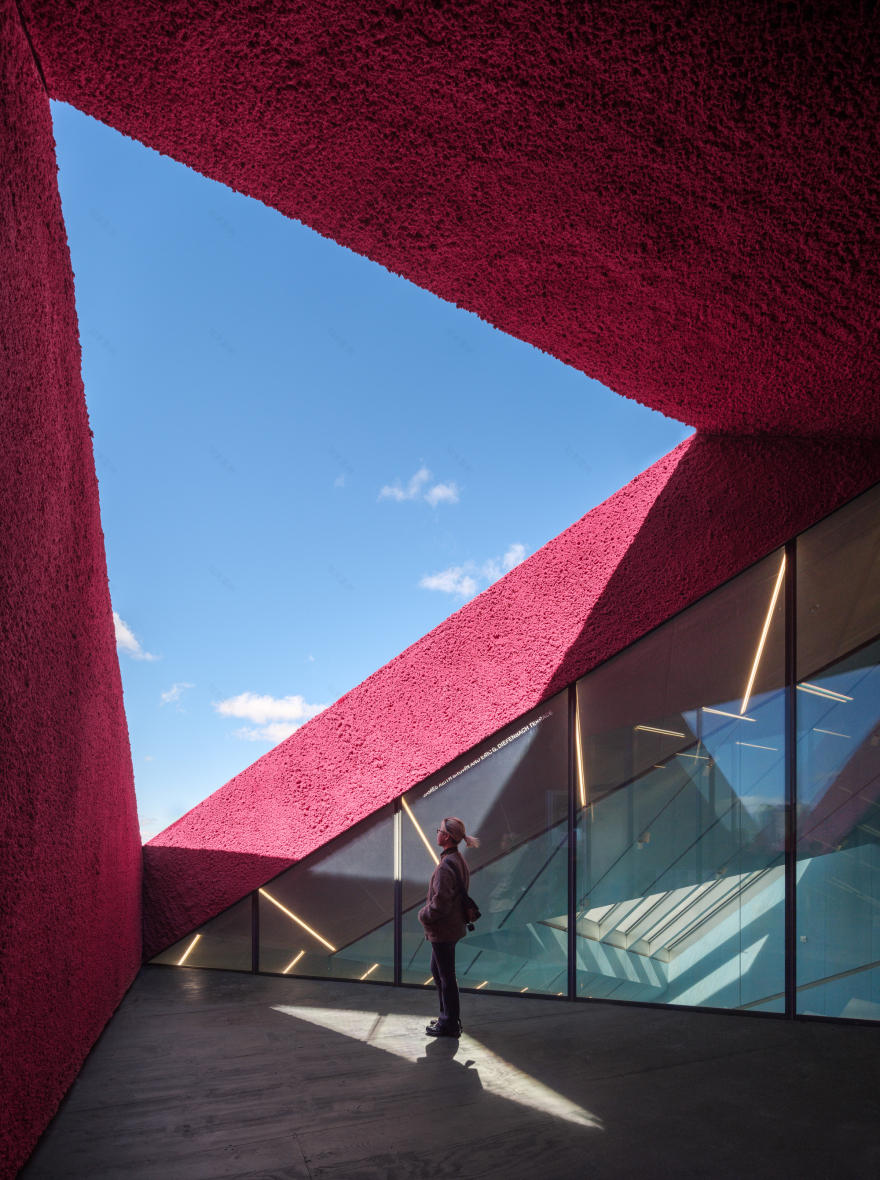
The existing tower's verticality treats the different programs within in the same expression. We wanted to create a healthy contrast by expanding the galleries horizontally and introducing two setbacks. An angled setback starting from the top of gallery stack to the street defines a new public plaza at the terminus of Prince Street that becomes a focal point and a buffer zone between existing and new. A second setback above the galleries makes the top of the building disappear, while opening up the upper-level terraces to the sky. Clad in laminated glass with a layer of metal mesh, the building appears monolithic during the day, establishing a unified exterior alongside the existing building's metal mesh facade. In the evening, the transparency of the facade is enhanced as light permeates through its openings, exposing the museum's anatomy.

The new, New Museum is a partnership of two different personalities with high compatibility—independent but in constant dialogue. The result is an expanded platform that provokes even more dynamic interactions between art, artists, and people, which are then exposed to communicate the museum's civic ambitions to the city.

Project gallery


南京喵熊网络科技有限公司 苏ICP备18050492号-4知末 © 2018—2020 . All photos and trademark graphics are copyrighted by their owners.增值电信业务经营许可证(ICP)苏B2-20201444 苏公网安备 32011302321234号
苏公网安备 32011302321234号客服
消息
收藏
下载
最近