

创作上传
VIP
收藏下载
登录 | 注册有礼
查看完整案例

收藏

下载

分享
我们在索契开始设计这所中学时,提出了三个命题:儿童不是“缩小版”的成年人。学校不是儿童的办公室。索契位于南方。
We began the design of the lyceum in Sochi with three statements: Children are not ‘small’ adults. A school is not an office for children. Sochi is in the South.
▼项目概念,Project diagram© Buromoscow


学校中最有趣的事情发生在走廊和校园庭院里,尤其是在建筑后方、成人视线之外的地方。大脑学习的很大一部分通过交流与运动完成,在协作中,在建立关系中,在游戏与兴奋之中。因此,模糊街道与教室之间的边界,可以将教育“机构”转变为一个研究型公园。
The most interesting things in school happen in the corridors and in the school yard, especially behind the building, outside the control of adults. A huge part of brain learning happens through communication and movement, in collaborative work, in building relationships, in games and excitement. Therefore, blurring the boundaries between the street and the classroom turns an educational “institution” into a research park.
▼将教育“机构”转变为一个研究型公园,Turns an educational “institution” into a research park © Buromoscow


在南方,几乎可以把所有时间都花在户外。人们希望尽可能待在室外,看到天空与绿植,在阴影中停留,听见鸟鸣,而不是看到围栏。学校位于城市公园中。幼儿园、学校和活动中心的一层建筑沿公园边界布置,其体量围合出内部庭院。
In the South it is possible to spend almost all the time outdoors. One wants to be outside as much as possible, to see the sky and greenery, to be in the shade, to hear birds, not to see fences. The school is located in a city park. One-storey buildings of the kindergarten, the school and the leisure center are placed along the perimeter of the park, enclosing internal courtyards with their volumes.
▼项目鸟瞰,Aerial view of the project© Buromoscow

索契有许多不同类型的公园。有可以停留一整天的自然区域,例如红波利亚纳(Krasnaya Polyana)或毗邻城市的国家公园与高加索自然保护区。也有城市公园,即传统的文化与休闲中央公园。还有南方文化公园,它曾长期被废弃,在飓风之后也未完全修复。当然,最美的地方是那些近似天堂的空间,例如“冶金工人”疗养院。由于伊梅列季低地的洪涝问题,许多植物在那里生长不良。灌溉系统在奥运建设期间被破坏,若能恢复,将大大改善水绿生态框架的状况。▼场地分析,Site analysis© Buromoscow

There are many different parks in Sochi. There are natural territories where one can go for a day, such as Krasnaya Polyana or the parts of the national park and the Caucasus reserve adjacent to the city. There are urban parks, the traditional central parks of culture and recreation. There is the Park of Southern Cultures, which was abandoned for a long time and has not been fully restored after the hurricane. The most beautiful places, of course, are almost paradise-like places such as the Metallurg sanatorium. Because of flooding in the Imereti lowland, many plants do not grow very well there. The irrigation system was destroyed during the Olympic construction, and restoring it would greatly improve the condition of the water-green framework.
▼自然的环境,Nature environment© Buromoscow


在天狼星地区,人们很少步行或骑行——开阔的沥青空间要么过于炎热,要么风力过大。如果建立一个连续的、由高大乔木和灌木组成的阴影公园系统,这一情况将会改变。
In Sirius people don’t walk or cycle much –open tarmac plains are either too hot or there is a strong wind. A continuous system of shadowy parks with planting leavy trees and bushes would change that.
▼广场,Plaza© Buromoscow

三个独立的建筑——三个私密庭院。建筑通过一圈水面与公共公园分隔。可见,但不可进入。
▼植物研究,Plant research© Buromoscow

Three separate buildings — three private courtyards. The buildings are separated from the public park by a perimeter water surface. Visible, but inaccessible.
▼花园,Garden© Buromoscow

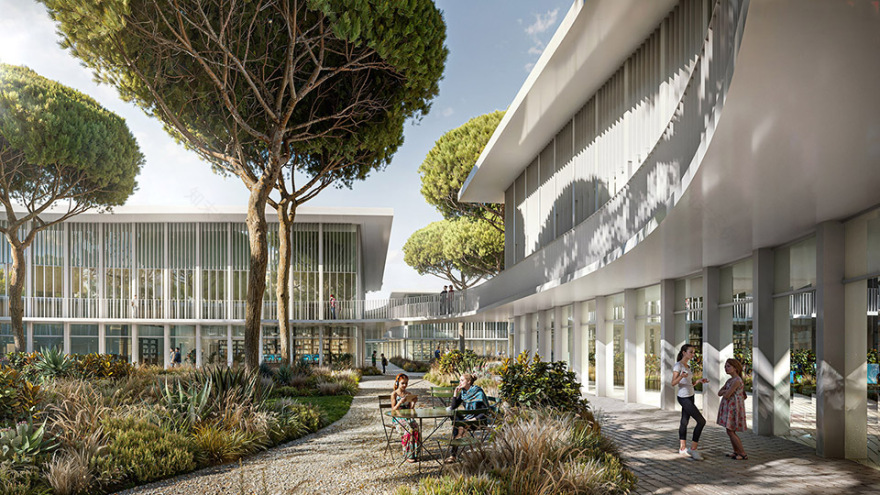
幼儿园呈环形,由两个半径错位的圆组成,并覆盖坡屋顶。十二个班级围绕一个共享的阴影花园展开,其外围布置有深进的露台。
The kindergarten is circular in form, composed of two circles with a shifted radius, covered with a pitched roof. Twelve groups open onto a common shaded garden, around the perimeter of which deep terraces are located.
▼户外步道,Outdoor pathway© Buromoscow

活动中心包含游泳池、图书馆、体育馆和工作坊,从外部看如同公园中央的一座高丘。它由两部分组成,并沿一条城市步行街组织,这条街以经典柱廊的形式贯穿山体。
The leisure center building with a swimming pool, library, sports halls and workshops appears from the outside as a high hill in the center of the park. It consists of two halves and is organized along an urban pedestrian street with a classical colonnade cut through the middle of the hill.
▼公共区域,Public space© Buromoscow

学校整体呈一个大型“三叶草”形态,在内部组织出五个不同的庭院:分别服务于小学、初中、高中和行政的四个庭院,以及一个用于集会与讲座的中央共享庭院。建筑的柱列在透视中与公园中的松树相互融合,“外部”与“内部”的空间在平面上自然流动。在三叶草的内角中设置了特殊教室、报告厅与咖啡空间。
The school has the form of a large clover, organizing five different courtyards inside: four for the primary, middle, senior school and administration, and one central shared courtyard for assemblies and lectures. The columns of the building in perspective merge with the pines of the park, and the plans “outside” and “inside” smoothly flow into each other. In the inner corners of the clover there are special classrooms, auditoriums and cafés.
▼项目场地,Site plan© Buromoscow

▼总平面图,Master plan© Buromoscow

▼平面图,Floor plan© Buromoscow


▼剖面图,Section© Buromoscow


Project name: Sirius Lyceum(天狼星学院)
项目类型:社会
设计方:Buromoscow
设计年份:2025
完成年份:2027
首席设计师 & 团队:合伙人:朱莉娅·布尔多娃,奥尔加·阿列克萨科娃,设计师:基里尔·斯卡奇科夫,团队:叶戈尔·比格丹、奥尔加·弗拉先科、克谢尼娅·加尔基纳、阿莱娜·古克、玛丽亚娜·德鲁西诺娃、伊利亚·涅克拉索夫、亚历山大·鲁莫、安德烈·里亚布科夫、伊娜·萨菲乌琳娜、尼基塔·谢尔盖夫、安东·斯皮瓦克、博格丹·特普西奇、阿纳斯塔西娅·施里亚耶娃
项目地点:索契
总建筑面积:学校建筑面积27900平方米,幼儿园建筑面积14000平方米,休闲中心建筑面积21300平方米
业主:ZEUS
材料:陶瓷、铝
Project type: social
Design: Buromoscow
Design year: 2025
Completion Year: 2027
Leader designer & Team: partners: Julia Burdova, Olga Aleksakova, leader designer: Kirill Skachkov, team: Jegor Bigdan, Olga Vlasenko, Ksenia, Galkina, Alena Guk, Maryana Drusinova, Ilya Nekrasov, Alexander Rummo, Andrey Ryabkov, Inna Safiullina, Nikita Sergeev, Anton Spivak, Bogdan Tepšić, Anastasia Shiryaeva
Gross built area: school 27900 ㎡, kindergarten 14000 ㎡, leisure center 21300 ㎡
Clients: ZEUS
Materials: ceramics, aluminum
南京喵熊网络科技有限公司 苏ICP备18050492号-4知末 © 2018—2020 . All photos and trademark graphics are copyrighted by their owners.增值电信业务经营许可证(ICP)苏B2-20201444 苏公网安备 32011302321234号
苏公网安备 32011302321234号客服
消息
收藏
下载
最近