

创作上传
VIP
收藏下载
登录 | 注册有礼
查看完整案例

收藏

下载

分享
从空间到参与
From Space to Participation
“Cities have the capability of providing something for everybody, only because, and only when, they are created by everybody.”
—— Jane Jacobs,《The Death and Life of Great American Cities》
城市之所以能让每个人都找到属于自己的位置,是因为它本来就是由所有人一起创造出来的。
——简·雅各布斯,《美国大城市的死与生》
简·雅各布斯在《美国大城市的死与生》中以此强调:城市的价值不只来自空间形态,更来自参与权——当每个人都能有机会介入都市内的每一个空间、并塑造日常,城市才具备持续生长的生命力。
In “The Death and Life of Great American Cities”, Jane Jacobs emphasized this point: The value of a city lies not only in its spatial form, but also in the right to participate – only when everyone has the opportunity to intervene in every space within the city and shape daily life, can the city maintain its vitality for continuous growth.
▼项目概览,overview of the project©陈铭
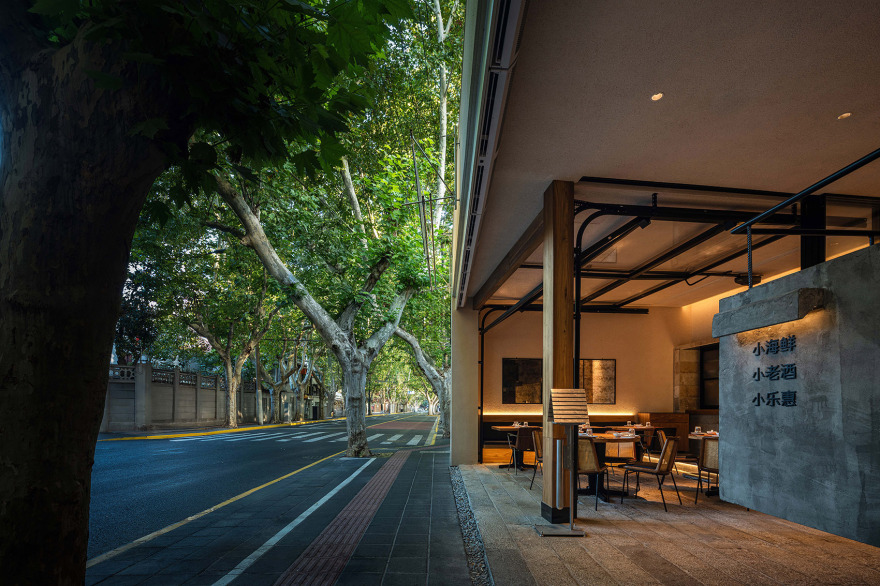
但在当代商业空间实践中,空间往往过度依赖坪效、转化率与流量模型,并不断强化造型与视觉识别度。在这一过程中,商业空间逐渐从城市生活的载体转变为高度功能化的消费界面,与周边街道及日常活动之间形成一种微妙的对立。作为城市空间基本构成要素之一的商业空间是否能够在满足基本运营逻辑的前提下,重新建立与城市日常之间的关系,并为更广泛的公众参与提供空间条件?这是本样设计一直在探索的课题。
However, in contemporary commercial space practices, the space often overly relies on floor area efficiency, conversion rates and traffic models, and continuously strengthens its design and visual recognition. During this process, commercial spaces gradually transform from the carriers of urban life to highly functional consumption interfaces, forming a subtle opposition with the surrounding streets and daily activities. As one of the fundamental components of urban space, can commercial spaces re-establish their relationship with the daily life of the city while adhering to the basic operational logic, and provide spatial conditions for broader public participation? This has been the subject that this design has been constantly exploring.
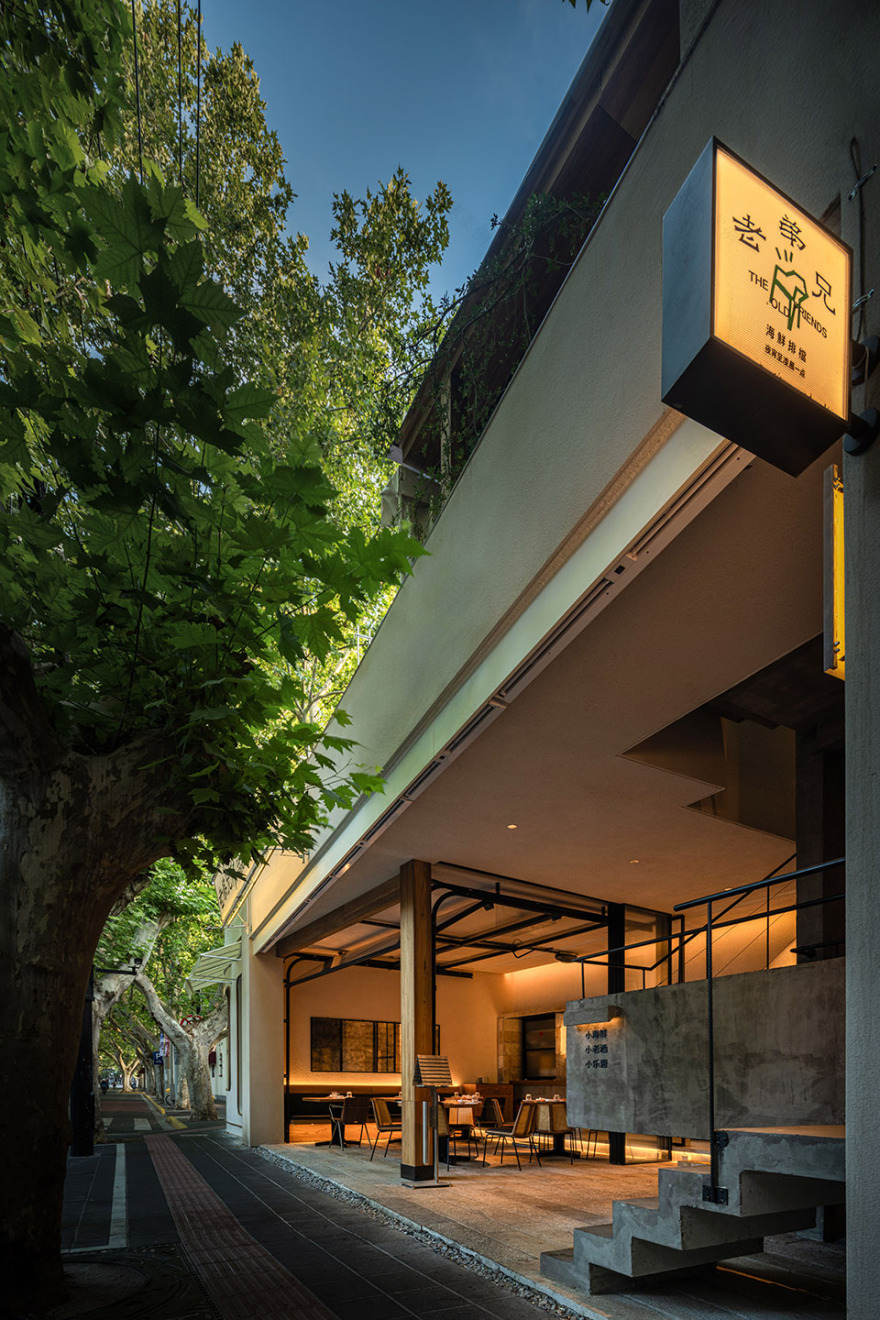
▼项目概览,overview of the project©陈铭
被分割的城市边界
A Fragmented Urban Edge
项目位于上海的陕西南路沿线,周边保留了较完整的近代街区肌理。梧桐行道树、1920年代以来的存量洋房与里弄住宅共同构成宜人的街道环境。项目拟引入一家以高频进出、多人聚集与等位停留为主要特征的海鲜排档型餐厅。
The project is located along Shaanxi South Road in Shanghai, with a relatively intact modern street layout preserved around it. The avenue trees, the existing colonial-style houses from the 1920s and the lane-style residences together create a pleasant street environment. The project intends to introduce a seafood restaurant of the type featuring frequent arrivals and departures, large crowds, and waiting times at the same location.
▼餐厅外观,facade of the restaurant©陈铭

改造前现状
Before the renovation
但在现状中,历史建筑多以单体更新为主,加之狭窄人行道与明确的产权/保护边界,使街道公共性与建筑使用之间缺少有效的过渡与互动,呈现“环境优越却彼此分隔”的状态。对于以“排档”这种高频进出、多人聚集、等位停留为常态的餐厅而言,这种断裂更为明显。在此背景下,本项目关注的问题并非单一建筑的更新,而是如何在尊重历史风貌与实际运营需求的前提下,重建餐厅与街道日常之间的联系。
▼改造前室内环境,environment before renovation©YOUNG 本样设计

However, in the current situation, historical buildings are mostly renovated as individual units. Coupled with narrow sidewalks and clear boundaries for property rights/conservation, there is a lack of effective transition and interaction between the public nature of the streets and the usage of the buildings. This results in a state where the environment is excellent but the buildings are isolated from each other. For restaurants that are characterized by frequent visits, large crowds, and waiting periods, this disconnection is even more pronounced. In this context, the issue this project focuses on is not the mere renovation of a single building, but rather how to re-establish the connection between the restaurant and the daily life of the street, while respecting the historical style and meeting the actual operational needs.
▼改造后餐厅内部环境,after renovation©陈铭

关系界面构建
Constructing the Relational Interface
YOUNG团队在该项目以“弱商业”作为核心空间策略,但并非削弱商业功能本身,而是通过消解商业界面在空间上的排他性与控制性,使商业空间在城市尺度中具备更开放的公共属性。
The YOUNG team adopted “weak business” as the core spatial strategy for this project. However, this did not mean weakening the commercial functions themselves. Instead, by eliminating the exclusivity and control of the commercial interface in the spatial domain, the commercial space was able to possess a more open public attribute within the urban scale.
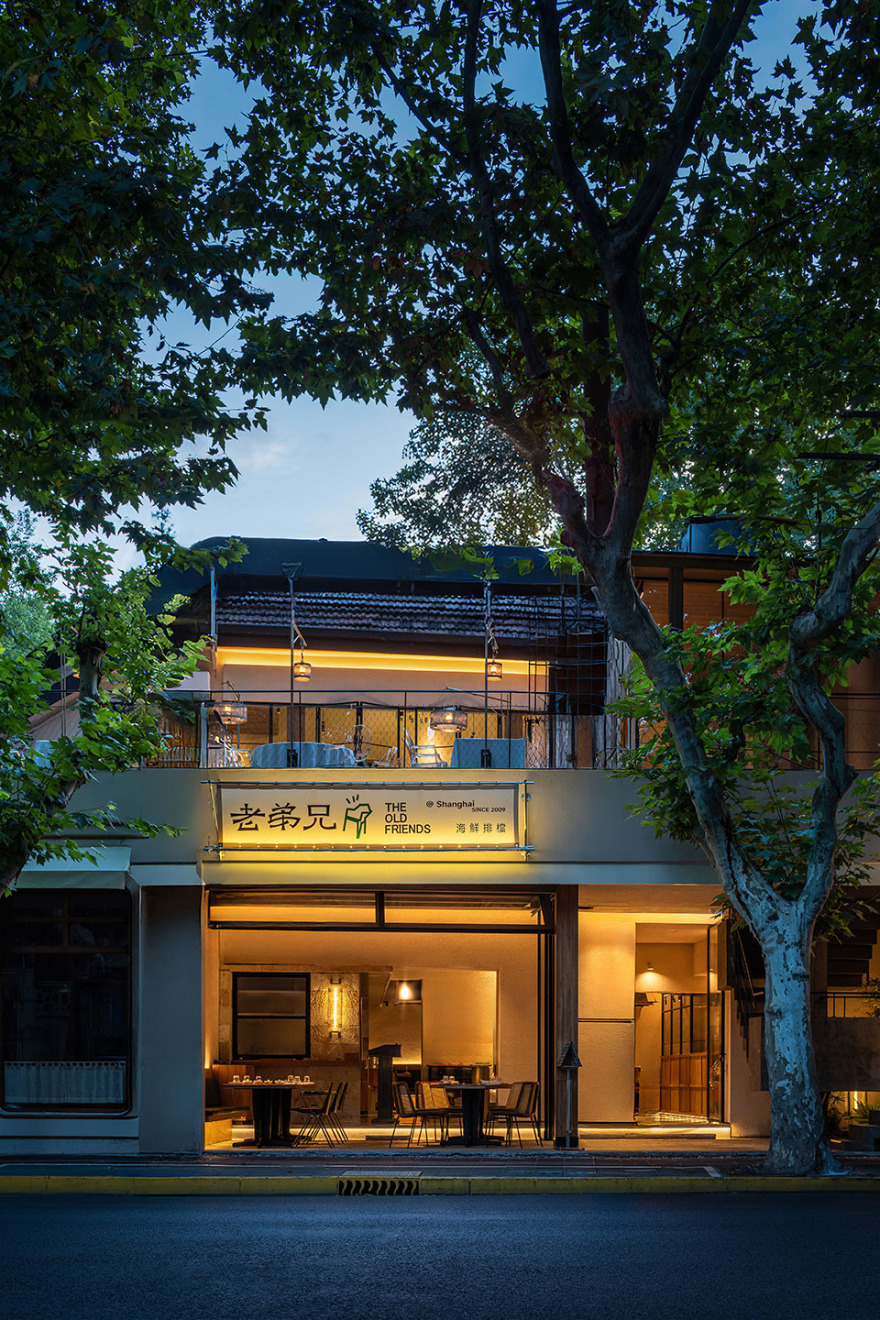
▼临街立面,street-facing facade©陈铭

1)界面倒退:将街道引入店内
Interface Backward: Introduce the street into the store
沿街界面有意识地后退,在原本属于店铺的范围内让渡出一个可被公众进入的前场空间。该空间既服务于商业经营,亦作为街道的物理延伸被日常共享:人可以自由进入、停留,甚至在雨天临时避雨,商业界面由此获得超越消费入口的城市属性,成为一种可被日常占用的公共领地。
The street interface is deliberately set back, creating an open front space accessible to the public within the original area designated for the shops. This space serves both commercial operations and functions as a physical extension of the street, shared daily by the public: people can freely enter, stay, and even take shelter from the rain on rainy days. Thus, the commercial interface gains urban attributes beyond the role of a consumption entrance, becoming a public territory that can be occupied on a daily basis.
▼将街道引入店内,introduce the street into the the store©陈铭


2)车库门机制:可开启的立面装置 重写空间边界
Interface Transition: Openable Facade Installation Redefines Spatial Boundaries
界面并未采用常规的平开或推拉玻璃门,而是引入可一键开启的车库式上翻门:门体沿轨道整体抬升并收纳至天花,开启时,立面几乎被完全“掀起”,室内前场与人行道在视觉与通行上直接贯通,空间边界被最大限度地消隐;关闭时,门体自上而下落位,形成连续且可控的围护,维持经营的安全性与领域感。
The interface does not adopt the conventional sliding or push-pull glass doors. Instead, it introduces a garage door facade device that can be opened with one click: The door body is lifted along the track and stored in the ceiling. When opened, the facade is almost completely “raised”, allowing the indoor front area and the sidewalk to be directly connected visually and in terms of passage. The spatial boundary is maximally concealed. When closed, the door body descends from top to bottom, forming a continuous and controllable enclosure, maintaining the safety and sense of domain of the operation.
▼可一键开启的车库式上翻门,introduces a garage door facade device that can be opened with one click©陈铭

这种开合机制使界面不再是静态立面,而成为一种可操作的“城市关系开关”——在营业、天气、人流等条件变化中,空间能够在融合与界定之间灵活切换,从而更精准地调节商业空间对街道公共性的让渡强度。▼可开合机制,this opening and closing mechanism©YOUNG 本样设计
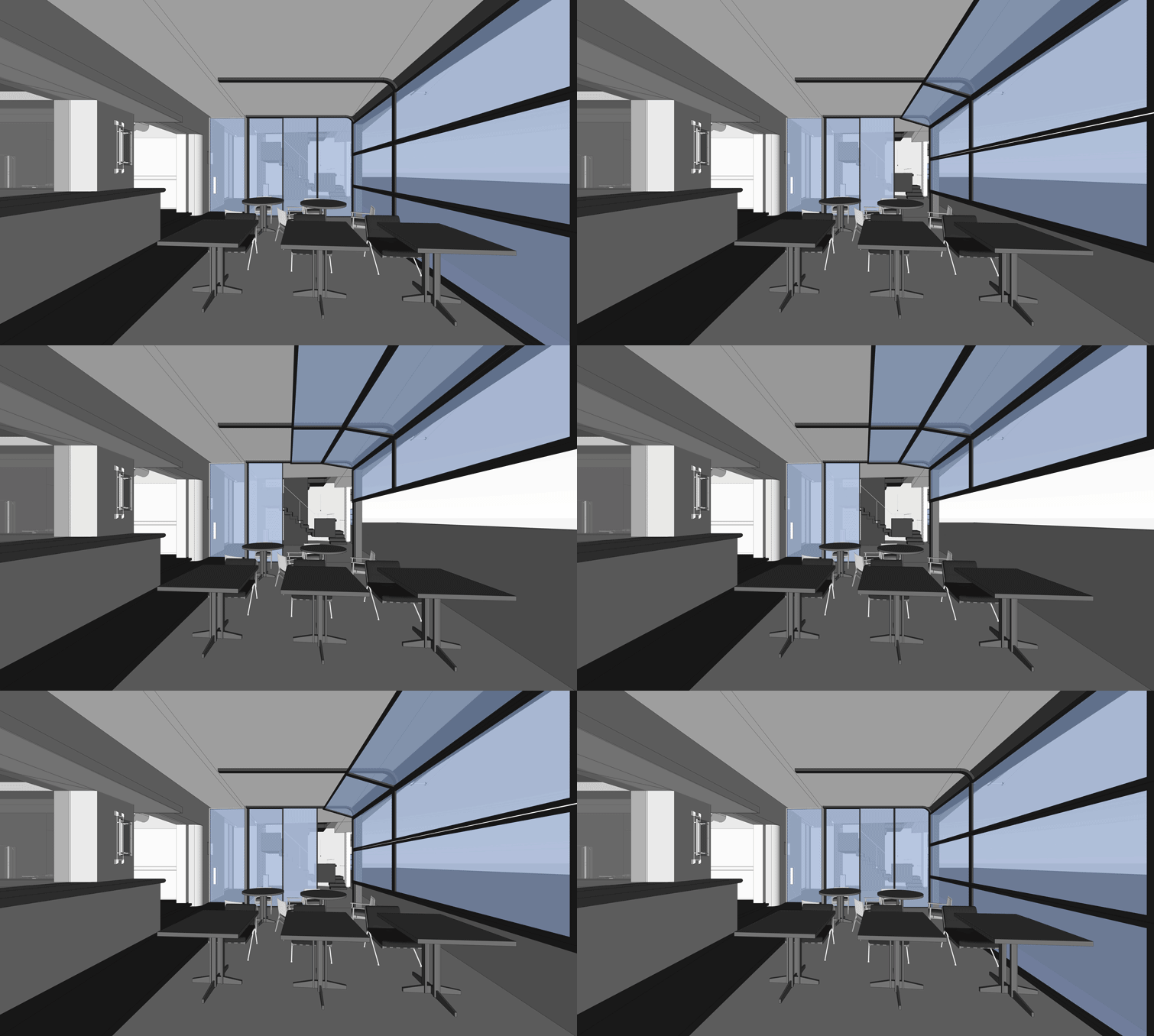
This opening and closing mechanism transforms the interface from a static facade into an operable “urban relationship switch” —— in response to changes in conditions such as business operations, weather, and human traffic, the space can flexibly switch between integration and definition, thereby more accurately regulating the extent to which commercial spaces give up their public nature to the streets.
▼空间能够在融合与界定之间灵活切换,the space can flexibly switch between integration and definition©陈铭

▼空间能够在融合与界定之间灵活切换,the space can flexibly switch between integration and definition©陈铭

3)楼梯外置:进入路径的事件化
External staircase: Eventualization of the entry path
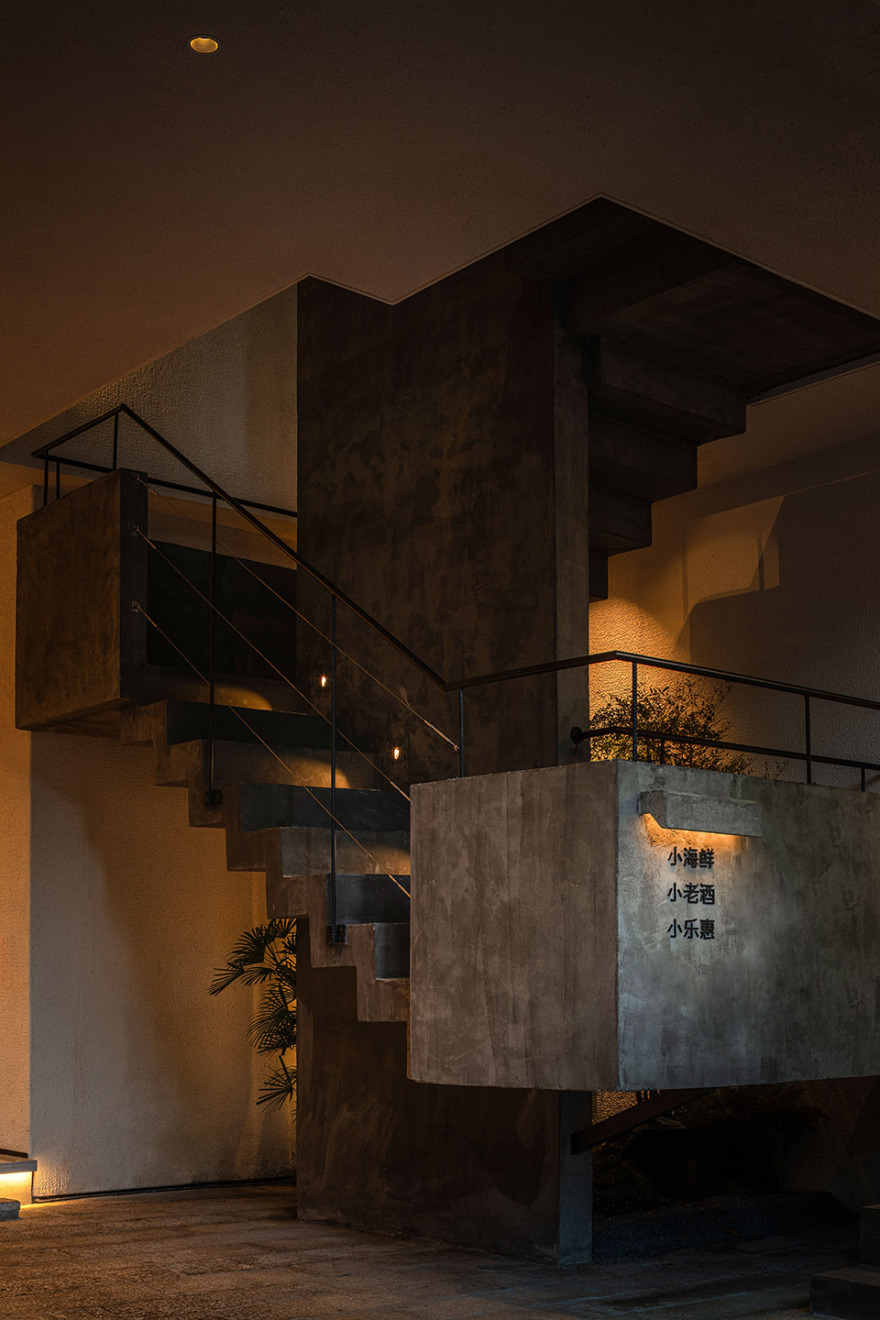
新建一组现浇混凝土楼梯被设置在餐厅与街道的界面处,直接连接二层空间。螺旋式上升路径组织垂直动线使“上楼”这一功能性动作转化成为可被观看、可被使用的空间事件。楼梯在承载垂直交通的同时,亦作为吸引视线、引导人流的媒介,强化了二层空间的可达性与视觉渗透。
A set of cast-in-place concrete stairs is positioned at the interface between the dining area and the street, directly connecting the second floor space. The spiral ascending path organizes the vertical movement line, transforming the functional action of “going upstairs” into a spatial event that can be observed and utilized. While bearing the vertical traffic, the stairs also serve as a medium to draw attention and guide the flow of people, enhancing the accessibility and visual permeability of the second floor space.
▼现浇混凝土楼梯,cast-in-place concrete stairs©陈铭


4)石板延伸:削弱内外边界
Stone slab extension: Reducing internal and external boundaries
关系界面处大量采用通常属于室外环境的石板地面铺装,YOUNG团队通过材料与触感的连续性,削弱内外边界,使人即使进入建筑,仍能感知到街道的延伸与地面的延续。这一细微的材料选择,成为空间边界消解的关键注脚。
At the interface of the building, large areas of stone flooring, which is usually found in outdoor environments, are extensively used. The YOUNG team, through the continuity of materials and texture, reduces the boundaries between inside and outside, allowing people even when entering the building to still perceive the extension of the street and the continuation of the ground. This subtle choice of materials serves as a key footnote in eliminating the spatial boundaries.
▼石板地面铺装,stone flooring©陈铭


从界面到内部的延伸(室内空间外部性的建构)
From Interface to Interior: (The Construction of Interior Exteriority)
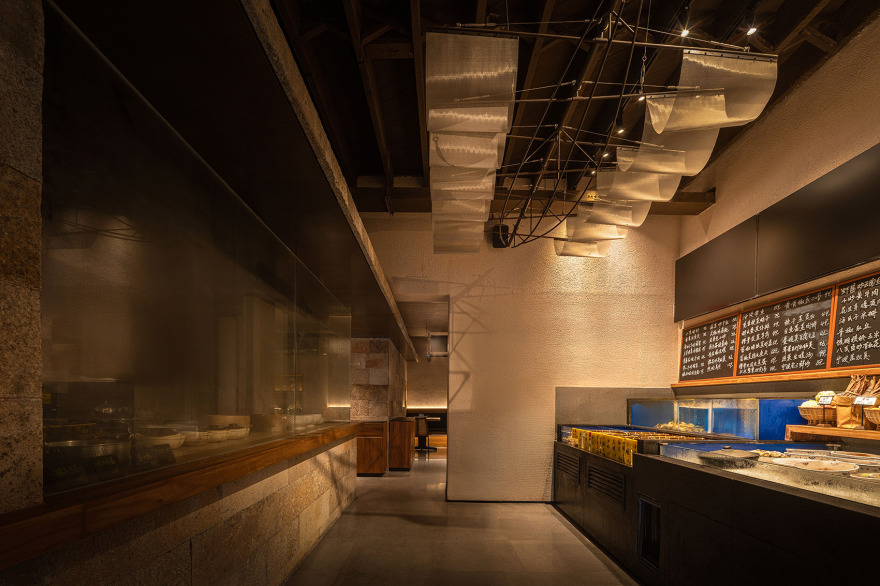
为了强化餐厅与街道的关系,YOUNG团队将沿街界面建立的“外部性”被进一步延伸至室内,并成为空间气质的核心。
In order to strengthen the connection between the restaurant and the street, the YOUNG team extended the “externality” established along the street interface further into the interior, and made it the core of the space’s atmosphere.
▼将沿街界面建立的“外部性”被进一步延伸至室内,extended the “externality” established along the street interface©陈铭


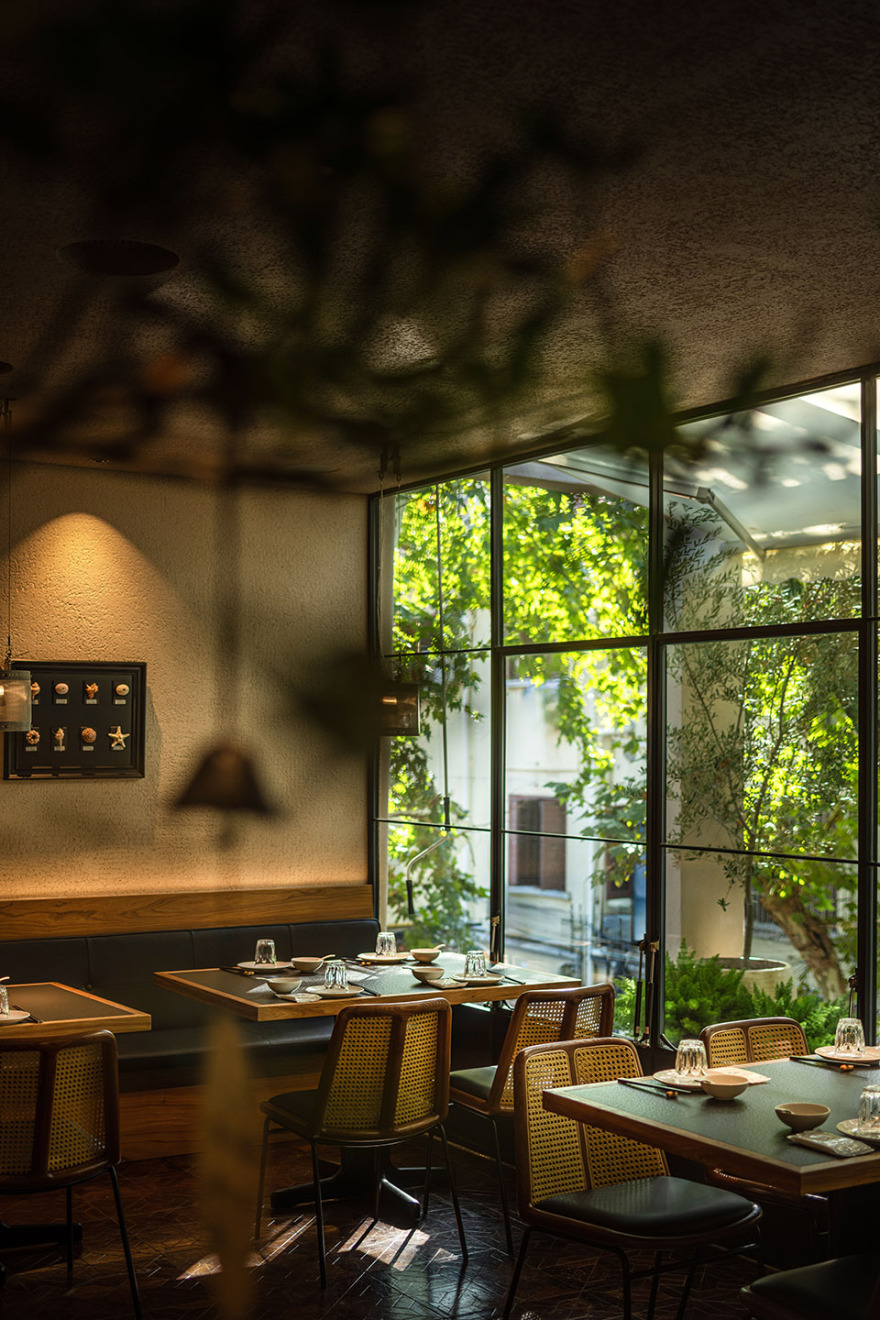
内部引入庭院与植物,并在墙体上开设接近室外尺度的大开口,使光线、视线与停留方式保持面向街道与庭院的开放感。
Internal courtyards and plants are introduced, and large openings of a scale similar to that of the outdoors are made on the walls, ensuring that light, sightlines, and the way of staying maintain an open feeling facing the street and the courtyard.
▼内部引入庭院与植物,Internal courtyards and plants are introduced©陈铭


▼面向街道与庭院的开放感,an open feeling facing the street and the courtyard©陈铭


YOUNG团队在材料上也采用偏室外的粗糙墙面与石板铺装的语汇,削弱内外差异,使室内成为街道经验的自然延续,而非封闭的消费容器。
The YOUNG team also employed a more outdoor-oriented rough wall surface and stone paving design in the materials, aiming to reduce the contrast between the interior and exterior, and make the interior a natural continuation of the street experience rather than a closed consumption container.
▼庭院夜景,courtyard at night©陈铭

▼庭院夜景,courtyard at night©陈铭


▼平面图,plan©YOUNG 本样设计

▼细部,detail©YOUNG 本样设计

项目名称:老弟兄海鲜排挡(上海)
设计方:本样设计
完成年份:2025.10
装置制作:十二平方制造
项目地址:上海
建筑面积:500㎡
摄影版权:陈铭


南京喵熊网络科技有限公司 苏ICP备18050492号-4知末 © 2018—2020 . All photos and trademark graphics are copyrighted by their owners.增值电信业务经营许可证(ICP)苏B2-20201444 苏公网安备 32011302321234号
苏公网安备 32011302321234号客服
消息
收藏
下载
最近