

创作上传
VIP
收藏下载
登录 | 注册有礼
查看完整案例

收藏

下载

分享
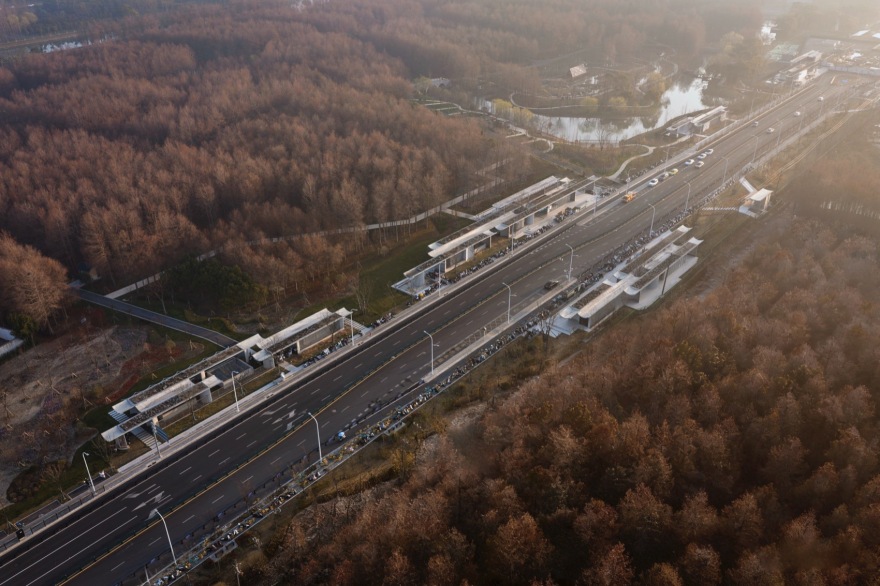
康桥东站位于上海张江科学城南部、外环生态廊道腹地,北侧紧邻横沔片区绿地带,依傍水网密布、田林环绕的自然基底。设计以“入沔”为理念,让地面站点生长于横沔湿地的自然肌理之中,实现城市发展与自然生境的耦合,打造一座城景相融的无界站点。
East Kangqiao Station is situated in the southern part of Zhangjiang Science City of ShangHai, at the heart of the Outer Ring Ecological Corridor, with the green belt of the Hengmian area immediately to its north. The site is embedded in a natural setting of dense waterways, fields, and woodland. Guided by the concept of “Emerging from the Wetland,” the design allows the above-ground station to grow out of the natural fabric of the Hengmian wetland, coupling urban development with natural habitat and creating a boundless station where city and landscape merge.
▼生长于湿地肌理的无界站点,A boundless station grown from the wetland tissue. ©章鱼见筑

▼入沔 出入口鸟瞰,Aerial view of the main entrance. ©章鱼见筑
01 融城入景,缝合边界
01 Merging City with Wetland, Healing the Boundary
横沔片区自唐代形成水乡聚落,至明清发展为繁盛集镇,水网密布、林田交错的地景基底延续至今,并逐步发展为上海独具特色的湿地公园带。2019年,上海机场联络线开工建设,康桥东站作为张江科学城南部门户,选址于横沔片区绿地带南部,既服务周边居住与工作人群,也承担着片区公园群的重要入园功能。
The Hengmian area first emerged as a waterside settlement in the Tang Dynasty and flourished into a prosperous market town during the Ming and Qing dynasties. Its landscape of dense waterways, interwoven woodland, and farmland has endured to the present day, gradually evolving into one of Shanghai’s most distinctive wetland park belts. In 2019, construction of the Shanghai Airport Link Line began in phases. As the southern gateway to Zhangjiang Science City, East Kangqiao Station is located along the southern edge of the Hengmian green belt, serving nearby residents and workers while also acting as an important entry point to the area’s wetland parks.
▼横沔公园片区的城市肌理演变,Historical transformation of the Hengmian Park Area. ©天地图

然而,为服务地下线性轨交工程,站点及附属设施沿康人路两侧线性散布,形成近700米长的工程带,犹如嵌入绿色生态基底的“灰色斑块”,加剧了城市建成区与自然生态区之间的边界对立。同时,传统轨交站点地面设施多强调效率与速度,形式往往硬质粗放,成为镶嵌于自然中的“标准符号”,带来空间切割、边界强化与环境异质性等一系列问题。
Yet, in order to serve the underground linear rail infrastructure, the above-ground facilities were arranged along both sides of Kangren Road, forming an engineering belt nearly 700 meters in length. Embedded within the green ecological setting, this belt appeared as a “grey patch,” intensifying the opposition between the built urban area and the natural ecological zone. Conventional above-ground metro facilities typically prioritise efficiency and speed, and their forms tend to be rigid and standardised, inserting “generic symbols” into the landscape and producing spatial fragmentation, reinforced boundaries, and environmental heterogeneity.
▼建设中的线性轨交工程带,Linear rail infrastructure corridor under construction. ©原作工作室

▼融城入景,织补边界,Merging city with wetland, repairing edges. ©章鱼见筑

对此,设计以“融城入景”为核心,通过整体环境营造消解基础设施与自然生态之间的隔阂,织补破碎的生态边界,使站点重新接入湿地脉络系统,推动区域空间由“城景分离”走向“城景共生”。
In response, the design adopts “merging city with wetland” as its core strategy. Through an integrated environmental approach, it seeks to dissolve the divide between infrastructure and ecology, repair fragmented ecological edges, and reconnect the station to the wetland’s spatial network, transforming the area from a condition of separation between city and landscape to one of coexistence.
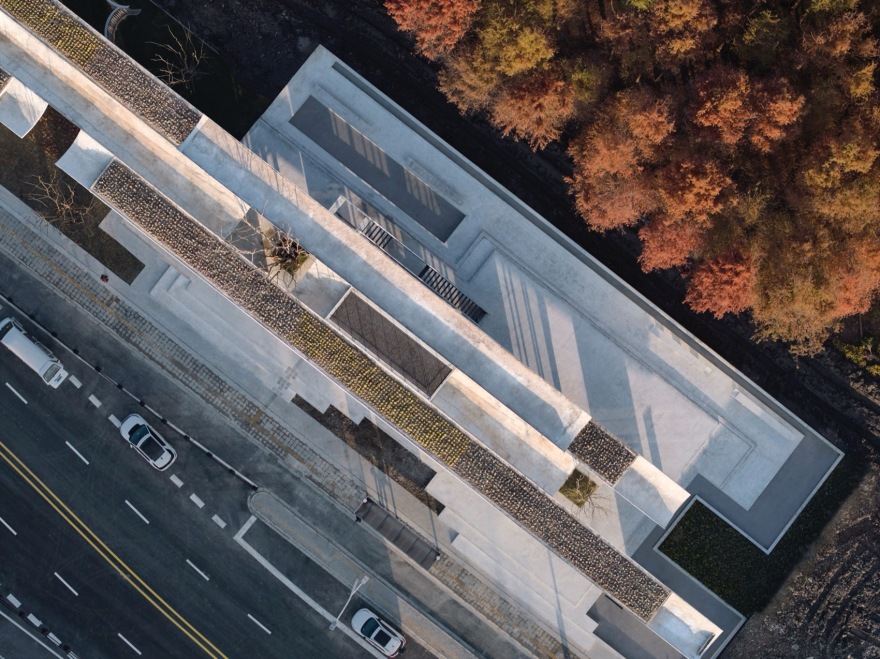
▼出入口站亭俯瞰,Aerial view of the main entrance pavilion. ©章鱼见筑
▼透过站点望向湿地,Looking toward the wetland through the station. ©章鱼见筑

02 阡陌纵横,由径而生
02 Weaving Paths through Fields, Shaping Space via Paths
康桥东站的出地面设施包括4 个地铁出入口、12 个安全出口、2 部无障碍电梯出入口、3处多联室外机、1 座冷却塔及 4 组风亭组,各类设施依据各自系统的工程约束散布于道路两侧,形成若干散落的灰色斑块。
The above-ground facilities of East Kangqiao Station include four metro entrances, twelve emergency exits, two accessible elevators, three outdoor VRV units, one cooling tower, and four ventilation pavilion clusters. Shaped by different engineering requirements, these elements are distributed along both sides of the road, appearing as a series of dispersed grey fragments.
▼重新整合线性散布的出地面设施,Reintegrating linearly dispersed above-ground facilities. ©章鱼见筑

设计延续横沔湿地纵横交错的景观肌理,构建起“阡陌纵横”的组织逻辑与“由径而生”的空间体系。站点空间布局沿循自然与城市的“径”脉展开,通过串联湿地西南入口、站点主要出入口、康人路人行系统及湿地游园路径,并衔接亲水路径与水系游线,形成“站—城—景”互联的立体路径网络,实现城市与湿地之间的无界穿行。
Drawing on the interwoven landscape tissue of the Hengmian wetland, the design establishes an organizational logic of “Weaving Paths through Fields” and a spatial system of “Shaping Space via Paths.” The station layout unfolds along both natural and urban routes, linking the wetland’s southwest entrance, the station’s main entrances, the pedestrian system along Kangren Road, and the internal paths of the wetland park. Together with waterside paths and water-based circulation routes, these elements form a multi-layered network connecting station, city, and landscape, enabling seamless movement between the urban fabric and the wetland.
▼生成分析图,Generation analysis. ©原作工作室

水渠是水乡常见的环境结构要素,既是组织地表、引导流向的基础设施,也是一种塑造界面与日常路径的在地原型。设计借用水渠的生成逻辑,通过“径”的生长与演绎,将规格各异的地面设施、慢行系统与开放空间编织为一个整体。
Water canals are among the most characteristic spatial elements of the local environment. They not only organize the ground plane and guide flows, but also serve as vernacular prototypes for shaping edges and everyday routes. Drawing on the generative logic of canals, the design weaves facilities of different sizes, slow-mobility systems, and open spaces into a cohesive whole through the growth and extension of paths.
▼延续湿地肌理,串联城林路径,Extending the wetland tissue, linking urban and woodland paths. ©章鱼见筑

▼“水渠”作为空间的形态原型,The “water canal” as a formal prototype for space. ©章鱼见筑
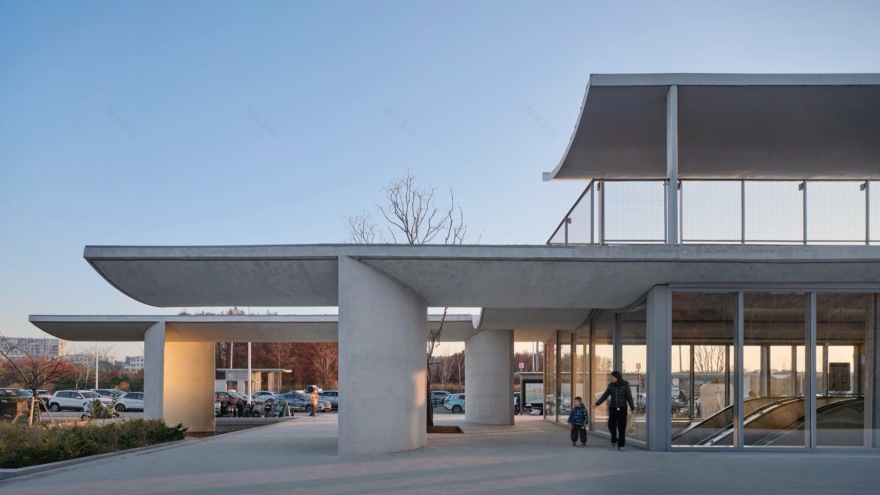
▼“水渠”檐口与杉树,The “water canal” eave and the woods. ©章鱼见筑

水渠也作为形态原型被纳入空间营造。主要出入口与风井、安全出口等设施通过弧形单元相互衔接,形成连续的景观界面,形成连续的景观场域;孤立的风亭组、冷却塔等设施,则通过弧形绿植界面围合,与游廊、景观亭及停留节点复合设置,演绎为湿地中的景观小品。不同组团单元的开口方向、界面转折与屋面高低变化均与周边路径、水系及视线关系相呼应,游人可自然接入湿地与城市的双重空间脉络,营造出“站在景中,景融于站”的意境。
Water canals are also taken as formal prototypes in the making of space. The main entrances are linked with ventilation shafts and emergency exits by means of arched modular elements, creating continuous landscape interfaces and spatial fields. Isolated ventilation structures and the cooling tower are enclosed by curved planted interfaces and integrated with corridors, garden pavilions, and pause points, transforming them into landscape features within the wetland. The orientation of openings, the turns of the interfaces, and variations in roof height all respond to surrounding paths, waterways, and sightlines, allowing visitors to move naturally between the wetland and the city.
▼弧形单元整合安全出口及设备用房,Arched modules integrating emergency exits and service rooms. ©章鱼见筑

▼弧形单元屋面消解体量,Arched roof modules dissolving building mass. ©章鱼见筑

▼将散布的设施整合为景观化的连续城市界面,Transforming dispersed facilities into a continuous landscaped urban interface. ©章鱼见筑

▼弧柱与檐廊组织路径,Arched wall and eaves organizing the path system. ©章鱼见筑

03 沔上浮亭,野趣入城
03 Raising Pavilions above Water, Bringing Nature to the City
在单体塑造上,设计以轻盈、谦逊而通透的方式,回应场地低平、水意流动、杉林成片的自然特征。“沔上浮亭”由此成为恰当的空间意象:站点及附属设施如轻轻落于湿地与杉林之上的停驻装置,在满足使用需求的同时,形成遮蔽、停留、转折与眺望的空间节点,在视觉上尽可能保持通透与开放,使人始终能够感知城市和湿地的风景。
In the shaping of individual structures, the design adopts a light, modest, and permeable approach in response to the site’s low-lying terrain, flowing waterscape, and groves of metasequoias. From this emerges the image of “floating pavilions above the wetland.” The station and its ancillary facilities are conceived as lightly placed structures set within the wetland and woodland: while meeting functional requirements, they create nodes for shelter, pause, transition, and viewing. Visually, they remain as open and transparent as possible, maintaining a constant visual connection with both the city and the wetland landscape.
▼轻落于湿地之上的浮亭,Floating pavilions lightly set above the wetland. ©章鱼见筑

▼浮亭一隅,A corner of the floating pavilion. ©章鱼见筑

为协调尺度不一的设施,并回应轨交基础设施快速建造的需求,设计深化水渠原型,形成了一套以3米为模数的弧形构件体系。
To coordinate facilities of varying scales while responding to the demand for rapid rail infrastructure construction, the design refines the water-canal prototype into an arched modular system based on a 3-meter module.
▼循水而生的建构表达,Constructive expression originated from water. ©章鱼见筑

▼基于水渠的构件系统,A water canal-based component system. ©原作工作室

弧形单元横向生成站厅出入口、游廊、长亭、浮桥等空间,纵向则作为支撑结构与绿植载体;部分屋面抬升形成可上人的景观屋面,部分则配置绿化屋面,与湿地景观自然衔接。4处屋面结合地面水池暗藏循环跌水装置,可按需启用形成轻缓瀑流景观,勾勒出“水从檐落,亭浮于沔” 的诗意画面。
Horizontally, the modules generate station entrances, corridors, long pavilions, and footbridges; vertically, they function as structural supports and planting frames. Some roofs rise to form accessible landscape terraces, while others are treated as green roofs that blend naturally into the wetland setting. At four points along the roof, concealed recirculating waterfall devices are integrated with ground-level pools, creating gentle cascades when activated and evoking the poetic image of “water falling from the eaves, pavilions floating above the wetland.”
▼绿植钢索弧柱与檐下空间,A planted steel-cable arched wall and the space beneath the eaves. ©章鱼见筑

▼休憩空间与一体化座椅,Resting space and integrated seating. ©章鱼见筑

▼二层平台傍晚回望,Looking back from the upper platform at dusk. ©章鱼见筑

在景观营造上,设计通过洄游动线组织周遭风景,让湿地野趣与城市生活深度交融。连续的室外挑檐既为行人提供遮阴避雨的通勤空间,也成为湿地公园的公共休闲设施;檐下空间、垂直绿化、观景平台与入水阶梯等设计,使站点与湿地公园自然衔接;登临屋顶,则可在林梢远眺湿地全貌,将城林景观尽收眼底。
In terms of landscape experience, the design choreographs the surrounding scenery through a looping sequence of movement, allowing the wild charm of the wetland to intertwine with urban life. Continuous outdoor eaves not only provide shade and shelter for daily commuters, but also serve as public leisure spaces within the wetland park. Spaces beneath the eaves, vertical greenery, viewing platforms, and steps descending toward the water create a natural transition between station and park. From the roof, visitors can look out across the wetland from above the treetops, taking in the full panorama of the city and woodland beyond.
▼出站即林海,扶梯沐秋色,Stepping out into the woodland, escalators bathed in autumn light. ©章鱼见筑

▼站亭成为湿地的景框,The entrance pavilion as a frame for the wetland. ©章鱼见筑

▼水畔浮亭,Floating pavilion by the water. ©章鱼见筑

结语:在水畔,在林梢 By the Water, Among the Treetops
当通勤、游憩与观景在同一处场所中自然交汇,康桥东站也由此超越了单一的交通属性,成为连接城市与湿地、日常与风景的开放载体。它栖息于水畔,也延展至林梢;既回应城市基础设施的效率诉求,也保留了湿地边界的松弛与诗意。于是,基础设施不再只是割裂场地的技术系统,而成为生长于自然肌理中的公共场域,在城市持续生长的过程中,为人与景、城与景之间重新建立更柔和、更持久的联系。
As commuting, recreation, and viewing naturally converge in one place, East Kangqiao Station transcends its purely infrastructural role and becomes an open interface connecting city and wetland, everyday life and landscape. It settles by the water and extends toward the treetops, responding to the demands of urban infrastructure while preserving the openness and poetry of the wetland. In this way, infrastructure is no longer merely a technical system that divides the site, but a public realm grown from the landscape fabric itself, gently and enduringly re-establishing connections between people and landscape, and between the city and its environment.
▼树梢瞰景,Viewing from the treetops. ©章鱼见筑

▼沔上浮亭,Floating pavilion over the wetland. ©章鱼见筑

▼总平面图,Master plan ©原作工作室

▼平面图,Plans ©原作工作室

▼剖立面图,Elevations and Sections ©原作工作室

▼墙身详图,Details ©原作工作室

项目名称:上海市域线康桥东站地面站点
主创设计单位:同济设计集团·原作设计工作室
主创建筑师:章明、张姿、丁纯
项目建筑师:陈凯扬、丁阔
设计团队:吴正浩、蔡汉、林瑜洋、郭璐炜、王易(实习)、乔丹(实习)
结构设计团队:王瑞、万瑜蕾、王潇
灯光设计团队:杨秀、卞晨、蔡融、刘苏玥
合作设计单位:中铁第四勘察设计院集团有限公司
合作设计团队:杨健、李永盛
建设单位:上海申铁投资有限公司
业主代表:雷磊、陈蕙
项目地点:上海市浦东新区
用地面积:10548平方米
建筑面积:2510平方米
建成时间:2024年12月
摄影:章鱼见筑
Project Name: East Kangqiao Station of Shanghai Airport Link
Lead Design Firm: Tongji Architectural Design and Research Institute (Group) Co., Ltd. Original Design Studio
Lead Architects: Zhang Ming, Zhang Zi, Ding Chun
Project Director: Chen Kaiyang, Ding Kuo
Design Team: Wu Zhenghao, Cai Han, Lin Yuyang, Guo Luwei, WangYi(Intern), QiaoDan(Intern)
Structural Design Team: Wang Rui, Wan Yulei, Wang Xiao
Lighting Design Team: Yang Xiu, Bian Chen, Cai Rong, Wei Yanmeng, Liu Suyue
Co-design Unit: China Railway SIYUAN Survey & Design Group Co., Ltd
Co-design Team: Yang Jian, Li Yongsheng
Construction Company: Shanghai Shentie Investment Co., Ltd
Owner’s Representative: Lei Lei, Chen Hui
Location: Pudong New District, Shanghai
Total Construction Area: 10548 m2
Building Area: 2510 m2
Completion Date: December 2024
Photography: ZY Architectural Photography
南京喵熊网络科技有限公司 苏ICP备18050492号-4知末 © 2018—2020 . All photos and trademark graphics are copyrighted by their owners.增值电信业务经营许可证(ICP)苏B2-20201444 苏公网安备 32011302321234号
苏公网安备 32011302321234号客服
消息
收藏
下载
最近