

创作上传
VIP
收藏下载
登录 | 注册有礼
查看完整案例

收藏

下载

分享
融美术馆由腾创未来投资建设,将聚焦20世纪与21世纪的视觉文化。在中国创新之都深圳,这一全新文化机构体现了大型科技企业推动文化发展与塑造城市生活的社会责任。
Conceived for Tenova Future, a private venture of the founder of Tencent, one of China’s largest tech companies, the Róng Museum of Art will be focused on visual culture of the 20th and 21st century. The new institution asserts a civic responsibility of big tech towards culture and urban life in China’s capital of innovation. © Buro-OS
奥雷·舍人为融美术馆所作的设计,在深圳南山区打造了一个共生空间,致力于呈现20世纪和21世纪的视觉与数字文化,并涵盖艺术、设计、建筑及电影等领域。融美术馆是奥雷·舍人同时设计的后海综合园区的核心组成部分,该园区将公寓、办公空间、精品商店,以及由太古地产运营的居舍酒店整合成一个 24小时运转的城市生态系统。
▼园区轴测图,Campus Axonometric © Buro-OS

Ole Scheeren’s design for Róng Museum of Art creates a symbiotic space in Shenzhen’s Nanshan District dedicated to visual and digital culture of the 20th and 21st century, including art, design, architecture and film. The museum forms the cornerstone of the Houhai Hybrid Campus – also designed by Ole Scheeren – which integrates residences, offices, curated specialty retail, and a House Hotel operated by Swire Properties into a 24‑hour urban ecosystem.
▼深圳的新文化地标,A new cultural landmark in Shenzhen © Buro-OS

科技与文化
Technology and Culture
融美术馆的“融”意指“共生”与“共融”,标志着深圳以科技驱动的经济支持艺术与文化的重要里程碑。融美术馆体现了中国最成功的科技企业家群体回馈社会的公共抱负。
▼花园露台,Garden Terrace © Buro-OS

▼具有适应性、注重休闲与生活方式的屋顶花园,An adaptive, leisure and lifestyle-focused roof garden © Buro-OS
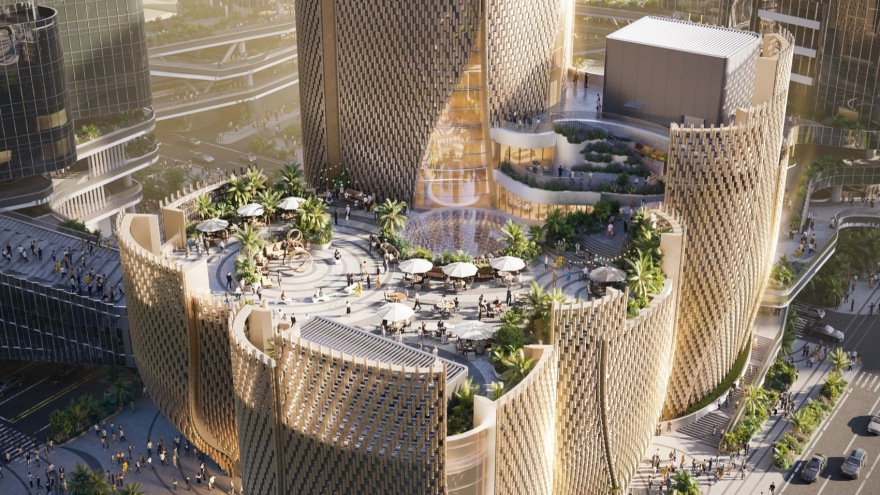
仅深圳南山区一地,其经济体量就可与新加坡或部分欧洲国家相媲美,而深圳全市的GDP规模更接近泰国等国家。在此背景下,融美术馆作为一家独具特色的文化机构,将科技带来的繁荣转化为推动深圳整体城市发展的文化动力,助力其成为拥有自身艺术声音的全球城市。▼艺术广场,Art Plaza © Buro-OS

Nanshan District alone generates an economy comparable to that of Singapore or some European countries, while the city of Shenzhen produces a GDP on the scale of nations such as Thailand. Against this backdrop, the Róng Museum of Art becomes a unique cultural institution that channels technology‑based prosperity to support the wider urban development of Shenzhen into a global city with its own artistic voice.
▼一座标志性的美术馆,作为园区的核心建筑,An iconic museum as the center piece of the Campus © Buro-OS

“真正重要的是,中国最成功的创新企业之一,正利用在科技产业前沿的地位,为文化与城市发展开辟新的路径。从项目伊始,我们便密切合作,将美术馆及整体综合体定义为一个不仅用于展示的空间,更是一种在城市与生态层面实现共生的声明,让大型科技企业成为核心文化赞助者。”奥雷·舍人表示。“在全球范围内,大多数科技导向的环境都高度自我聚焦。而在这里,其愿景是通过投资公共空间,文化场所和教育以开辟一条不同的道路,用经济成功支撑一种更深层、更慷慨的城市与社会参与方式。”
“What is significant is that the founder of Tencent, one of China’s most successful innovation businesses, is using his company’s position at the forefront of China’s tech industry to open new ground for culture and urban development. From the very beginning, we worked closely to define a museum and overall complex that is not only a showcase, but a symbiotic urban and ecological statement with big tech as a central cultural patron” says Ole Scheeren. “Around the world, most tech environments are relentlessly self‑focused. Here, the ambition is to chart a different path by investing in public space, cultural venues and education, and to use economic success to underwrite a deeper, more generous engagement with the city and wider society.”
▼与绿洲融为一体的新兴文化地标,Emerging cultural landmark integrated with the oasis © Buro-OS

面向城市的开放论坛
An open forum for the city
在建筑设计上,融美术馆旨在激发公众的好奇心,并促进美术馆、后海综合园区与周边城市之间的流动与交流。美术馆总建筑面积为 4,500 平方米,其中 2,300 平方米为展览空间;同时配备完善的公共教育设施,包括一座大型面向公众的艺术图书馆、工作坊、讲座与放映空间,以及以文化为主题的零售空间、咖啡馆和餐厅。
▼画廊展馆,Gallery Pavilion © Buro-OS

Architecturally, the Róng Museum of Art is designed to generate curiosity and invite movement and exchange between the museum, the Hybrid Campus and the surrounding city. The museum comprises a total of 4,500 square meters, with 2,300 square meters of gallery space, as well as extensive educational facilities, including a major public art library, workshops, spaces for lectures and screenings, culture-focused retail and cafes and restaurants. The exhibition spaces are lifted on five sculptural pavilions that touch the ground as slender structures and expand as they rise, forming a distinctive figure within the broader ensemble of Shenzhen’s towers.
▼深圳湾的综合文化地标,An integrated cultural landmark for Shenzhen Bay © Buro-OS

展览空间由五个雕塑感十足的亭阁结构抬升而起,这些结构以纤细的形态触地,在向上延展时逐渐展开,在深圳高楼林立的城市天际线中形成极具辨识度的形象。通过将建筑主体悬浮于地面之上,奥雷·舍人的设计释放出一个遮阳且自然通风的公共广场。▼活动与空间分析剖面图,Life Section © Buro-OS

By suspending the building’s main body above the ground, Ole Scheeren’s design frees its base as a covered, naturally ventilated public plaza.
▼灵活的展览空间, Flexible Gallery Space © Buro-OS


一个宏大的天窗将自然光引入公共广场,这里被构想为“艺术论坛”,全天24小时向公众开放,市民与访客可自由穿行与停留。艺术作品、临时装置与公共活动将在此激活空间,使日常的城市流动转化为文化体验。
▼剖面图,Section © Buro-OS

A grand skylight brings daylight into the sun and rain‑protected space. Envisioned as an “art forum”, this organic space will be accessible 24 hours a day, allowing visitors and the public to pass through and gather. Artworks, temporary installations and public events will activate the space, turning casual movement through the site into a cultural encounter.
▼一座宏伟的楼梯连接了下层和上层的展厅空间,为参观者在博物馆中的游览增添丰富体验,A grand staircase links the lower and upper gallery spaces – enriching the visitor’s journey through the museum © Buro-OS

悬浮其上的多个展览体量汇聚成灵活的展览系统,包括一处可容纳大型装置作品的双层通高展厅。一条蜿蜒的楼梯沿着建筑外立面向上延伸,最终抵达屋顶花园。这一开放的绿色空间将后海综合园区的中央绿洲引入美术馆,成为高架的户外活动平台,可举办展览、演出及各类公共活动,并俯瞰深圳滨水景观。▼环绕着中央绿洲的三维步道,3-dimensional promenade around the central oasis © Buro-OS

Floating above, the constellation of gallery volumes merges to form a flexible exhibition space – including an extensive double‑height gallery capable of hosting large‑scale installations. A meandering stair flows along the building’s outer facades to culminate in a rooftop garden. This open green space extends the Houhai Hybrid Campus’ central oasis into the museum itself and acts as an elevated exterior events platform, able to host shows, performances and outdoor programming with views across Shenzhen’s waterfront.
▼一个适合艺术论坛和聚会的充满活力的城市空间,A dynamic urban space for art forums and gathering © Buro-OS

标志性的建筑轮廓
A Magical Silhouette
融美术馆立面由层层水平退台的构件组成,塑造出生物形体般的锥形体量。其外部包覆着一层通过参数化设计的悬挂式玻璃管系统,在建筑体量周围形成半透明的窗纱。
▼建筑幕墙,Facade © Buro-OS

▼遮阳,Sunshading © Buro-OS

The museum’s façades consist of a system of horizontal layers that step backwards to form the organic cone shapes of the building. These are further enveloped by an outer layer of parametrically engineered suspended glass tubes that create a translucent veil around the volumes.
▼这些工艺精湛、层层叠叠的玻璃管,营造出如浮云般熠熠生辉的薄纱效果,Intricately crafted, layered glass tubes that create a floating, luminous veil © Buro-OS

“我希望赋予这座美术馆一种独特而富有魅力的形象,尤其能激发年轻一代的好奇心。整个项目被构想为一次跨文化的互动体验,在拥有专注展示艺术和活动的展览空间的同时,也提供多种参与文化与建筑的方式。” —— Ole Scheeren
“I wanted to give the museum a distinctive and magical appearance that creates a sense of curiosity, especially amongst the younger generation. The whole project was conceived as a cross‑cultural interactive experience, with a very focused exhibition space and programme at its core, but with many more ways to engage with culture and architecture,” says Ole Scheeren.
▼建于雕塑感亭阁结构之上的展览空间,Exhibition spaces that are lifted on sculptural pavilions © 朱雨蒙

玻璃管在材质与视觉效果上呼应了中国历史上对玻璃的运用方式,玻璃并非作为完全通透的媒介,而是一种过滤光线、承载色彩、质感与意义的元素。通过现代参数化技术的优化与演绎后,融美术馆的玻璃管系统创造了过去与当下、文化与科技之间的对话。
The glass tubes, in their materiality and effect, echo China’s historic application of glass – not as a means of transparency and uninterrupted views through a window, but as a filter of light imbued with color, texture and meaning. Their cumulative effect, adapted and optimized through today’s parametric technology, creates a dialogue between past and present, between culture and technology.
▼双层挑高展厅空间,Double height gallery volumes © 朱雨蒙

一座生态雕塑
An Ecological Sculpture
如同树木的枝叶,这些玻璃管为建筑提供遮阳、光线漫射与通风效果,显著提升建筑的能效,同时将柔和的自然光引入室内空间。锥形体量的屋顶可收集雨水,经处理后汇入地面蓄水池循环利用,呼应深圳“
Much like the foliage of a tree, the glass tubes provide shading, light diffusion and ventilation, significantly improving the energy performance of the building, while bringing diffused natural light to the interior spaces. The cone‑shaped volumes collect rainwater on their roofs, which is filtered into retention ponds on the ground for recycling, contributing to Shenzhen’s broader ‘sponge city’ approach to water management.
▼蜿蜒的通道引导游客步入美术馆的同时欣赏悬挂的玻璃管所展现的精妙细节,
Inviting pathways lead visitors into the museum whilst appreciating the intricacies of the hanging glass tubes © Buro-OS

“海绵城市”的整体水管理策略。白天,玻璃管捕捉自然光;夜晚,在灯光照明下柔和发亮,形成如织物般的视觉效果,具有丰富的触感层次与有机质感,使其在密集的深圳天际线中清晰可辨。▼海绵城市,Sponge City © Buro-OS

The textured glass tubes catch light by day and glow softly when illuminated at night. The result is a woven‑like appearance with tactile depth and organic texture, creating a legible landmark within the dense Shenzhen skyline.
▼玻璃幕墙,Glass Facade © 朱雨蒙

每一根磨砂玻璃管均可独立控制照明,从而在建筑外表皮上呈现细腻变化与精心编排的灯光序列。夜幕降临后,建筑宛如一个文化灯塔,光芒吸引着全城人的目光与想象。
Each fritted glass tube can be illuminated individually, allowing for subtle variations and curated sequences of light across the museum’s envelope. After dark, the building evokes the character of a cultural lantern, its shifting glow acting as a radiant focal point that draws the city’s gaze and imagination.
▼夜幕降临时亮起的玻璃幕墙,Glass Facade llluminated at Nightfall © 朱雨蒙

联接深圳未来
Wired into Shenzhen’s Future
融美术馆直接接入后海综合园区,并与周边城市的多层级立体交通网络连接。多层联桥将美术馆与其他塔楼以及深圳人才公园相连,同时,地铁站的连接也被整合进整体开发之中,使访客能够从地下直接抵达文化广场。
The Róng Museum of Art plugs directly into the extensive multi‑level circulation network that connects the Houhai Hybrid Campus with the wider city around. Elevated bridges link the museum to the other towers and to Shenzhen Talent Park at the bayfront, while a connection to the metro station is integrated into the development to bring visitors directly up into the cultural plaza from below.
▼后海综合园区功能,Houhai Hybrid Campus Program © Buro-OS

在更广泛的城市语境中,融美术馆作为一家全新的文化机构,发挥着文化枢纽的作用,确保城市的经济实力与对记忆、思考及公众文化意识的投入相辅相成,为中国未来的文化与城市发展作出贡献。融美术馆目前正在建设中,计划于 2027 年向公众开放。
Within its wider context, the Róng Museum of Art acts as a privately operated cultural anchor, ensuring that the city’s economic power is matched by an investment in memory, reflection and public cultural awareness, contributing to China’s cultural and urban future.
The Róng Museum of Art is currently under construction, with its opening to the public scheduled for 2027.
▼后海综合园区剖面,Houhai Hybrid Campus Section © Buro-OS
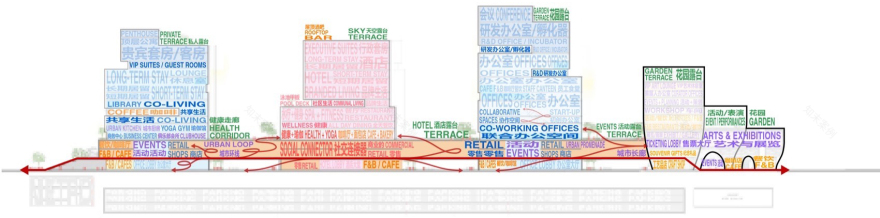
类型:美术馆,文化
状态:2018 年 6 月委托,2023 年 9 月开建,预计2027 年6月开幕
客户:腾创未来
地点:深圳,中国
基地:后海,南山区,深圳
规模:建筑面积:14,500平方米,美术馆面积:4,500 平方米,展厅面积:2,300 平方米,高度:T4 (阶梯式屋顶 – 24.00 米,34.15 米,53.00米)
功能:文化建筑(美术馆零售、展厅、教育区、展厅办公室、餐饮)
设计团队
设计建筑师: Büro Ole Scheeren
设计主持: Ole Scheeren
合伙人: Dan Cheong
项目负责人: Connie Wan, Henry Chan, Chris Chan, Hao Wang
方案设计—初步设计团队:
Vincent Ku, Daniel Guan, Wei Chao, Xindi Ai, Qiuyun Chen, Tung Chui, Yufei Ding, Tsz Wai Goh, Shuhong Hao, Yannie Ho, Irene Hsu, Jinkun Huang, Jonathan Kan, Stephen Kwok, Anda Lam, Diana Lam, Mingyuan Li, Jialin Liang, I-Chun Lin, Michael Lui, Haoran Ma, Marcus Ma, Rebecca Pan, Subin Park, Dylan Peng, Jake Qin, Yanling Shi, Gloria Tam, Issac Tam, Stefanie Tan, Jack Tsai, Yuchen Tsai, Katrina Wang, Peng Wang, Xingnan Wang, Zhuofan Wu, Yiwen Xing, Hualin Yang, Jesse Yang, Maggie Yang, Circle Yuen, Freddie Zhang, Michael Zhang, Qiwei Zhang, Yiqu Zhang, Bella Zhong, Mary Zoller, Danfeng Zou, with Yifei Cai, Pinelopi Kourti, Jayden Lau, Huihao Ma, Nicolas Madariaga Frez, Jiayi Mao, Harry Musson, Yuchen Qiu, Denizhan Peker, Shanil Riyaz, Justin Tan, Jianfeng Yin, Bruno Zhao, Shengxiao Zhao, Jing Zhang
概念团队:
Robyn Houghton, Irene Hsu, Jacob Hu, Pinelopi Kourti, Yingzhou Li, Can Liu, Nicolas Madariaga Frez, Ibrahim Rajah, Marijana Simic, Justin Tan, Hao Wang, Edward Wu, Xingnan Wang, Jianfeng Yin, with Yingqi Li, Shanil Riyaz, Zijie Tang, Peng Zhang, Bruno Zhao, Shengxiao Zhao
顾问:
本地设计院:ECADI, Shenzhen and LWK, Shenzhen
结构工程师:ECADI, Shenzhen
幕墙顾问 (T4):RFR, Shanghai
擦窗机:Inhabit, Hong Kong
室内设计 (T4 美术馆):Gluckman Tang Architects, New York
照明顾问: ULDA Unolai Lighting Design Associates, Shenzhen
可持续性顾问: Arup, Hong Kong and MMoser, Hong Kong
景观顾问: PLA, Bangkok
交通顾问:MVA, Shenzhen and Movveo, Bristol
机电顾问:ECADI, Shenzhen
竖向交通顾问:Arup, Hong Kong
影音/声学/弱电/信息服务/安全系统顾问:Arup, Hong Kong
造价顾问:Arcadis, Shenzhen
项目图像: Buro Ole Scheeren, TMRW, Atchain, Frontop, Bezier
摄像:朱雨蒙
实体模型:RJ Models
FACT SHEET
PROJECT: Róng Museum of Art
Type: Museum; Cultural
Status:
Commission: 2018.06
Construction: 2023.09
Completion: 2026.10
Opening: 2027.06
Client: Tenova
Location: Shenzhen, China
Site: Houhai, Nanshan District, Shenzhen
Scale:
Gross Floor Area: 14,500 m2
Museum Area: 4,500 m2
Gallery Space: 2,300 m2
Height: T4 (Stepping Roof – 24.00m, 34.15m, 53.00m)
Program: Cultural Building (Museum Retail, Galleries, Education, Gallery Offices, F&B)
DESIGN TEAM
DESIGN ARCHITECT: Büro Ole Scheeren
PRINCIPAL / DESIGN: Ole Scheeren
PARTNER: Dan Cheong
PROJECT LEADERS:
Connie Wan, Henry Chan, Chris Chan, Hao Wang
SD-DD TEAM:
Vincent Ku, Daniel Guan, Wei Chao, Xindi Ai, Qiuyun Chen, Tung Chui, Yufei Ding, Tsz Wai Goh, Shuhong Hao, Yannie Ho, Irene Hsu, Jinkun Huang, Jonathan Kan, Stephen Kwok, Anda Lam, Diana Lam, Mingyuan Li, Jialin Liang, I-Chun Lin, Michael Lui, Haoran Ma, Marcus Ma, Rebecca Pan, Subin Park, Dylan Peng, Jake Qin, Yanling Shi, Gloria Tam, Issac Tam, Stefanie Tan, Jack Tsai, Yuchen Tsai, Katrina Wang, Peng Wang, Xingnan Wang, Zhuofan Wu, Yiwen Xing, Hualin Yang, Jesse Yang, Maggie Yang, Circle Yuen, Freddie Zhang, Michael Zhang, Qiwei Zhang, Yiqu Zhang, Bella Zhong, Mary Zoller, Danfeng Zou,
with Yifei Cai, Pinelopi Kourti, Jayden Lau, Huihao Ma, Nicolas Madariaga Frez, Jiayi Mao, Harry Musson, Yuchen Qiu, Denizhan Peker, Shanil Riyaz, Justin Tan, Jianfeng Yin, Bruno Zhao, Shengxiao Zhao, Jing Zhang
CONCEPT TEAM: Robyn Houghton, Irene Hsu, Jacob Hu, Pinelopi Kourti, Yingzhou Li, Can Liu, Nicolas Madariaga Frez, Ibrahim Rajah, Marijana Simic, Justin Tan, Hao Wang, Edward Wu, Xingnan Wang, Jianfeng Yin, with Yingqi Li, Shanil Riyaz, Zijie Tang, Peng Zhang, Bruno Zhao, Shengxiao Zhao
CONSULTANTS:
Local Design Institute: ECADI, Shenzhen and LWK, Shenzhen
Structural Engineer: ECADI, Shenzhen
Façade Consultant (T4): RFR, Shanghai
BMU: Inhabit, Hong Kong
Interior Design (T4 Museum): Gluckman Tang Architects, New York
Lighting Consultant: ULDA Unolai Lighting Design Associates, Shenzhen
Sustainability Consultants: Arup, Hong Kong and MMoser, Hong Kong
Landscape Consultant: PLA, Bangkok
Traffic Consultant: MVA, Shenzhen and Movveo, Bristol
MEP Consultant: ECADI, Shenzhen
Vertical Transportation Consultant: Arup, Hong Kong
AV/Acoustics/ELV/Information Service/Security System Consultant: Arup, Hong Kong
Cost Consultants: Arcadis, Shenzhen
PROJECT IMAGERY: Buro Ole Scheeren, TMRW, Atchain, Frontop, Bezier
PHOTOGRAPHY: Zhu Yumeng
PHYSICAL MODEL: RJ Models
南京喵熊网络科技有限公司 苏ICP备18050492号-4知末 © 2018—2020 . All photos and trademark graphics are copyrighted by their owners.增值电信业务经营许可证(ICP)苏B2-20201444 苏公网安备 32011302321234号
苏公网安备 32011302321234号客服
消息
收藏
下载
最近